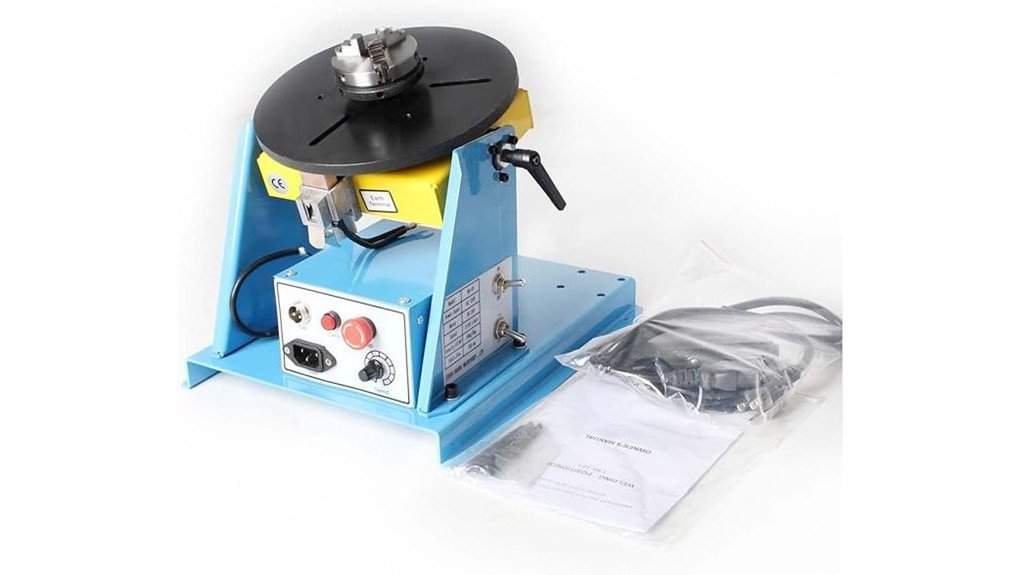
The 10KG rotary welding positioner (listed as the LEHUNDI HD10) is a small tabletop turntable that holds a light workpiece, tilts from 0 to 90 degrees and rotates it at 2 to 20 r/min, according to the listing. It suits hobby welding, small fabrication and light assembly. It is not for heavy parts: the listed capacity is 10 kg, and you should check how that figure applies when the table is tilted.
Quick take
- Best for: small round or tube work, hobby fabrication, light cutting, grinding and assembly jobs where turning the part by hand is a nuisance.
- Main strength: adjustable tilt and a slow, steady rotation range in a 9 kg unit that is easy to move.
- Main caution: the load rating, power input and any ground path are seller figures; confirm them in the manual before welding.
10KG rotary welding positioner specs (per the listing)
| Item | Detail |
|---|---|
| Model | LEHUNDI HD10 |
| Listed load | 10 kg (about 22 lb) |
| Tilt range | 0 to 90 degrees, adjustable |
| Rotation speed | 2 to 20 r/min |
| Weight | About 9 kg |
| Size | About 14.92 x 13.62 x 12.4 in as listed (may be the package size) |
| Construction | Alloy steel, per the listing |
| Power | 110V input, per the listing |
| Warranty, chuck, foot pedal | Not confirmed here; check the live listing |
Retailer pages for other 10 kg positioners list a similar 10 kg load, 0 to 90 degree tilt and roughly 2 to 20 r/min range, so these figures are typical for the size. Some makers state a lower load for horizontal use, so read the manual for your unit.
Who should buy it
A good fit if you:
- Weld small circular joints, flanges, pipe stubs or brackets under about 10 kg.
- Want the part to turn at a steady pace while you hold the torch still.
- Need a compact unit you can clamp to a bench and put away.
Skip it if you:
- Handle heavy or long workpieces, or work that needs a verified industrial load rating.
- Need a documented ground path through the table or a foot pedal control.
- Want a larger table or chuck set; compare a bigger unit such as the VEVOR rotary welding positioner.
How to set up and use it
- Fix the positioner to a stable, level bench so it cannot walk while it turns.
- Set the tilt angle for the joint and lock it before loading the part.
- Centre the workpiece and clamp it securely. An off-centre load strains the motor and changes the effective speed.
- Start at a low speed and raise it only until the travel speed suits the weld.
- Connect your work lead directly to the workpiece or to the table, as the manual allows, so welding current does not pass through the gears or motor bearings.
- Weld, then let the part and the table cool before unclamping.
For a plain-English overview of positioners, see what a welding positioner is and how it is used.
Safety and limits
- Stay within the listed load and keep the weight close to the table centre.
- Keep hands, sleeves and cables clear of the rotating table and the clamp points.
- Welding current can damage bearings and electronics if it flows through them. Use the ground arrangement the manual describes.
- Use the correct welding helmet, gloves and ventilation for your process.
- Check the voltage on the nameplate before plugging in; do not assume the listed 110V input matches your outlet.
Pros and limitations
Pros
- Adjustable tilt from 0 to 90 degrees.
- Slow, adjustable rotation suited to small circular welds.
- Light enough to move and store.
Limitations
- Small load capacity compared with shop positioners.
- Warranty, ground path and duty cycle are not confirmed here.
- Needs a stable bench and careful centring of the load.
Frequently Asked Questions
How much weight can the 10KG rotary welding positioner hold?
The listing gives a 10 kg load. Treat it as a maximum for a well-centred part, and check the manual for any lower figure when the table is tilted or the load is off-centre.
What speed range does it have?
The listing states 2 to 20 r/min. Use the low end for slow, controlled welds and raise it only if the travel speed suits the joint.
Can I run welding current through the positioner?
Only if the manual says the unit is built for it. Otherwise connect the work lead directly to the workpiece so current does not pass through the bearings or motor.
Is a small positioner worth it for hobby welding?
It helps most with round or tube work where you would otherwise keep re-positioning the part. For flat plate and straight seams it adds little.
Does it come with a warranty?
The listing details checked here do not confirm warranty terms. Check the live listing and the seller policy before you buy.
Conclusion
The 10KG rotary welding positioner is a practical, low-cost aid for small round or tube welds when the part stays within about 10 kg. Treat the listed specs as seller figures, set up a safe ground path, and step up to a larger unit if your work is heavy.