Disclosure: As an Amazon Associate, we earn from qualifying purchases. If you click a link on this page and make a purchase, we may receive a small commission at no extra cost to you.
Holding a round workpiece steady while you weld can turn a simple joint into a frustrating setup problem. Basic clamps can help, but they do not give you controlled rotation around a pipe, sleeve, ring, or small cylindrical part. The VEVOR Rotary Welding Positioner 10KG HD-10 is built for lighter bench work where a 1-12 RPM turntable, 0-90° tilt, and three-jaw chuck can help you keep a steadier torch angle. This review explains where it works well, where its 22 lb horizontal and 11 lb vertical capacity limits matter, and what you should check before buying.
Quick Verdict
Rating: 8.4/10
Best For: DIY welders, small fabrication shops, metal artists, and repair users who need controlled rotation for smaller round parts.
Bottom Line: The VEVOR Rotary Welding Positioner gives you a practical mix of 1-12 RPM speed control, a 0-90° tilting worktable, and a 205 mm three-jaw chuck. Its main tradeoff is capacity, so it fits small pipe and bench work better than heavy fixtures or large assemblies.
| Specification | Detail |
|---|---|
| Brand | VEVOR |
| Model | HD-10 |
| Product type | Rotary welding positioner |
| Design | Compact bench-style rotating and tilting worktable |
| Turntable diameter | 8.1 in / 205 mm |
| Chuck | K01-63 three-jaw chuck |
| Clamping range | 2-58 mm |
| Holding range | 22-50 mm |
| Speed range | 1-12 RPM stepless speed control |
| Controls | Speed adjustment knob and foot pedal switch |
| Motor power | 20W |
| Worktable tilt | 0-90° |
| Load capacity | 22 lb / 10 kg horizontal, 11 lb / 5 kg vertical |
| Material | High-strength carbon steel |
| Turning structure | Worm gear turning structure with locking butterfly bolt for table angle control |
| Net weight | 23.4 lb / 10.6 kg |
| Product dimensions | 12.6 x 10.6 x 11.1 in / 319 x 270 x 282 mm |
| Best use | Small pipe welding, cylindrical workpieces, cutting, grinding, assembly, testing, and manual or automatic welding setups |
| Safety note | Stay within the rated load, center the workpiece, keep hands clear of rotating parts, and protect cables from heat and sparks. |
What Is the VEVOR Rotary Welding Positioner?
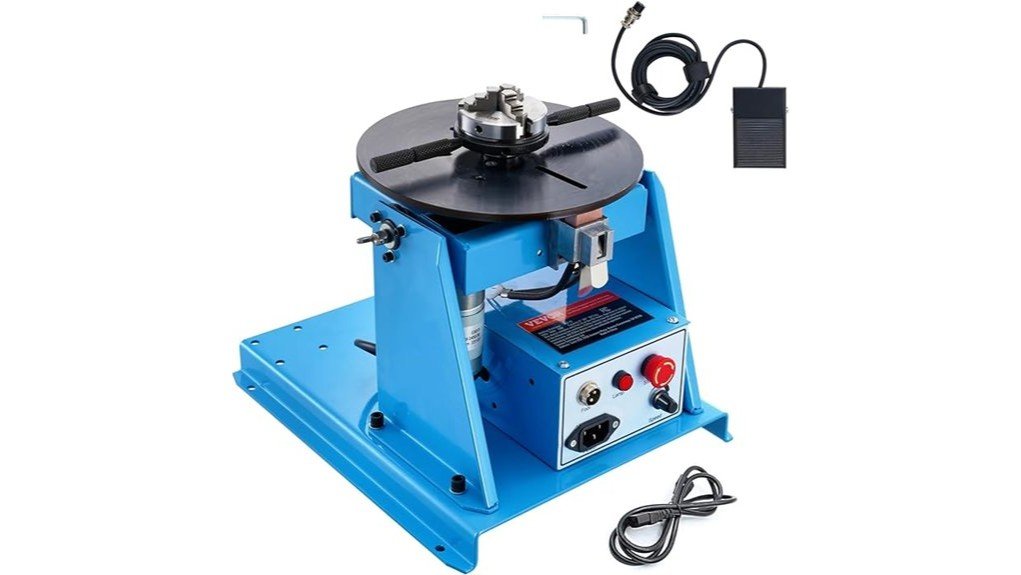
The VEVOR Rotary Welding Positioner 10KG HD-10 is a compact welding turntable made to hold and rotate smaller workpieces while you weld. Instead of stopping to reposition a pipe or ring by hand, you can clamp the part in the three-jaw chuck, set the worktable angle, and control rotation with the speed knob or foot pedal.
The HD-10 uses a 20W motor with a 1-12 RPM speed range. That slow, adjustable movement is useful for circular welds, small pipe sections, sleeves, couplers, metal art pieces, and repair parts where steady rotation can help you keep a cleaner bead.
Before You Buy: Check both the weight and balance of your workpiece. This positioner is rated for 22 lb horizontally and 11 lb vertically, so it is not the right choice for oversized pipe, heavy fixtures, or large fabrication assemblies.
Who Should Buy It?
Best For
- DIY welders who want better control on small round parts, rings, sleeves, and pipe sections.
- Small fabrication shops that need a compact bench positioner for repeatable lighter work.
- Metal artists and repair users working with smaller brackets, couplers, tubes, and cylindrical pieces.
Skip If
- You need to position workpieces over 22 lb horizontally or 11 lb vertically.
- You mainly weld large assemblies that need a larger floor-standing positioner.
- You need programmable controls for complex production welding schedules.
Design and Build Quality
The VEVOR HD-10 is built around a high-strength carbon steel body with a compact footprint. At 12.6 x 10.6 x 11.1 inches, it belongs on a workbench rather than a large floor setup. The 23.4 lb net weight gives it enough mass to feel planted for small parts while still being movable around a shop.
The 0-90° tilting worktable gives you more control over weld angle and part access. You can use it flat for horizontal rotation or tilt it when a workpiece needs a better torch position. The worm gear turning structure and locking butterfly bolt help hold the selected angle.
This is not a heavy industrial positioner, and that matters. The frame and table are made for lighter work, so you should avoid using it as a support for large, off-center, or poorly balanced pieces.
Chuck, Clamping, and Workpiece Control
The 8.1-inch / 205 mm turntable includes a K01-63 three-jaw chuck. A three-jaw chuck is useful for centering round or cylindrical pieces, especially when you need the part to rotate evenly while welding. The listed clamping range is 2-58 mm, with a holding range of 22-50 mm.
For small pipe welding, round stock, sleeves, couplers, and similar parts, the chuck is one of the strongest reasons to consider this positioner. It reduces the need to constantly unclamp, rotate, and reset the part by hand.
The limitation is workpiece shape. Irregular parts may need extra fixturing, careful setup, or a different holding method. Always confirm that the workpiece is secure before you power the rotation.
Speed Control and Foot Pedal Operation
The positioner uses a 20W motor and stepless speed control from 1 to 12 RPM. That range is slow enough for welding control and broad enough for different part diameters. Larger diameters usually need slower rotation, while smaller pieces may be easier to weld at a slightly higher setting.
The speed adjustment knob lets you tune the rotation rate before or during work. The foot pedal switch adds hands-on convenience because you can start or stop rotation without reaching across the machine during a weld.
Pro Tip: Start at a slower RPM on your first test pass, especially with wider pipe or thicker parts. Once your bead timing feels steady, increase speed in small steps instead of jumping straight to the highest setting.
Capacity, Balance, and Stability
For its size, the VEVOR Rotary Welding Positioner gives you a stable work platform when you stay within the rated load. The 22 lb horizontal capacity is useful for many small shop projects, while the 11 lb vertical capacity is more limited and should be treated carefully.
Stability depends on three things: workpiece weight, how well the part is centered, and how securely the machine sits on the bench. A part that sits far off-center can create uneven rotation and extra stress even if the total weight looks acceptable.
The smoothest performance will come from balanced parts that fit cleanly in the chuck. For repeatable circular welds, that can reduce hand movement and help you keep a more consistent torch angle.
Applications and Usability
This positioner is useful for more than one welding task. You can use it for small pipe welding, cylindrical workpieces, small metal structures, parts fabrication, cutting, grinding, assembly, and testing. It can be used for manual welding or paired with other welding equipment when your setup supports automatic welding.
| Use Case | Helpful Feature | What You Gain |
|---|---|---|
| Small pipe welding | Three-jaw chuck and 360° rotation | Better bead consistency around round parts |
| Manual welding | Foot pedal switch | Easier start and stop control |
| Cutting and grinding | Tilting worktable | Improved angle access for small parts |
| Assembly and testing | Compact bench design | Easier inspection and part positioning |
How It Performs in Real Use
For Small Pipe Welding
This is where the VEVOR HD-10 makes the most sense. The chuck holds smaller round pieces while the turntable rotates at a controlled pace. You can focus more on torch angle, heat input, and bead timing instead of repositioning the part by hand.
For Repetitive Shop Work
If you weld similar parts often, the positioner can save setup time once you find the right chuck position, table angle, and RPM. It is especially helpful when you need repeatable movement on lighter workpieces rather than one-off freehand positioning.
For Metal Art and Light Fabrication
Metal artists and hobby fabricators may like the compact design because it can handle rings, sleeves, decorative metal parts, and small structures. The 0-90° tilt gives you more ways to approach awkward shapes as long as the part stays inside the capacity limit.
For Cutting, Grinding, Assembly, and Testing
You can also use the rotating table to inspect parts, line up small components, or support lighter grinding and cutting tasks. It is not a replacement for a full fixture table, but it can make small bench jobs easier to control.
Setup Tips Before First Use
Place the positioner on a flat, stable workbench before clamping a part. If your workbench moves, the positioner will not feel steady under load. For better control, keep the power cord and foot pedal cable clear of hot metal, grinding sparks, and moving parts.
Before welding, test the rotation without an arc. Watch for wobble, slipping, or uneven motion. If the part is not centered, stop and reset the chuck before continuing.
Choose the table angle before striking an arc, then confirm the butterfly bolt is locked. When you change from horizontal to tilted work, remember that the vertical load rating is lower than the horizontal rating.
Compatibility and Safety Notes
The VEVOR Rotary Welding Positioner is made for smaller welding and fabrication tasks. It works best with workpieces that can be securely held by the three-jaw chuck and kept within the listed capacity. Do not use the chuck to hold parts that are too large, unstable, or poorly balanced.
You should also follow normal welding safety practices. Wear proper PPE, protect cables from heat, ground your welding setup correctly, and keep hands clear of the rotating chuck and table. If you pair the positioner with automated welding equipment, confirm that the full setup is safe before running it unattended.
For maintenance, keep the machine clean, remove metal dust and grinding debris, and check moving parts before use. If the unit shows unusual noise, slipping, damaged wiring, or poor rotation, stop using it until the issue is corrected.
Pros and Cons
Pros
- 1-12 RPM stepless speed control helps you match rotation speed to the workpiece diameter.
- 8.1-inch / 205 mm turntable with K01-63 three-jaw chuck supports secure clamping for smaller round parts.
- 0-90° tilting table improves access for angled welding, cutting, grinding, and assembly.
- Foot pedal switch makes start and stop control easier during manual welding.
- Compact 23.4 lb body is easier to place on a shop bench than a large industrial positioner.
Cons
- 22 lb horizontal and 11 lb vertical capacity limits it to lighter workpieces.
- Irregular or off-center shapes may need extra fixturing beyond the included three-jaw chuck.
- The vertical load rating drops quickly, so tilted setups need more care than flat work.
- It does not offer advanced programmable controls for complex automated welding setups.
Is It Worth the Price?
The VEVOR Rotary Welding Positioner is worth considering if you need controlled rotation for small welding projects but do not want to buy a larger shop-grade positioner. Its value comes from the combination of a tilting table, foot pedal control, 1-12 RPM speed range, and included three-jaw chuck.
It is a smart buy for everyday small-shop use when your workpieces stay within the load rating. You get the most value if you often weld round or cylindrical parts and want cleaner, more repeatable positioning.
It is not the best fit if your main work involves heavy pipe, large assemblies, or production welding that requires more capacity and programmable controls. In that case, a higher-capacity positioner will be a better long-term choice.
How It Compares to Alternatives
Compared with simple clamps, vises, or a fixed welding table, the VEVOR HD-10 gives you powered rotation and a tilting work surface. That makes it more useful for circular welds and repeatable small-part work.
Compared with larger VEVOR rotary positioners or other higher-capacity shop models, this 10KG version is more compact and easier to place on a bench. The tradeoff is lower load capacity, so you should choose a larger model if your parts often exceed 22 lb horizontally or 11 lb vertically.
Frequently Asked Questions
What is the VEVOR Rotary Welding Positioner best used for?
It is best for small pipe welding, cylindrical workpieces, metal art, small fabrication parts, and repair work. The 8.1-inch turntable and three-jaw chuck are most useful when the part can be centered and rotated smoothly.
How much weight can it hold?
The rated load is 22 lb / 10 kg horizontally and 11 lb / 5 kg vertically. Stay within those limits and keep the workpiece balanced to reduce wobble and strain on the machine.
Can it be used for automatic welding?
Yes, it can be paired with welding equipment for automatic welding when your setup supports it. You still need to confirm alignment, grounding, cable routing, load balance, and safety before running any automatic process.
What is the chuck size and clamping range?
The positioner uses a 205 mm K01-63 three-jaw chuck. The listed clamping range is 2-58 mm, and the holding range is 22-50 mm.
Is it portable enough for on-site work?
At 23.4 lb, it is portable enough to move between benches or job areas. It is still a powered shop tool, so you need a stable work surface and safe access to power before using it on site.
Can it be used for cutting, grinding, or assembly?
Yes, the positioner can support cutting, grinding, assembly, and testing tasks for smaller parts. Keep the workpiece secure and avoid side loads or forces that exceed what the table and chuck can safely hold.
What should you check before welding with it?
Check that the machine sits on a flat, stable bench, the workpiece is centered, the chuck is tight, the table angle is locked, and all cables are clear of heat, sparks, and moving parts.
Who should skip this welding positioner?
Skip it if you need to handle large pipe, heavy fixtures, or workpieces beyond the listed capacity. You should also choose a different setup if you need programmable speed schedules or heavy production automation.
The Bottom Line
The VEVOR Rotary Welding Positioner 10KG HD-10 is a solid choice if you need a compact, controlled rotating table for lighter welding tasks. Its 1-12 RPM speed control, 0-90° tilt, foot pedal switch, and three-jaw chuck make it useful for small pipe, round parts, and repeatable bench work.
You should skip it if your projects exceed the 22 lb horizontal or 11 lb vertical load rating, or if you need a larger industrial positioner. For the right small-shop buyer, it earns its 8.4/10 rating by offering practical control without taking up too much bench space.
Ready to Buy?
Check the latest Amazon price and product details before you decide.