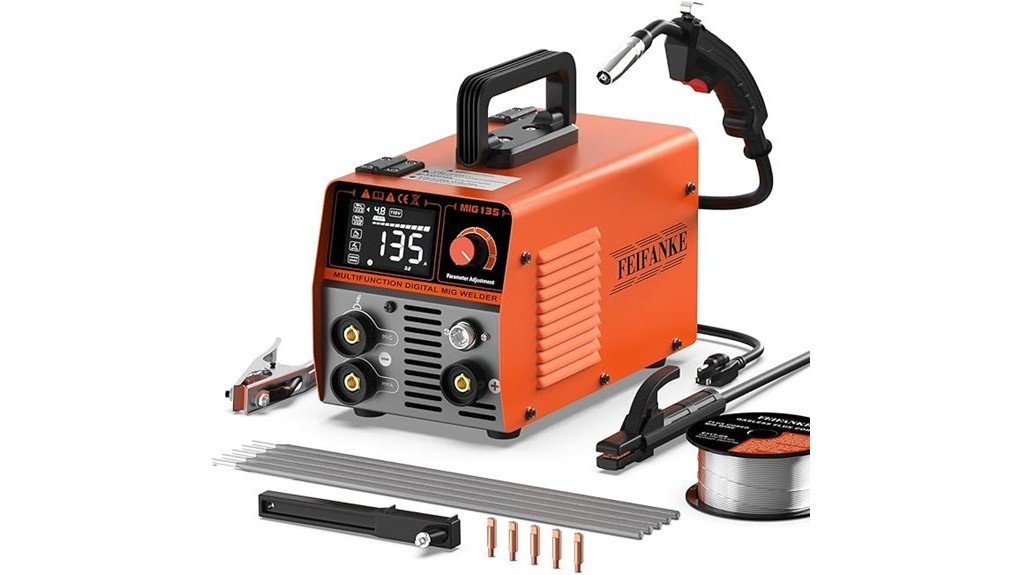
A compact 110V welder can save space and simplify home repairs, but only if its processes, accessories, and power limits match the work you plan to do. The FEIFANKE MIG145 combines gas MIG, gasless flux-core MIG, stick welding, and Lift TIG in one portable machine. Its synergic controls and included starter wire make it approachable for beginners, while manual voltage trimming gives you more control as your skills improve. The main tradeoffs are its 110V power ceiling, the extra equipment needed for gas MIG and Lift TIG, and limited verification of long-term support.
Quick Verdict
Rating: 8/10, recommended with caveats
Best For: Home garages, DIY repairs, hobby fabrication, and buyers who want both gas and gasless MIG options on 110V power
Bottom Line: The FEIFANKE MIG145 offers a useful mix of four welding modes, synergic setup, and a broad starter kit. It makes less sense for thick production work or anyone expecting a complete Lift TIG and shielding-gas setup in the box.
Key Specifications
| Specification | Detail |
|---|---|
| Brand | FEIFANKE |
| Model | MIG145 |
| Product Type | Portable multi-process wire-feed welder |
| Input Power | 110V AC |
| Maximum Output | 145A, according to the current product listing |
| Welding Processes | Gas MIG, gasless flux-core MIG, MMA stick, and Lift TIG |
| Control System | Synergic wire-speed and voltage matching with ±3V fine adjustment |
| Wire Types | ER70S-6 solid wire and E71T-GS flux-core wire |
| Included Wire | 1.1 lb of 0.030 in flux-core wire and 1.1 lb of 0.030 in solid wire |
| Contact Tips | Two each in 0.030, 0.035, and 0.040 in sizes |
| MIG Torch | 10 ft gas-capable MIG torch |
| Ground Clamp Lead | 6.5 ft |
| Item Weight | 19.31 lb |
| Package Dimensions | 15 x 13.5 x 7.75 in |
| Housing | Metal |
| Important Package Note | The published accessory list does not name a Lift TIG torch, gas cylinder, or gas regulator |
What Is the FEIFANKE MIG145?
The FEIFANKE MIG145 is a 110V, four-process inverter welder built for home maintenance, light fabrication, farm repairs, and hobby work. You can run it as a conventional gas MIG machine with solid wire, as a self-shielded flux-core machine without a gas bottle, as an MMA stick welder, or as a Lift TIG power source after adding the proper torch.
Its main selling point is flexibility without a large footprint. The synergic mode pairs voltage and wire feed with the selected wire size and current, which gives you a reasonable starting point instead of forcing you to build every setting from scratch. You can then use the listed ±3V fine adjustment to tune arc behavior for joint fit-up, travel speed, and your preferred bead profile.
Who Should Buy It?
Best For
- DIY welders who want one 110V machine for gas MIG, flux-core, stick, and occasional Lift TIG
- Garage users repairing brackets, gates, carts, lawn equipment, and light steel assemblies
- Beginners who value automatic starting settings but still want basic manual voltage control
Skip If
- You regularly weld thick plate, long production seams, or structural work that needs more output and a published heavy-duty duty cycle
- You need aluminum MIG capability through a spool gun or a full AC TIG setup
- You expect a TIG torch, gas bottle, and regulator to be included
Before You Buy: The current accessory list includes a gas hose but does not list a shielding-gas cylinder, regulator, or Lift TIG torch. Budget for those items if you plan to use gas MIG or Lift TIG.
Welding Modes and Controls
Gas MIG and Flux-Core MIG
Gas MIG gives you the cleaner option when you are welding prepared carbon steel indoors with solid ER70S-6 wire and the correct shielding gas. Stainless steel requires compatible stainless wire and the proper gas blend. The included 0.030 in solid wire lets you test gas MIG mode, but you still need the correct cylinder, regulator, and gas setup.
Flux-core mode is simpler for outdoor repairs because self-shielded E71T-GS wire does not rely on an external gas cloud. The kit includes a 1.1 lb spool of 0.030 in flux-core wire, so you can begin with the gasless process after confirming polarity and setup in the manual. Flux-core usually creates more smoke, slag, and cleanup than gas MIG, which matters when appearance is a priority.
Stick and Lift TIG
Stick mode gives you another option for repair work, rusty equipment, and joints where wire feeding is less convenient. The package list includes an electrode holder and five 5/64 in electrodes, which is enough for setup checks and practice rather than a large project.
Lift TIG expands the machine’s range for controlled steel or stainless work, but it is not a complete TIG package. The current listing does not include a TIG torch, and Lift TIG does not provide the same arc-start behavior or aluminum capability as a dedicated AC high-frequency TIG machine.
Synergic Control and Digital Display
The digital display and synergic control are helpful when you are still learning the relationship between current, voltage, and wire feed speed. You choose the process, wire size, and current, and the machine supplies a starting combination. The ±3V adjustment lets you shorten or lengthen the arc without abandoning the automatic setup.
Synergic control is a starting aid, not a substitute for test welds. Joint design, metal condition, extension-cord voltage drop, wire quality, and travel technique can all change the setting you need.
Build, Portability, and Protection
The listing gives an item weight of 19.31 lb and package dimensions of 15 x 13.5 x 7.75 in. That is manageable for moving between a garage, shed, trailer, or repair area, although it is heavier than the older 13.89 lb MIG135 described in the original article.
The metal housing is a better fit for shop use than a thin plastic shell, but it still needs dry storage and protection from grinding dust. Listed safeguards include over-current, overload, over-voltage, and overheat protection. These systems can protect the machine from certain electrical and thermal conditions, but they do not replace correct circuit sizing, sound cable connections, ventilation, and personal protective equipment.
Included Accessories and Consumables
The listed package is broader than many starter kits. It includes the MIG145 machine, a 10 ft MIG torch, a 6.5 ft ground clamp, an electrode holder, a gas hose, two hose clamps, a brush, and five 5/64 in welding electrodes.
For wire setup, you get two contact tips each in 0.030, 0.035, and 0.040 in sizes. The package also lists a 0.030/0.035 in K-groove drive roller and a 0.035/0.040 in V-groove drive roller, plus 1.1 lb spools of both 0.030 in flux-core and solid wire. Before loading wire, match the drive-roll groove, contact tip, polarity, and process to the consumable you are using.
Pro Tip: Make a short test bead on scrap from the same material and thickness before welding the actual part. Use the synergic setting as your baseline, then adjust voltage, travel speed, and wire stickout one change at a time.
Setup Tips Before First Use
- Confirm the circuit: Use a properly grounded 110V outlet and follow the manual’s input-current requirements. Avoid undersized extension cords because voltage drop can weaken arc performance and overheat the cord.
- Check polarity: Solid-wire gas MIG and self-shielded flux-core wire often use different polarity. Follow the machine diagram and wire manufacturer’s instructions before striking an arc.
- Match the feed path: Select the correct drive-roll groove and contact tip for the wire diameter. Set enough roller tension to feed consistently without crushing the wire.
- Prepare the joint: Remove paint, oil, heavy rust, and plating from the weld zone. Clean metal improves arc stability and reduces contamination.
- Protect yourself: Wear a properly rated welding helmet, gloves, flame-resistant clothing, and eye protection. Keep combustible materials away and provide effective fume ventilation.
How It Performs in Real Use
For Home and Garage Repairs
The MIG145 is best matched to intermittent repairs where convenience matters more than maximum deposition rate. Brackets, carts, mower parts, light frames, and gate repairs fit its intended role, provided the material thickness and joint design stay within the machine’s practical 110V range.
For Outdoor Flux-Core Work
Gasless flux-core is the more convenient mode when wind would disturb shielding gas. You still need to control sparks, fumes, slag, and fire risk. Clean the joint first, keep the work clamp close to the weld, and chip or brush slag before adding another pass.
For Cleaner Indoor MIG Work
Solid-wire gas MIG is the better choice when you want less slag and a cleaner bead on prepared steel. The included solid wire and gas hose reduce the number of small items you need to source, but the missing cylinder and regulator mean the gas setup is not ready out of the box.
For Stick or TIG Practice
Stick mode gives you useful flexibility for repair tasks and lets you work without a wire spool. Lift TIG is better viewed as an add-on capability for someone who already understands gas selection and torch setup. Buyers focused mainly on TIG should compare a dedicated TIG machine with confirmed torch, pedal, and AC/DC features.
Pros and Cons
Pros
- Four processes cover gas MIG, flux-core, stick, and Lift TIG
- Synergic settings simplify the first setup for new welders
- ±3V fine adjustment gives you more control than a fully locked automatic mode
- Includes both flux-core and solid wire, multiple contact-tip sizes, and two drive rollers
- 110V input and a 19.31 lb body suit home garages and mobile repair work
Cons
- Lift TIG torch, shielding-gas cylinder, and regulator are not listed in the package
- 110V output is not the best choice for thick plate or sustained production welding
- Current warranty terms and the affiliate listing’s model mapping need confirmation before purchase
Is It Worth the Price?
The FEIFANKE MIG145 is worth considering as a value-focused multi-process machine when you want to try several welding methods without buying separate power sources. Its strongest value comes from the combination of gas and gasless MIG, stick capability, synergic control, and a starter set that includes two wire types.
You get less value if your work is mostly thick plate, aluminum, or TIG. Those jobs can require a dual-voltage machine, spool-gun support, AC TIG output, a higher documented duty cycle, or accessories that are not listed with this package. Check the current seller, warranty, and included-item details before ordering because marketplace bundles can change.
How It Compares to Alternatives
The YESWELDER FLUX-135PRO is worth comparing when you want a compact gasless MIG, stick, and Lift TIG machine from a brand with a clearly listed product-support system. The Forney Easy Weld 141 FC-i is a simpler choice when you only need flux-core welding and prefer a focused machine with manufacturer documentation.
The Hobart Handler 140 is the more established option for conventional MIG and flux-core work, with a gas regulator included in its published package, but it does not offer the same four-process layout. The FEIFANKE MIG145 makes the most sense when process variety and a broad starter kit matter more than brand history or specialization.
Warranty and Customer Support
The current Amazon page provides a warranty-information link and Amazon return information, but it does not show enough detail to verify a specific manufacturer warranty in the visible listing text. Confirm the warranty length, claim process, replacement-parts availability, and seller contact method before buying.
Keep your order record, serial number, and manual. For a lower-cost inverter welder, access to contact tips, liners, drive rollers, torch parts, and technical support can matter as much as the original purchase price.
Frequently Asked Questions
Is the FEIFANKE MIG145 a gas or gasless welder?
It supports both. You can use self-shielded E71T-GS flux-core wire without external gas, or use ER70S-6 solid wire with the correct shielding-gas system.
Does the package include everything needed for gas MIG?
No. The listed kit includes solid wire, a gas-capable torch, and a gas hose, but it does not list a shielding-gas cylinder or regulator. Confirm fittings and gas requirements before buying those parts.
Is a Lift TIG torch included?
The current accessory list does not include a Lift TIG torch. You need a compatible torch and the correct shielding-gas setup before using Lift TIG mode.
Can the MIG145 weld aluminum?
Do not assume aluminum compatibility. The current listing describes steel-focused gas MIG, flux-core, stick, and Lift TIG use but does not verify a spool-gun connection or AC TIG output. Choose a machine with explicit aluminum support if that is a priority.
What wire comes with the welder?
The listed package includes 1.1 lb of 0.030 in E71T-GS flux-core wire and 1.1 lb of 0.030 in ER70S-6 solid wire. It also includes contact tips in 0.030, 0.035, and 0.040 in sizes.
Is it suitable for a beginner?
Yes, the synergic mode can provide a practical starting point by matching voltage and wire feed to your selected settings. You still need to learn polarity, wire loading, joint preparation, safe PPE, and how to evaluate a test bead.
What maintenance does the MIG145 need?
Keep the machine dry, blow dust from ventilation openings with the power disconnected, inspect cables and clamps, and replace worn tips or feed parts. Store wire in a dry place and follow the manual for internal service.
Who should choose a larger welder instead?
Choose a higher-output dual-voltage machine when you regularly weld thick material, need longer high-amperage runs, or require verified aluminum and spool-gun support. A dedicated TIG machine is also better when TIG is your main process.
The Bottom Line
The FEIFANKE MIG145 is a practical choice for DIY welders who want gas MIG, flux-core, stick, and optional Lift TIG from one 110V machine. Its synergic controls and included wire kit are the main strengths, while its incomplete gas and TIG accessories, marketplace listing changes, and light-duty power class are the main reasons to pause.
Ready to Buy?
Check the latest model, package contents, warranty, and seller details before you decide.