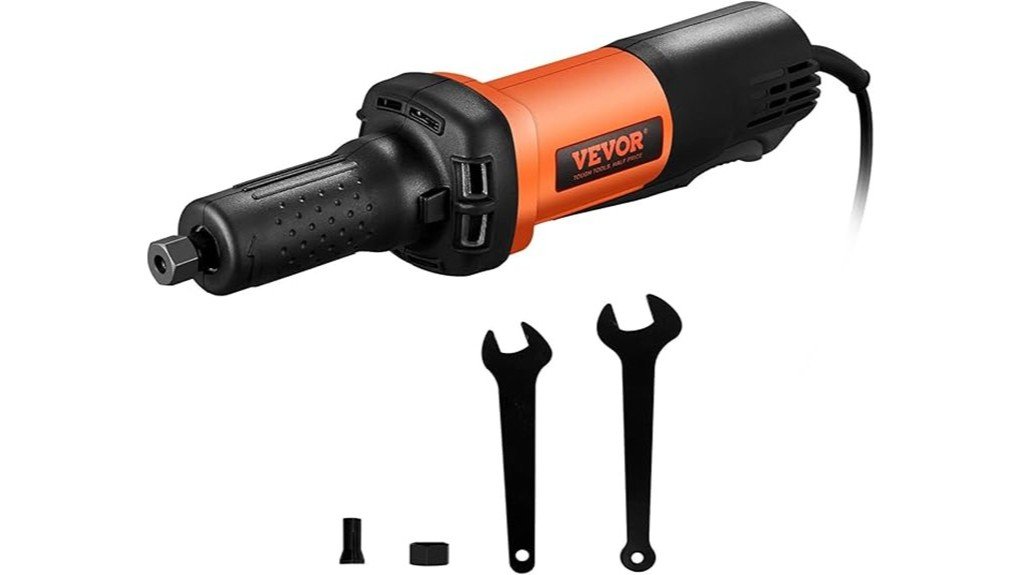
A die grinder needs enough speed for fast metal cleanup without becoming difficult to control during detailed work. The VEVOR Die Grinder combines a corded 820W brush motor, six speed settings, and two common collet sizes in a compact straight-grinder design. It is best suited to rust removal, weld cleanup, deburring, polishing, sanding, carving, and other small-area finishing jobs. Its main limitation is that listing versions have shown different speed ranges, so you should confirm the exact specifications and package contents before ordering.
Quick Verdict
Rating: Recommended with caveats
Best For: Garage users, welders, fabricators, mechanics, and DIYers who need a variable-speed corded die grinder
Bottom Line: The VEVOR Die Grinder offers useful speed control, an 820W motor, and both 1/4-inch and 1/8-inch collets. It is a practical value-focused option, but you need to verify the exact listing variant, accessories, and warranty before buying.
Key Specifications
| Specification | Detail |
|---|---|
| Brand | VEVOR |
| Product Type | Corded straight die grinder |
| Amazon ASIN | B0DYV2P54S |
| Input Power | 120V, 60Hz |
| Rated Current | 7A |
| Motor | 820W brush motor |
| Current Listed Speed Range | 10,000 to 28,000 RPM, no load |
| Speed Settings | Six settings |
| Collet Sizes | 1/4 inch and 1/8 inch |
| Weight | 4.2 lb / 1.9 kg |
| Cord Length | 5.9 ft / 1.8 m |
| Protection Grade | IP20 listed |
| Listed Noise Level | Up to 90 dB |
| Common Uses | Grinding, rust removal, deburring, sanding, polishing, carving, milling, and sharpening |
Specifications are based on the current VEVOR US product page. Because older indexed listings show a different speed range, confirm the exact Amazon version before purchase.
What Is the VEVOR Die Grinder?
The VEVOR Die Grinder is a corded handheld tool designed for controlled material removal in areas where an angle grinder is too large or aggressive. Its narrow body accepts small burrs, grinding stones, sanding accessories, polishing tools, and other attachments with compatible shanks.
The current US manufacturer listing describes an 820W brush motor with six no-load speed settings from 10,000 to 28,000 RPM. The included 1/4-inch and 1/8-inch collet sizes support two widely used accessory-shank formats, which makes the tool useful for both general metal cleanup and smaller detail work.
At 4.2 pounds, it is not an ultralight rotary tool, but it remains manageable for two-handed grinding and repeated shop tasks. Its corded design also avoids battery-runtime limits, although you need an appropriate AC outlet and enough cord reach for the work area.
Who Should Buy It?
Best For
- Welders who need to smooth small welds, clean tight joints, or remove light spatter
- Mechanics and fabricators working on rust, burrs, ports, brackets, and small metal parts
- DIY users who want one corded tool for grinding, sanding, polishing, carving, and sharpening
Skip If
- You need a cordless grinder for remote work or frequent movement around a large jobsite
- You need a lightweight precision rotary tool for very small crafts or delicate electronics
- You require independently verified continuous-duty data, vibration figures, or a confirmed warranty period
Before You Buy: Listings for this grinder have shown both 7,000–30,000 RPM and 10,000–28,000 RPM ranges. The current VEVOR US page lists 10,000–28,000 RPM, but you should confirm the speed range, voltage, collets, and included accessories on the exact Amazon listing.
Feature-by-Feature Review
820W Corded Motor
The current manufacturer specifications list a 120V, 7A, 820W brush motor. This gives the grinder more power than a small hobby rotary tool and makes it better suited to burr removal, weld cleanup, rust removal, and repeated metal-finishing work.
A corded motor also delivers steady power without charging breaks. The tradeoff is that your movement depends on the 5.9-foot power cord or a correctly rated extension cord. Avoid lightweight household extension cords that are not suitable for the tool’s current draw.
Six-Speed Control
The six settings let you adjust the tool from a listed 10,000 RPM to 28,000 RPM. Lower settings are useful when you need more control, want to reduce heat, or are working with an accessory that has a lower maximum speed. Higher settings support faster material removal when the burr, stone, sanding drum, or polishing accessory is rated for that RPM.
The speed dial does not remove the need for careful setup. Always check the accessory’s maximum rated speed before use. Running an attachment above its limit can damage the accessory and create a serious safety hazard.
1/4-Inch and 1/8-Inch Collets
The two collet sizes are one of the grinder’s strongest practical features. A 1/4-inch collet works with many carbide burrs, mounted stones, and shop-focused grinding accessories. The 1/8-inch collet expands compatibility to smaller sanding, engraving, polishing, and detail attachments.
The collet must match the accessory shank exactly. Do not place a metric or undersized shank into a collet that cannot clamp it securely. Insert the shank to the depth recommended by the accessory maker, tighten the collet with the correct wrench, and check for movement before starting the grinder.
Grip, Weight, and Tool Control
VEVOR lists the grinder at 4.2 pounds and describes the handle as soft and ergonomic. The straight body helps you reach narrow areas, but the weight can still cause fatigue during overhead work or long one-handed sessions.
Use two hands when the task allows it. One hand can control the main grip while the other supports the front of the tool without touching the rotating accessory. This improves accuracy and helps you react if the burr catches an edge.
Cooling and Switch Design
The grinder uses a flow-through ventilation layout to move air through the housing. Good airflow can reduce heat buildup, but it does not make the tool immune to overheating. Grinding pressure, clogged vents, dull accessories, and long uninterrupted sessions can still raise the temperature.
The listed safety switch is intended to reduce accidental operation. Check its action before each job and disconnect the power before changing collets, adjusting accessories, clearing debris, or inspecting the tool.
Pro Tip: Let the accessory do the cutting. Light, steady passes usually produce a cleaner finish and less heat than forcing the grinder against the workpiece.
How It Performs in Real Use
For Weld Cleanup and Deburring
A die grinder works well where a full-size angle grinder cannot reach. With a compatible carbide burr or mounted abrasive, you can smooth small weld beads, remove sharp edges, clean holes, and reach inside brackets or tubing openings.
Start with light contact and keep the accessory moving. Holding a burr in one spot can create a low area, dig into the base metal, or generate unnecessary heat.
For Rust and Surface Preparation
Small wire brushes, abrasive points, and sanding accessories can remove rust from corners, seams, fastener areas, and irregular parts. The six speed settings help you balance removal rate with control.
This tool is better for focused areas than large flat panels. For broad surface preparation, an angle grinder, sander, or dedicated surface-conditioning tool may finish the job faster.
For Polishing and Detail Work
The 1/8-inch collet supports smaller polishing and engraving accessories. Begin at a lower setting, apply only the compound recommended for the material, and test the process on scrap before working on a visible surface.
High speed can quickly heat thin metal, plastic, paint, or plated surfaces. Use short passes and inspect the finish often.
For Repeated Garage Work
The corded design makes sense when you work near a bench or garage outlet and do not want to manage batteries. The 820W motor provides useful capacity for repeated cleanup and shaping tasks, but you should still pause if the housing becomes unusually hot, the motor tone changes, or power drops.
Setup Tips and Common Mistakes to Avoid
- Inspect the accessory first. Do not use cracked stones, damaged burrs, bent shanks, loose sanding drums, or accessories with an unknown RPM rating.
- Match the shank and collet. Use the 1/4-inch collet only for 1/4-inch shanks and the 1/8-inch collet only for 1/8-inch shanks.
- Tighten before plugging in. Disconnect the grinder from power whenever you install or remove an accessory.
- Test at low speed. Run the tool away from your body and workpiece to check for wobble or vibration before starting the job.
- Secure the workpiece. Use a vise or clamps instead of holding a small metal part in your hand.
- Use light passes. Excessive pressure can slow the motor, overheat the tool, damage the accessory, and reduce control.
- Keep the vents clear. Metal dust and abrasive debris can restrict airflow. Clean the exterior vents only after unplugging the tool.
Safety and Accessory Compatibility
Wear eye protection whenever the grinder is running. Add a face shield when the work creates sparks or flying fragments, and use hearing protection because the manufacturer lists noise up to 90 dB. Grinding dust may also require suitable respiratory protection and local ventilation.
The current page lists an IP20 protection grade. Treat the grinder as a dry-location electrical tool. Keep it away from rain, standing water, wet work surfaces, and conductive liquids.
Never exceed the accessory maker’s rated RPM. Not every rotary-tool accessory is suitable for an 820W die grinder, even when its shank fits the collet. Follow the VEVOR manual and the accessory manufacturer’s instructions for maximum speed, installation, guards, direction of use, and approved materials.
Let the grinder stop completely before setting it down. Unplug it before servicing the collet, cleaning the vents, checking the brushes, or removing tangled material.
Pros and Cons
Pros
- 820W corded motor is suited to grinding, deburring, rust removal, and weld cleanup
- Six speed settings provide more control than a fixed-speed grinder
- Includes compatibility with both 1/4-inch and 1/8-inch accessory shanks
- Straight body reaches areas that are difficult to access with an angle grinder
- No batteries or compressor are required
Cons
- Older and current listings show conflicting speed ranges
- The exact Amazon accessory package and warranty were not confirmed
- At 4.2 pounds, it may feel tiring during long overhead or one-handed work
Is It Worth the Price?
The VEVOR Die Grinder is positioned as a value-focused corded option rather than a premium industrial tool. It offers strong practical value if you need variable speed, two collet sizes, and more power than a small hobby rotary tool.
You will get the most value from it when you regularly clean welds, remove rust, deburr parts, polish metal, or shape small areas near a workbench. It is less compelling if portability is your main concern or if you already own a compressor and prefer a lighter pneumatic die grinder.
The unresolved listing differences are the main buying limitation. Check the current speed range, package contents, return terms, and warranty information rather than assuming every VEVOR listing includes the same version.
How It Compares to Alternatives
The Makita GD0601 is worth comparing if you want a well-known fixed-speed electric die grinder and do not need variable control. The DEWALT DWMT70783 and Ingersoll Rand 301B are pneumatic alternatives that may feel lighter in your hand, but they require an air compressor with enough airflow.
The VEVOR makes the most sense when you want corded electric operation, six speed settings, and both common collet sizes without adding a compressor to your setup.
Frequently Asked Questions
What is the speed range of the VEVOR Die Grinder?
The current VEVOR US page lists six settings from 10,000 to 28,000 RPM. Older indexed listings show 7,000 to 30,000 RPM, so confirm the exact range on the Amazon page before ordering.
Does it use a standard 120V outlet?
The current US manufacturer specification lists 120V, 60Hz operation with a 7A rated current. Follow the manual, use a suitable grounded outlet, and avoid an undersized extension cord.
Which accessory shank sizes fit this grinder?
The grinder is listed with 1/4-inch and 1/8-inch collets. The accessory shank must match the installed collet exactly and must be rated for the grinder’s operating speed.
Can it remove welds and rust?
It can clean small welds, remove burrs, and work on focused rust areas when fitted with the correct carbide burr, abrasive, or wire accessory. It is less efficient than a larger grinder for broad panels or heavy stock removal.
Is it suitable for polishing?
Yes, with a compatible polishing accessory and compound. Begin at a lower setting, test on scrap, and avoid holding the accessory in one place long enough to overheat or damage the surface.
Is the VEVOR Die Grinder beginner-friendly?
The variable-speed control can help a beginner start slowly, but a die grinder still requires firm workholding and careful accessory selection. New users should read the manual, wear protective equipment, and practice on scrap material.
How much does the grinder weigh?
The current VEVOR US listing gives a weight of 4.2 pounds, or 1.9 kilograms. That is manageable for bench and garage work but may cause fatigue during long overhead sessions.
What comes in the Amazon package, and what is the warranty?
The exact Amazon accessory package and warranty period were not confirmed during this review. Check the current product description, package list, seller information, and warranty terms before completing your purchase.
The Bottom Line
The VEVOR Die Grinder is a practical choice for garage users who want an 820W corded grinder with six speeds and both 1/4-inch and 1/8-inch collets. Skip it if you need cordless portability, a very lightweight precision tool, or fully documented continuous-duty specifications. Its strongest advantages are power and accessory flexibility, while the main limitation is the inconsistent specification data across older and current listings.
Ready to Buy?
Check the latest speed range, package contents, warranty terms, and product details before you decide.