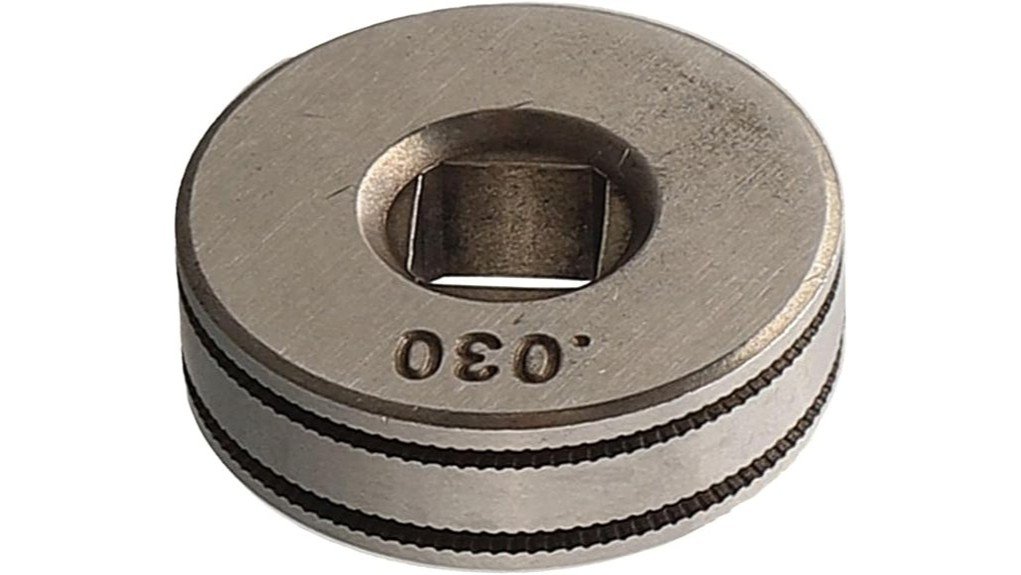
The MIG welder wire feed drive roller is a small replacement roller listed for Chicago Electric MIG welders and 0.8 to 0.9 mm wire. This drive roller review uses the Amazon listing data: it is worth considering if your feeder slips on a worn groove and your model matches, but skip it until you have measured your old roller.
Quick specs at a glance
| Item | Per the listing |
|---|---|
| Type | MIG wire feed drive roller |
| Listed for | Chicago Electric MIG welders |
| Wire size | 0.8 to 0.9 mm (about 0.030 to 0.035 in) |
| Outer diameter / width | 25 mm / 7.45 mm |
| Verify | Bore size, groove type, exact model compatibility |
Check current price on Amazon →
What it does and who it suits
The drive roller grips the welding wire and pushes it from the spool toward the liner. When its groove wears, the wire slips, feeds unevenly or birds-nests at the feeder, which causes erratic arcs and burn-back.
This roller suits owners of compatible Chicago Electric machines running 0.030 or 0.035 inch wire who want a spare. It is a basic consumable, so expect no special feature beyond fit.
How to check it fits your welder
- Remove the existing roller and measure its outer diameter, width and bore with calipers.
- Compare with the listing: 25 mm outer diameter and 7.45 mm width.
- Look at the groove shape. V-groove suits solid steel wire, knurled suits flux-core, and U-groove suits soft aluminum wire.
- Confirm the wire diameter stamped on the roller matches your spool.
- Check your manual’s parts list for the model number.
The listing does not state groove type, so verify it before using flux-core or aluminum wire.
Pros and limitations
- Pros: Low-cost fix for a common wear item; dimensions are given in the listing; simple swap.
- Limitations: Material and hardness are not detailed, there is no stated warranty, and compatibility is limited to the listed brand family. A new roller will not cure a bad liner or tip.
How to replace a drive roller
- Unplug the welder and remove the spool wire from the feeder if needed.
- Release the tension arm and open the feeder cover.
- Remove the retaining screw or clip and slide off the old roller.
- Fit the new roller with the correct groove side facing the wire path.
- Refit, set light tension, and feed a few inches of wire to test.
Clean wire dust from the feeder and check the inlet guide while you are in there.
Alternatives and related guides
- See how the groove and size relate in the drive roll compatibility review.
- If the motor is the problem, read the wire feed motor review.
- Replacing the wire path? Try the MIG liner and conduit review.
Frequently Asked Questions
Which welders is this drive roller listed for?
The listing points to Chicago Electric MIG welders. Roller outer diameter, width and bore vary between models, so compare the 25 mm outer diameter, 7.45 mm width and bore with your old roller or the parts diagram in your manual before ordering.
What wire size does it take?
The listing gives 0.8 to 0.9 mm wire, about 0.030 to 0.035 inch. Always match the groove to the wire diameter on your spool. A groove that is too large lets wire slip, and one that is too small can deform it.
How do I know the drive roller is worn?
Signs include wire that slips or stalls with correct tension, a groove that looks shiny or widened, flakes of wire shavings, and uneven feeding that goes away with a new roller. Check the roller before replacing the whole feeder.
Is there a set replacement interval?
No fixed interval applies. Wear depends on how much you weld, wire type and tension. Inspect the groove when you change spools and replace the roller when feeding gets erratic or the groove shows visible wear.
Verdict
A budget roller worth buying only when it matches your machine’s old roller in size and groove. Measure first, then order.
Check current price on Amazon →