As an Amazon Associate, Garage Welding may earn from qualifying purchases. This does not change the price you pay.
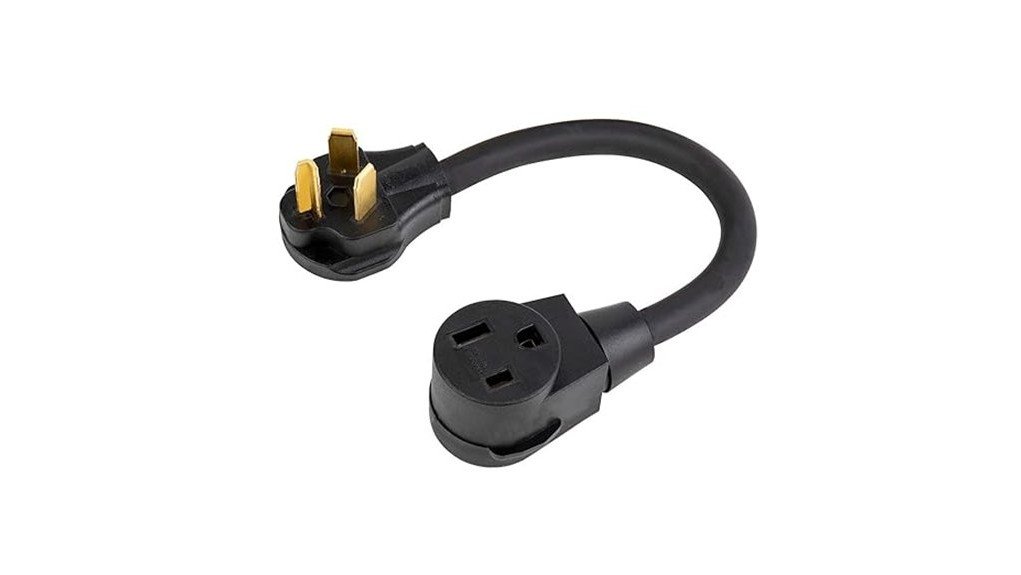
The NEMA 10-30P to 6-50R adapter is a short cable that lets a welder with a 6-50 plug connect to an older 3-wire 10-30 dryer outlet. It can be a workable stopgap for a small welder that draws well under the circuit’s 30 amp limit, but it does not turn a 30 amp circuit into a 50 amp one, and the missing ground on a 10-30 outlet is a real safety concern.
Read the electrical checks below before you buy. If any of them is unclear, have an electrician look at the outlet.
Quick specs at a glance
| Item | Detail |
|---|---|
| Item | Adapter cable, NEMA 10-30P male plug to NEMA 6-50R female receptacle |
| Listed length | About 1.5 ft |
| Listed conductors | STW 10 AWG, three conductors, copper (per the listing) |
| Listed voltage | 250 V |
| Listed amperage | 30 A on the plug side, 50 A on the receptacle side |
| Listed power | About 7,000 to 7,500 W maximum |
| Key point | The source circuit still limits you to 30 A, however the receptacle is rated |
What it is and who it suits
NEMA 10-30 is an older 3-wire, 240 V, 30 A configuration once used for electric dryers and ranges. It has two hot pins and a neutral, but no separate safety ground. NEMA 6-50 is a 240 V, 50 A configuration with two hot pins and a ground, and it is the standard receptacle for many welders. This adapter links the two.
It may suit:
- Owners of a smaller 240 V welder whose input draw is comfortably below 30 A, who only have a dryer outlet in their garage or basement.
- Temporary or rented spaces where wiring a new outlet is not possible.
It does not suit larger welders, or any machine whose manual calls for a 40 or 50 amp circuit at the output setting you plan to use. The adapter cannot add capacity that the wire in the wall and the breaker do not have.
Electrical checks before you plug in
This is the most important part of the page. Check each item:
- Read the welder’s nameplate for rated input current at the duty cycle and output you will use. As a rule of thumb, the circuit breaker and wiring need to handle that current continuously with margin.
- Confirm the outlet really is NEMA 10-30 and is on a 30 A breaker with wire sized for it. Do not assume.
- Understand the ground problem. A 10-30 has no ground pin, while the 6-50 receptacle has one. This adapter has three conductors, so ask the seller how the ground terminal is wired. Tying the neutral to the machine frame is a known hazard and is not how modern code wires equipment.
- Never swap the breaker for a bigger one to suit the welder. A bigger breaker on 10 AWG wire can overheat the wiring.
- Check local code or ask an electrician. In many places modifying or adapting dryer outlets for other equipment is restricted.
A safer long-term option is a dedicated 6-50 circuit installed by a qualified electrician.
Pros and limitations
Pros
- Cheap and quick way to power a small 240 V welder from an existing outlet.
- Short 1.5 ft cable keeps the connection compact and avoids a long thin cord.
- Listed 10 AWG copper conductors are a reasonable gauge for a 30 A load.
Limitations
- The circuit stays at 30 A, so a welder drawing more will trip the breaker or overheat wiring.
- No equipment ground on the source outlet, which weakens shock protection.
- The listing’s 30 A input and 50 A output wording is easy to misread; it is a plug-shape conversion, not a power conversion.
- No stated certification in the information provided, so check for a UL or ETL mark on the product.
Use and inspection tips
- Switch the welder off before plugging or unplugging, and never pull on the cable.
- Run the welder at the lower end of its range and watch for a warm plug, discoloured pins or a tripping breaker. Stop if you see any of these.
- Inspect the cable and plug faces before each session for nicks, cracks or burn marks.
- Keep the adapter dry and off the floor in wet areas; do not use it outdoors unless it is rated for that.
- Do not daisy-chain adapters or extension cords on top of this one. Extra connections add resistance and heat.
Alternatives and related guides
- NEMA 10-30P to 14-50R adapter: a different 10-30 conversion, with its own ground and use caveats
- NEMA 6-50P to 14-50R adapter: the reverse direction, from a welder outlet to a 4-wire receptacle
- Journeyman Pro 2715 plug: for replacing a damaged welder plug instead of adapting
- NEMA L14-30P extension cord: a 30 A locking cord if you need extra reach
Frequently Asked Questions
Can I run a 50 amp welder on a 30 amp dryer outlet with this adapter?
Only if the welder actually draws less than the circuit allows at the settings you use. The adapter changes the plug shape, not the capacity. A welder needing more than 30 A will trip the breaker or overheat the wiring, so check the nameplate first.
Does a NEMA 10-30 outlet have a ground?
No. NEMA 10-30 is a 3-wire layout with two hots and a neutral, and no separate ground pin. A 6-50 receptacle has a ground terminal, so check how this adapter connects it and consider having an electrician add a proper grounded circuit.
Is it safe to use this adapter outdoors?
Do not assume so. The listing does not clearly state a weather rating. Keep the adapter dry and protected, and use equipment rated for outdoor or wet locations if the job is outside, with GFCI protection where code requires.
What is the difference between NEMA 10-30 and 6-50?
NEMA 10-30 is an older 30 A, 3-wire 240 V layout with a neutral and no ground. NEMA 6-50 is a 50 A, 3-wire 240 V layout with a ground and no neutral. They are different designs, so an adapter has to be wired with care.
Final verdict
The NEMA 10-30P to 6-50R adapter can bridge a plug mismatch for a small welder, but it is a compromise: the circuit stays at 30 A and there is no equipment ground at a 10-30 outlet. For anything beyond light, occasional use, install a proper 6-50 circuit.