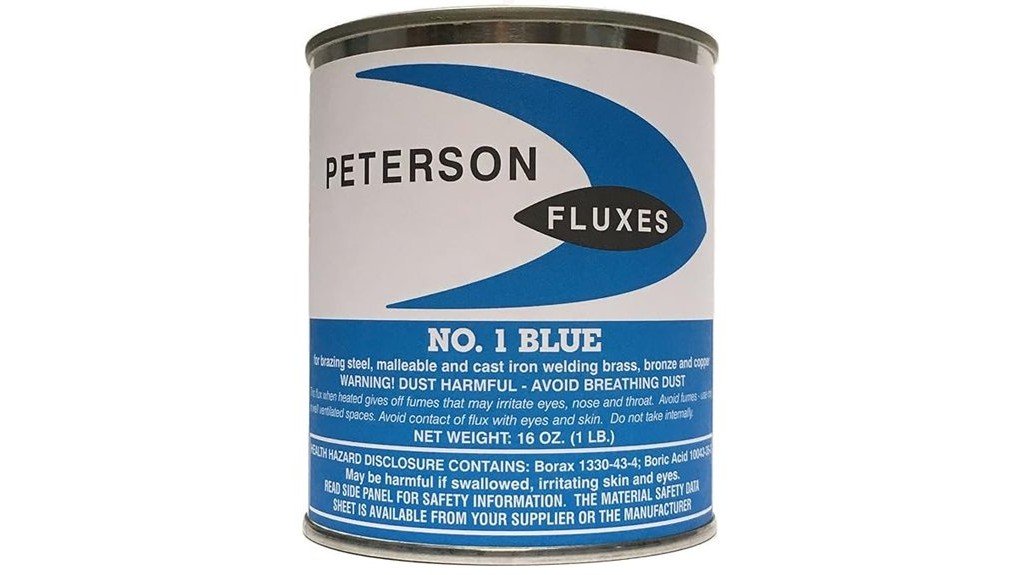
Peterson #1 Blue Flux is a powerful tool for those engaged in welding and brazing tasks. Operating within a temperature range of 1200-1600°F (650-870°C), it is particularly effective for cast iron, malleable iron, and steel. Its coarse powder design enhances adhesion and provides a smoother finish, which is essential for quality work. Understanding its application methods and troubleshooting techniques can greatly improve results. What comes next is an exploration of its benefits and comparisons to other flux options.
Key Takeaways
- Peterson #1 Blue Flux is a versatile coarse powder ideal for brazing and welding cast iron, malleable iron, and steel.
- The flux operates effectively within a temperature range of 1200-1600°F, ensuring strong joints and improved adhesion.
- Its formulation promotes a smoother finish, making it suitable for torch welding of brass, bronze, and copper.
- Best practices for application include even distribution and maintaining a clean surface to prevent contamination.
- Compared to competitors, Peterson #1 excels in performance with its robust formulation tailored for specific welding materials.
How to Use Peterson #1 Blue Flux Effectively
To use Peterson #1 Blue Flux effectively, individuals should begin by understanding its formulation and applications.
This coarse powder, classified under AWS as FB3-F, is designed for brazing and welding cast, malleable iron, and steel, as well as torch welding brass, bronze, and copper.
Employing proper application techniques is essential; apply the flux evenly to guarantee peak bonding.
Additionally, safety precautions must be taken, including the use of protective gear to safeguard against fumes and splatter.
Working within a temperature range of 1200-1600°F (650-870°C) will yield the best results, enhancing the overall quality of the weld.
Top Benefits of Using Peterson #1 Blue Flux for Welding
When considering the advantages of utilizing Peterson #1 Blue Flux for welding, one immediately notices its remarkable versatility and effectiveness across various applications.
This flux excels in providing heat resistance, withstanding temperatures between 1200-1600°F (650-870°C), making it suitable for brazing and welding cast and malleable iron, steel, brass, bronze, and copper.
Its coarse texture enhances adhesion and promotes a smoother finish, ensuring strong joints.
Additionally, the application versatility of Peterson #1 Blue Flux enables welders to tackle diverse projects with confidence, allowing for seamless integration into various welding processes.
How Peterson #1 Blue Flux Compares to Other Flux Options
How does Peterson #1 Blue Flux stack up against other flux options on the market?
In the domain of flux alternatives, its coarse powder formulation distinctively supports brazing and welding cast iron, malleable steel, brass, bronze, and copper. Operating effectively within a working temperature of 1200-1600°F (650-870°C), its comparative effectiveness is evident in diverse applications.
While other fluxes may offer varying textures or compositions, Peterson #1 Blue Flux provides robust performance, particularly for torch welding.
This versatility makes it a strong choice, especially when considering the specific needs of iron and steel welding as compared to its competitors.
Best Practices for Applying Peterson #1 Blue Flux
Applying Peterson #1 Blue Flux requires attention to detail and adherence to best practices to guarantee ideal results.
For peak performance, confirm proper flux consistency by mixing the coarse powder evenly with the base materials. Effective application techniques include using a brush or sprayer to distribute the flux uniformly across the joint surfaces. This promotes superior bonding during welding or brazing processes.
Maintain a working temperature between 1200-1600°F (650-870°C) to activate the flux properties fully. Regularly assess the application for any inconsistencies, as achieving a smooth, even coating will greatly enhance the quality of the final weld or braze joint.
How to Troubleshoot Issues With Peterson #1 Blue Flux?
Troubleshooting issues with Peterson #1 Blue Flux involves recognizing and addressing common problems that may arise during the brazing or welding processes.
One frequent concern is flux contamination, which can compromise the quality of the joint. To mitigate this, verify that surfaces are clean and free from oils or residues before application.
Additionally, maintaining the proper application temperature between 1200-1600°F (650-870°C) is essential, as deviations may hinder performance.
If issues persist, review the technique, verifying even application and adequate heating, to achieve ideal results.
Addressing these factors promotes effective brazing or welding, fostering successful projects.
Frequently Asked Questions
What Materials Can I Use Peterson #1 Blue Flux With?
Peterson #1 Blue Flux dances gracefully with cast and malleable iron, steel, brass, bronze, and copper, showcasing its material compatibility through various application techniques. Its versatility empowers creators to forge lasting connections between metals with ease.
Is Peterson #1 Blue Flux Safe for Indoor Use?
Peterson #1 Blue Flux is not recommended for indoor use without proper ventilation. The product’s fumes can pose health risks, emphasizing the importance of ensuring adequate airflow to maintain safety during brazing and welding activities.
How Should I Store Peterson #1 Blue Flux?
To guarantee longevity, Peterson #1 Blue Flux should be stored in proper containers, away from moisture and extreme temperatures. Temperature control is essential, as fluctuations can compromise the product’s integrity and effectiveness during use.
Can Peterson #1 Blue Flux Be Used in High Humidity?
Peterson #1 Blue Flux may face humidity effects, potentially impacting performance. To guarantee ideal results, application tips include storing in a dry environment and using promptly after opening to maintain its effectiveness during humid conditions.
What Is the Shelf Life of Peterson #1 Blue Flux?
The shelf life of Peterson #1 Blue Flux is influenced by factors such as humidity and storage conditions, as flux degradation can occur over time. Proper care guarantees peak performance and liberation from potential welding challenges.