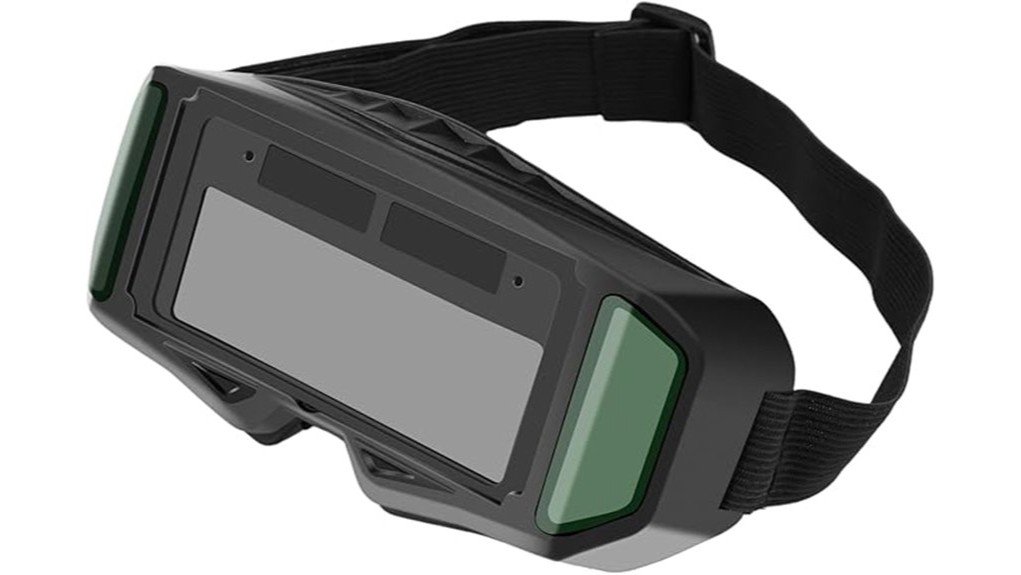
These auto-darkening welding goggles are a light, glasses-style alternative to a full helmet, aimed at quick, small jobs. They are worth considering for occasional tack welding, brazing or spot repairs where a helmet is awkward. Skip them if you weld for hours at a time, weld overhead, or cannot confirm a safety rating, because goggles give less face coverage than a helmet.
This review is based on the seller’s Amazon listing, not hands-on testing. Some listing figures conflict, so verify the details below before you rely on them.
Auto-darkening welding goggles specs at a glance
| Item | Detail |
|---|---|
| Product type | Auto-darkening welding goggles |
| Weight (per listing) | About 90 g |
| Size (per listing) | About 160 x 80 mm |
| Dark state (per listing) | Shade described as digital 11 |
| Switching speed (per listing) | Listed both as 0.1 ms and as 5/10000 s (0.5 ms), so the figure is unclear |
| Materials (per listing) | PP frame, LCD filter, PC lens, soft rubber contact area |
| Safety marking | Not confirmed, check for ANSI Z87.1 or EN379 on the product |
What these welding goggles are and who they suit
An auto-darkening filter (ADF) stays light until it detects an arc, then darkens within a fraction of a millisecond. Goggle-style units put a small filter in front of your eyes, with soft rubber against the face and an adjustable strap.
The listing describes processes such as electric (stick), gas-shielded and argon arc welding. A fixed dark shade of about 11 falls in the range commonly used for MIG and stick work at moderate amperage. It is not a one-size shade, and lower-amp TIG can call for a lighter shade while higher amperage may need a darker one, so check the filter’s own chart.
How to check the goggles are safe and a fit for your work
- Look for a safety marking. The filter or frame should show ANSI Z87.1 and/or EN379. If the listing and product do not show one, do not use it as primary arc protection.
- Confirm the shade range. A fixed shade 11 cannot be adjusted, so make sure it matches your process and amperage.
- Sort out the speed claim. The listing mentions both 0.1 ms and 5/10000 s. Ask the seller or check the product label.
- Check sensor coverage. Make sure the sensor sees the arc from your usual positions.
- Check fit over eyewear. Prescription glasses may not fit under goggles this size. Test it, and keep the return window in mind.
If you want a helmet instead, see the welding helmet review or the high-definition welding helmet review.
Pros and limitations
Pros
- Light, about 90 g per the listing, so it is easy to wear for short jobs.
- No need to flip a helmet up and down for tack welds.
- Rubber contact area and an adjustable strap are listed for comfort.
Limitations
- Goggles cover far less of the face than a helmet, so your skin and neck stay exposed to arc UV and spatter.
- A fixed shade does not suit every process, and no shade adjustment is described in the listing.
- Conflicting speed figures and no confirmed safety standard are reasons to be cautious.
- Lighter auto-darkening filters may not suit grinding, so wear separate safety glasses or a face shield for that.
Safety and care tips
Cover all exposed skin with flame-resistant clothing and wear welding gloves. Test the goggles by striking an arc on scrap with someone nearby, and stop if the lens flickers, does not darken or leaves bright light leaking in. Never look at an arc with a goggle that has failed the test.
Wipe the lens with a soft cloth and keep it out of heat and moisture. Replace the unit if the lens is cracked, scratched or the auto-darkening becomes inconsistent. Keep the sensor window clean of spatter and dust.
Alternatives and related guides
- Miller Classic Series helmet if you want a full-coverage helmet from a known brand.
- Auto-darkening welding lens if you need a replacement filter rather than goggles.
- Shade 12 welding glass lens for a fixed-shade option.
- Hobart oxy-acetylene goggles for gas welding and cutting.
Frequently Asked Questions
Are auto-darkening welding goggles as safe as a helmet?
Usually no for arc welding. A helmet protects your whole face and neck from UV, infrared and spatter, while goggles cover only the eyes. Goggles may suit short, light jobs if they carry a recognised rating such as ANSI Z87.1 or EN379.
What shade is shade 11 good for?
Shade 11 is commonly used for MIG and stick welding at moderate amperage. It can be too dark for low-amp TIG and too light for high-amp work. Check the filter manufacturer’s shade chart for your process and current.
Can I wear prescription glasses under these goggles?
The listing does not clearly confirm this. At about 160 x 80 mm they may be tight over frames. Try them with your glasses, or consider prescription safety inserts, and use the return window if they do not fit comfortably.
How do I test that the auto-darkening works?
Strike an arc on scrap metal in a safe setup and check that the lens darkens instantly without flicker or leaks. Do not point it at the sun or test it on an arc you are looking at directly. Stop using it if it fails.
Conclusion
These goggles offer a light, glasses-style way to get auto-darkening protection for short jobs, but the listing leaves open questions about the speed figure and the safety rating. Confirm the marking, match the shade to your process, and use a helmet for longer sessions.