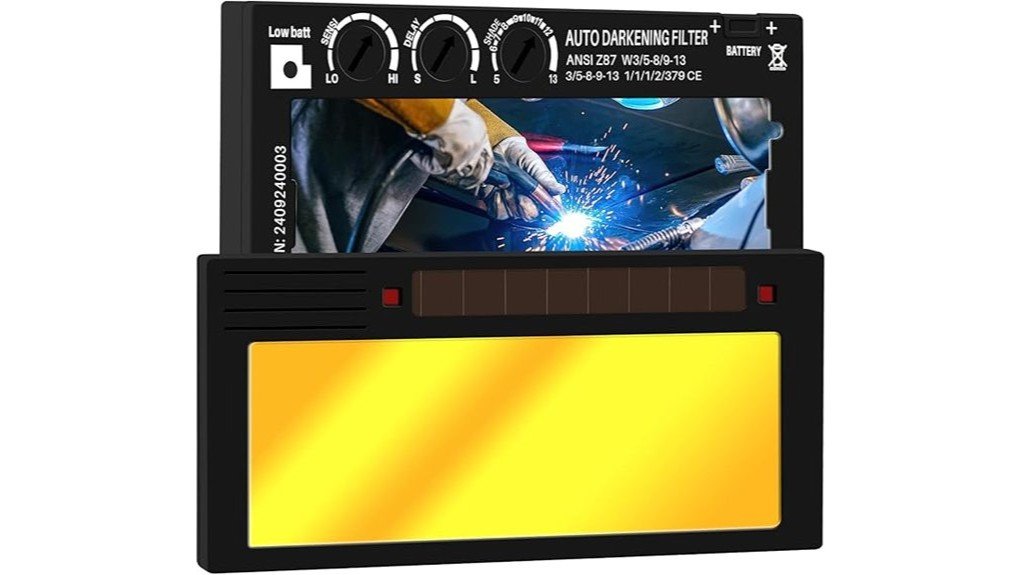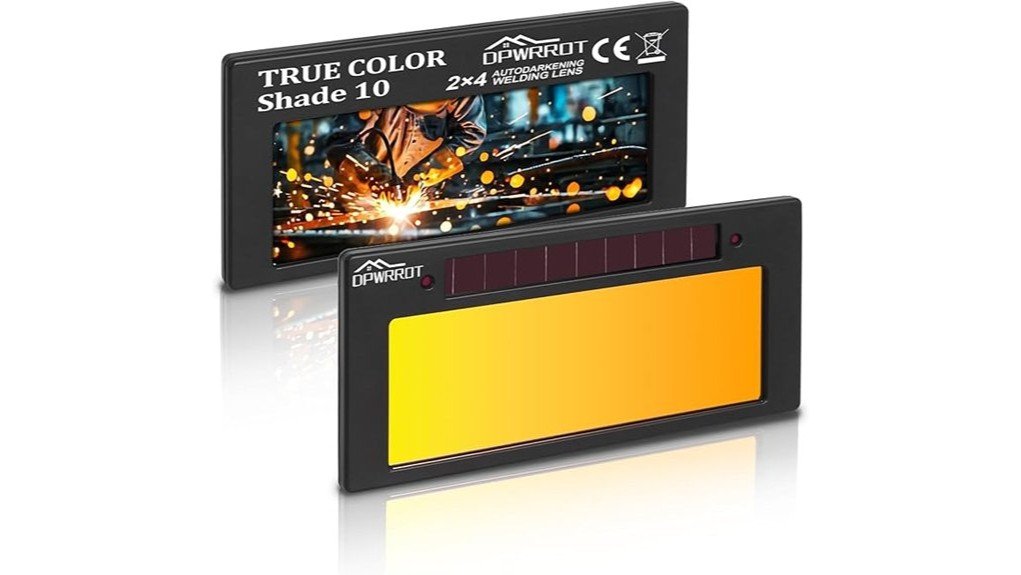
This shade 10 auto darkening lens is a solar-powered, gold-tinted replacement lens that, per the Amazon listing, switches to shade 10 when an arc starts and is marketed for “true color” viewing. Shade 10 is on the lighter side for arc welding, so it fits low to mid-current work (for example, many TIG and low-amp MIG or stick jobs) better than heavy-current work. The listing does not state the lens size, so measure your helmet before ordering. This shade 10 auto darkening welding lens has a gold tint for clearer viewing.
Shade 10 auto darkening lens at a glance
| Item | Detail |
|---|---|
| Product | Gold-tinted auto-darkening welding lens, shade 10 |
| Dark state | Shade 10, fixed, per the listing |
| Power | Solar powered, per the listing |
| Tint | Gold lens marketed for true-color viewing |
| Size | Not clearly stated in the listing; measure the cartridge window of your helmet |
| Compatibility | Described as suitable for various helmets; verify the lens size and the mounting style |
| Limits | A single dark shade; no adjustable shade, sensitivity or delay controls are described |
What a fixed shade 10 auto-darkening lens does
An auto-darkening lens is clear (a light shade such as 3 to 4) until the arc starts. Sensors then darken it to its working shade in a fraction of a second. With a fixed lens, that working shade is always the same, here shade 10, and you cannot dial it up or down.
The gold tint is intended to give a warmer, more natural color view than the old green glass. How it looks in your helmet depends on lighting, the weld and your eyes, so keep the return option in mind.
Is shade 10 right for your welding?
- Low to moderate TIG amperage: shade 9 to 11 is common, so 10 can work.
- MIG and stick at higher amperages: many welders step up to 11 to 13, so 10 may be too light.
- Plasma cutting and oxy-fuel cutting: the correct shade follows a chart for current or tip size, and fixed shade 10 may not be right.
- Bright, reflective work (aluminum, stainless) can feel more intense, so a darker lens may feel safer.
Always compare the shade to the manufacturer’s chart for your process and amperage. When in doubt, choose the darker option that still lets you see the joint, or use an adjustable-shade helmet instead.
How to check it fits and works
- Measure the opening where the cartridge sits. Listings often omit the size, so ask the seller if the page does not show it.
- Check the thickness and the way the cartridge mounts: clips, side brackets or a frame.
- Look for an ANSI Z87.1 marking or equivalent on the lens or packaging, and ask the seller if it is not stated.
- Check where the sensors and solar cell sit, and make sure the helmet does not cover them.
- Test the lens on scrap: it should darken instantly with each arc start, and not flicker or lag.
- Keep a clear cover lens in front to guard the gold surface from spatter.
Pros and limitations
Pros
- Convenient auto-darkening function for helmets that need a replacement cartridge.
- Solar-powered, so no routine battery change, per the listing.
- Gold tint aimed at better color view.
- Straightforward drop-in design if the size matches.
Limitations
- Fixed shade 10 does not suit heavy-current work.
- Size and brand details are limited in the listing.
- Without sensitivity and delay controls, it may not suit low-amp TIG as well as an adjustable cartridge.
- Solar-powered units can be slower to respond if light is poor or sensors are blocked.
Safety and care
- Stop welding at once if the lens fails to darken, flickers or stays light.
- Keep sensors clean. Dust or spatter blocking them can delay switching.
- Use a cover lens and replace it when pitted.
- Store the cartridge out of direct sun, and avoid extreme heat in a parked vehicle.
- Wear a respirator or ventilate for fumes, since an auto-darkening lens only protects your eyes from light.
Alternatives and related guides
- Shine 2×4 auto-darkening lens – a lens with a stated size to compare
- Shade 12 welding glass lens – a darker fixed lens for higher current
- TRQWH shade 12 lens – another darker shade option
- Auto-darkening welding goggles – goggles if you do not use a hood
Frequently Asked Questions
Is shade 10 dark enough for welding?
It depends on your process and current. Shade 10 is commonly used for low to mid amperage TIG, while MIG and stick at higher current often use shade 11 to 13. Check the shade chart and use a darker option if the arc feels uncomfortable.
Is this lens adjustable?
The listing describes a fixed shade 10 and does not describe sensitivity, delay or shade controls. If you need adjustable settings, look for a cartridge that lists a variable shade range and controls.
What does a gold welding lens do?
The gold tint is meant to give a warmer, more natural color view of the weld and surroundings than older green filters. The shade number and the protection rating still decide how safe the lens is, not the tint.
Does a solar-powered lens need batteries?
Many solar-assisted lenses run on light from the arc and ambient light, and some also have a small battery. The listing calls this one solar powered, so check for details on the page and test the lens before each session.
Conclusion
This shade 10 gold lens is a convenient auto-darkening replacement for lower to moderate current welding, provided you can confirm the size. If you weld at higher amperages, consider a darker or adjustable lens.