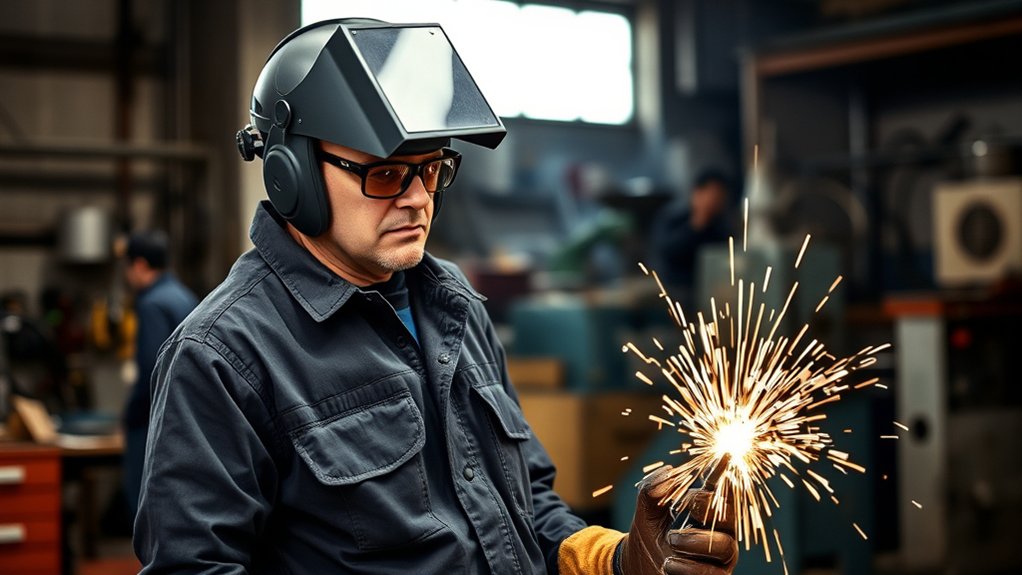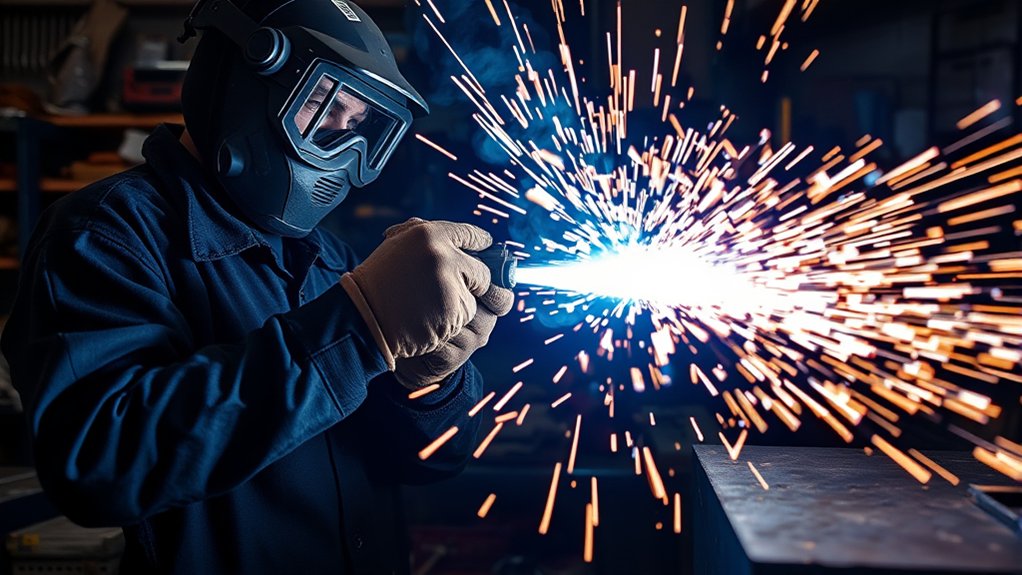
Plasma cutting creates intense visible light, ultraviolet radiation, hot sparks, and flying metal. The correct plasma cutting lens shade must match the arc current, your equipment manual, and any workplace safety rules that apply. The chart below separates ANSI/AWS minimum protective shades from darker comfort recommendations so you can protect your eyes without losing sight of the cut line.
Quick Answer
ANSI Z49.1:2021 lists minimum shades 4 under 20 amps, 5 at 20–40 amps, 6 at 40–60 amps, 8 at 60–300 amps, 9 at 300–400 amps, and 10 at 400–800 amps. Suggested comfort shades increase to 9, 12, and 14 above 80 amps. Always follow your cutter manual and workplace requirements.
Key Takeaways
- Do not use one blanket shade recommendation for every current above 80 amps.
- ANSI/AWS publishes both a minimum protective shade and, at higher currents, a darker suggested comfort shade.
- OSHA’s workplace table differs from the ANSI/AWS chart when the plasma arc is clearly visible.
- Use full-face protection that is rated for plasma arc cutting, with impact-rated safety glasses underneath where required.
- An auto-darkening helmet must have the correct cutting-shade range. Never plasma cut while the lens is in grind mode.
At a Glance
| Time Required | About 2–5 minutes before cutting |
| Difficulty | Easy, but safety-critical |
| Tools Needed | Plasma cutter manual, amperage setting, correctly rated helmet or shield, and impact-rated safety glasses |
| Cost | No added cost when your existing PPE has the required shade and ratings; otherwise, cost varies by protector type |
Importance of Choosing the Right Lens Shade
The right lens shade performs two jobs at once. It limits the intense visible light and radiant energy reaching your eyes while allowing you to see the torch position, workpiece, and cut line.
A filter that is too light may leave you exposed to hazardous arc radiation. A filter that is much darker than necessary can hide the work, encourage poor torch control, and make nearby hazards harder to see.
A NIOSH evaluation of plasma arc cutting measured optical radiation above safe levels for the unprotected eye in ultraviolet and visible-light ranges. The evaluation also found that a welding curtain reduced exposure to the operator and other people in the area.
Plasma arc light can exceed safe exposure levels for an unprotected eye, so the shade lens and the surrounding face protection both matter.
Warning: Never watch a plasma arc through ordinary sunglasses, clear prescription glasses, a camera screen, or an unrated face shield. These do not replace a correctly marked filter lens and suitable eye-and-face protection.
Recommended Shade Numbers for Plasma Cutting
Choosing the correct lens shade is one part of complete eye protection and visibility during plasma cutting. The helmet, shield, and underlying safety eyewear must also match the hazards.
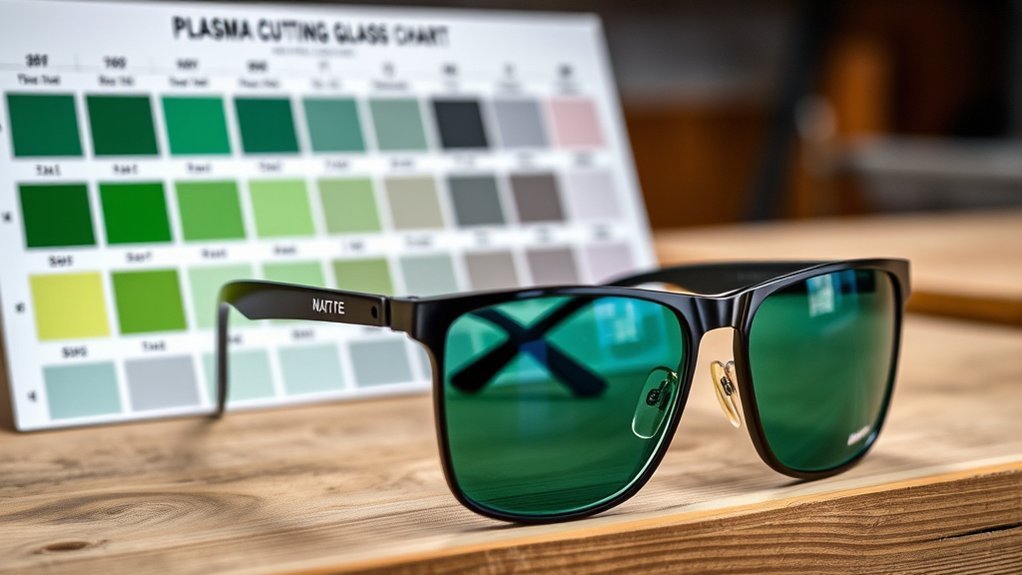
The following chart reproduces the plasma arc cutting ranges in ANSI Z49.1:2021, Table 1. “Minimum protective shade” and “suggested comfort shade” are not interchangeable terms.
| Plasma Arc Current | ANSI/AWS Minimum Shade | Suggested Comfort Shade | Practical Guidance |
|---|---|---|---|
| Under 20 amps | 4 | 4 | Use only when your manual and applicable workplace rules permit this shade. |
| 20–40 amps | 5 | 5 | A common low-current cutting range, but full-face and impact protection still matter. |
| 40–60 amps | 6 | 6 | Confirm that an auto-darkening helmet includes a cutting range that reaches shade 6. |
| 60–80 amps | 8 | 8 | Use a helmet or protector approved for the process and current. |
| 80–300 amps | 8 | 9 | Shade 9 is the ANSI/AWS comfort suggestion even though shade 8 is the listed minimum. |
| 300–400 amps | 9 | 12 | Industrial cutting at this current needs equipment specifically rated for the job. |
| 400–800 amps | 10 | 14 | Use the machine manufacturer’s instructions and the site-specific PPE program. |
ANSI/AWS advises starting with a shade that is too dark to see the work zone. Move to a lighter setting only until you can see adequately, and never go below the applicable minimum.
Note: Plasma arc cutting and plasma arc welding are different processes. Plasma arc welding uses a separate shade chart and generally requires darker filters at comparable currents. Verify which process your equipment performs before selecting a shade.
Understanding Lens Shade Standards
Lens shade numbers are calibrated filter levels, but the number alone does not tell you which rule applies. The most useful sources serve different purposes:
- ANSI Z49.1:2021: The American Welding Society’s consensus standard provides minimum protective and suggested comfort shades for welding and cutting processes. It is a voluntary consensus standard unless a law, contract, employer, or other authority adopts it.
- OSHA 1910.133: OSHA requires covered employers to provide eye and face protection against flying particles, molten metal, and injurious light radiation. Its plasma-cutting table lists minimum shades of 8 below 300 amps, 9 at 300–400 amps, and 10 at 400–800 amps when the actual arc is clearly seen.
- OSHA 1910.252: In covered general-industry workplaces, helmets or hand shields are required during arc welding and arc cutting. The protector must shield the face, neck, and ears from direct radiant energy.
- ANSI/ISEA Z87.1: This standard addresses the performance and markings of eye-and-face protectors. It does not replace the process-specific shade chart in ANSI Z49.1.
- Your equipment manual and workplace PPE assessment: These may require a specific protector, shade, or operating mode based on the machine, torch, material, arc visibility, and work environment.
OSHA’s eye and face protection standard notes that its plasma-cutting shade values apply where the actual arc is clearly seen. It also notes that lighter filters may sometimes be used when the workpiece hides the arc. That qualification should be applied through a proper workplace hazard assessment, not by guessing during a cut.
Warning: Employees should not choose a lower shade solely because an online chart lists it. Follow the employer’s PPE assessment, the machine manual, and the highest applicable safety requirement.
How to Choose the Correct Plasma Cutting Shade
- Confirm the process. Make sure you are performing plasma arc cutting rather than plasma arc welding or another arc process.
- Read the plasma cutter manual. Find the manufacturer’s eye-and-face protection section and any machine-specific shade recommendation.
- Check the actual cutting current. Use the amperage selected for the cut, not merely the machine’s maximum advertised output.
- Identify the rules that apply. In a workplace, follow the employer’s hazard assessment and OSHA requirements. In a personal shop, use the manual and recognized consensus guidance.
- Start dark and adjust carefully. Begin with a darker suitable shade, then lighten only enough to see the work without dropping below the applicable minimum.
- Verify the complete protector. Check the filter shade, impact rating, face coverage, side protection, cover lenses, and auto-darkening operation before striking the arc.
Pro Tip: Write the correct cutting-mode and shade settings inside your helmet bag or near the plasma cutter. Recheck them whenever you change amperage, helmets, lenses, or operators.
Products Worth Considering

FASTER AUTO DARKENING - Equipped with high-end auto-darkening lenses and four premium arc sensors, the switching time from light to dark is 1/25000 seconds. The lens brightness and sensitivity can be easily adjusted for different working environments, making it ideal for TIG/MIG/ARC welding and grinding. DIN4 on light state, DIN5-9/9-13 on dark state.

LED Lighting: Equipped with LED lights, so that you can get plenty of light when welding.

Automatic Darkening Design: Experience enhanced safety with our welding goggles' automatic dimming feature. Instant darkening upon arc generation protects your eyes from intense light, ensuring a safer welding experience.
Comparing Different Types of Protective Eyewear
The shade number is only part of the selection. Your protective equipment must also cover the face and resist the impact hazards created by sparks, slag, and flying metal.
Products Worth Considering

【True Color & Optical Clarity】Experience unmatched clarity with our True Color welding helmet, featuring optical class technology. The advanced golden lens eliminates distortion and color saturation, delivering a lifelike view of your weld pool and workpiece for precision in TIG, MIG, Stick, Cut, and Grind tasks.
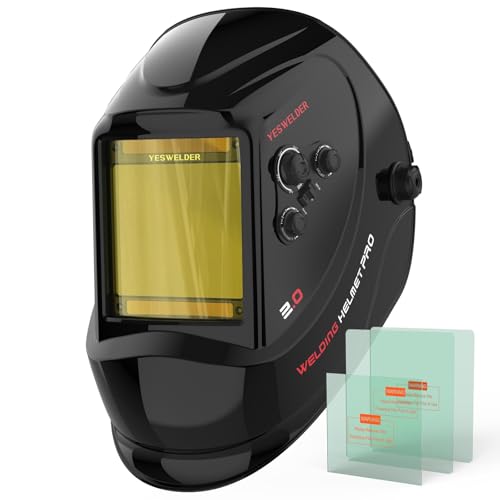
LARGE VIEW WITH TRUE COLOR CLARITY: See more of the weld puddle, joint edges, and work position through a wide 3.93" x 3.66" viewing area. The 1/1/1/1 true-color optical clarity provides a clearer, more natural view than traditional green-tinted lenses, helping support better visibility for detailed welding, fabrication, and garage projects.

【Upgraded version】The shading level at 9, ONLY suitable for ARGON ARC and GAS SHIELDED welding. Welding machine using high molecular polymers, the molecular structure of polycarbonate does not change under high temperature conditions.
Types of Protective Eyewear
- Welding helmets: A properly rated helmet is the most practical full-face option for plasma arc cutting. It protects the eyes, face, forehead, and much of the neck from arc radiation and hot debris. In OSHA-covered general-industry work, helmets or hand shields are required for arc-cutting operations.
- Purpose-built plasma cutting shields: Some manufacturers offer full-face shields designed for lower-current plasma cutting. Use one only when its filter shade, impact rating, coverage, and manufacturer instructions match the task and applicable workplace rules.
- Filter goggles or shaded spectacles: These may provide rated eye filtering for certain low-current applications, but they leave more of the face and skin exposed. They are not a universal substitute for a helmet during arc cutting.
- Clear safety glasses: Wear impact-rated safety glasses with side protection underneath the helmet or shield when required by the equipment instructions or workplace PPE program. They continue protecting your eyes when the helmet is raised.
Hypertherm, for example, identifies its shade-5 flip-up eye shades for plasma cutting below 40 amps. That is a product-specific recommendation, not permission to ignore full-face hazards or workplace rules.
Eye Safety Standards Compliance
Check the permanent markings on the lens and frame rather than trusting packaging language alone. OSHA requires covered eye-and-face protectors to comply with specified ANSI Z87.1 editions or to provide demonstrably equivalent protection.
- Look for the manufacturer identification and applicable Z87 marking.
- Use side protection where flying particles are a hazard.
- Do not rely on ordinary prescription glasses as safety glasses.
- Use a prescription safety protector or a helmet and eye protection that fit over your prescription lenses without disturbing either pair.
- Confirm that replacement cover lenses, filters, and cartridges are approved for your protector.
People with unusual eye sensitivity or an existing eye condition should ask a qualified eye-care professional about additional protection. They should not compensate by using a shade below the required minimum.
Tips for Ensuring Proper Eye Protection
Inspect your eye-and-face protection before every cutting session. Damage that blocks your view, weakens impact protection, exposes the filter, or interferes with auto-darkening operation is a reason to stop and correct the problem.
- Clean the viewing area: Remove dust and residue with the cleaning method approved by the manufacturer. Do not use solvents or abrasive products unless the manual permits them.
- Inspect the cover lenses: Replace covers that are cracked, badly scratched, pitted, warped, cloudy, loose, or covered with spatter that cannot be removed safely.
- Inspect the shell and headgear: Check for cracks, damaged retainers, missing parts, and a fit that leaves the face or neck unnecessarily exposed.
- Verify the shade: Cross-check the cutting current, process, manual, and applicable shade table before starting.
- Check markings: Confirm that lenses and frames still carry readable manufacturer and safety markings.
- Protect nearby people: Use suitable curtains, screens, or barriers and prevent unprotected people from viewing the arc.
Do Passive Shade Lenses Expire?
Passive filter lenses do not have one universal expiration date. Replace them according to the protector manufacturer’s instructions and whenever damage, haze, pitting, contamination, poor fit, or reduced visibility makes safe use uncertain.
A superficial mark does not automatically mean that the shade number has disappeared, but a damaged lens or cover can impair vision, expose other components, or weaken impact protection. When in doubt, replace the affected approved part rather than attempting a repair.
Auto-Darkening Helmet Checks
An auto-darkening helmet must include a shade range suitable for plasma cutting. Many welding-only filters begin at shade 8 or 9 and may not provide the lower cutting shades used for low-current work.
- Select the helmet’s designated cut mode when the manual calls for it.
- Never cut in grind mode. On many helmets, grind mode disables automatic darkening.
- Test the lens using the manufacturer’s test procedure before cutting.
- Clean the arc sensors and make sure the torch or work position does not block them.
- Adjust sensitivity only as directed by the manual.
- Replace weak batteries or other service parts when indicated.
- Stop immediately if the filter flickers, fails to darken, changes shade unexpectedly, or remains too light.
Warning: Do not continue cutting to “test” an auto-darkening filter that fails to switch correctly. Stop, move the torch to a safe condition, and troubleshoot the helmet according to its manual.
Expert Insights on Plasma Cutting Safety
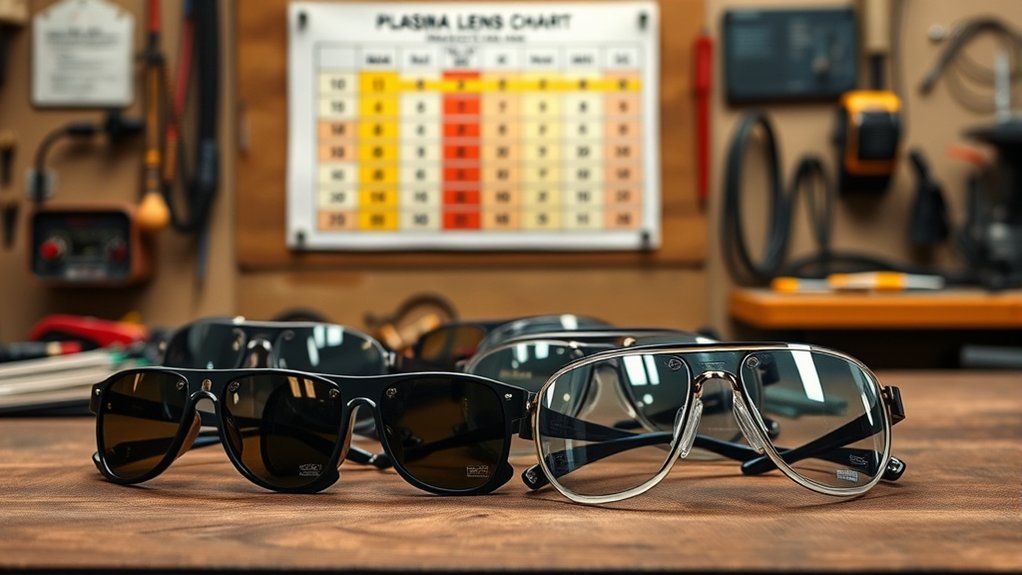
Lens shade selection is the starting point, not the complete safety system. Plasma arc cutting can expose the operator and nearby people to optical radiation, flying particles, sparks, hot metal, fumes, electric shock, and noise.
Essential Safety Gear
- Rated helmet or face protector: Use equipment designed for the process, current, arc visibility, and workplace conditions.
- Impact-rated eye protection: Wear suitable safety glasses with side protection beneath the helmet when required.
- Skin and clothing protection: Cover exposed skin with appropriate flame-resistant clothing, gloves, and footwear.
- Hearing protection: Use approved hearing protection when noise levels require it.
- Ventilation: Control fumes at the source and follow the material-specific and workplace ventilation requirements.
- Barriers for other people: Use suitable curtains or screens and keep unprotected observers away from the arc.
Proper Lens Selection
Use the following order when two sources appear to give different answers:
| Priority | Source | How to Use It |
|---|---|---|
| 1 | Applicable law and workplace PPE assessment | Follow enforceable requirements and the protection selected for the site-specific hazard. |
| 2 | Plasma cutter and protector manuals | Follow model-specific limits, approved equipment, modes, and maintenance instructions. |
| 3 | ANSI/AWS shade guide | Use the exact amperage range and distinguish the minimum shade from the comfort suggestion. |
| 4 | Personal comfort adjustment | Choose a darker shade when needed, but never go below the applicable minimum to improve visibility. |
If a shade is too dark to see the line, first confirm that the cover lens is clean, the work is adequately lit, the helmet is in cut mode, and the selected shade is correct for the current. Do not solve poor visibility by dropping below the minimum.
If an auto-darkening filter does not trigger reliably, stop cutting. Clean the sensors, verify the mode and sensitivity, check the battery, and make sure the torch position is not blocking the arc from the sensors. Replace or service the unit if the problem continues.
Frequently Asked Questions
Can a plasma cutting lens shade be too dark?
Yes. An unnecessarily dark shade can hide the cut line, torch position, and nearby hazards. Start with a darker appropriate shade and lighten it only until the work is visible, without going below the applicable minimum shade.
How do lens shades affect color perception during cutting?
Filter lenses reduce and alter the visible light reaching your eyes, so materials, markings, and hot areas may look different through different filters. Choose a compliant shade that still provides enough contrast to follow the cut line.
Are adjustable lens shades available for different plasma cutter amperages?
Yes. Some auto-darkening helmets include dedicated cutting shades such as 5–8 as well as darker welding ranges. Confirm that the helmet’s range includes the shade you need, select its cutting mode, and test the filter before use. Grind mode is not a cutting mode.
Do plasma cutting lenses expire or degrade over time?
There is no universal expiration date for every passive filter lens. Replace a lens, cover, or auto-darkening cartridge when required by the manufacturer or when it is cracked, pitted, badly scratched, cloudy, contaminated, loose, or malfunctioning. Test electronic filters and maintain their batteries and sensors as directed.
Can prescription glasses be used while plasma cutting?
Yes, but ordinary prescription glasses are not a substitute for safety eyewear. Use prescription safety lenses or protective equipment that fits over your glasses without shifting the prescription lenses or the protective filter.
Can I use shade 5 safety glasses alone for low-amperage plasma cutting?
Some manufacturers rate shade-5 eye shades for specific low-current plasma cutters, but shaded glasses do not protect the whole face and neck. Follow your cutter manual and workplace rules. OSHA-covered general-industry arc cutting requires a helmet or hand shield.
Why do the OSHA and ANSI plasma cutting shade charts differ?
They have different scopes and table structures. ANSI Z49.1:2021 gives detailed current ranges with minimum and suggested comfort shades. OSHA’s workplace table groups plasma cutting into broader ranges and includes a qualification based on whether the actual arc is clearly visible. Employees should follow their employer’s hazard assessment and the highest applicable requirement.
Conclusion
The correct plasma cutting lens shade depends on more than a single cutoff point. ANSI Z49.1:2021 lists minimum shades of 4 under 20 amps, 5 at 20–40 amps, 6 at 40–60 amps, 8 at 60–300 amps, 9 at 300–400 amps, and 10 at 400–800 amps. Its suggested comfort shades rise to 9, 12, and 14 in the three ranges above 80 amps.
Use those values together with your plasma cutter manual, protector instructions, and applicable workplace requirements. Wear suitable full-face protection, keep impact-rated eye protection underneath where required, inspect every component before use, and never operate an auto-darkening lens in grind mode while cutting.
Sources
- ANSI Z49.1:2021 — Safety in Welding, Cutting, and Allied Processes — minimum and suggested plasma arc cutting shade numbers
- OSHA 29 CFR 1910.133 — Eye and Face Protection — radiant-energy filter shades, side protection, prescription eyewear, and protector criteria
- OSHA 29 CFR 1910.252 — Welding, Cutting, and Brazing Requirements — helmet, hand-shield, face, neck, and arc-radiation requirements
- NIOSH Evaluation of Optical Radiation Hazards From Plasma Arc Cutting — measured radiation exposure and the benefit of welding curtains
- Hypertherm Flip-Up Eye Shades — manufacturer example of shade-5 eye shades for plasma cutting below 40 amps
- Miller Auto-Darkening Helmet Manual — cut mode, grind-mode warning, sensitivity, delay, and operational checks