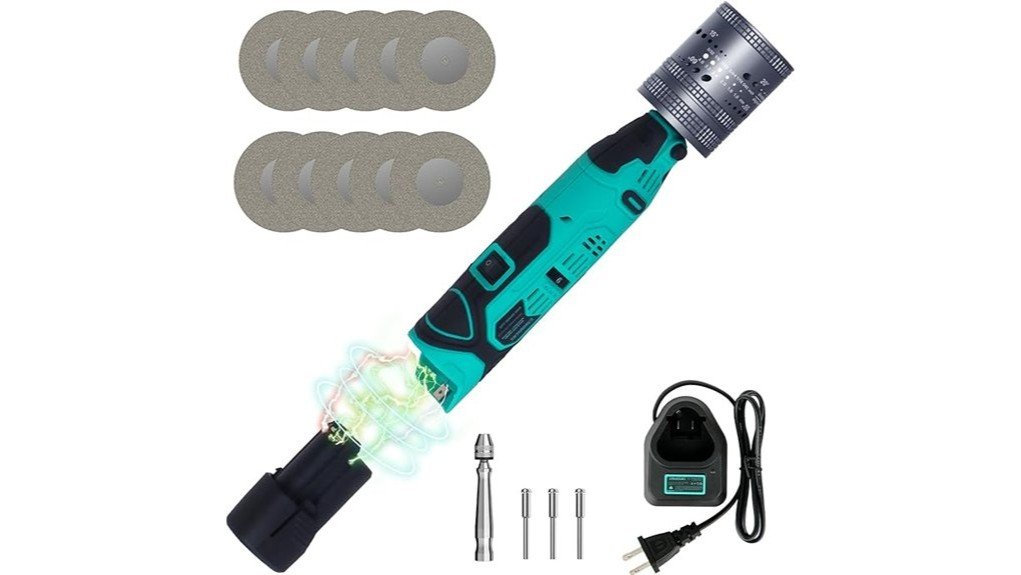
This cordless tungsten sharpener is a small handheld grinder for putting a consistent point on TIG tungsten electrodes without running a bench grinder. Per the listing it uses diamond wheels with preset angles from 7.5 to 60 degrees and several electrode sizes. It suits mobile or small-shop TIG welders who want repeatable points; skip it if you only sharpen a rod occasionally and already have a dedicated tungsten grinder.
Cordless tungsten sharpener at a glance
| Item | What the listing says |
|---|---|
| Type | Cordless handheld tungsten electrode sharpener |
| Grinding angles | Ten angles, 7.5 to 60 degrees |
| Wheels | Diamond wheels (listing mentions ten) with CNC mandrels (three) |
| Electrode sizes | Several sizes via fixed holes (listing text mentions six) |
| Size | About 2.16 x 2.16 x 2.75 in |
| Weight | Listed as 4 lb; confirm on the listing, as the compact size suggests a lighter unit |
| Power | Battery; check the listing for battery type and charging method |
All figures come from the seller’s Amazon listing and have not been independently measured. Confirm the wheel and mandrel count, battery details and bundled accessories before you buy.
What it is and who it suits
A tungsten sharpener holds the electrode in a fixed hole at a set angle against a spinning diamond wheel. That removes most of the guesswork of freehand grinding. The point needs to be ground lengthwise so the arc stays stable and the tip does not wander.
The cordless format is the main selling point:
- Mobile and field welders can sharpen at the job site with no outlet.
- Small shops get a tool that stores in a drawer rather than taking bench space.
- Beginners benefit from fixed holes and preset angles instead of eyeballing a point.
How to check it fits your setup
- Electrode diameters: List the tungsten sizes you use (for example 1/16, 3/32 and 1/8 inch, or 1.6, 2.4 and 3.2 mm) and confirm each has a matching hole.
- Angle range: Low-amp work often uses a longer, sharper taper and high-amp DC work a shorter one. Confirm the preset angles cover what you weld at.
- Tungsten type: Diamond wheels suit common types, but thoriated tungsten (red) is mildly radioactive and its grinding dust should be controlled. Many welders now prefer ceriated, lanthanated or rare-earth types.
- Power and runtime: Check battery type, charge time and whether a charger is included. Look at the stated figures rather than assuming a runtime.
- Replacement parts: Find out whether spare wheels or mandrels are sold separately. The tungsten sharpener grinder head review covers a replacement-style option.
Pros and limitations
Pros
- Cordless and compact, so it works anywhere.
- Preset angles and fixed holes make repeatable points easier.
- Diamond wheels are the right abrasive for hard tungsten.
Limitations
- Battery runtime is limited, so check the stated figures before relying on it for a long session.
- It is built for tungsten only. Using it on other metals will clog or damage the wheel.
- A small tool leaves little room for error with dust; it does not collect or filter it for you.
- Not a replacement for a full bench setup if you sharpen dozens of electrodes per day.
How to sharpen tungsten safely
- Wear safety glasses and keep the work area clear of flammable material.
- Insert the electrode into the matching hole and press lightly against the wheel. Let the tool do the cutting.
- Rotate the electrode as you grind if the design allows, so the point is even and the grind marks run along the length.
- Do not quench a hot electrode in water. Let it cool in air.
- Wipe dust off the wheel and body, and use local extraction or a respirator when grinding thoriated or large quantities of tungsten.
- Store the tool dry. Charge and store the battery as the maker advises, away from heat.
Dust from grinding tungsten should not be blown around the shop. Wipe it up with a damp cloth.
Alternatives and related guides
- A different style of unit is the Sonnler tungsten sharpener grinder.
- If you would rather not grind at all, the pre-ground TIG tungsten electrodes arrive ready to use.
- For a specific electrode type, see the blue 3/32 tungsten electrode review.
- Keep points stable with the right holder in the Nexon tungsten electrode holder review.
Frequently Asked Questions
Can I use this sharpener on materials other than tungsten?
It is designed for tungsten electrodes. Grinding other metals on a diamond wheel can clog or wear it quickly, and the preset holes only suit electrode diameters. Use a normal grinder or file for other work and keep this tool for tungsten.
How long does the battery last?
The listing is the only source for this, and it may not state a runtime. Check the battery type and charge time on the listing. For a few electrodes per session it is usually enough, but heavy use may need recharging.
Should I grind tungsten lengthwise or across?
Grind lengthwise so the scratches run along the electrode toward the tip. This helps keep the arc stable and focused. Grinding across the electrode leaves rings that can make the arc wander and the tip wear unevenly.
Is thoriated tungsten safe to grind?
Thoriated tungsten (red) is mildly radioactive, and grinding dust should be controlled with extraction and a respirator. Many welders choose ceriated, lanthanated or rare-earth electrodes instead, which are generally preferred for dust and handling concerns.
Verdict
A cordless tungsten sharpener is convenient and gives repeatable angles, provided the hole sizes match your electrodes and you accept battery limits. Confirm the specs on the listing, then use it with eye protection and sensible dust control.