As an Amazon Associate, Garage Welding may earn from qualifying purchases. This does not change the price you pay.
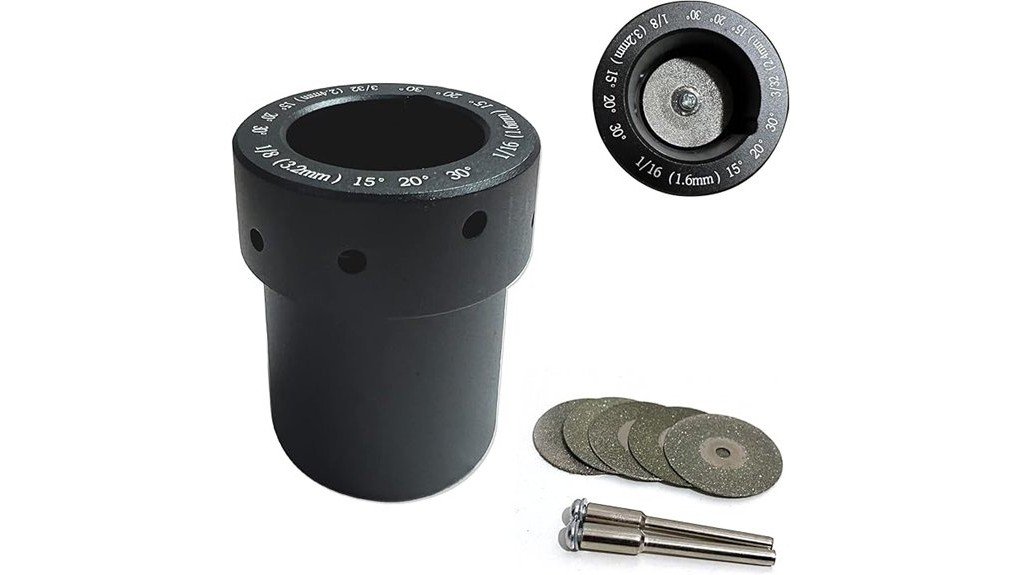
The tungsten sharpener grinder head is not a stand-alone tool. It is an aluminum attachment with diamond wheels and a guide block that fits on a compatible electric rotary tool and turns it into a TIG tungsten sharpener with 15, 20 and 30 degree angles. It suits welders who already own a rotary tool and want repeatable points on a budget. Skip it if your tool does not match the listing’s thread size, or you want a ready-to-use cordless unit.
Tungsten sharpener grinder head at a glance
| Item | What the listing says |
|---|---|
| Type | Add-on sharpener head for electric rotary tools |
| Body | CNC-machined aluminum with diamond wheels |
| Angles | 15, 20 and 30 degrees |
| Electrode sizes | 1/16, 3/32 and 1/8 in (1.6, 2.4, 3.2 mm); listing text mentions a 9-hole setup |
| Tool mounting | 3/4-12 thread (about 18 mm) according to the listing |
| Size and weight | About 3.27 x 2.44 x 2.05 in, 4.6 oz |
These figures come from the seller’s listing. Always confirm the mounting thread against your own tool before ordering.
Check Current Price on Amazon →
What it is and who it suits
A grinder head holds the tungsten in an angle guide so the electrode meets the diamond wheel at a fixed angle. You get the same taper each time without freehand grinding. The offset design lets you change angle without taking the head apart, according to the listing.
It tends to suit:
- Hobbyists with a rotary tool who sharpen a few electrodes per session.
- Welders who prefer a modular setup over a dedicated sharpener.
- Students learning consistent tungsten preparation.
How to check it fits your tool
Compatibility is the whole story with an attachment like this. Work through these points.
- Thread and nose: The listing mentions a 3/4-12 (18 mm) thread. Look at your rotary tool’s front end and compare it to this figure. Do not assume a tool brand name alone guarantees a fit, as models within the same brand differ.
- Tool speed: Keep the tool’s no-load speed within the wheel’s rated speed. If the listing does not state a wheel rating, run the tool at a modest speed.
- Corded versus cordless: Confirm the tool has enough torque and a safe grip for holding the head and the electrode.
- Electrode diameter: Make sure each tungsten size you use has a hole. Sizes outside 1/16 to 1/8 inch will not fit.
- Angle needs: 15, 20 and 30 degrees cover a range of tapers. If you want a very steep or very blunt point, a different tool may suit you better.
Pros and limitations
Pros
- Cheaper than a dedicated sharpener if you already own a tool.
- Small and light, simple to store.
- Fixed angles improve repeatability.
Limitations
- Fit depends entirely on your rotary tool, and not all tools will mount it.
- Buyers commonly question how long small diamond wheels last, so check the listing for spare wheels.
- Only three angles, with no fine adjustment.
- It sharpens tungsten only.
How to use it safely
- Wear safety glasses. Tungsten dust and fragments can fly.
- Mount the head securely and check nothing rubs before switching on.
- Choose the angle, insert the electrode into the correct hole and bring it to the wheel with light pressure.
- Grind lengthwise so the finish lines run toward the tip.
- Use extraction or a dust mask when grinding. Thoriated (red) tungsten is mildly radioactive and its dust should be controlled.
- Brush off the wheels after use and store the head dry.
Alternatives and related guides
- For a ready-made cordless option, see the cordless tungsten electrode sharpener.
- Another stand-alone option is the Sonnler tungsten sharpener grinder.
- To skip sharpening altogether, the pre-ground TIG tungsten electrodes are ready to use.
- For a different tungsten type, read the blue 3/32 tungsten review.
Frequently Asked Questions
Which rotary tools does this grinder head fit?
The listing mentions a 3/4-12 (about 18 mm) thread and names several brands, but models within a brand differ. Compare the thread and nose of your own tool with the listing, and check the questions section on the product page before ordering.
What angles does it grind?
The listing gives three preset angles: 15, 20 and 30 degrees. Choose according to your welding current and electrode size. If you need other tapers, you may prefer a sharpener with more angle options or a bench grinder with a tungsten guide.
How long do the diamond wheels last?
It depends on how many electrodes you sharpen and how hard you press. Small diamond wheels wear with use, so light pressure and cleaning help. Check whether spare wheels are sold, and treat the wheels as a consumable part.
Can I use this head to sharpen things other than tungsten?
It is designed for tungsten electrodes in fixed-size holes. Using it on other metals can clog or damage the diamond coating, so keep it for TIG electrodes and use a standard grinder for other work.
Verdict
The tungsten sharpener grinder head is a sensible, low-cost way to get consistent points if its mounting thread matches your rotary tool. Check the thread, the electrode sizes and the angles first, then sharpen with eye protection and dust control.
View This Grinder Head on Amazon →
Check Current Price and Availability →