Disclosure: As an Amazon Associate, we earn from qualifying purchases. If you click a link on this page and make a purchase, we may receive a small commission at no extra cost to you.
Learning to weld is easier when you can repeat the same joint without wasting time cutting scrap for every attempt. The 24-Piece Welding Practice Kit gives you a ready-made set of 16-gauge low-carbon mild-steel coupons for practicing MIG, TIG, Stick, and laser welding techniques. Its biggest advantage is convenience: you can focus on fit-up, tacks, bead placement, and heat control instead of preparing raw stock. The main limitation is equally clear, 24 pieces can disappear quickly if you practice often, and 16-gauge material still demands careful heat control.
Quick Verdict
Rating: Recommended with caveats
Best For: Beginners, hobby welders, vocational students, and DIY users who want pre-cut mild-steel practice pieces.
Bottom Line: This kit removes much of the cutting and setup work from basic welding practice and gives you several shapes for joint exercises. It is less attractive if you need thick plate, large quantities, or a reusable long-term training fixture.
| Specification | Detail |
|---|---|
| Product type | Welding practice coupon kit |
| Quantity | 24 pieces |
| Material | Low-carbon mild steel |
| Thickness | 16 gauge, about 0.06 inch |
| Listed plate sizes | 5 x 3 in window-style, 4 x 2 in solid, 3 x 3 in window-style, and 2 x 2 in solid |
| Supported practice processes | MIG, TIG, Stick, and laser welding |
| Typical exercises | Tack welds, fillet-style joints, angle joints, bead practice, and small assemblies |
| Best use | Beginner practice, classroom demonstrations, and hobby skill-building |
| ASIN | B0DSMCLW7W |
Key Takeaways
- You get 24 pre-cut 16-gauge mild-steel pieces, so you can spend more time welding and less time cutting practice stock.
- The roughly 0.06-inch thickness is useful for learning heat control because it is thick enough for repeated drills but still thin enough to expose poor settings or slow travel speed.
- The listed shapes and sizes support tack welds, fillet-style joints, angle joints, and small assemblies instead of only straight bead practice.
- The kit is intended for MIG, TIG, Stick, and laser welding practice, making it flexible for a home shop or training environment.
- It is a consumable practice set, not a substitute for thicker certification coupons, production material, or a complete welding safety setup.
What Is the 24-Piece Welding Practice Kit?
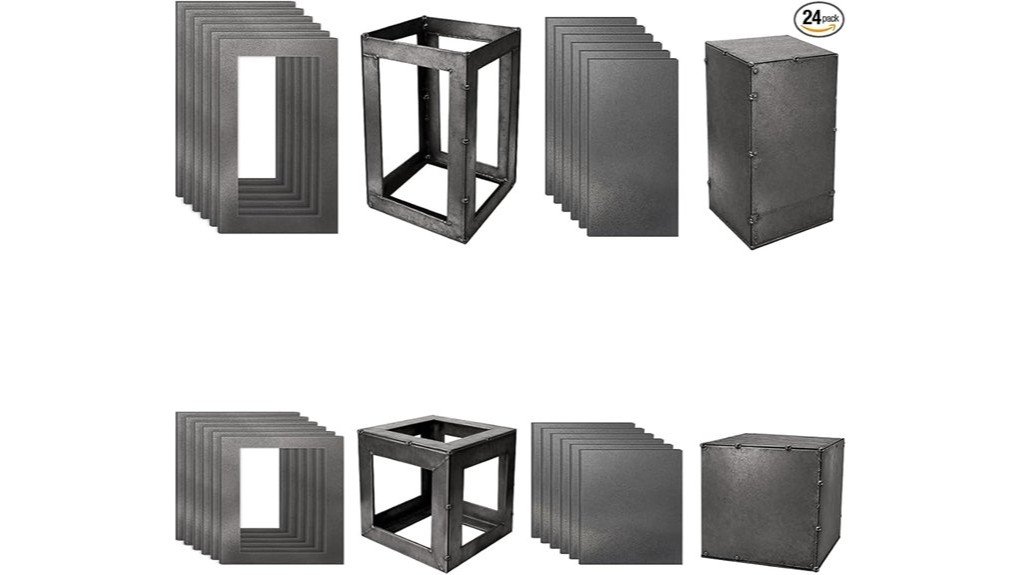
This is a pre-cut mild-steel practice set designed to give you consistent pieces for welding drills. Current product data lists 24 pieces made from 16-gauge, approximately 0.06-inch low-carbon mild steel, with multiple solid and window-style plate shapes.
Listings describe the pieces as laser-cut and include engraved separation lines on some sections. That can reduce preparation time and make it easier to move from basic beads to fit-up and small joint exercises. You still need to inspect each piece before welding and remove any oil, coating, rust, or contamination that could affect the weld.
The kit makes the most sense when your goal is repetition. You can practice the same type of tack, corner, or fillet several times and compare how travel speed, torch angle, arc length, or machine settings change the result.
Who Should Buy It?
Best For
- Beginners who want consistent steel pieces for repeated welding drills.
- DIY and hobby welders who do not want to cut every practice coupon from sheet stock.
- Students or instructors who need a compact set for basic joint and bead exercises.
Skip If
- You need thick plate for certification-style testing or heavy fabrication practice.
- You weld every day and would burn through a 24-piece supply very quickly.
- You want stainless steel, aluminum, or mixed-metal coupons instead of mild steel.
Before You Buy: Check the selected Amazon variant and package details before ordering. Retailer listings have shown more than one configuration, and this review focuses on the 24-piece, 16-gauge low-carbon steel practice kit tied to ASIN B0DSMCLW7W.
Build Quality and Materials
The core material is 16-gauge low-carbon mild steel. That is a practical training material because it is common, easy to source filler and settings for, and thin enough to make heat control part of the lesson. It is not truly burn-through proof. If your amperage, voltage, wire feed, arc length, or travel speed is poorly matched, you can still overheat the edge or blow a hole through the coupon.
The benefit of pre-cut coupons is consistency. When several pieces start at the same thickness and similar dimensions, it is easier to judge whether a cleaner result came from your technique rather than a different piece of scrap. The multiple plate shapes also let you move beyond flat beads and practice fit-up, tacking sequence, and simple joint positioning.
Welding Process Compatibility
The product is listed for MIG, TIG, Stick, and laser welding practice. That does not mean one machine setting works for every process. Each process needs its own consumables, polarity, shielding approach, and heat input. Use the settings recommended for your welder, electrode, wire, filler, and shielding gas, then make small adjustments based on the actual arc and bead.
For MIG or TIG beginners, 16-gauge steel can be useful because mistakes show up quickly. Excess heat can distort or burn the edge, while poor cleaning or weak technique can show as an irregular bead. Stick welding on this thickness is possible, but it generally requires more care because the material is relatively thin.
Shape Variety and Practice Options
Current product data lists four plate formats: 5 x 3-inch and 3 x 3-inch window-style pieces, plus 4 x 2-inch and 2 x 2-inch solid pieces. That mix gives you more practice options than a stack of identical rectangles.
You can use solid sections for bead-on-plate drills or small joint practice. Window-style pieces can add more edges and connection points for tacks, positioning, and simple assemblies. Because the pieces are small, they are best treated as training coupons rather than material for load-bearing projects.
How to Use the Welding Practice Kit
- Inspect the steel: Check each coupon for sharp edges, rust, oil, coating, or contamination. Clean the weld area as needed.
- Set up a safe work area: Use a stable welding table or suitable fire-resistant surface, remove nearby combustibles, and provide appropriate ventilation.
- Wear proper PPE: Use a correctly rated welding helmet, welding gloves, suitable protective clothing, and any other protection required by your process and workspace.
- Choose one drill: Start with a single goal, such as tack consistency, a straight bead, a fillet-style joint, or an angle joint.
- Use conservative settings: Follow your welder and consumable guidance for 16-gauge mild steel, then adjust gradually instead of making large changes.
- Compare results: Look at bead width, tie-in, consistency, distortion, and burn-through. Change one variable at a time on the next coupon.
Pro Tip: Write your machine settings on the finished coupon with a paint marker after each practice run. Keeping the voltage, amperage, wire speed, filler, and travel notes beside the bead makes it much easier to repeat a good result.
Maximize Your Welding Practice
A small kit goes farther when every coupon has a purpose. Instead of filling each plate with random beads, plan a short sequence and compare one variable at a time.
| Practice Goal | What to Focus On |
|---|---|
| Tack welds | Consistent tack size, spacing, and fit-up without excessive heat. |
| Bead control | Steady travel speed, even bead width, and consistent arc length or stickout. |
| Fillet-style joints | Torch or electrode angle, tie-in at both pieces, and heat balance. |
| Heat control | Avoiding warping and burn-through on the 16-gauge steel. |
How It Performs in Real Use
For Basic Bead Practice
The flat sections give you a simple way to work on travel speed and consistency. Because the steel is only about 0.06 inch thick, it encourages you to learn heat control instead of relying on a large thermal mass to absorb mistakes.
For Tack and Joint Practice
The mix of shapes gives you more edges and connection points than plain rectangular coupons. That is useful for learning how to hold a small fit-up in position, place tacks, and then connect the joint without causing excessive movement.
For Classroom or Shared-Shop Training
Pre-cut pieces can save setup time when several learners need the same basic exercise. The limitation is quantity. A 24-piece kit is enough for focused practice, but a class or frequent user may need multiple sets or bulk coupons.
For Hobby and DIY Skill Building
The kit is convenient when your goal is to improve technique before touching a real project. You can make mistakes on inexpensive practice steel first, then move to your actual fabrication material once your settings and hand control are more consistent.
Compatibility and Safety
These coupons are raw welding practice material, not a complete safety system. Use them only with equipment and consumables that are appropriate for mild steel and the selected welding process. Follow the instructions for your welder, torch, electrode, wire, filler metal, shielding gas, and ventilation setup.
Arc welding can expose you to intense light, hot metal, sparks, fumes, and fire hazards. A proper welding helmet and suitable protective clothing are essential, and the work area should be arranged to control fumes and keep combustibles away. If you are learning in a classroom or shop, follow the instructor or facility safety procedure.
Pros and Cons
Pros
- 24 pre-cut steel pieces reduce material-prep time.
- 16-gauge mild steel is useful for learning heat control.
- Several shapes support more than simple bead-on-plate practice.
- Listed for MIG, TIG, Stick, and laser welding exercises.
- Compact format works well for home shops and training benches.
Cons
- Only 24 pieces, so frequent practice can use the supply quickly.
- 16-gauge steel is not a substitute for thick-plate or certification-style practice.
- Low-carbon steel can rust if you store it in a damp area.
Is It Worth the Price?
The value comes from convenience more than from the raw steel itself. You are paying for a ready-to-use assortment that saves you from sourcing sheet metal, measuring pieces, and cutting every practice coupon before you can start welding.
That makes it worth considering for beginners, hobby users, and students who want a small structured set. It is less compelling for experienced welders who already have access to clean scrap, a shear, saw, plasma cutter, or bulk coupons, because they may be able to create more practice material for less.
How It Compares to Alternatives
Weld Metals Online Carbon Steel Flat Coupons are a better fit if you want simple rectangular practice pieces with more thickness choices. The Weld Metals Online Steel Cube Kit is more specialized and focuses on fit-up, tacking, and outside-corner practice with six thicker steel squares.
The 24-Piece Welding Practice Kit makes more sense if you want one compact mild-steel set with multiple shapes for different beginner exercises. If your main goal is TIG practice across carbon steel, stainless steel, and aluminum, a mixed-metal starter kit may provide more material variety.
Frequently Asked Questions
What welding process is best for beginners using this kit?
The kit is listed for MIG, TIG, Stick, and laser welding practice. For a beginner, the best choice is the process you have safe access to and can learn with proper instruction, because each process uses different settings and consumables.
How thick are the welding coupons?
They are listed as 16-gauge low-carbon mild steel, about 0.06 inch thick. That thickness is useful for heat-control practice, but you can still warp or burn through it if the heat input is too high.
Can you reuse the coupons after welding?
You may be able to place more beads on unused areas of a coupon, but a welded joint is no longer a fresh practice piece. For repeatable comparisons, use a clean unused section whenever possible.
Do the steel plates need cleaning before welding?
Product listings describe the pieces as ready for practice, but you should still inspect the weld area. Remove visible rust, oil, coating, or contamination so the surface is suitable for your welding process.
How should you store the coupons to reduce rust?
Keep the mild-steel pieces dry and away from condensation. A closed container in a dry shop, with a moisture absorber if needed, can help reduce surface rust between practice sessions.
Is this kit suitable for advanced welding practice?
It can still be useful for warm-up drills or technique practice, but it is mainly a beginner and hobby-oriented set. Advanced welders who need thick plate, pipe, specific alloys, or certification-style test coupons should choose material matched to that task.
What safety equipment should you use with the kit?
Use a properly rated welding helmet, welding gloves, suitable protective clothing, and any additional PPE required by your process. Work in an appropriate welding area with ventilation and fire precautions, and follow your equipment instructions or instructor guidance.
The Bottom Line
The 24-Piece Welding Practice Kit is a practical choice when you want pre-cut 16-gauge mild-steel pieces for beginner drills, joint practice, and small training exercises. Its main strength is convenience and shape variety, while its main limits are the small 24-piece quantity and relatively thin material. Choose it for structured practice, but skip it if you need bulk coupons, thicker test material, or mixed metals.
Ready to Buy?
Check the latest price, selected variant, and product details before you decide.