Disclosure: As an Amazon Associate, we earn from qualifying purchases. If you click a link on this page and make a purchase, we may receive a small commission at no extra cost to you.
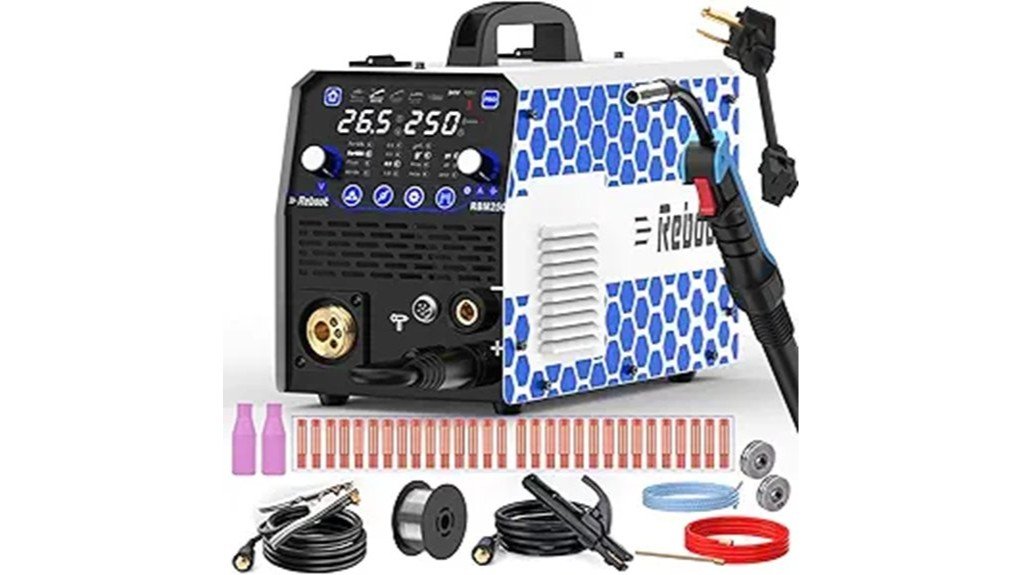
A 250-amp multi-process welder can replace several machines, but only when its power limits, controls, and accessory requirements match your projects. The Reboot 250Amp MIG Welder, sold on the linked Amazon page as the RBM2500 PRO and described in the manual as the dual-voltage RBM2500D PRO, combines gas MIG, flux-core MIG, MAG, Lift TIG, stick, timed spot, and two aluminum-feed options. Its strongest points are broad process support, 120V/240V input, synergic and manual MIG controls, and a compact 23.15-pound body. Its main limitation is package completeness: the linked package does not include the Lift TIG torch or spool gun, and maximum output requires a suitable 240V circuit.
Quick Verdict
Rating: 8/10, recommended with caveats
Best For: DIY welders, garage fabricators, farm and equipment repair users, and buyers who want gas MIG, flux-core, stick, and aluminum-capable MIG in one machine.
Bottom Line: The Reboot 250Amp MIG Welder offers useful control depth, dual-voltage flexibility, and a verified 30 to 250A output range on 240V. You will need to budget for a separate Lift TIG torch or spool gun if those processes are central to your work.
Key Takeaways
- The linked Reboot welder is the dual-voltage version, with a manual-rated range of 30 to 182A on 100V to 120V input and 30 to 250A on 200V to 240V input.
- Its core machine modes are manual MIG, synergic MIG, Lift TIG, and stick, with gas selection, wire-size selection, 2T/4T trigger control, and a timed MIG spot setting.
- The manufacturer listing states capacity up to 1/4-inch steel and 3/16-inch aluminum, but results depend on joint design, process, input power, wire, gas, and operator skill.
- The included Teflon liner and U-groove roller support aluminum wire feeding through the MIG torch, while the compatible spool gun is sold separately.
- The unit weighs 23.15 pounds and measures 18.90 by 12.60 by 12.99 inches, making it portable enough for a garage or mobile repair cart.
- The 60% duty-cycle figure is useful for intermittent fabrication, but it does not make this a substitute for a production-class industrial welder.
Key Specifications
| Specification | Verified Detail |
|---|---|
| Brand | Reboot |
| Model / Variant | RBM2500D PRO dual-voltage version; the Amazon title shortens the name to RBM2500 PRO |
| Product Type | Inverter multi-process MIG welder |
| Advertised Functions | Gas MIG, gasless flux-core MIG, MAG, Lift TIG, stick, timed spot, spool-gun aluminum, and liner-fed aluminum MIG |
| Input Voltage | Single-phase AC 100V to 120V or AC 200V to 240V, 50/60Hz |
| Welding Current Range | 30 to 182A on low-voltage input; 30 to 250A on high-voltage input |
| Rated Input | 3.4 kVA / 31A on low voltage; 5.5 kVA / 25A on high voltage |
| Wire Feed Speed | 2.0 to 10 m/min, or 79 to 393 IPM |
| MIG Wire Sizes | 0.6, 0.8, 0.9, and 1.0 mm, approximately .024, .030, .035, and .040 inch |
| Stick Electrode Sizes | 1.6, 2.5, and 3.2 mm |
| Duty Cycle | 60% listed in the manual; practical runtime varies with output and temperature |
| Dimensions | 18.90 x 12.60 x 12.99 inches |
| Weight | 23.15 pounds |
| Display and Controls | Dual digital displays, synergic and manual MIG, 2T/4T, spot timer, inductance, creep start, pre-flow, and post-flow adjustment |
| Protection | Overheat, overvoltage, and overcurrent protection; E02 overheat code |
| Enclosure Rating | IP21S, for dry conditions and not for use in rain |
| Included Accessories | 10-foot MB15 MIG torch, ground clamp, electrode holder, gas hose, 1.1-pound wire spool, Teflon liner, contact tips, nozzles, conversion lead, and three wire-feed rollers |
| Not Included | Lift TIG torch and compatible spool gun in the linked package |
| Warranty | One year / 12 months, according to the listing and manual |
What Is the Reboot 250Amp MIG Welder?
The Reboot 250Amp MIG Welder is a compact inverter machine designed around four main control modes: stick, manual MIG, synergic MIG, and Lift TIG. The listing markets it as an 8-in-1 unit by counting gas and gasless MIG configurations, MAG, timed spot welding, Lift TIG, stick, and two ways to feed aluminum wire.
For most buyers, the practical value is not the number on the box. It is the ability to run solid wire with shielding gas, flux-core wire without gas, stick electrodes, and aluminum MIG wire from one 23.15-pound unit. The digital panel also gives you more adjustment than a basic entry-level welder, including wire diameter, gas type, inductance, creep start, gas pre-flow, gas post-flow, and trigger mode.
Before You Buy: The linked package is compatible with Lift TIG and a spool gun, but those two accessories are not included. Lift TIG is also a DC touch-start process, not AC TIG for aluminum. Aluminum support is primarily through MIG wire feeding with the supplied Teflon liner or a separately purchased spool gun.
Who Should Buy It?
Best For
- Garage and farm users who switch between gas MIG, flux-core, and stick repairs.
- Hobby fabricators who want synergic setup help but still want manual voltage and wire-speed control.
- Buyers who need a portable dual-voltage machine and may add a spool gun or Lift TIG torch later.
Skip If
- You need AC TIG for aluminum, high-frequency arc start, or foot-pedal TIG control.
- You want a package with the TIG torch and spool gun included from the start.
- You need verified production-duty output for long, continuous welds at high amperage.
Process Range and Output
On 240V input, the manual rates the dual-voltage model from 30 to 250A. On 120V input, the listed range falls to 30 to 182A. That difference matters more than the headline rating. A standard low-voltage setup is useful for thinner material, repairs, tack work, and portable jobs, while the 240V side is the better choice when you need the machine’s upper output range.
The manufacturer claims welding capacity up to 1/4-inch steel and 3/16-inch aluminum. Treat those figures as upper capability claims, not automatic one-pass guarantees. Joint preparation, bevel angle, travel speed, wire diameter, shielding gas, polarity, and available input power all affect penetration.
The manual lists a 60% duty cycle, 85% overall efficiency, a 65V no-load voltage, and a 2.0 to 10 m/min wire-feed range. The duty-cycle rating supports normal stop-and-start fabrication, but the manual does not turn the unit into a continuous-production machine. When the welder overheats, the E02 protection code stops output until internal temperature drops.
MIG Controls and Arc Setup
Synergic MIG is the easier starting point. You select the wire size and gas or material setting, then the machine coordinates a starting combination of current and wire feed. The panel supports .024, .030, .035, and .040-inch wire selections, plus gasless flux-core, 100% CO2, an argon and CO2 mix, and 100% argon for aluminum.
Manual MIG gives you direct control over wire-feed speed and output voltage. In synergic mode, you can fine-tune voltage by minus 3V to plus 3V. You can also adjust inductance from minus 10 to plus 10, creep start from 0 to 10, and pre-flow and post-flow from 0.0 to 2.0 seconds. These controls help you correct a harsh arc, reduce wire stub-out, and tune starts for different wire and joint conditions.
The 2T mode runs while you hold the torch trigger, which suits tacks and short beads. The 4T mode lets you release the trigger during a longer weld, reducing hand strain. The spot setting is a timed MIG function from 0.0 to 3.0 seconds. It is not a resistance spot welder with clamping electrodes.
Pro Tip: Start in synergic MIG, run a test bead on scrap of the same thickness, then adjust voltage trim and inductance in small steps. Record the wire, gas, voltage input, and settings that produced the best bead so you can repeat the setup later.
Aluminum Welding Options
The Reboot offers two aluminum MIG feed approaches. The included Teflon liner and U-groove roller can reduce drag and deformation when feeding softer aluminum wire through the standard MIG torch. This approach can work for short torch runs and careful setup, but aluminum wire is more likely to bird-nest than steel wire.
A compatible spool gun places the wire spool near the torch, shortening the feed path and improving reliability. The spool gun is the better choice when aluminum is a regular part of your work, but the linked package does not include it. The listing also states a 3/16-inch aluminum capacity, which should be treated as a manufacturer claim that depends on input power, alloy, joint preparation, and technique.
Lift TIG is a separate DC touch-start mode. It is useful for steel and stainless work when you add the correct valve torch and argon supply. It should not be confused with a dedicated AC/DC TIG machine for aluminum.
Build, Portability, and Protection
At 18.90 by 12.60 by 12.99 inches and 23.15 pounds, the welder is manageable for a shelf, welding cart, or service vehicle. The compact size is a practical advantage for a garage where floor space is limited, although you still need room for wire, gas, cables, and ventilation.
The enclosure is rated IP21S. The manual says to keep the machine dry, avoid rain, and leave at least 30 cm of clearance around the ventilation openings. Internal fan cooling and overheat protection help manage temperature, but blocked louvers or dust buildup can shorten component life.
The manual lists overheat, overvoltage, and overcurrent protection, plus insulation class F and the UL60974-1 standard. These entries are useful technical references, but you should still follow the supplied manual, local electrical code, and normal welding safety practices.
What Comes in the Box?
The linked package includes the machine, a 10-foot MB15 MIG torch, ground clamp, electrode holder, gas hose, conversion lead, a 1.1-pound wire spool, contact tips, nozzles, and a Teflon liner. It also includes three wire-feed rollers: a preinstalled 0.8/1.0 mm knurled roller, a 0.8/1.0 mm V-groove roller, and a 1.0/1.2 mm U-groove roller.
The contact tips and rollers give you a useful starting kit for flux-core, solid steel wire, and aluminum wire. However, consumables wear and wire packages can change, so compare the current listing contents with your preferred wire diameter before ordering replacements.
The Lift TIG torch and spool gun are separate purchases for this ASIN. You also need process-specific supplies such as shielding gas, regulator or flowmeter, electrodes, filler material, helmet, gloves, and protective clothing.
Setup Tips Before First Use
- Confirm input power. Use a properly grounded circuit that matches the machine and local electrical code. Do not assume an ordinary outlet can support maximum output.
- Choose the process first. Gas MIG, flux-core, stick, Lift TIG, and aluminum MIG require different polarity, consumables, and gas arrangements.
- Match the feed path. Use the correct roller groove, contact tip, liner, and drive pressure for the selected wire.
- Check polarity. The manual shows DCEN for gasless MIG and Lift TIG, while other processes may require a different connection. Follow the wire or electrode instructions.
- Run a scrap test. Confirm wire feed, arc sound, penetration, and gas coverage before welding the finished part.
- Keep airflow clear. Leave the ventilation openings unobstructed and stop if the E02 overheat code appears.
How It Performs in Real Use
For Garage Fabrication
The strongest setup for brackets, carts, frames, and general mild-steel projects is gas MIG on 240V. Synergic control gets you close to a workable starting point, while manual voltage, wire speed, and inductance let you refine bead shape. The 4T trigger mode is helpful for longer seams.
For Outdoor and Farm Repairs
Flux-core MIG and stick are the practical choices when wind makes shielding gas unreliable. The machine is portable enough to move to a repair area, but the IP21S enclosure must stay dry and protected from rain. Extension leads and generator use also require careful sizing and stable power.
For Thin Sheet and Tack Work
The 30A lower range, .024-inch wire support, voltage trim, and timed spot mode give you more control than a fixed-setting flux-core machine. Thin sheet still requires short welds, clean fit-up, and heat control to avoid burn-through. Test on scrap before working on body panels or finished material.
For Aluminum Projects
The Teflon liner and U-groove roller make occasional aluminum MIG possible without buying a spool gun immediately. For regular aluminum work, the separate spool gun is the more dependable feed method. Buyers who want precision AC TIG on aluminum should choose a dedicated AC/DC TIG machine instead.
Safety, Power, and Workspace Requirements
Welding exposes you to arc radiation, hot metal, fumes, electric shock, fire, and moving wire-feed parts. Wear an appropriate helmet, gloves, flame-resistant clothing, and hearing and eye protection. Use local exhaust or strong ventilation, keep flammable materials away, and have a suitable fire extinguisher nearby.
The machine needs a grounded, correctly rated circuit. Maximum output on 240V can demand more from the supply than light household tools, and the manual warns that an undersized breaker may trip. A qualified electrician should evaluate any new receptacle, adapter, breaker, or hardwired circuit.
Do not weld sealed containers, unknown coated metal, fuel systems, pressurized parts, or safety-critical vehicle structures without the correct training and preparation. Keep the welder dry, protect it from conductive dust, and disconnect power before changing internal wire-feed parts.
Warranty and Support
The Amazon listing and manual state a one-year, or 12-month, warranty. The manual also provides regional support contacts and a warranty-registration section. Keep your order record, serial information, and photos of any shipping damage in case you need service.
A one-year warranty is reasonable for a value-focused multi-process welder, but it is shorter than the coverage offered with some premium professional machines. Buyers who depend on a welder for daily income should compare local service access and replacement-part availability before choosing any online-only model.
Pros and Cons
Pros
- Verified dual-voltage output range reaches 250A on 240V.
- Synergic and manual MIG controls support both easy setup and fine adjustment.
- Includes rollers and a Teflon liner for steel, flux-core, and aluminum wire setups.
- Compact 23.15-pound body is practical for garages and mobile repair carts.
- 2T/4T, timed spot, gas timing, inductance, and creep-start controls add useful flexibility.
Cons
- The linked package does not include the Lift TIG torch or spool gun.
- Output is limited to a manual-rated 182A on 100V to 120V input.
- Lift TIG is DC touch-start, so this is not an AC TIG solution for aluminum.
Is It Worth the Price?
The Reboot 250Amp MIG Welder offers strong value for buyers who will use several processes and already have, or plan to add, the required gas and accessories. Its main value comes from verified dual-voltage output, detailed MIG controls, a useful roller package, and aluminum-feed compatibility in a compact machine.
You get the most value when gas MIG is your main process, flux-core and stick cover repair work, and aluminum is an occasional or future need. The package is less attractive when Lift TIG or spool-gun aluminum is your immediate priority because both accessories add to the total cost.
It is worth considering for hobby and repair use, but professional production buyers should compare duty-cycle documentation, local service, cable quality, and long-term parts support against established shop-grade brands.
How It Compares to Alternatives
The Reboot RBM2000 complete kit is worth comparing when an included spool gun matters more than the higher advertised output. The Reboot RBM2500D MAX offers a simpler 5-in-1 feature set for buyers who do not need the same number of panel adjustments or counted modes.
If aluminum TIG is your main goal, a dedicated 200A AC/DC TIG welder is the better category because it provides AC output and TIG-focused controls. The Reboot makes the most sense when MIG is the priority and stick, Lift TIG, timed spot, and aluminum MIG are supporting functions.
Frequently Asked Questions
Can the Reboot 250Amp MIG Welder weld aluminum?
Yes. The package includes a Teflon liner and U-groove roller for feeding aluminum wire through the MIG torch, and the machine is compatible with a separate spool gun. The listing states capacity up to 3/16-inch aluminum, but actual results depend on alloy, joint preparation, input power, wire, and technique.
Does it produce 250 amps on a 120V outlet?
No. The manual rates the dual-voltage model at 30 to 182A on 100V to 120V input and 30 to 250A on 200V to 240V input. Use a properly rated 240V circuit when you need the upper output range.
Are the Lift TIG torch and spool gun included?
Not in the package linked in this review. The Amazon listing says both accessories are compatible and available separately. Check the exact package contents before ordering because Reboot also sells other bundles and variants.
What MIG wire sizes does it support?
The manual lists 0.6, 0.8, 0.9, and 1.0 mm MIG wire, approximately .024, .030, .035, and .040 inch. The listing notes that a dedicated roller for the smallest .023 or .024-inch wire may need to be purchased separately.
Is the spot mode the same as resistance spot welding?
No. The manual describes a timed MIG spot function that stops the arc after a selected period from 0.0 to 3.0 seconds. It does not use the opposed copper electrodes found on a resistance spot welder.
Can it run from a normal household circuit?
The dual-voltage model can operate on 100V to 120V input, but maximum current is lower and the circuit still needs adequate capacity. Follow the manual and have a qualified electrician assess any outlet, adapter, extension lead, or new 240V circuit.
Can the welder be used outside?
Flux-core and stick can be useful outdoors because they do not rely on external shielding gas in the same way as gas MIG. However, the machine has an IP21S enclosure and the manual says not to use it in rain, so keep it dry and protected.
Who should skip the Reboot 250Amp MIG Welder?
Skip it if you need AC TIG for aluminum, a foot pedal, high-frequency TIG start, or a complete spool-gun and TIG package. A dedicated industrial welder may also be a better fit for daily production work that demands longer high-output duty cycles and local service support.
The Bottom Line
The Reboot 250Amp MIG Welder is a capable value-focused machine for buyers who want gas MIG, flux-core, stick, timed spot, Lift TIG compatibility, and aluminum MIG options in one portable unit. Its verified strengths include 120V/240V input, a 30 to 250A high-voltage range, synergic and manual MIG controls, 2T/4T operation, and a practical set of wire-feed rollers and consumables.
Buy it when MIG is your main process and you value flexibility more than a fully bundled accessory kit. Choose another machine when AC TIG aluminum, production-duty service, or an included spool gun and TIG torch are must-have features.
Ready to Compare the Current Package?
Review the latest listing details, included accessories, and seller terms before ordering.