Disclosure: As an Amazon Associate, we earn from qualifying purchases. If you click a link on this page and make a purchase, we may receive a small commission at no extra cost to you.
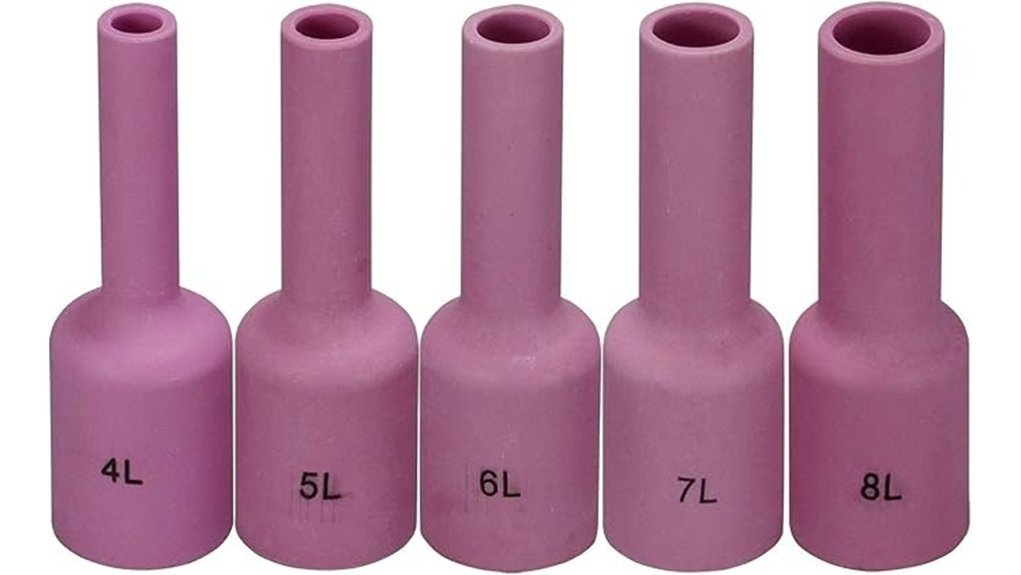
Choosing a TIG cup is mostly about compatibility, cup opening, and access around the joint. The RIVERWELD TIG Alumina Nozzles reviewed here are a five-piece assortment of long 54N-series ceramic gas-lens cups for compatible 17, 18, and 26-series TIG torches. You get five different opening sizes in the same 3-inch-long format, which makes the kit useful when you want to experiment with cup size instead of buying several individual cups. The main limitation is important: these cups are designed around a compatible 45V-series gas-lens collet body, so you should confirm your torch setup before ordering.
Quick Verdict
Rating: 8.5/10, Recommended with compatibility caveats
Best For: TIG welders using compatible 17, 18, or 26-series torches with a 45V-series gas-lens setup
Bottom Line: The five-size assortment gives you a practical way to test cup openings from 1/4 inch to 1/2 inch without buying each size separately. The 3-inch cups also provide extra length, but they are not a universal fit for every collet-body configuration.
| Specification | Detail |
|---|---|
| Brand | RIVERWELD |
| Product Type | Long TIG gas-lens ceramic cups |
| Series | 54N long series |
| Material | Ceramic aluminum oxide (alumina) |
| Quantity | 5 cups, one of each listed size |
| 54N18L | #4L, 1/4-inch opening |
| 54N17L | #5L, 5/16-inch opening |
| 54N16L | #6L, 3/8-inch opening |
| 54N15L | #7L, 7/16-inch opening |
| 54N14L | #8L, 1/2-inch opening |
| Cup Length | 3 inches / 76 mm |
| Torch Compatibility | SR, DTA, DB, and WP 17, 18, and 26-series TIG torch configurations listed by the manufacturer |
| Gas-Lens Compatibility | 45V24, 45V25, 45V26, 45V27, 45V28, and 45V29 gas-lens collet bodies |
| Best Use | Keeping several long cup opening sizes available for compatible TIG gas-lens setups |
Key Takeaways
- You receive five long 54N-series ceramic cups ranging from #4L to #8L.
- Every cup is listed at 3 inches, or 76 mm, long.
- The set is intended for compatible SR, DTA, DB, and WP 17, 18, and 26-series TIG torches.
- These cups are designed to work with 45V24 through 45V29 gas-lens collet bodies.
- The assortment is most useful when you want several cup opening sizes available without purchasing each size separately.
Before You Buy: Do not choose these cups only because your torch is labeled WP-17, WP-18, or WP-26. Confirm that your torch is configured with a compatible 45V-series gas-lens collet body. A standard collet-body setup can require a different cup family.
What Is the RIVERWELD TIG Alumina Nozzle Kit?
This RIVERWELD product is an assortment of five long alumina ceramic cups used at the front of a compatible TIG gas-lens torch setup. The individual part numbers are 54N18L, 54N17L, 54N16L, 54N15L, and 54N14L.
The cup openings increase from 1/4 inch on the #4L cup to 1/2 inch on the #8L cup. Because all five are included, you can keep multiple sizes on hand and select the opening that better suits access around the joint and the shielding setup you are using.
These are consumable torch parts, not a complete gas-lens conversion kit. You still need the correct torch components, including a compatible gas-lens collet body and other parts required by your specific torch setup.
Who Should Buy It?
Best For
- Welders already using a compatible 45V-series gas-lens collet body.
- Owners of compatible 17, 18, or 26-series TIG torches who want several long cup sizes.
- Fabricators who prefer an assortment instead of committing to one cup opening size.
Skip If
- Your torch uses an incompatible standard collet-body or stubby gas-lens setup.
- You need short cups rather than the 3-inch long format.
- You are buying parts for MIG welding rather than TIG welding.
Build Quality and Materials
The cups are made from ceramic aluminum oxide, commonly called alumina. Ceramic cups are widely used on TIG torches because the material can sit close to the welding arc while electrically isolating the outer cup from the torch’s conductive parts.
That does not make a ceramic cup indestructible. Dropping a cup onto concrete, striking it against a workpiece, overtightening related torch parts, or continuing to use a visibly cracked cup can shorten its service life.
The assortment uses the familiar pink ceramic appearance associated with many TIG alumina cups. More important than the color is the cup’s physical condition. Inspect the rim and body before welding, especially after the torch has been dropped.
Long 3-Inch Design
Each cup in this kit is listed at 3 inches, or 76 mm, long. That length distinguishes this set from standard-length versions of similar TIG cups.
A longer cup can be useful when the torch body needs additional stand-off from surrounding parts or when the joint is recessed enough that a conventional short cup feels awkward. The tradeoff is that a long ceramic cup adds leverage at the front of the torch and can be easier to bump into the work if you are used to a shorter setup.
Pro Tip: Before starting an important weld, dry-position the torch with the selected cup installed. Check that the 3-inch cup reaches the joint comfortably without forcing your wrist or causing the ceramic rim to contact nearby metal.
Five Cup Sizes in One Kit
The biggest practical advantage is the assortment. Instead of receiving five identical cups, you get one each of #4L, #5L, #6L, #7L, and #8L.
- #4L, 54N18L: 1/4-inch opening
- #5L, 54N17L: 5/16-inch opening
- #6L, 54N16L: 3/8-inch opening
- #7L, 54N15L: 7/16-inch opening
- #8L, 54N14L: 1/2-inch opening
The different openings let you change the physical space available around the electrode and the area through which shielding gas exits the cup. A smaller cup can be easier to place around restricted joints, while a larger cup gives you a wider opening when your procedure calls for broader shielding coverage.
Cup size alone does not determine weld quality. Gas flow, tungsten extension, gas-lens condition, torch angle, joint geometry, drafts, material cleanliness, amperage, and technique all matter. Use the cup as one part of the complete TIG setup rather than treating a larger cup as an automatic performance upgrade.
Fit and Compatibility
RIVERWELD lists the cups for SR, DTA, DB, and WP 17, 18, and 26-series TIG torch configurations. This covers several common torch families, but the torch number by itself is not enough to guarantee that the cup will screw onto your current front-end parts.
The product listing specifically identifies 45V24, 45V25, 45V26, 45V27, 45V28, and 45V29 gas-lens collet bodies as compatible components. That detail is more important than simply seeing “WP-17” or “WP-26” in a product description.
If you currently use standard 10N-series cups, a stubby gas-lens conversion, or another aftermarket setup, compare the part numbers before ordering. Changing cup families can require matching insulators, gas lenses, or related torch components.
How to Choose the Right Cup Size
Start with the joint and your existing welding procedure. The five sizes give you a progression from a 1/4-inch opening to a 1/2-inch opening, so you can choose based on access and the shielding arrangement required for the job.
Use the Smaller Cups When Access Is Tight
The #4L and #5L cups have the smallest openings in the set. They can be easier to position where surrounding geometry limits the space available around the front of the torch.
Use the Middle Sizes as General Options
The #6L and #7L cups sit between the smallest and largest options. They give you additional room around the electrode without jumping directly to the 1/2-inch #8L opening.
Use the #8L When You Need the Largest Opening in the Kit
The 54N14L #8L cup has a 1/2-inch opening. It provides the widest cup opening included in this assortment, but it also needs more physical room around the joint.
Do not copy another welder’s gas-flow setting simply because you use the same cup number. Set shielding gas according to your welding procedure, torch setup, material, environment, and equipment instructions.
How It Performs in Real Use
Bench and Shop Fabrication
For general shop work, the assortment saves you from keeping five separate product packages. You can organize the cups with the rest of your 17, 18, or 26-series torch consumables and switch sizes as the joint geometry changes.
Restricted Joint Access
When surrounding parts make torch positioning difficult, the smaller #4L or #5L opening may be easier to maneuver. The 3-inch length can also change how the torch reaches into a recessed area, although you should test the position before striking an arc.
Jobs Requiring a Larger Cup Opening
The #7L and #8L cups provide larger openings when your TIG procedure benefits from that geometry. The #8L reaches 1/2 inch, the largest opening in this five-piece set.
Keeping Spare Cup Sizes Available
Ceramic cups are consumables that can eventually chip or crack. Even though this assortment contains only one of each size, it gives you several cup choices in one purchase and can help you decide which sizes are worth stocking individually later.
Setup Tips Before First Use
- Identify your torch series. Confirm that your torch belongs to a compatible 17, 18, or 26-series family.
- Check the gas-lens hardware. Compare your gas-lens collet-body part number with the compatible 45V24 through 45V29 family.
- Inspect the ceramic. Do not install a cup with visible cracks or badly chipped edges.
- Choose a cup for the joint. Start with the opening size that gives you comfortable access without unnecessary bulk.
- Dry-fit the torch. Position the torch at the joint before welding to make sure the long cup does not interfere with the surrounding work.
- Follow your normal TIG procedure. Set tungsten position and shielding gas according to your equipment, joint, and welding procedure rather than relying on cup size alone.
Compatibility and Safety
These ceramic cups are only one part of a TIG torch assembly. Make sure the complete front end is assembled correctly before welding, and follow the torch and welding-machine manufacturer’s instructions.
Allow hot torch components to cool before handling or changing the ceramic cup. Wear the appropriate welding helmet, gloves, protective clothing, and other PPE required for your work. Maintain proper ventilation and follow applicable shop safety procedures.
Replace a cup if it becomes significantly cracked, broken, or unable to mount correctly. Ceramic fragments can have sharp edges, so handle damaged cups carefully.
Pros and Cons
Pros
- Includes five different cup openings from #4L through #8L.
- All five cups use the long 3-inch / 76 mm design.
- Made from ceramic aluminum oxide for TIG torch use.
- Supports several common 17, 18, and 26-series torch families when fitted with compatible gas-lens components.
- Useful for learning which cup sizes you prefer before buying larger packs of one size.
Cons
- Not a complete gas-lens conversion kit.
- Compatibility depends on your collet-body setup, not just the torch model number.
- Only one cup of each size is included, so a broken favorite size leaves you without an identical spare.
What Should You Look for in Buyer Feedback?
For a simple TIG consumable, buyer feedback is most useful when it discusses fit, cup condition on arrival, threading or mounting compatibility, and whether the received assortment matches the advertised sizes. Those practical points tell you more than a general statement that a cup “works well.”
Because ratings and review totals can change over time, you should also compare recent feedback with the current product description before ordering. Pay special attention to reviews from buyers using a torch and gas-lens configuration similar to yours.
Is It Worth the Price?
This RIVERWELD kit makes the most sense as a budget-friendly consumable assortment for a compatible TIG setup. Its value comes from getting five cup sizes in one package instead of having to choose a single opening before you know which one you prefer.
It is especially worth considering if you regularly change joint geometry or want to experiment with #4L through #8L cups. Once you find that you consistently use one particular size, buying a larger package of that single cup may make more sense for long-term shop inventory.
The main value limitation is compatibility. A low-cost cup kit is not useful if it does not match the gas-lens hardware already installed on your torch, so checking the collet-body family should come before price.
How It Compares to Alternatives
If you do not need the extra 3-inch length, standard-length 54N-series gas-lens cups may give you a more compact torch front end. They are worth considering when clearance around the torch body is not a problem and you prefer a shorter ceramic cup.
If your torch uses a standard 10N collet-body configuration instead of the compatible 45V gas-lens components, a 10N-series alumina cup is the more appropriate family to compare. Clear quartz cup systems are another option when visibility around the tungsten is a priority, but they use different components and should be matched carefully to the torch setup.
Frequently Asked Questions
What sizes come in the RIVERWELD 54N long cup kit?
The five-piece kit includes 54N18L #4L at 1/4 inch, 54N17L #5L at 5/16 inch, 54N16L #6L at 3/8 inch, 54N15L #7L at 7/16 inch, and 54N14L #8L at 1/2 inch. You receive one cup of each size.
How long are these TIG cups?
RIVERWELD lists each cup at 3 inches, or 76 mm, long. That makes this the long version of the 54N cup assortment rather than a standard-length set.
Are these cups compatible with WP-17, WP-18, and WP-26 torches?
They are listed for compatible WP, SR, DTA, and DB 17, 18, and 26-series TIG torch setups. You still need to verify the front-end hardware because the cups are designed for specific gas-lens collet bodies.
Which gas-lens collet bodies work with these cups?
The product listing specifies the 45V24, 45V25, 45V26, 45V27, 45V28, and 45V29 gas-lens collet-body family. Compare the part number on your existing setup before purchasing.
Can I use these with a standard 10N collet body?
Do not assume so. This 54N long assortment is specified for compatible 45V-series gas-lens collet bodies, while standard 10N configurations use different cup and collet-body combinations.
Can these ceramic cups be used for MIG welding?
No. These are TIG torch gas-lens ceramic cups designed for compatible TIG torch hardware. MIG guns use a different nozzle and consumable system.
How do I choose between the #4L and #8L cups?
The #4L has the smallest opening at 1/4 inch, while the #8L has the largest at 1/2 inch. Choose according to joint access and your TIG shielding procedure rather than assuming that the largest cup is automatically better.
When should I replace an alumina TIG cup?
Replace the cup when it is badly chipped, cracked, broken, or no longer mounts correctly. Let the torch cool before inspecting or changing components, and handle broken ceramic carefully because damaged edges can be sharp.
The Bottom Line
The RIVERWELD 54N Long Alumina Nozzle Kit is a practical choice if you already have a compatible 17, 18, or 26-series TIG torch with the correct 45V gas-lens hardware and want five cup openings in one package. Its strongest feature is the useful #4L through #8L assortment, while its biggest limitation is that the cups are not universal replacements for every WP-17, WP-18, or WP-26 front-end configuration.
If you verify the gas-lens collet-body compatibility first and specifically want the 3-inch long format, this is an easy kit to recommend. If your torch uses standard, stubby, or otherwise different consumables, confirm the correct cup family before buying.
Ready to Buy?
Check the latest price, selected variation, and product details before you decide.