Disclosure: As an Amazon Associate, we earn from qualifying purchases. If you click a link on this page and make a purchase, we may receive a small commission at no extra cost to you.
Getting clean welds depends on more than your torch, wire, or filler rod. You also need steady shielding gas control, especially when you switch between MIG and TIG work. The SPARC Argon Regulator is built for welders who want adjustable CFH flow, a clear cylinder pressure gauge, and compatibility with common inert gas tank setups. This review helps you decide if its flow range, fittings, warranty support, and setup flexibility match your welding needs. It looks like a strong fit for many home shops and small fabrication setups, but you should confirm your tank connection and hose size before buying.
Quick Verdict
Rating: 8.1/10
Best For: Welders who need a CGA-580 argon or argon/CO2 flowmeter regulator for MIG or TIG welding.
Bottom Line: The SPARC Argon Regulator gives you useful flow control, a visible ball indicator, and broad hose compatibility for common inert gas setups. Its main tradeoff is that buyers must verify tank and hose fit before ordering because gas fittings are not universal.
| Specification | Detail |
|---|---|
| Brand | SPARC |
| Product Type | Argon and argon/CO2 flowmeter regulator |
| Best Use | MIG and TIG welding shielding gas control |
| Argon Flow Range | 0 to 65 CFH |
| AR/CO2 Flow Range | 0 to 70 CFH |
| Input Pressure Gauge | Reads up to 4000 PSI |
| Flow Indicator | Ball indicator for visual flow monitoring |
| Tank Compatibility | CGA-580 style argon, helium, and argon/CO2 blend tanks |
| Hose Compatibility | Barb adapter supports 5/16-inch and 1/4-inch hoses |
| Outlet Nut | 5/8 UNF-18RH nut for standard inert gas hoses |
| Warranty | Lifetime warranty listed in the supplied product details |
| Support | Email, phone, or text support listed from 9 AM to 5 PM MST |
What Is the SPARC Argon Regulator?
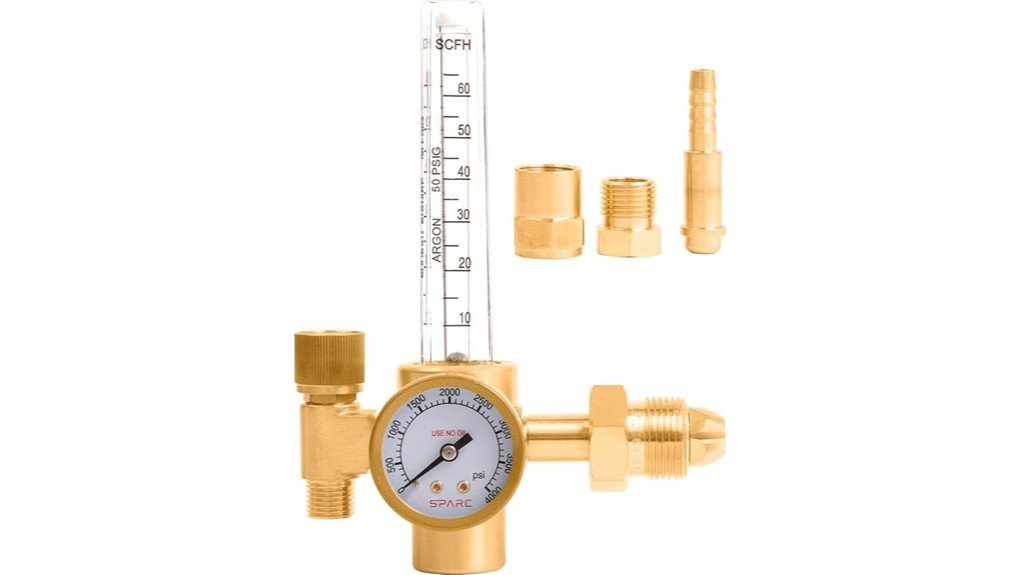
The SPARC Argon Regulator is a shielding gas regulator and flowmeter for welding applications. It is designed for argon and argon/CO2 blends, which makes it useful for common MIG and TIG welding setups. The regulator gives you adjustable gas flow rather than a fixed output, so you can tune shielding gas based on the process, joint, and work area.
The main buying appeal is its combination of CFH adjustment, visible pressure reading, and broad connection support. The supplied article lists a 0 to 65 CFH range for argon and a 0 to 70 CFH range for AR/CO2. It also includes a ball indicator, which helps you see flow changes while setting up your weld.
Key Takeaways
- The SPARC Argon Regulator supports adjustable flow up to 65 CFH for argon and up to 70 CFH for AR/CO2.
- The input pressure gauge reads up to 4000 PSI, helping you monitor cylinder pressure before and during work.
- It fits CGA-580 style argon, helium, and argon/CO2 blend tanks, based on the supplied product details.
- The barb adapter works with 5/16-inch and 1/4-inch hoses, which gives you more setup flexibility.
- The regulator is best for buyers who want practical gas control for MIG or TIG welding, not a universal regulator for every gas cylinder.
Who Should Buy It?
Best For
- MIG and TIG welders using argon or argon/CO2 shielding gas.
- Home shop users who want a clear ball-style flow indicator for setup.
- Buyers with CGA-580 style tanks and 5/16-inch or 1/4-inch hose needs.
Skip If
- Your gas cylinder does not use a CGA-580 style connection.
- You need a regulator for oxygen, fuel gas, or another non-inert gas setup.
- You want verified material, size, or weight details before purchasing.
Before You Buy: Confirm your cylinder valve type, gas blend, and hose size before ordering. A regulator can be well built and still be the wrong choice if the fitting does not match your tank or hose.
Flow Control and Gauge Visibility
The biggest practical feature is the adjustable flow range. For argon, the supplied details list 0 to 65 CFH. For AR/CO2, the listed range is 0 to 70 CFH. That range gives you room to set lower flow for controlled TIG work or higher flow when your MIG setup needs more shielding gas coverage.
The input pressure gauge reads up to 4000 PSI. That gauge helps you see the cylinder-side pressure, while the ball indicator helps you monitor the actual flow setting. This split is useful because pressure and flow are not the same thing. You want enough cylinder pressure to continue working, but you also need the flow set correctly for the weld.
Compatibility With Welding Tanks and Hoses
The SPARC Argon Regulator is designed around CGA-580 style argon and helium tanks, along with argon/CO2 blend tanks. That makes it a practical match for many inert gas welding setups. It is not described as a universal regulator for every gas or every cylinder type.
The hose side also adds flexibility. The supplied product details list a barb adapter that fits both 5/16-inch and 1/4-inch hoses. The 5/8 UNF-18RH nut is also listed for standard inert gas hoses used with popular welding brands such as Miller and Lincoln.
Pro Tip: Check the stamped connection type on your gas cylinder and measure your hose before buying. Matching CGA style and hose size first prevents most regulator fit problems.
Build Quality and Daily Handling
The supplied article describes the regulator as heavy-duty. For a welding accessory, that matters because the regulator may be handled often, connected and removed from tanks, and stored near other shop equipment. A sturdy design also helps protect the adjustment components from normal shop wear.
The ball indicator is one of the more buyer-useful design details. Instead of guessing from knob position alone, you can watch the ball and set the CFH range more clearly. That helps when you move between different welding tasks and need repeatable gas flow.
Setup Tips Before First Use
Start by matching the regulator to the correct cylinder type. This model is described for CGA-580 style argon, helium, and argon/CO2 blend tanks. Do not force the regulator onto a tank connection that does not match.
After connecting the regulator, secure the gas cylinder upright and check the hose connection before opening the cylinder valve. Open the valve slowly, then adjust the flow while watching the ball indicator. Use the product instructions and your welder manual when setting CFH for your process.
If you are new to shielding gas setup, avoid treating the highest flow setting as the best setting. Too much gas can waste shielding gas and may create turbulence around the weld area. Your goal is a stable shield for the weld, not the highest number on the flowmeter.
Compatibility and Safety Notes
Gas regulators are safety-related shop equipment, so fit and correct use matter. This regulator is described for inert gas welding setups, not oxygen or fuel gas service. Use it only for gas types and cylinders that match the product instructions.
Inspect the regulator, nut, adapter, hose, and cylinder valve before use. Do not use damaged fittings, cracked hoses, or a regulator that shows signs of impact or leaking. If you smell gas, hear leaking, or cannot get a stable reading, stop and check the setup before welding.
For best safety, follow the cylinder supplier guidance, the regulator instructions, and your welder manual. When in doubt, ask a qualified welding professional or gas supplier to confirm the correct fitting and setup.
Customer Support and Warranty Information
The supplied article lists a lifetime warranty for the SPARC Argon Regulator. That is useful for buyers who want support beyond the first few weeks of ownership. Warranty terms can still depend on seller policy, proof of purchase, and product condition, so review the current product page before you buy.
The support details list email, phone, or text contact from 9 AM to 5 PM MST. That can help if you need help with setup, fit questions, or warranty support. Clear support access is especially helpful for newer welders who may not know every gas fitting by name.
How It Performs in Real Use
For TIG Welding
For TIG work, controlled argon flow is important because the weld area needs steady shielding. The 0 to 65 CFH argon range gives you room to adjust based on torch setup and working conditions. The ball indicator helps you make small flow changes without relying only on guesswork.
For MIG Welding With Argon/CO2 Blends
For MIG welding, the listed 0 to 70 CFH AR/CO2 range gives you flexibility for common shielding gas blends. This is useful when you need to tune flow for different shop conditions. You should still follow your welder settings and gas supplier guidance for the correct range.
For Home Shop Use
In a home garage or small fabrication shop, simple setup and readable flow control matter. The SPARC regulator gives you a clear gauge, ball indicator, and common hose adapter support. That makes it easier to set up than a regulator that requires extra fittings right away.
For Long-Term Use
The lifetime warranty listed in the article improves confidence for longer ownership. The main long-term concern is not the flow range, but correct handling and storage. Keep the regulator protected from impact, moisture, and dirt when it is not connected to a cylinder.
Pros and Cons
Pros
- Adjustable 0 to 65 CFH argon flow range supports controlled TIG shielding gas setup.
- 0 to 70 CFH AR/CO2 range adds flexibility for MIG welding with gas blends.
- Input pressure gauge reads up to 4000 PSI for clear cylinder pressure monitoring.
- Ball indicator makes flow changes easier to see while setting up.
- Barb adapter supports both 5/16-inch and 1/4-inch hoses.
Cons
- Not suitable for every gas cylinder because it is described for CGA-580 style connections.
- Material, dimensions, and weight were not available in the supplied article details.
- Beginners still need to learn correct CFH settings for their welding process.
Is It Worth the Price?
The SPARC Argon Regulator is worth considering if you need adjustable shielding gas flow for argon or argon/CO2 welding setups. Its value comes from the wide CFH ranges, visible ball indicator, pressure gauge, hose adapter support, and listed lifetime warranty.
It makes the most sense for home shop welders, hobby fabricators, and small-shop users who want a practical regulator without adding extra complexity. It is not the best fit if you need a regulator for a different gas, a different cylinder connection, or a setup with fully verified size and weight details before purchase.
How It Compares to Alternatives
Compared with basic pressure-only regulators, the SPARC Argon Regulator gives you a more direct way to monitor flow through the ball indicator. That can be easier when you need to set CFH for welding rather than only watching cylinder pressure.
Compared with brand-specific shop setups from larger welding equipment ecosystems, this SPARC model is more appealing if your priority is a practical CGA-580 flowmeter regulator with common hose adapter support. If you need a regulator that matches a specific industrial system, compare the fittings, hose size, warranty terms, and gas compatibility before choosing.
Frequently Asked Questions
Does the SPARC Argon Regulator work for both MIG and TIG welding?
Yes, the supplied product details describe it for MIG and TIG welding applications. It supports argon flow up to 65 CFH and AR/CO2 flow up to 70 CFH.
What tanks is this regulator designed to fit?
It is described for CGA-580 style argon and helium tanks, plus argon/CO2 blend tanks. Check your cylinder valve type before ordering because gas tank fittings are not universal.
What hose sizes does the barb adapter support?
The supplied details list support for 5/16-inch and 1/4-inch hoses. The regulator also lists a 5/8 UNF-18RH nut for standard inert gas hoses.
Can beginners use this regulator for hobby welding?
Yes, it can work for hobby welding if your tank, gas type, and hose match the regulator. Beginners should follow the regulator instructions and welder manual when setting CFH.
Does the 4000 PSI gauge show gas flow?
No, the 4000 PSI input gauge shows cylinder-side pressure. The ball indicator is the part you use to monitor and adjust CFH flow.
Is this regulator safe for oxygen or fuel gas?
The supplied details describe it for argon, helium, and argon/CO2 blend welding setups. Do not use it for oxygen, fuel gas, or any gas not supported by the product instructions.
What should you check before buying?
Check your cylinder connection, gas type, hose size, and welder setup. The most common mistake is buying a regulator with the right flow range but the wrong fitting.
Does it come with warranty support?
The supplied article lists a lifetime warranty and support by email, phone, or text from 9 AM to 5 PM MST. Review the current seller details before purchase because warranty handling can depend on the seller and proof of purchase.
The Bottom Line
The SPARC Argon Regulator is a strong choice if you need adjustable shielding gas flow for MIG or TIG welding with a CGA-580 style argon or argon/CO2 setup. Its best strengths are the clear ball indicator, useful CFH ranges, 4000 PSI input gauge, and flexible hose adapter support. Skip it if your cylinder connection, gas type, or hose size does not match.