Disclosure: As an Amazon Associate, we earn from qualifying purchases. If you click a link on this page and make a purchase, we may receive a small commission at no extra cost to you.
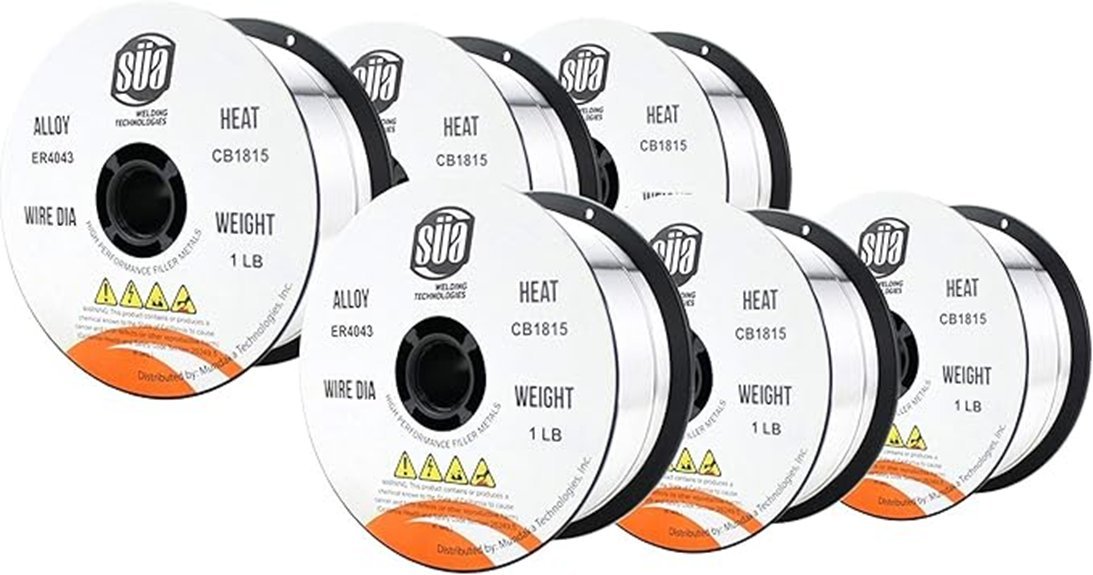
Aluminum MIG welding gets frustrating fast when soft wire birdnests, oxide contaminates the joint, or the filler does not match the base alloy. The SÜA ER4043 MIG Aluminum Welding Wire gives you a 0.035-inch AlSi5 filler in six 1-pound spools, a practical format for repeated shop, repair, and practice work. This review explains its verified specifications, compatible applications, setup needs, and limits so you can decide whether model 4043W6x35 fits your welder and project. Its fluid puddle and low hot-cracking sensitivity make it useful for many 6xxx-series and cast-aluminum jobs, but it is not the right choice for every alloy, anodized finish, or code-controlled weld.
Quick Verdict
Rating: 8.7/10, Recommended with setup caveats
Best For: Welders who need 0.035-inch ER4043 wire for compatible 6xxx-series aluminum, 3003 or 3004 sheet, selected 5052 work, and common aluminum castings.
Bottom Line: SÜA ER4043 offers a fluid weld puddle, a common AWS A5.10 filler classification, and six manageable 1-pound spools. You still need a suitable aluminum wire-feed system, correct shielding gas, clean base metal, and a verified filler-to-base-metal match.
Key Takeaways
- The reviewed SÜA variant is model 4043W6x35: 0.035-inch ER4043 MIG wire supplied as six 1-pound spools.
- ER4043 is an aluminum-silicon filler, commonly called AlSi5, with a nominal silicon content near 5%.
- The listed melting range is 1065 °F to 1170 °F, which supports good wetting and a fluid puddle on compatible aluminum.
- The product listing identifies AWS/SFA A5.10 ER4043, DC positive polarity, and argon-based shielding for MIG/GMAW use.
- ER4043 is commonly used on 6061, 6063, 3003, 3004, selected 5052 applications, and several cast alloys when the welding procedure permits it.
- The weld can turn gray after anodizing, so this filler is a poor choice when a close post-anodizing color match is required.
Product Specifications and Features
| Specification | Detail |
|---|---|
| Brand | SÜA |
| Model Number | 4043W6x35 |
| ASIN | B07NXVVST2 |
| Product Type | Solid aluminum MIG/GMAW welding wire |
| AWS Classification | AWS/SFA A5.10 ER4043 |
| Reviewed Diameter | 0.035 inch (0.9 mm nominal) |
| Package Count | 6 spools |
| Wire Per Spool | 1 pound |
| Total Nominal Wire | 6 pounds across the six spools |
| Other Listed Diameters | 0.030 inch and 0.045 inch |
| Other Listed Pack Sizes | 1, 2, and 4 spools within the same 1-pound ER4043 family |
| Composition Type | Aluminum-silicon filler, commonly called AlSi5 |
| Nominal Silicon Content | About 5% |
| Melting Range | 1065 °F to 1170 °F |
| Listed Density | 0.097 lb/in³ |
| Recommended Polarity | DC positive (DCEP/DC+) |
| Shielding Gas | 100% argon or an argon/helium mixture, subject to machine and procedure guidance |
| Listed Welding Positions | All positions except vertical down |
| Common Base Metals | 6061, 6063, 3003, 3004, selected 5052 work, and compatible cast alloys when ER4043 is approved |
| Listed Cast-Alloy Examples | 356, 357, 413, and 443 series castings |
| Post-Anodizing Color | Gray; not recommended when a close anodized color match is required |
| Storage Note | Keep the spools dry, clean, covered, and away from grinding dust or other shop contamination. |
What Is the SÜA ER4043 MIG Aluminum Welding Wire?
The SÜA ER4043 MIG Aluminum Welding Wire is a solid aluminum-silicon electrode for MIG/GMAW welding. The reviewed variant, model 4043W6x35, contains six 1-pound spools of 0.035-inch wire. This gives you six pounds of nominal filler wire without committing to one large production spool.
ER4043 contains about 5% silicon. That silicon lowers the alloy’s melting range and improves wetting, so the puddle tends to flow more freely than a stiffer magnesium-based filler. The benefit is easier bead shaping on compatible joints. The tradeoff is that ER4043 does not meet every strength, service-temperature, corrosion, or finish requirement.
The listing describes the 1-pound spools as suitable for most standard spool guns. Compatibility still depends on your gun, hub, liner, drive rolls, contact tip, and welder output, so check your equipment manual before loading the wire.
Before You Buy: Confirm the exact 0.035-inch, six-spool variant and make sure ER4043 matches your base alloy and welding procedure. Also check your feeder or spool-gun support, DCEP output, shielding-gas setup, and finish requirements. The deposited weld can appear gray after anodizing.
Who Should Buy It?
Best For
- You weld compatible 6061, 6063, 3003, 3004, or cast aluminum and want the wetting behavior of ER4043.
- Your MIG welder or spool gun is set up for 0.035-inch soft aluminum wire and argon-based shielding.
- You want six separate 1-pound spools for practice, repair work, backup stock, or jobs performed at more than one location.
Skip If
- Your drawing, welding procedure, engineer, or equipment maker specifies ER5356 or another filler alloy.
- Your machine cannot feed aluminum wire reliably or does not provide the required gas-shielded MIG setup.
- You need a close color match after anodizing, certified lot documents, or project-specific structural approval that the retail listing does not establish.
Compatibility and Welding Setup
Soft aluminum wire is more likely than steel wire to birdnest, shave, or hesitate in a long feed path. A spool gun keeps the spool close to the contact tip, which is why it is a common choice for 1-pound aluminum spools. A standard MIG gun can work only when the welder maker approves the setup and the liner, drive rolls, tip, and cable length are suitable for aluminum.
The listing calls for DC positive polarity and argon-based shielding. For the 0.035-inch size, it also provides reference settings rather than one universal recipe. Your correct voltage, wire-feed speed, gas flow, and travel speed depend on joint design, material thickness, gun angle, machine output, and the shielding environment.
Match the 0.035-inch wire to the correct contact tip and drive-roll groove. Set only enough drive pressure to feed consistently. Excess pressure can flatten the wire, while too little pressure can cause slipping and an unstable arc.
Pro Tip: Remove oil and dirt first, then clean the oxide layer with a stainless-steel brush reserved only for aluminum. Brush close to welding time and run a test bead on matching scrap before touching the final part.
Fluidity, Weld Appearance, and Crack Resistance
The key advantage of ER4043 is its silicon content. The listed 1065 °F to 1170 °F melting range and AlSi5 chemistry help the puddle wet into the joint and form a smooth bead profile when your settings and preparation are correct. That can make ER4043 easier to control on many heat-treatable 6xxx-series alloys and aluminum castings.
The deposited weld often looks bright in the as-welded condition, but appearance changes after finishing. The product data states that the weld tint is gray after anodizing. Use another approved filler when matching an anodized surface is a design requirement.
ER4043 is also known for low sensitivity to hot cracking on suitable base alloys. This does not make a weld crack-proof. Joint restraint, base-metal chemistry, heat input, contamination, crater filling, and filler selection still control the final result.
Applications and Performance
SÜA ER4043 is intended for general-purpose aluminum MIG work on compatible alloys. The listing names 6061, 6063, 5052, 3003, and 3004, plus cast alloys such as 356, 357, 413, and 443. Treat that list as a starting point, not blanket approval. The same alloy number can face different strength, corrosion, heat-treatment, or code requirements in different assemblies.
The wire is most convincing for noncritical repairs, brackets, frames, fixtures, practice coupons, and cast-aluminum work where ER4043 is specified or otherwise approved. Safety-critical, pressure-retaining, transportation, lifting, or code-controlled parts need a qualified procedure and the required inspection.
How It Performs in Real Use
For 6xxx-Series Fabrication
On compatible 6061 or 6063 joints, the fluid puddle can help the bead wet into the toes with less stiffness than some magnesium-bearing fillers. You still need enough heat to establish fusion without overheating the joint or collapsing a thin edge.
For Cast-Aluminum Repair
ER4043 is widely used on many aluminum castings, and the listing identifies several compatible cast-alloy families. Repair success depends heavily on identifying the casting, removing oil from porous metal, grinding out the full crack, and controlling contamination. Unknown castings remain a trial-and-evaluation job, not a guaranteed repair.
For Practice and Hobby Welding
The six-spool format gives you room to tune your machine and technique without using an entire large spool. Separate 1-pound spools are also easier to keep sealed until needed. Practice on the same alloy and thickness as the final work so your settings transfer more reliably.
For Mobile or Occasional Shop Use
One-pound spools are easier to divide between a garage, service vehicle, and secondary welder than a single bulk spool. The downside is more packaging and more spool changes if you weld aluminum continuously. High-volume production users may prefer a larger spool and a purpose-built push-pull system.
Setup Tips Before First Use
- Verify the selected variant: Confirm the Amazon option shows 0.035 inch and six 1-pound spools before ordering.
- Check the entire feed path: Use the liner, drive rolls, contact tip, gun length, and spool-gun setup approved by your welder manufacturer.
- Use DCEP: The product data specifies DC positive polarity for MIG/GMAW operation.
- Use approved shielding gas: The listing specifies 100% argon or an argon/helium mixture. Follow your machine and procedure guidance.
- Clean in the right order: Degrease first, then remove oxide with an aluminum-only stainless-steel brush.
- Keep gas coverage stable: Avoid drafts that can disturb the shielding envelope and create porosity.
- Tune on scrap: Adjust voltage, wire-feed speed, gas flow, and travel speed on matching scrap before welding the final joint.
- Fill the crater: Do not snap out of the weld and leave a deep end crater, which can become a crack-starting point.
Compatibility and Safety Notes
Wear a welding helmet with the proper shade, flame-resistant clothing, gloves, and suitable eye protection for cleaning and grinding. Provide effective ventilation and keep the work area free from flammable materials. Aluminum reflects heat and light, and freshly welded parts stay hot even when they do not glow.
Do not weld coated, painted, oily, or unknown aluminum until you understand the contamination and fume risks. Follow the wire label, safety data sheet, welder manual, gas-supplier guidance, and workplace rules. Never treat a retail product listing as a substitute for a welding procedure specification.
For load-bearing, pressure, transportation, lifting, marine, or code-regulated parts, have the filler selection and procedure reviewed by a qualified welding professional. ER4043 may be appropriate for one joint and unacceptable for another, even when both parts are aluminum.
Customer Feedback and Buyer Impressions
This review does not depend on an unverified star rating or review count. The most useful buyer checks for this product are whether the package arrives as six sealed 1-pound spools, whether the selected diameter is 0.035 inch, and whether each spool fits and feeds through your approved aluminum setup.
Judge performance with test beads on known, clean base metal. Consistent feeding, stable spray transfer where appropriate, clean wetting, and low porosity are more meaningful than bead shine alone. If the wire feeds poorly, inspect the gun path, drive pressure, tip, liner, spool brake, and shielding setup before deciding the filler itself is defective.
Pros and Cons
Pros
- Verified 0.035-inch, six-spool package provides six pounds of nominal filler wire.
- ER4043’s roughly 5% silicon content supports good wetting and a fluid puddle on compatible aluminum.
- AWS/SFA A5.10 classification makes the filler type clear for procedure and compatibility checks.
- Separate 1-pound spools suit many spool guns and are convenient for occasional or mobile work.
- The listing covers common 6xxx-series alloys and several cast-aluminum families.
Cons
- Soft aluminum wire can feed poorly without an approved spool gun or aluminum-ready MIG path.
- ER4043 is not suitable for every 5xxx-series, structural, marine, high-temperature, or code-controlled application.
- The weld turns gray after anodizing, so it is a weak choice when finish color must match.
Is It Worth the Price?
The SÜA six-spool package is best viewed as a bulk-convenience option rather than a one-repair purchase. It offers stronger value for a hobbyist, school shop, mobile repair setup, or small fabricator that will use several pounds of ER4043 over time. Separate spools also let you keep unused wire covered until needed.
It is less compelling if you need only one pound, weld aluminum rarely, or already use a large-spool push-pull system. Value also disappears if ER4043 is the wrong filler for your base metal or finish requirement, so compatibility matters more than the package discount.
How It Compares to Alternatives
ER5356 wire is the main alloy alternative. It may be preferred when the approved procedure calls for higher as-welded strength, better anodized color matching, or service conditions better suited to a magnesium-bearing filler. ER4043 remains attractive when fluidity, 6xxx-series weldability, and lower hot-cracking sensitivity are the priority.
Single-spool ER4043 products from Lincoln Electric, Forney, Blue Demon, and other established filler-metal brands may be a better fit for one small repair. The SÜA package makes more sense when you specifically want six 1-pound spools and have already confirmed the 0.035-inch diameter.
Frequently Asked Questions
Is SÜA ER4043 compatible with every aluminum MIG welder?
No. Your welder must support gas-shielded aluminum MIG welding and 0.035-inch soft wire. Check the spool-gun or feeder approval, liner, drive rolls, contact tip, polarity, gas connections, and output range in your machine manual.
What aluminum grades can you weld with this ER4043 wire?
The listing names 6061, 6063, 5052, 3003, 3004, and cast alloys such as 356, 357, 413, and 443. Use that list only when ER4043 also meets the joint’s procedure, strength, corrosion, heat-treatment, and service requirements.
What comes in the reviewed package?
The reviewed Amazon variant is model 4043W6x35. It includes six spools of 0.035-inch ER4043 wire, with 1 pound of wire on each spool for six pounds of nominal filler wire in total.
Do you need a spool gun for this wire?
A spool gun is not always mandatory, but it is often the simplest way to feed soft aluminum wire because the feed path is short. A conventional MIG gun should be used only with the aluminum liner, drive rolls, tip, cable length, and settings approved by the welder manufacturer.
What shielding gas and polarity does SÜA list?
The product data specifies DC positive polarity and 100% argon or an argon/helium mixture. Your final gas choice and flow rate should follow the welder manual and the approved welding procedure because drafts, nozzle size, and joint geometry affect coverage.
Can you anodize a weld made with ER4043?
The part can be anodized, but the ER4043 deposit typically develops a gray tint that may contrast with the base metal. The listing therefore says this filler is not recommended when post-anodizing color matching matters.
How should you store the six spools?
Keep unused spools sealed or covered in a dry, clean cabinet. Protect them from moisture, grinding dust, steel particles, oil, and handling contamination, then inspect the exposed wire before loading it.
Who should skip this welding wire?
Skip it when your procedure calls for ER5356 or another alloy, your machine cannot feed 0.035-inch aluminum wire, or you need certified lot documentation not supplied by the retail listing. Also skip it when a close anodized color match is required.
The Bottom Line
The SÜA ER4043 MIG Aluminum Welding Wire is a recommended multi-spool option for welders who need 0.035-inch ER4043 for approved 6xxx-series, sheet-aluminum, or casting work. Its main strengths are fluid wetting behavior and six convenient 1-pound spools; its main limits are feeder sensitivity, alloy-specific compatibility, and a gray post-anodizing tint.
Choose it after confirming your base metal, machine, shielding gas, and procedure. Skip it when the job specifies another filler, requires matched anodized color, or involves safety-critical work without qualified welding guidance.
Ready to Buy?
Confirm the 0.035-inch, six-spool option and check the latest product details before you decide.