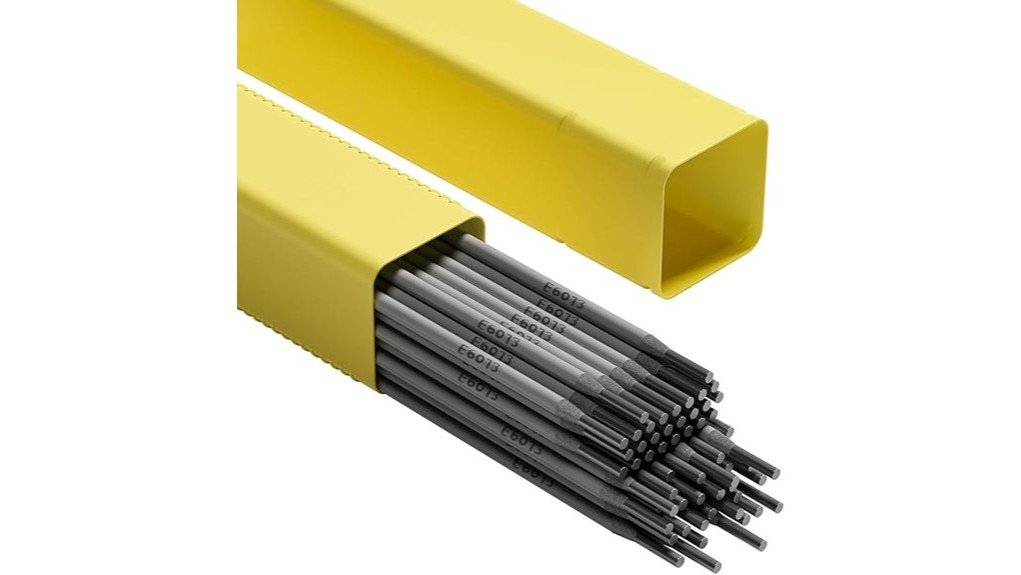
The E6013 1/8 welding rods 2.5 lb pack holds general-purpose stick electrodes for mild steel, light fabrication, and garage repairs. The listing shows a 1/8 inch (3.2 mm) diameter, 14 inch length, AC and DC compatibility, and all-position use. Expect an easy arc and a clean bead with medium penetration, not the deep bite of E6010 or E6011. Confirm the brand and exact pack on Amazon, since the details here come from the listing.
Quick Specs (Per the Listing)
| Classification | E6013 stick electrode |
| Diameter | 1/8 inch (3.2 mm) |
| Length | 14 inches |
| Package weight | 2.5 lb |
| Current | AC or DC; confirm polarity on the box |
| Suggested amperage | 80-120 A per the listing; follow the rod box |
| Positions | Flat, horizontal, vertical, overhead |
Who Should Buy These E6013 1/8 Welding Rods 2.5 lb
- Beginners who want an easy-starting rod for practice and small repairs.
- Garage and farm welders fixing brackets, gates, frames, and light equipment in mild steel.
- Hobbyists with a basic AC or DC stick welder that can supply 80 A or more.
Skip them if you weld thin sheet metal (a 3/32 inch rod or a smaller diameter is easier to control), need deep penetration through rust or heavy scale, or must use a code-specified low-hydrogen electrode such as E7018.
How These Rods Perform
E6013 has a smooth, stable arc, low spatter, and slag that releases easily when the settings are right. Penetration is medium, which suits clean mild steel and light-gauge fabrication. It copes with slightly rusty surfaces better than most beginner rods, but cleaning the joint first still gives the best weld.
This review was not hands-on tested. Feedback on the listing page is the best check for brand-specific behavior, and the star rating shown there can change over time, so read the recent comments yourself.
Using E6013 Rods for Best Results
- Check your welder can deliver the current for a 1/8 inch rod. The listing suggests 80-120 A, and the rod box has the maker’s range.
- Clean off paint, oil, and loose rust at the joint.
- Keep a short arc and a steady travel speed.
- Lower the current a little for vertical and overhead welds.
- Chip and brush the slag between passes, then inspect the bead.
- Store leftover rods in a sealed, dry container.
Galvanized or coated steel gives off harmful fumes when welded, so grind the coating off the weld area and ventilate the space. Wear a helmet, dry gloves, and flame-resistant clothing.
Pros and Limitations
- Pro: easy arc starts and re-strikes, good for learning.
- Pro: works on AC and DC machines and in all positions.
- Pro: low spatter and easy slag removal.
- Limitation: medium penetration only, so it is not for thick or heavily contaminated steel.
- Limitation: 1/8 inch is too hot for very thin sheet.
- Limitation: not a low-hydrogen rod, so avoid it for critical structural welds.
Other E6013 options to compare:
Related stick electrode guides: WISUNO E6013 Welding Rod 1/8 in Review | Faiuot E6013 Welding Rods 1/8 in Review: 32-Rod Pack | YESWELDER E6013 Welding Rod Review
Frequently Asked Questions
Are E6013 welding rods good for beginners?
Yes. E6013 starts easily, runs smoothly, and leaves slag that is simple to remove, so it is a common first stick electrode. Practice on scrap steel before welding a real part.
What can I weld with E6013 rods?
Mild and low carbon steel, from brackets and frames to light fabrication. Do not use E6013 for stainless steel, aluminum, or cast iron, and be careful with galvanized steel because of the fumes.
What amperage should I use with a 1/8 inch E6013 rod?
The listing suggests 80-120 A. Start in the lower half of the range printed on the rod box, test on scrap of the same thickness, and adjust for position and joint.
How should I store E6013 welding rods?
Keep them in a sealed container in a dry place away from high humidity. Damp flux makes the arc unstable and the weld rougher.
Can I use E6013 rods outdoors?
Yes, as long as wind does not blow the arc around and the rods stay dry. Shield the work area when possible.