As an Amazon Associate I earn from qualifying purchases. Buying through these links costs you nothing extra.
E6013 Welding Rod Review
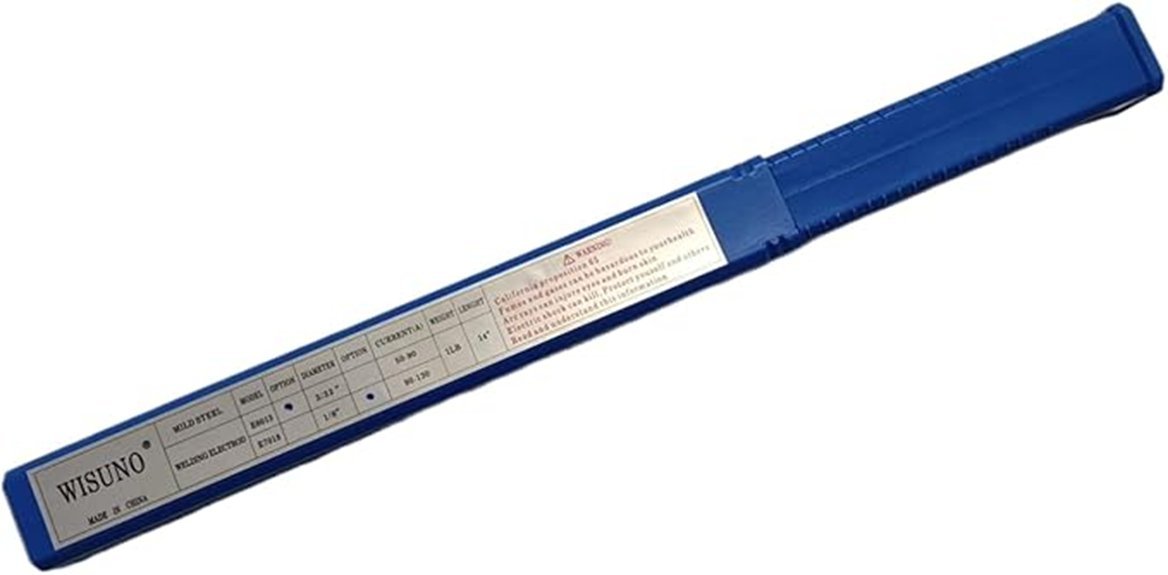
Choosing a stick electrode is less about finding one rod that does everything and more about matching penetration, arc behavior, and diameter to the job. The WISUNO E6013 welding rod linked in this review is a 1/8-inch, 1-pound pack made for mild and low-carbon steel. It favors easy starts, a steady arc, and a smooth bead over aggressive digging action. This review explains where it fits, where it falls short, and what you should check before using it on a real project.
Quick Verdict
Best For: Beginners, hobby welders, light fabrication, sheet-metal practice, and clean mild-steel repairs
Bottom Line: This WISUNO E6013 pack is a practical choice when you want calm arc behavior and neat-looking welds from a common 1/8-inch rod. Its main tradeoff is modest penetration, so it is not the first choice for dirty steel, heavy sections, or safety-critical work without an approved procedure.
Key Specifications
| Specification | Detail |
|---|---|
| Brand | WISUNO |
| Electrode classification | E6013 |
| Product type | Carbon-steel stick welding electrode |
| Welding process | Shielded metal arc welding (SMAW) |
| Linked variant | 1/8-inch diameter, 1-pound package |
| Current compatibility | AC or DC according to the product listing; confirm preferred polarity on the package |
| Typical starting range | About 80 to 120 amps for a 1/8-inch E6013, then adjust to the rod label, welder, joint, and position |
| Welding positions | All-position use is stated for this listing; vertical and overhead work still require correct technique |
| Best base metal | Clean mild steel and low-carbon steel |
| Penetration profile | Low to medium, with an emphasis on smooth bead appearance and easy control |
| Storage | Keep dry and sealed when possible; follow the package guidance before attempting any reconditioning |
| ASIN | B0DDJRPNH7 |
Before You Buy: E6013 is an electrode classification, not proof that every pack is approved for every structural job. For load-bearing, coded, pressure, vehicle-safety, lifting, or other critical work, use the electrode and procedure required by the drawing, welding procedure specification, engineer, or governing code.
What Is the WISUNO E6013 Welding Rod?
This product is a consumable flux-coated electrode for SMAW, also called stick welding. The linked WISUNO variant uses a 1/8-inch rod diameter and comes in a 1-pound pack. The listing describes it for AC or DC operation, all-position welding, low-carbon steel, easy arc initiation, stable arc behavior, smooth weld seams, and easier slag removal.
The E6013 classification is widely associated with rutile-based general-purpose electrodes. In practical terms, that usually means a softer arc, manageable puddle, and flatter-looking bead than a more aggressive cellulosic rod. It is designed for welders who value control and appearance on clean, light to medium mild-steel work.
Who Should Buy It?
Best For
- Beginners learning to strike, hold, and restart an arc on mild steel
- Hobby welders making brackets, gates, furniture, light frames, and shop fixtures
- Users who want a 1/8-inch rod for smooth cover passes and general repairs on clean steel
Skip If
- You need deep penetration through heavy rust, paint, scale, or poor surface preparation
- Your project requires a low-hydrogen electrode or a specific code-qualified consumable
- Your welder cannot supply the current needed to run a 1/8-inch rod comfortably
Arc Starts and Control
Easy starting is one of the main reasons buyers choose E6013. The coating supports a relatively soft, quiet arc, which can make it easier to see the puddle and maintain a consistent travel speed. That is useful when you are still learning how close to hold the rod without sticking it to the workpiece.
The forgiving feel does not remove the need for setup. A damp rod, weak ground connection, low open-circuit voltage, or incorrect amperage can still cause sticking and unstable restarts. Begin near the middle of the package range, then make small adjustments rather than turning the current up sharply.
Bead Appearance and Slag Removal
E6013 is usually selected when bead appearance matters. With the right heat and travel speed, it can lay down an even bead with smooth ripples and a flat to slightly convex profile. The slag often lifts or chips away more easily than it does with some general-purpose rods.
Easy slag removal depends on fusion and technique. If you run too cold, hold a long arc, or trap slag at the toes, the finished weld may look acceptable while hiding poor fusion. Clean each pass fully before adding another bead, especially on fillets and multi-pass work.
Penetration and Material Thickness
The tradeoff for a calm arc and tidy bead is limited digging action. E6013 generally gives low to medium penetration, so it works best on clean steel with sound fit-up. It can be useful on sheet metal and lighter sections, but a 1/8-inch rod may still put too much heat into very thin material if your machine will not run it steadily at the low end.
For thinner work, a smaller diameter such as 3/32 inch is often easier to control. For thicker joints, proper beveling, root gap, preheat when required, and multiple passes matter more than simply increasing amperage. Never treat rod diameter as a substitute for a qualified joint design.
Polarity and Welding Position
The WISUNO listing states AC and DC compatibility. General E6013 data commonly supports AC, DC electrode positive, and DC electrode negative, but the exact brand label should decide your starting polarity. Your welder also needs enough open-circuit voltage and stable output to maintain the arc.
All-position capability does not mean every position feels equally easy. Flat and horizontal beads are the simplest starting point. Vertical and overhead welds need a tighter arc, lower heat, careful puddle control, and practice on scrap before you work on a finished part.
How It Performs in Real Use
For Sheet Metal and Light Fabrication
On clean light-gauge steel, E6013 can produce neat beads with less aggressive penetration than E6011. The smooth puddle helps on lap joints, small fillets, light brackets, and cosmetic repairs. Use short welds and allow cooling time if distortion or burn-through starts to appear.
For Home and Farm Repairs
It fits non-critical repairs where the metal can be cleaned and the joint does not need a deep, forceful root. Examples include shop carts, mild-steel frames, fences, and small equipment guards. It is less suitable when the repair surface is heavily contaminated or when failure could injure someone.
For Practice and Skill Building
The stable arc makes E6013 useful for practicing starts, restarts, straight beads, fillet welds, and travel consistency. A 1-pound pack is also a manageable quantity for occasional use. Practice on steel that matches the thickness and joint style of the planned job.
For Vertical and Overhead Work
The rod can be used out of position, but the fluid slag and puddle require attention. Reduce amperage from your flat-position setting, keep the arc short, and use small controlled movements. Stop and adjust when the puddle begins to sag or slag runs ahead of the arc.
Setup and Usage Tips
Start With a Sensible Amperage
A representative manufacturer data sheet lists 80 to 120 amps for 1/8-inch E6013. Treat that as a general starting window, not a WISUNO-specific command. Use the package label first, then account for material thickness, joint type, position, cable length, and your machine’s actual output.
Prepare the Workpiece
Remove oil, paint, moisture, heavy rust, and loose mill scale around the joint. E6013 may tolerate minor surface discoloration, but it does not dig through contamination as aggressively as E6011. A clean ground-clamp location also improves arc stability.
Keep the Arc Short
A long arc adds spatter, weakens shielding, and makes the bead harder to control. Hold the tip close enough to maintain a compact arc without pushing the rod into the puddle. Use a slight drag angle unless the joint or procedure calls for something different.
Test Before the Final Weld
Run a bead on scrap from the same material before welding the part. Check the sound, bead width, toe fusion, slag behavior, and heat distortion. Break or cut test coupons when joint strength matters, and use qualified inspection for critical work.
Pro Tip: Mark the amperage and polarity that worked on a piece of scrap, then store that note with the remaining rods. It gives you a faster starting point the next time you use the same welder, rod diameter, and steel thickness.
Safety, Storage, and Technical References
Arc welding can expose you to ultraviolet radiation, hot metal, sparks, electrical shock, and welding fumes. Wear a properly shaded welding helmet, safety glasses, flame-resistant clothing, gloves, and suitable footwear. Remove combustible materials from the area, use effective ventilation, and never weld a closed container or unknown coated metal without the correct procedure.
Galvanized, painted, plated, or contaminated steel can create hazardous fumes. Follow the safety data for the base metal and consumable, and use workplace controls appropriate to the material. OSHA provides official guidance on welding, cutting, and brazing hazards.
Keep unused rods dry, protected from liquid water, and sealed from humid air when possible. Do not apply a generic oven temperature to this WISUNO pack unless its label or manufacturer instructions allow it. For general classification context only, the Pinnacle Alloys E6013 data sheet lists representative current ranges, positions, and storage guidance for its own E6013 product.
Pros and Cons
Pros
- Easy starts and calm arc behavior suit practice and general shop work
- 1/8-inch diameter is common for light to medium mild-steel jobs
- AC and DC compatibility makes it usable with many stick welders
- Smooth bead profile works well when appearance matters
- Slag is usually manageable when the heat and technique are correct
Cons
- Lower penetration makes it a weaker choice for dirty steel and demanding root passes
- The 1/8-inch size may be too hot for very thin sheet or small low-output welders
- Detailed WISUNO warranty, certification, and brand-specific amperage data are not clearly published on the listing
Is It Worth the Price?
This 1-pound WISUNO pack is worth considering as a budget-friendly supply for practice, small repairs, and occasional fabrication. The small package lets you try the 1/8-inch size without buying a large container, and E6013 is a useful rod to keep for clean mild-steel work where appearance matters.
The value is weaker if your projects involve heavy rust, thick structural joints, or a welder that struggles to run 1/8-inch electrodes. Compare the current package weight, shipping terms, and label instructions with established brands before deciding. A lower purchase price does not outweigh missing documentation on a safety-critical job.
How It Compares to Alternatives
E6011 is usually the better comparison when you need stronger digging action on less-clean steel or a root pass. E7018 is the better candidate when a specified low-hydrogen electrode and higher strength classification are required, but it demands stricter storage and procedure control. E6010 offers forceful penetration for compatible DC setups and specialized root work, yet it is less forgiving for casual users.
The WISUNO E6013 makes the most sense when your priorities are easy handling, a tidy bead, AC or DC flexibility, and light general-purpose mild-steel welding.
Related stick electrode guides: E6013 Welding Rods Review: Performance and Reliability | YESWELDER E6013 Welding Rod Review | Saker E6013 Welding Rod Review
Frequently Asked Questions
What does E6013 mean?
Under the common AWS classification system, “E” identifies an electrode, “60” refers to a 60,000 psi minimum tensile-strength class, “1” indicates all-position use, and “3” identifies coating and current characteristics. The marking does not replace the need to confirm the actual package specifications and project requirements.
What amperage should you use for a 1/8-inch E6013 rod?
A general starting range is about 80 to 120 amps, with roughly 100 amps often used as a middle reference. Follow the WISUNO package first, then adjust for steel thickness, joint type, welding position, and your machine’s actual output.
Can this WISUNO E6013 rod run on AC and DC?
Yes. The product listing states that it is suitable for both AC and DC applications. Check the package for the preferred DC polarity and make sure your welder can supply stable current for a 1/8-inch electrode.
Is E6013 good for rusty or painted steel?
It works best after oil, paint, moisture, heavy rust, and loose scale are removed. E6011 generally handles contamination and poor surface preparation better, but hazardous coatings still require proper identification, removal, ventilation, and protective controls.
Can you weld sheet metal with a 1/8-inch E6013 rod?
You can use it on some light-gauge work, but the 1/8-inch diameter may add too much heat for very thin sheet. Short beads, good fit-up, lower current within the approved range, and a smaller 3/32-inch rod can provide better control.
Can E6013 be used for vertical or overhead welding?
The listing describes all-position use, so vertical and overhead welding are within the intended category. Reduce heat as needed, keep a short arc, and practice puddle control on scrap before making a finished weld.
Is E6013 suitable for structural welding?
Do not choose it for structural work based only on the rod name. Use the electrode classification, brand, diameter, storage condition, joint design, and welding procedure required by the engineer, code, or project specification.
How long do E6013 rods last in storage?
They can remain usable for a long time when kept clean and dry, but there is no universal shelf-life date for every brand and package. Inspect the coating for moisture damage, cracking, or contamination and follow the WISUNO label before use.
The Bottom Line
The WISUNO E6013 1/8-inch, 1-pound pack is a sensible buy for beginners and hobby welders who want smooth arc behavior on clean mild steel. Skip it when you need deep penetration, a smaller rod for very thin sheet, or documented approval for a critical weld. Its strongest point is ease of control, while its main limitation is modest penetration and limited brand-specific technical documentation.
Ready to Buy?
Check the current 1/8-inch variant, package weight, label instructions, and seller details before you decide.