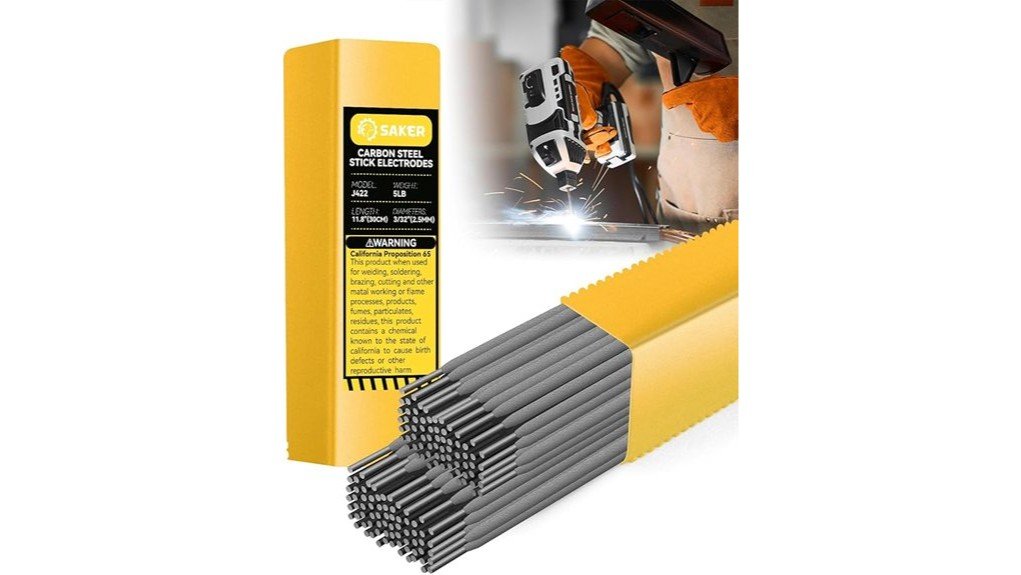
Choosing a stick electrode for thin steel can be frustrating because a rod that penetrates too aggressively may burn through the workpiece, while a hard-starting rod can slow down every repair. The Saker E6013 Welding Rod is a 3/32-inch, 5 lb pack made for low-carbon steel and light to medium welding jobs. Its main strengths are AC/DC compatibility, easy arc starts, low spatter, and manageable slag. This review explains where it fits, where its shallow penetration becomes a limitation, and what you should confirm before ordering.
Quick Verdict
Rating: 8/10, Recommended with caveats
Best For: Beginners, hobby welders, and DIY users working on light-gauge low-carbon steel
Bottom Line: The Saker E6013 is a practical general-purpose rod when you value easy starts, AC/DC flexibility, and simpler cleanup. Its shallow penetration is useful on thinner steel, but it is not the right choice for aluminum, deep-penetration work, or code-critical structural welds.
Key Specifications
| Specification | Detail |
|---|---|
| Brand | Saker |
| Model / Part Number | GJ86632-X59903 |
| ASIN | B0DQL1T246 |
| Product Type | E6013 coated stick welding electrodes |
| Target Material | Low-carbon steel |
| Rod Diameter | 3/32 inch (2.5 mm) |
| Nominal Pack Weight | 5 lb (2.27 kg) |
| Listed Item Weight | 5.08 lb |
| Listing Dimensions | 12 x 1.77 x 1.77 inches |
| Current Compatibility | AC and DC, including low-voltage AC machines |
| Welding Positions | All-position use, including flat and vertical work |
| Penetration Profile | Shallow penetration |
| Included Components | Welding rods |
| Best Uses | Light fabrication, sheet metal, small repairs, and suitable light-duty pipe work |
What Is the Saker E6013 Welding Rod?
The Saker E6013 is a consumable electrode for shielded metal arc welding, also called stick welding. This version uses a 3/32-inch diameter and comes in a nominal 5 lb pack. Saker lists it for low-carbon steel, with AC and DC compatibility that broadens the range of machines you can use.
The rod is designed around control and ease of use rather than deep penetration. That makes it better suited to light-gauge steel, small brackets, maintenance work, practice beads, and other jobs where an aggressive arc could create burn-through. The listing also describes easy arc initiation, minimal spatter, all-position use, and flux that supports easier slag removal.
Who Should Buy It?
Best For
- Beginners practicing arc starts and bead control on low-carbon steel
- DIY welders repairing thin steel, brackets, guards, and light shop projects
- Owners of AC or DC stick welders who need a 3/32-inch general-purpose rod
Skip If
- You need an electrode for aluminum, stainless steel, or cast iron
- Your job requires deep penetration, heavy structural work, or a specified code procedure
- You need a published Saker-specific amperage chart before purchasing
Before You Buy: Confirm that your welder accepts 3/32-inch E6013 electrodes and check the package or machine manual for the correct amperage and polarity. Do not use this rod for aluminum or assume it meets a structural welding procedure simply because it is labeled all-position.
Feature-by-Feature Review
3/32-Inch Diameter and Control
The 3/32-inch diameter is a practical size for lighter stick welding. It gives you more control on thin material than a larger electrode, especially when you are trying to limit heat input and avoid blowing through an edge. The tradeoff is a lower deposition rate than larger rods, so it is not the fastest choice for filling wide joints or building large welds.
AC, DC, and Low-Voltage Machine Compatibility
Saker lists the rod for both AC and DC welding current and says it can run on low-voltage AC machines. That flexibility matters if you use a basic transformer welder, a portable inverter, or more than one machine in your shop. You still need to match the machine setting to the rod package, material thickness, joint design, and welding position.
Easy Arc Starts
Easy arc initiation is one of the most useful features for new stick welders. A rod that starts cleanly can reduce repeated sticking and help you focus on travel speed, arc length, and bead placement. It does not remove the need for clean work leads, sound connections, and correct settings, but it can make practice less frustrating.
All-Position Use and Shallow Penetration
The listing describes these rods as suitable for all-position welding, including flat and vertical work. It also highlights shallow penetration, which can help on light-gauge steel and joints with less-than-perfect fit-up. That same shallow profile is the main limitation when a joint needs strong root penetration or when the welding procedure calls for a different electrode.
Spatter and Slag Cleanup
Saker claims minimal spatter and flux that supports easy slag removal. Less spatter can shorten cleanup around the weld, while cooperative slag makes it easier to inspect the bead between passes. Vertical-down welds may clean up especially easily, but results still depend on technique, settings, rod condition, and joint preparation.
Material Compatibility
This product is specifically presented for low-carbon steel. It is not an aluminum electrode, and the listing does not support using it on stainless steel or cast iron. Choosing an electrode by diameter alone is a mistake because the electrode classification and base-metal compatibility matter just as much.
How It Performs in Real Use
Beginner Practice
The easy-starting E6013 format makes sense for practicing strike technique, maintaining a short arc, and learning how travel speed changes bead shape. The 3/32-inch diameter is manageable on small coupons and light steel. Practice on scrap from the same material thickness before moving to a repair that matters.
Sheet Metal and Small Brackets
Shallow penetration can be helpful on thin sheet, tabs, guards, and small brackets because it lowers the risk of immediately cutting through the base metal. You still need tight fit-up, controlled heat, and short weld segments where distortion is a concern. E6013 does not make very thin sheet automatically easy, so test your settings first.
Garage Repairs and Light Fabrication
For non-critical garage work, the rod offers a useful balance of arc control and cleanup. It can suit light frames, tool stands, small supports, and general maintenance on compatible steel. Inspect the joint design before choosing it, since a repair that carries heavy or dynamic loads may need a different electrode and a qualified procedure.
Light-Duty Pipe and Vertical-Down Work
The listing includes pipe welding and vertical positions among the intended uses. The controllable puddle and easy slag behavior may help on suitable light-duty work. Do not use it as a substitute for a required pipe-welding procedure, inspection standard, or code-specified electrode.
How to Use It Correctly
- Check the package first: Use the amperage and polarity information supplied with the rods, then confirm that your welder can deliver the required range.
- Test on matching scrap: Use steel with a similar thickness and joint shape so you can adjust heat before welding the finished part.
- Prepare the joint: Remove paint, oil, heavy rust, plating, and other contamination that can affect arc stability or create hazardous fumes.
- Keep the rods dry: Store unused electrodes in a sealed, dry container and avoid using rods with damaged or damp flux.
- Control arc length: A long, wandering arc can increase spatter and reduce bead control. Follow the rod label and your welder manual for technique guidance.
- Remove slag between passes: Chip and brush the weld before adding another pass so slag is not trapped in the joint.
Pro Tip: Start your setup on scrap with the lowest practical setting that maintains a stable arc, then increase current only as needed. The correct setting depends on the machine, position, joint, and steel thickness, so avoid copying a single amperage number without checking the rod package.
Welding Safety and Storage
Use a properly rated welding helmet, safety glasses, leather welding gloves, flame-resistant clothing, and closed footwear. Keep combustible materials away from the work area, provide ventilation, and maintain a fire watch after welding. Never weld in wet conditions or on containers, tanks, or coated materials unless you understand and control the specific hazards.
Keep electrodes dry because moisture can damage the flux and affect arc behavior. Store the pack off damp concrete and away from large temperature swings. The current listing does not publish a verified shelf-life claim, so judge stored rods by package guidance, storage history, and flux condition rather than an assumed number of years.
Pros and Cons
Pros
- 3/32-inch diameter suits light-gauge steel and smaller repairs
- Runs on both AC and DC welding current
- Compatible with low-voltage AC machines according to Saker
- Easy arc starts can reduce sticking during practice and repair work
- Low spatter and easier slag removal can shorten cleanup
Cons
- Shallow penetration is not suitable for every heavy-duty joint
- Designed for low-carbon steel, not aluminum or specialty alloys
- The Amazon listing does not provide a Saker-specific amperage range
Is It Worth the Price?
The Saker E6013 is worth considering when you need a 5 lb supply of 3/32-inch electrodes for light low-carbon steel work. You get a useful mix of AC/DC compatibility, easy starting behavior, all-position capability, and simpler cleanup. Buyers who practice often or handle routine garage repairs are likely to get more value from the larger pack than someone who needs only a few rods for one job.
Its value falls if your projects require deep penetration, a published procedure, or a different base-metal electrode. The current Amazon page should be checked for the latest price, seller, package details, and return terms before ordering because consumable pricing and offers can change.
How It Compares to Alternatives
The Forney 30305 E6013 is the closest size-for-size comparison because it is also sold as a 3/32-inch, 5 lb general-purpose steel electrode. The Hobart 3/32-inch E6013 is another established carbon-steel option, while Lincoln Electric Fleetweld 37 is worth comparing if you want a well-documented E6013 designed for small AC welders and sheet-metal work.
The Saker makes the most sense when its current price is competitive and you want the verified combination of a 5 lb pack, 3/32-inch diameter, AC/DC use, easy starts, and shallow penetration. Compare package condition, published amperage guidance, local availability, and brand support before deciding.
Frequently Asked Questions
What welding machines work with Saker E6013 rods?
Saker lists these rods for both AC and DC stick welders, including low-voltage AC machines. Your welder must also accept 3/32-inch electrodes and provide the amperage required by the rod package.
What metal can you weld with these rods?
The product listing specifies low-carbon steel. It does not support using these rods on aluminum, stainless steel, or cast iron, which require electrodes or processes matched to those materials.
Are 3/32-inch E6013 rods good for thin steel?
They can be a practical choice for light-gauge steel because the smaller diameter and shallow penetration give you more heat control than a larger rod. Very thin sheet can still burn through, so practice on matching scrap and use short, controlled welds.
Can Saker E6013 rods weld in vertical positions?
Yes. Saker lists them for all-position welding, including vertical work, and specifically notes manageable slag during vertical-down welding. Technique and settings still matter, so follow the package directions and test before working on the finished part.
What amperage should you use?
The current Amazon listing does not publish a Saker-specific amperage range. Use the range printed on the electrode packaging and confirm it against your welder manual, material thickness, joint type, and welding position.
Can you use these rods for structural welding?
Do not assume they are suitable for a structural joint just because they are all-position electrodes. Structural, load-bearing, or code-regulated work must follow the required procedure, electrode classification, preparation, inspection, and welder qualification.
How should you store Saker E6013 rods?
Keep the electrodes sealed, dry, and protected from damp floors and rapid temperature changes. Do not rely on an assumed shelf life because the current listing does not publish one; inspect the flux and follow any storage directions on the package.
What is the most common mistake with E6013 rods?
A common mistake is treating E6013 as a universal rod for every metal and joint. Match the electrode to the base metal and required penetration, keep a controlled arc, remove slag between passes, and verify the procedure before welding a critical part.
The Bottom Line
The Saker E6013 Welding Rod is a solid choice for beginners and DIY welders who need a 3/32-inch electrode for light low-carbon steel work. Its strongest points are easy starts, AC/DC compatibility, all-position use, and easier cleanup, while shallow penetration and the missing published amperage range limit its appeal for demanding or procedure-driven jobs. Skip it for aluminum, specialty alloys, or heavy structural welding.
Ready to Buy?
Check the latest price, seller, package details, and compatibility before you decide.