I learned how much TIG filler selection matters when a stainless joint that looked acceptable developed cracks and an uneven bead. The rod must do more than resemble the base metal. It must suit the exact alloy, joint design, service temperature, corrosion exposure, required strength, and welding procedure. This guide was reviewed in July 2026 to provide a safer, clearer starting point for common shop and fabrication work.
Quick Answer
Match the TIG filler rod to the base alloy first, then check strength, corrosion, temperature, and appearance requirements. Common starting choices are ER70S-2 or ER70S-6 for carbon steel, ER308L for 304 stainless, ER316L for 316, ER309L for stainless-to-carbon joints, and an approved 4xxx or 5xxx filler for aluminum.
Key Takeaways
- Identify the exact base-metal grade before selecting a rod; “steel,” “stainless,” or “aluminum” is not specific enough.
- Use ER70S-2 or ER70S-6 for ordinary carbon steel, ER308L for 304 stainless, ER316L for 316, and ER309L for many stainless-to-carbon joints.
- Choose aluminum filler by cracking resistance, strength, corrosion, anodizing color, service temperature, and postweld treatment—not by base-alloy number alone.
- Rod diameter affects puddle control, but joint design, heat input, and feeding rhythm matter as much as material thickness.
- For structural, pressure, sanitary, aerospace, racing, or other safety-critical work, the drawing and qualified welding procedure override any general chart.
At a Glance
| Time Required | About 10–20 minutes to identify the alloy, check the service requirements, and verify the filler recommendation; welding time varies by joint. |
| Difficulty | Beginner for common matched alloys; intermediate to advanced for dissimilar metals, specialty alloys, code work, and heat-treated components. |
| Tools Needed | Material markings or alloy records, WPS or manufacturer chart, calipers, labeled filler rods, dedicated cleaning tools, TIG machine, shielding gas, and proper PPE. |
| Cost | Low for common carbon-steel rods, moderate for stainless and aluminum, and substantially higher for titanium, nickel alloys, and other specialty fillers. |
Warning: This chart is a general selection aid, not a welding procedure specification. For structures, pressure equipment, sanitary systems, vehicles, aircraft, lifting devices, or parts that can injure someone if they fail, follow the drawing, applicable code, filler manufacturer, and qualified WPS.
Understanding TIG Filler Rods
A TIG filler rod is a straight, bare consumable that you feed by hand into the front edge of the weld puddle. The tungsten electrode creates the arc but normally does not become part of the weld. The filler rod supplies metal, controls weld chemistry, fills the joint, and can influence strength, cracking, corrosion resistance, color match, and response to heat treatment.
Many cut-length TIG rods are about 36 inches long and are sold in sealed tubes or boxes. Keep every tube labeled. Once two similar-looking stainless or aluminum rods are mixed together, visual identification is rarely dependable.
You do not always need filler. A tight, thin joint may be fusion welded without added metal when the alloy, design, penetration, and procedure permit it. This is called an autogenous weld. However, filler is usually needed for fillets, open roots, imperfect fit-up, reinforcement, multiple passes, or joints that require a controlled weld-metal chemistry.
There is no reliable rule that says every joint above one thickness must receive filler. Base alloy, joint geometry, loading, fit-up, penetration requirements, and the governing procedure decide that. Early on, I tried skipping filler on a loaded butt joint because the fit looked tight. The joint later cracked, which taught me not to treat appearance as proof that an autogenous joint is suitable.
The base-metal name starts the selection process; the joint’s service conditions finish it.
How to Read AWS TIG Filler Classifications
The American Welding Society classifies common bare filler metals in standards including AWS A5.18/A5.18M:2025 for carbon steel, AWS A5.9/A5.9M:2022 for stainless steel, and AWS A5.10/A5.10M:2023 for aluminum.
For a designation such as ER70S-6:
- ER means the product can be supplied as an electrode or rod, depending on the process and product form.
- 70 identifies a minimum tensile-strength class of about 70 ksi under the classification test conditions.
- S means solid wire or rod.
- -6 identifies a particular chemical-composition and deoxidizer classification.
Stainless names such as ER308L and ER316L mainly describe alloy chemistry. The “L” identifies a low-carbon version intended to reduce harmful carbide precipitation in suitable applications. Aluminum designations such as ER4043 and ER5356 identify different aluminum filler-alloy families.
Note: An AWS classification confirms that a filler meets a classification specification. It does not prove that the filler is suitable for every joint made from a broadly similar metal.
How to Choose the Right TIG Filler Rod
- Identify both base metals. Read mill markings, drawings, certificates, part records, or manufacturer data. Do not guess from color or magnet response alone.
- Check the controlling documents. A drawing, repair manual, code, WPS, sanctioning-body rule, or filler-selection chart may specify the exact classification.
- Choose the matching filler family. Start with the common match for the base alloy, such as ER308L for 304 stainless.
- Check service conditions. Consider corrosion, sustained temperature, impact, fatigue, cyclic loading, pressure, food contact, anodizing, postweld heat treatment, and exposure to chemicals.
- Account for dilution and dissimilar metals. The weld puddle contains material melted from both sides of the joint. A filler that works between similar alloys may crack or lose corrosion resistance in a mixed joint.
- Select a manageable diameter. The rod should melt smoothly without chilling the puddle or forcing an oversized bead.
- Test and document the setup. Use representative scrap when possible. For critical work, qualify or follow the required procedure rather than relying on a shop test alone.
Pro Tip: Write the alloy, diameter, purchase lot, and usual applications on every storage tube. My filler bins became color-coded after I once reached for a mild-steel rod during a stainless job.
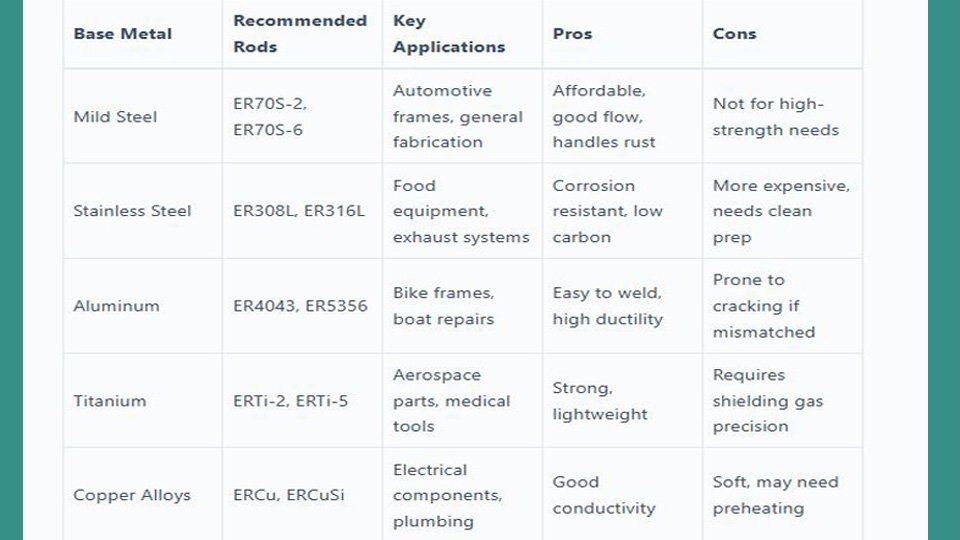
TIG Welding Filler Rod Selection Chart
Use the following chart as a practical starting point. Specialty grades, heat-treated materials, castings, pressure work, and dissimilar joints require additional verification.
| Base Metal or Joint | Common Starting Filler | Why It Is Used | Limits and Checks |
|---|---|---|---|
| Ordinary mild or carbon steel | ER70S-2 or ER70S-6 | Compatible strength class and useful deoxidizers | Do not use automatically for high-strength or heat-treated steel; follow the WPS |
| 4130 chromoly | ER80S-D2 is common; some procedures use ER70S-2 or another filler | Commonly selected for strength and compatibility in motorsports fabrication | Tube condition, thickness, heat treatment, design, and sanctioning rules may change the requirement |
| 304 or 304L stainless | ER308L | Matches common 18-8 austenitic stainless chemistry | Control heat tint and purge full-penetration roots where required |
| 316 or 316L stainless | ER316L | Provides molybdenum-bearing weld metal for suitable 316-series service | Do not select it solely because the finished part will be outdoors; match the base alloy and procedure |
| Austenitic stainless to carbon steel | ER309L | Handles dilution from stainless and carbon steel in many common joints | ER312 or nickel filler may be specified for difficult repairs; verify the procedure |
| 2205 duplex stainless | ER2209 is common | Designed to help maintain suitable duplex weld-metal chemistry | Heat input, interpass temperature, shielding, and ferrite balance require procedure control |
| 17-4 precipitation-hardening stainless | ER630 when the approved procedure permits it | Matches the precipitation-hardening alloy family | Final properties depend heavily on heat treatment and service requirements |
| 6061 and many other 6xxx aluminum alloys | ER4043, ER4943, or ER5356 as approved | Offers different balances of crack resistance, strength, ductility, anodizing color, and corrosion behavior | Use a manufacturer selection chart; no single filler is best for every 6xxx joint |
| 5052, 5083, and other weldable 5xxx aluminum alloys | ER5356, ER5183, ER5556, or another approved 5xxx filler | Common choices for matching magnesium-bearing aluminum and structural requirements | High-magnesium fillers are generally unsuitable for prolonged service above 150°F (65°C) |
| Weldable aluminum castings | ER4043 or ER4047 are common starting choices | Silicon improves fluidity and can reduce hot-cracking sensitivity | Identify the casting alloy and remove oil from the pores; some castings remain difficult or unsuitable to weld |
| Commercially pure titanium | ERTi-2 for Grade 2 material | Matches a widely used commercially pure titanium grade | Requires exceptional cleanliness, high-purity argon, trailing coverage, and backside shielding where needed |
| Ti-6Al-4V titanium | ERTi-5 for Grade 5 material | Matches the common alpha-beta titanium alloy family | Contaminated blue, gray, or white weld metal may need complete removal |
| Pure copper | ERCu or a procedure-specified copper filler | Maintains copper-rich weld metal and conductivity | Copper removes heat quickly and may need preheat or a high-output setup |
| Steel sheet joined by silicon-bronze braze welding | ERCuSi-A | Lower melting temperature can limit distortion and coating damage | It is a braze-weld deposit, not an automatic structural substitute for a fusion weld |
| Nickel alloys or nickel-to-steel joints | Match the alloy and procedure; ERNiCr-3 and ERNiCrMo-3 are common examples | Special nickel fillers can tolerate dilution and demanding corrosion or temperature service | Choose from the exact base-alloy combination and service requirements |
| Cast iron | Nickel-based filler selected by a cast-iron repair procedure | Nickel fillers can reduce hardness and improve machinability in suitable repairs | TIG is not always the preferred repair process; crack control, preheat, cooling, and base-metal condition are critical |
Selecting Filler Rods for Mild Steel and Chromoly
ER70S-2
ER70S-2 is a common TIG rod for clean mild steel, tubing, root passes, repairs, and general fabrication. It contains aluminum, titanium, and zirconium deoxidizers. Those additions help control small amounts of oxygen and contamination in the puddle, but they do not make surface preparation optional.
ER70S-2 usually provides a calm puddle and good control on tubing and precise shop work. It is the filler I reach for first on clean mild-steel TIG joints unless the drawing or procedure says otherwise.
ER70S-6
ER70S-6 has higher manganese and silicon than ER70S-2. According to Lincoln Electric’s ER70S-6 data, this gives it greater tolerance for mill scale and surface contaminants and promotes fluidity.
That does not mean you should weld over oil, paint, heavy rust, moisture, plating, or unknown coatings. Clean to sound metal whenever the job permits. Higher silicon can also leave small glassy islands on the cooled bead that should be removed before another pass or coating.
4130 Chromoly
ER80S-D2 is a common TIG choice for 4130 chromoly in motorsports and fabricated tubing, and Miller lists it for several 4130 applications. However, ER70S-2 and other fillers also appear in established procedures.
Do not select a chromoly filler by tensile strength alone. Tube thickness, normalized or heat-treated condition, joint restraint, fatigue loading, preheat, postweld treatment, and sanctioning-body rules can change the correct choice.
Best Filler Rods for Stainless Steel
Stainless steel rewards clean preparation, short arc length, controlled heat input, and the correct filler chemistry. Hobart’s austenitic stainless guidance supports the common pairings below.
- ER308L: Standard starting filler for 304 and 304L stainless.
- ER316L: Standard starting filler for 316 and 316L, including suitable service where molybdenum improves pitting resistance.
- ER309L: Common choice for joining austenitic stainless to carbon steel or for some stainless overlay work.
- ER312: A high-ferrite, crack-resistant option used in some difficult dissimilar joints and repairs. It is not a universal upgrade from ER309L.
- ER2209: Common filler for 2205 duplex stainless when heat input and interpass temperature are controlled by a procedure.
- ER630: Used for 17-4 precipitation-hardening stainless when the approved procedure and heat-treatment plan call for it.
For full-penetration stainless tube, pipe, tanks, and sanitary work, shield the root side when the procedure requires it. An unprotected root can oxidize heavily, creating a rough “sugared” surface that reduces cleanliness and corrosion performance.
On one stainless tank job, I focused on filler classification but rushed the degreasing step. The resulting porosity was a reminder that the right rod cannot compensate for oil, marker residue, moisture, or dirty purge equipment.
Pro Tip: Use stainless-steel brushes, abrasives, and work surfaces that are dedicated to stainless. Tools previously used on carbon steel can embed iron particles that later rust.
Products Worth Considering

ER308L TIG WELDING ROD: ER308L is a low -carbon stainless steel tig welding rod, which has excellent anti -crystal interval corrosion properties and full -location welding performance.

ER308L: Most popular stainless rod for general-purpose applications where corrosion is moderate and applications at cryogenic temperatures.

er308l stainless steel tig welding rods 1 16 x 16 1 6mm tig filler rod thin stainless sheet tubing handrail kitchen equipment low splatter corrosion resistant stainless steel welding wire tig welding accessories gta w argon arc
Aluminum TIG Filler Rod Guide
Aluminum filler selection requires more than matching the first digit of an alloy number. ESAB’s aluminum filler-selection guidance recommends considering crack resistance, strength, ductility, corrosion, sustained temperature, anodizing response, and postweld heat treatment.
Products Worth Considering

ER4043 TIG WELDING ROD: This TIG welding rod has 5% added silicon, This can improve the liquidity of the melt pool.

ER4043 TIG WELDING ROD: ER4043 is a 5% silicon -containing aluminum and silicon alloy welding rod. It has high silicon content, good liquidity, and strong heat resistance
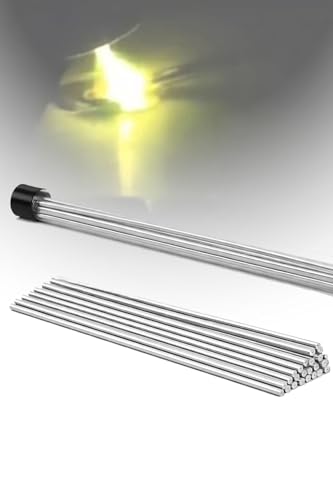
【Easy To Use】ER5356 Aluminum tig welding rod provides smooth arc stability and minimal spatter for clean weld seams, making it easier to achieve precise and visually appealing results.
ER4043
ER4043 is an aluminum-silicon filler commonly used on 6xxx alloys and many weldable castings. It wets smoothly, has relatively low crack sensitivity in suitable combinations, and produces a fluid puddle. Its gray anodized color may differ from the base metal.
ER4943
ER4943 is used in approved applications where a manufacturer chart or WPS calls for a 4xxx filler with a different strength response from ER4043. It appears in many current automotive recommendations for 6xxx components, but it should not be treated as an automatic replacement in every ER4043 joint.
ER5356
ER5356 is an aluminum-magnesium filler used on many 5xxx and 6xxx combinations. It can provide higher as-welded strength in suitable joints and often gives a closer color match after clear anodizing than ER4043.
Warning: Aluminum fillers containing more than about 3% magnesium, including ER5356, are generally not recommended for prolonged service above 150°F (65°C). Long exposure can make the weld more vulnerable to sensitization and stress-corrosion cracking. Use a filler approved for the operating temperature.
ER4047
ER4047 contains more silicon than ER4043. Its high fluidity and lower melting range can help with suitable cast repairs, sealing applications, and joints prone to hot cracking. The casting alloy still must be identified because not every aluminum casting is safely weldable.
Aluminum Alloys That Need Extra Caution
Some 2xxx and 7xxx aluminum alloys have poor fusion-welding characteristics or require tightly controlled aerospace or manufacturer procedures. Do not assume that an available filler rod makes an unknown aircraft, wheel, suspension, or high-strength aluminum part repairable.
Aluminum Machine Setup
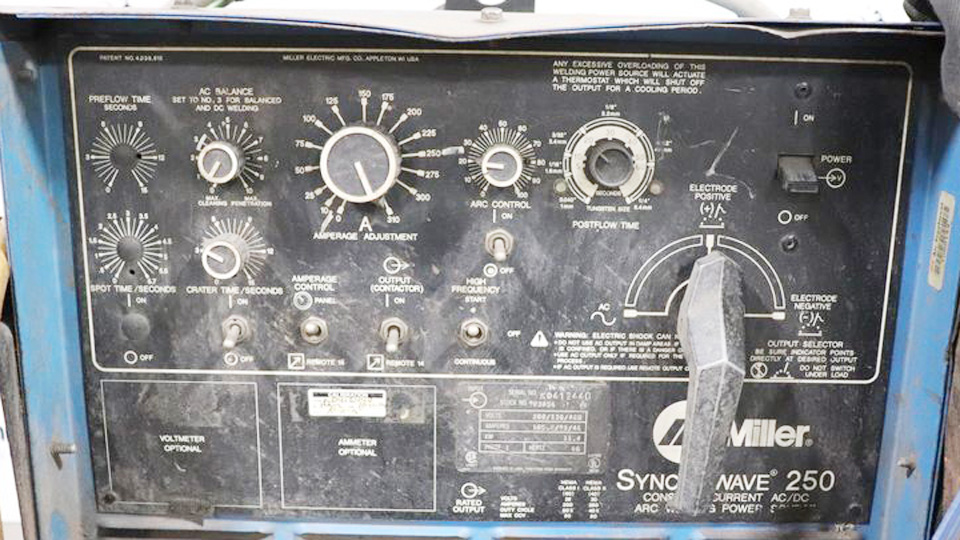
For ordinary manual aluminum TIG, use AC unless a qualified procedure specifically requires another method. Electrode-positive time helps break up the oxide layer, while electrode-negative time directs more heat into the workpiece.
A practical starting point on clean aluminum is roughly 70–80% electrode negative. Adjust toward more cleaning only when the oxide condition requires it. Miller’s AC-balance guide explains how too much electrode-positive time overheats the tungsten and reduces penetration.
Degrease first, then remove oxide with a clean stainless brush or scraper reserved for aluminum. Clean the joint shortly before welding because a new oxide layer begins forming immediately.
Filler Rods for Titanium, Copper, Nickel Alloys, and Cast Iron
Titanium
Match titanium filler to the exact grade. ERTi-2 is used for Grade 2 commercially pure titanium, while ERTi-5 matches Ti-6Al-4V Grade 5 in suitable procedures. Use high-purity argon, a large gas lens or trailing shield, and backside purging where needed.
Miller’s titanium guidance stresses keeping the hot filler tip and cooling weld under shielding gas. Silver and light straw colors are normally preferable. Dark blue, gray, chalky white, or flaking deposits indicate serious atmospheric contamination and may require removal of the affected metal.
Copper and Silicon Bronze
ERCu is a common starting filler for suitable pure-copper work. Copper carries heat away from the joint rapidly, so thick parts may require preheat and a high-output machine.
ERCuSi-A silicon bronze is useful for TIG braze welding thin sheet, sculpture, automotive panels, and some coated-steel assemblies. Because the filler melts below the steel’s melting point, it can reduce distortion. However, a silicon-bronze braze weld is not automatically equivalent to a structural fusion weld.
Nickel Alloys
Nickel-alloy filler must be chosen from both base metals and the intended service. ERNiCr-3 is common in some nickel-to-steel and high-temperature joints, while ERNiCrMo-3 is used in suitable corrosion-resistant nickel-alloy combinations. These fillers are not interchangeable, especially in chemical, pressure, or elevated-temperature service.
Cast Iron
Cast iron repairs may use nickel-based filler, but TIG is not always the safest or easiest process. Carbon content, contamination, crack location, casting restraint, preheat, bead length, peening, and cooling rate all affect the result. Treat an unknown or highly loaded casting as a procedure-development job rather than a simple filler substitution.
TIG Filler Rod Diameter Chart
Rod size controls how much cold metal enters the puddle with each dip. A rod that is too large can chill a small puddle and encourage excessive heat input while you wait for it to melt. A rod that is too small may require frantic feeding and make the bead harder to build.
| Base-Metal Thickness | Common Starting Rod Diameter | Practical Guidance |
|---|---|---|
| Up to 0.040 in. (1.0 mm) | 0.035 or 0.045 in. | Useful for very thin sheet, small edges, and precise low-heat work |
| 0.040–0.063 in. (1.0–1.6 mm) | 0.045 or 1/16 in. | Choose the smaller rod when fit-up is tight and heat control is difficult |
| 1/16–1/8 in. (1.6–3.2 mm) | 1/16 in. | A versatile size for tubing, sheet, brackets, and general fabrication |
| 1/8–1/4 in. (3.2–6.4 mm) | 3/32 in. | Feeds more metal without the heavy chilling effect of an oversized rod |
| Over 1/4 in. (6.4 mm) | 1/8 in. or procedure-specified size | Joint beveling, preheat, multiple passes, and a higher-output torch may be more important than using a larger rod |
For thin-wall stainless, a smaller rod often makes heat control easier, but lower thermal conductivity does not create a universal one-size-down rule. Aluminum may accept a larger rod when the puddle is wide and fluid, yet thin sheet still benefits from 0.045- or 1/16-inch filler.
Measure unknown filler with calipers and return it to a labeled tube immediately. Diameter alone cannot identify its alloy.
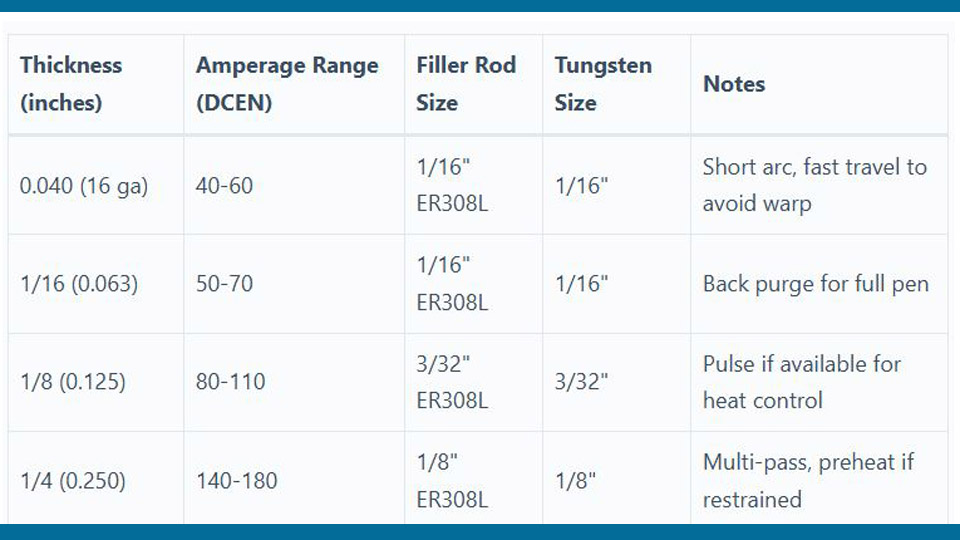
TIG Welder Settings Based on Material and Rod Size
The following settings are only starting ranges for clean material in ordinary shop conditions. Joint shape, machine waveform, tungsten type, cup size, gas lens, position, fit-up, preheat, travel speed, and required penetration can change them substantially.
| Material and Thickness | Polarity | Tungsten | Filler | Current Range | Argon Flow |
|---|---|---|---|---|---|
| Mild steel, 1/16 in. | DCEN | 1/16 in. | 0.045 or 1/16 in. | About 50–90 A | About 15–20 CFH |
| Mild steel, 1/8 in. | DCEN | 3/32 in. | 1/16 or 3/32 in. | About 90–140 A | About 15–20 CFH |
| Stainless steel, 1/16 in. | DCEN | 1/16 in. | 0.045 or 1/16 in. | About 40–80 A | About 15–20 CFH |
| Stainless steel, 1/8 in. | DCEN | 3/32 in. | 1/16 or 3/32 in. | About 80–130 A | About 15–20 CFH |
| Aluminum, 1/16 in. | AC | 3/32 in. | 1/16 in. | About 60–100 A | About 15–20 CFH |
| Aluminum, 1/8 in. | AC | 3/32 or 1/8 in. | 3/32 in. | About 120–180 A | About 15–25 CFH |
Stainless retains heat near the joint, so reduce average heat by moving steadily, limiting dwell time, controlling interpass temperature, and using pulse only when it genuinely improves control. Do not rely on one fixed percentage reduction from mild-steel settings.
More shielding gas is not always better. Excessive flow can create turbulence and draw room air into the shielding envelope. Increase coverage with the correct cup, gas lens, torch angle, and draft control before simply turning the flowmeter higher.
Preparing and Storing TIG Filler Rods
- Keep rods labeled: Store each classification, diameter, and lot separately.
- Keep them enclosed: Close the tube after removing a rod so dust, grinding debris, moisture, and oil cannot settle on the rest.
- Handle with clean gloves: Skin oils can contribute to porosity, especially on aluminum and titanium.
- Use compatible cleaning methods: Wipe contaminants with a cleaner approved for the metal and welding operation, then allow the surface to dry fully.
- Use dedicated tools: Keep separate brushes and abrasives for aluminum, stainless, and carbon steel.
- Protect the hot end: During welding, keep the heated filler tip inside the shielding-gas envelope instead of pulling it into room air between dips.
- Quarantine unknown rods: Do not return an unidentified rod to a labeled package.
Common Filler-Rod Problems and Fixes
| Symptom | Likely Causes | What to Check |
|---|---|---|
| Crack beside or through the weld | Wrong filler, crack-sensitive base alloy, high restraint, contamination, poor joint design, or improper heat treatment | Confirm both alloys, filler chart, joint design, preheat, interpass temperature, and WPS |
| Porosity | Oil, moisture, gas leak, contaminated filler, dirty tungsten, excessive gas flow, or a draft | Leak-test the gas path, clean all materials, trim the filler end, regrind the tungsten, and shield the work area |
| Black specks or soot on aluminum | Oxide, hydrocarbon contamination, poor torch angle, inadequate cleaning action, or filler leaving the gas shield | Degrease, brush immediately before welding, adjust AC balance, and keep filler under argon |
| Rough, crystallized stainless root | Missing, weak, or contaminated backside purge | Check purge flow, dams, vent opening, oxygen level where specified, and purge time |
| Dark-blue, gray, or white titanium weld | Atmospheric contamination while the weld or filler was hot | Improve torch, trailing, and backside shielding; remove rejected contaminated metal as required |
| Tungsten repeatedly contaminated | Touching the puddle, dipping filler into the tungsten, excessive stickout, or an unstable arc | Regrind the tungsten, shorten the arc, improve hand support, and feed at the puddle’s leading edge |
| Lack of fusion | Low current, long arc, fast travel, oversized filler, oxide, or poor joint access | Increase useful heat, shorten the arc, improve preparation, reduce filler size, or redesign the joint |
| Rod balls up without joining the puddle | Rod is too large, being fed ahead of the shielding zone, or added before a stable puddle forms | Use a smaller rod, establish the puddle first, and dip into the leading edge |
Workshop Technique and Safety
Hold a short, steady arc and feed the rod into the leading edge of the puddle. Do not drag a dirty rod through the joint. Rest your hands where possible so torch angle, arc length, and filler rhythm stay consistent.
Walking the cup is useful in some pipe and tube procedures, but it is not a universal TIG technique. Freehand movement may be more suitable for thin sheet, aluminum, small parts, or joints where the cup cannot safely ride on the surface.
Warning: Welding fumes and gases can cause serious injury. Stainless welding can generate chromium-containing fumes, and galvanized steel can release zinc oxide. Paint, plating, cleaners, and unknown coatings may create additional toxic products. Remove hazardous coatings when permitted, use effective local exhaust, and follow the employer’s exposure-control and respiratory-protection program.
Follow ANSI Z49.1:2021 and applicable OSHA welding requirements. At a minimum:
- Wear an appropriate welding helmet, safety glasses, flame-resistant clothing, gloves, and closed footwear.
- Use local exhaust or mechanical ventilation suitable for the metal, coating, filler, and work area.
- Never weld in a confined space without the required permit, atmospheric testing, ventilation, attendant, and rescue controls.
- Remember that argon has no warning odor and can displace breathable oxygen.
- Secure shielding-gas cylinders upright and protect the valve from impact.
- Remove combustibles, inspect the opposite side of the joint, and maintain a fire watch when required.
- Keep the work lead, torch, cables, cooling system, and electrical connections in safe condition.
- Treat recently welded metal, filler stubs, and cutoffs as burn hazards even when they no longer glow.
Wrapping It Up
A reliable TIG filler rod selection chart should narrow the choices, not hide the decisions behind them. Begin with the exact base alloy, then verify the joint’s strength, corrosion, temperature, appearance, heat-treatment, and code requirements. After that, choose a diameter that feeds smoothly and establish settings on representative material.
For everyday work, ER70S-2 and ER70S-6 cover many carbon-steel jobs, ER308L and ER316L cover their matching stainless families, ER309L handles many stainless-to-carbon joints, and 4xxx or 5xxx aluminum fillers are selected by the full service conditions. Keep the rods clean and labeled, use sound shielding, and let the qualified procedure—not guesswork—control critical joints. Once those checks are complete, you can fire up the torch with far more confidence and far less rework.
Frequently Asked Questions
What size TIG filler rod should I use for thin metal?
For sheet up to about 1/16 inch (1.6 mm), start with 0.035-, 0.045-, or 1/16-inch filler. Use the smallest rod that builds the required bead without forcing you to feed too quickly. Tight fit-up, low average heat, and a short arc are just as important as rod diameter.
Can I use MIG wire as TIG filler rod?
Clean, solid MIG wire can serve as TIG filler when its AWS classification and diameter match the required filler. Straighten it carefully and keep it clean. Dedicated cut-length TIG rod is still better for routine work because it is easier to handle, label, store, and trace. Normal copper coating on a compatible solid wire is not, by itself, proof that the wire is unusable.
What is the difference between ER4043 and ER5356 aluminum filler?
ER4043 is an aluminum-silicon filler with smooth flow and relatively low crack sensitivity in suitable 6xxx and casting applications. ER5356 is an aluminum-magnesium filler that may provide higher as-welded strength and a closer clear-anodized color match. ER5356 is generally unsuitable for prolonged service above 150°F (65°C), so the operating temperature matters.
How do I prevent porosity when TIG welding with filler rod?
Clean the base metal, filler, and tungsten; check the gas system for leaks; block drafts; use a suitable cup and flow rate; and keep the heated filler end inside the shielding envelope. On full-penetration stainless and reactive metals, provide the backside shielding required by the procedure.
Is there one universal TIG filler rod for dissimilar metals?
No. ER309L is common for many austenitic-stainless-to-carbon-steel joints, while ER312 or a nickel filler may be used in some difficult combinations. Dilution, cracking, corrosion, temperature, loading, and code requirements determine the correct filler for each joint.
Can I weld 304 stainless to 316 stainless?
These alloys can be joined with an approved austenitic stainless filler, but the best classification depends on the required corrosion resistance and procedure. ER316L is often considered when the finished joint must retain molybdenum-bearing weld metal, but the drawing or WPS should make the final choice.
When can I TIG weld without filler metal?
Autogenous TIG may be suitable for tight, thin joints when the alloy, design, penetration, loading, and procedure permit it. Do not decide from thickness alone. Fillets, gaps, open roots, loaded joints, and joints needing controlled weld chemistry normally require filler.
How should TIG filler rods be stored?
Keep rods dry, clean, enclosed, and separated by classification, diameter, and lot. Close tubes after use, handle clean rods with clean gloves, and quarantine any rod that loses its identification. Never return an unknown rod to a labeled container.
Sources
- American Welding Society — AWS A5.18/A5.18M:2025 — carbon-steel electrode and rod classifications.
- American Welding Society — AWS A5.9/A5.9M:2022 — bare stainless-steel filler classifications.
- American Welding Society — AWS A5.10/A5.10M:2023 — aluminum electrode and rod classifications.
- Hobart Brothers — Filler Metals for Austenitic Stainless Steel — common 308L, 316L, and 309L selection guidance.
- ESAB — Choosing Aluminum Filler for 6061-T6 — cracking, strength, ductility, corrosion, anodizing, and temperature considerations.
- Occupational Safety and Health Administration — 29 CFR 1910.252 — welding, ventilation, fire-prevention, and confined-space requirements.