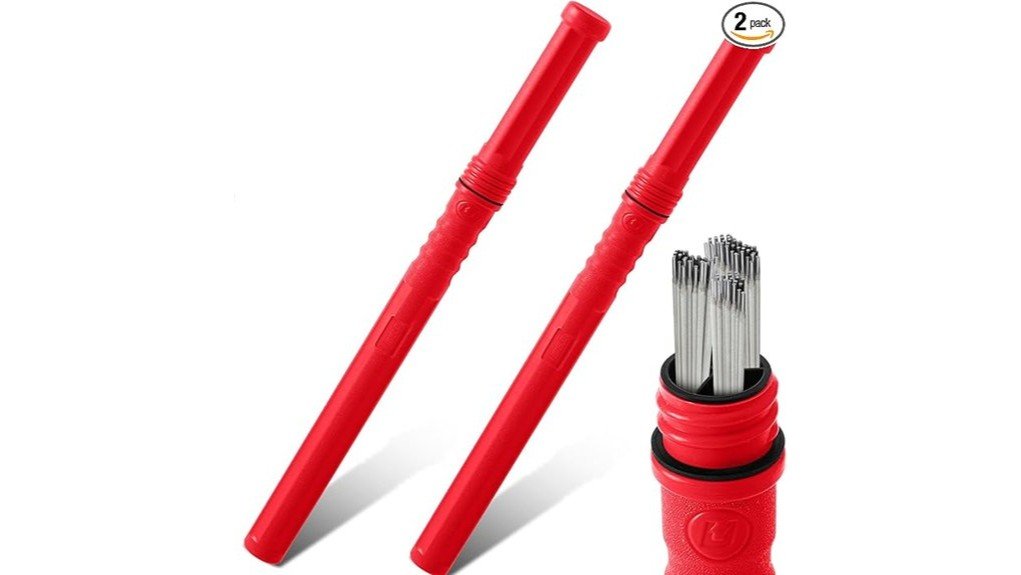
The Tandefio welding rod storage is a red ABS canister set, listed at 40 x 2 x 2 inches, that holds stick electrodes and keeps moisture and dust out. It is a good fit for keeping loose 6011, 6013 or 7014 rods tidy in a truck or shop. For low-hydrogen rods such as E7018, a sealed tube slows moisture pickup but does not replace a heated rod oven.
Tandefio Rod Storage at a Glance
| Item | Per the listing | What to verify |
|---|---|---|
| Type | Welding rod storage canisters | How many tubes are in the set |
| Material | ABS plastic, red | Heat tolerance. Not meant for a rod oven |
| Size | 40 x 2 x 2 in. | Whether that is overall or inside length and diameter |
| Sealing | Described as sealed and waterproof | Cap seal and gasket |
| Rod capacity | Not stated per tube | Your rod diameter and length |
Check the current price on Amazon →
What It Is and Who It Suits
Stick electrodes have flux coatings that can pick up moisture from the air. Moisture hurts arc stability and can lead to porosity, and low-hydrogen rods are the most sensitive. A sealed tube keeps rods separated from damp air, dust and rough handling, and its color makes it easy to spot in a toolbox.
These canisters suit hobbyists, farm users and mobile welders who keep several rod types on hand. They are not a rod oven. Heated ovens keep low-hydrogen electrodes at a controlled temperature, which a plastic tube cannot do. If you weld structural joints with E7018, follow the electrode maker’s storage and re-drying guidance.
How to Check It Fits Your Rods
- Rod length: most stick electrodes are 14 inches long (some are 9 or 18 inches). Confirm that the inside length of the tube clears your rods with the cap closed. The listing’s 40-inch figure should be checked, because it is a large number for a rod tube.
- Diameter and capacity: a tube that is about 2 inches across holds a limited number of rods, so check how many pounds the tube can take. A 5 lb box may need more than one tube.
- Cap seal: look for a gasket or thread seal and test that it closes firmly. A loose cap defeats the purpose.
- Rod type: keep different classifications in separate, labeled tubes so you do not mix 6013 and 7018.
- Heat: do not put rods straight from an oven into a plastic tube unless the maker says it is rated for it.
View the Tandefio rod storage on Amazon →
Pros and Limitations
Pros
- Protects rods from dust, impact and moisture exposure.
- ABS is lightweight and resists rust.
- Bright color is easy to find in a shop or truck.
- Helps you keep different rod classes separate.
Limitations
- Not a rod oven. Does not dry damp rods.
- Rod capacity and dimensions need checking against the listing images.
- Plastic can crack if dropped or left in strong heat.
- A sealed tube cannot rescue rods that were already damp when you put them in.
Storing Electrodes Properly
- Store rods dry, at room temperature, away from the floor and direct sunlight.
- Add a desiccant pack if the maker’s guidance allows, and keep the cap closed when not in use.
- Label the tube with the rod classification and diameter.
- Check rods before welding: cracked or flaking flux, rust and a loose coating mean you should discard them.
- For E7018, read the manufacturer’s packaging for recommended oven temperatures. See our E7018 rod review.
Related Guides
- YBENLLD electrode storage tube review for another tube option.
- PCS electrode storage tube for a comparison.
- AP Leather Pro 14 rod bag if you want a bag for jobsite carry.
Verdict
The Tandefio canisters are a simple, practical way to keep stick electrodes clean and dry, as long as the tube size fits your rods. Treat them as storage, not a replacement for a rod oven, and verify capacity before ordering.
Check Tandefio storage availability →
Frequently Asked Questions
Can a plastic tube keep E7018 rods dry enough?
A sealed tube slows moisture pickup, but it does not dry rods or replace a heated rod oven. For structural or code work with E7018, follow the electrode maker’s storage and re-drying guidance. For general hobby work, a sealed tube with a desiccant is a practical step.
How long are the rods this tube can hold?
The listing gives dimensions of 40 x 2 x 2 inches, but the usable inside length and capacity are not spelled out. Standard electrodes are usually 14 inches, so compare the inside size and cap design with your rods, and check the listing images.
Do sealed rod tubes need a desiccant?
A small desiccant pack can help in humid shops, as long as it does not touch the flux or leave residue. Replace or re-dry it according to its instructions. If rods have already absorbed moisture, a desiccant will not reverse it.
Is it safe to store rods that have gotten damp?
Rods with swollen, flaking or rusty flux should be discarded. Slightly damp general-purpose rods may be dried per the maker’s instructions, but low-hydrogen rods that took on moisture can cause cracking in important welds. When in doubt, replace them.