Disclosure: As an Amazon Associate, we earn from qualifying purchases. If you click a link on this page and make a purchase, we may receive a small commission at no extra cost to you.
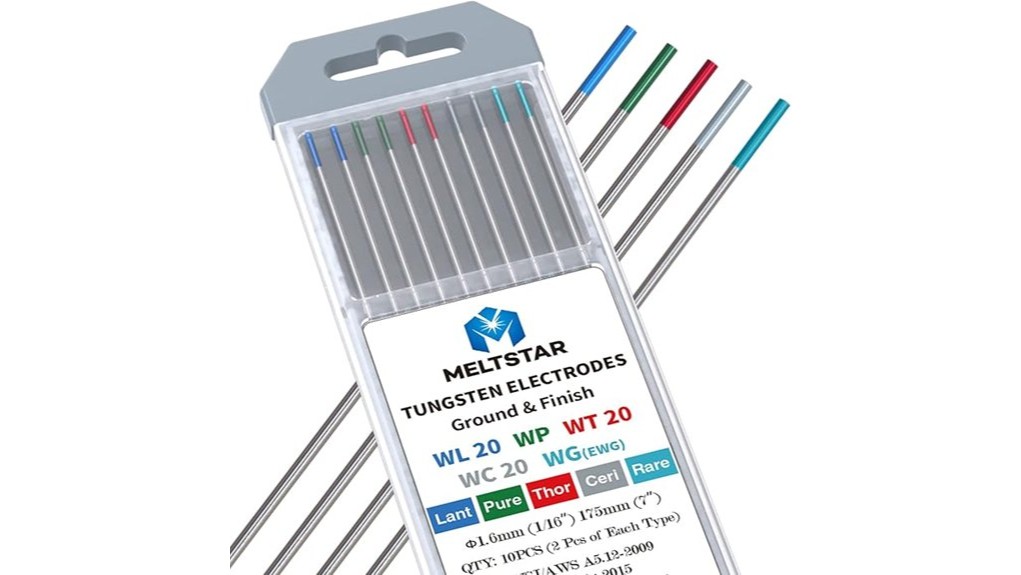
Buying a full pack of the wrong TIG tungsten can leave you with electrodes that do not suit your machine, amperage, or base metal. The MELTSTAR MIX1.6 TIG Welding Tungsten Electrodes Mix Set gives you five color-coded electrode types in one 10-piece box, with two electrodes of each type. Every electrode is listed at 1/16 inch by 7 inches, so the set is most useful for lower-amperage work and for welders whose torch hardware accepts 1/16-inch tungsten. The variety is practical for testing, but the mixed quantity and thoriated red electrodes make it less suitable for production procedures or buyers who want only non-thoriated tungsten.
Quick Verdict
Rating: 7.6/10, Recommended with caveats
Best For: TIG welders who want an inexpensive sampler for comparing five tungsten types in a 1/16-inch size.
Bottom Line: The MELTSTAR MIX1.6 is a useful practice and troubleshooting set because it includes two each of red, green, gray, blue, and turquoise tungsten. Its limits are the small quantity of each type, the fixed 1/16-inch diameter, and the extra handling care required for the red thoriated electrodes.
| Specification | Detail |
|---|---|
| Brand | MELTSTAR |
| Model / part number | MIX1.6 |
| Product type | Mixed TIG/GTAW tungsten electrode assortment |
| Amazon ASIN | B0BQ2WG7Z3 |
| Electrode size | 1/16 inch × 7 inches (1.6 mm × 175 mm) |
| Total count | 10 electrodes, two of each color/type |
| Types included | WT20 red, WP green, WC20 gray, WL20 blue, and WG turquoise rare-earth blend |
| Material | Mixed tungsten electrode formulations |
| Listed item weight | 3.52 ounces |
| Listed dimensions | 8.2 × 2.2 × 0.2 inches |
| Standard claimed by listing | AWS A5.12M/A5.12:2009 |
| Manufacturer | Wenzhou Meltstar Welding Technology Co., Ltd. |
| Compatibility | TIG torches fitted with a 1/16-inch collet and matching torch parts |
| Best use | Practice, electrode comparison, low-amperage TIG work, and arc troubleshooting |
| Important limitation | Only two electrodes per type, and the red WT20 electrodes require thoriated-tungsten precautions |
What Is the MELTSTAR MIX1.6 Tungsten Set?
The MELTSTAR MIX1.6 is a sampler of non-consumable tungsten electrodes for TIG welding, also called gas tungsten arc welding or GTAW. The box contains 10 electrodes in one fixed size, with two red, two green, two gray, two blue, and two turquoise electrodes.
The set is designed to help you compare electrode behavior without buying five separate full packs. That makes sense for practice coupons, machine setup, process experiments, and small repairs. It is not a substitute for a documented electrode specification when a welding procedure requires a certain classification, brand, diameter, or lot traceability.
Before You Buy: All 10 electrodes are 1/16 inch in diameter. Confirm that your torch has a matching 1/16-inch collet, collet body or gas lens, and back-cap clearance. Also note that the red WT20 electrodes are thoriated, so this is not an all-nonradioactive assortment.
Who Should Buy It?
Best For
- Beginners who want to feel how different tungsten types affect starts, arc focus, and tip life.
- Garage welders using 1/16-inch tungsten for thin material and lower-amperage TIG work.
- Shops that want a small comparison set for troubleshooting AC and DC TIG setups.
Skip If
- You need 3/32-inch or another diameter for your normal amperage range.
- Your procedure requires one verified electrode classification in production quantity.
- You want a set with no thoriated electrodes or do not have a safe tungsten-grinding setup.
Five Electrode Types in One Box
The main advantage is the assortment itself. You receive two electrodes from each of five common color groups, so you can run controlled tests on the same material and machine. The listing identifies the included classifications as WT20, WP, WC20, WL20, and WG.
Red WT20 Thoriated Tungsten
Red WT20 tungsten is commonly associated with 2% thoriated electrodes. It has a long history of reliable DC arc starts and a stable pointed tip, but thorium is mildly radioactive. The main handling concern is dust created during cutting or grinding, so you should follow the product safety information, use suitable dust controls, and keep the grinding area clean.
Green WP Pure Tungsten
Green WP is pure tungsten. It is traditionally used with transformer-based AC TIG equipment, especially for aluminum and magnesium, where welders may prepare a rounded or balled end. Modern inverter machines often work better with lanthanated or ceriated electrodes, so check your welder manual before choosing green tungsten by habit.
Gray WC20 Ceriated Tungsten
Gray WC20 is a ceriated tungsten type that is often useful at low and medium current. It can provide clean starts and restarts, which makes it worth testing on thin material, small parts, and jobs where you repeatedly stop and restart the arc.
Blue WL20 Lanthanated Tungsten
Blue WL20 is a 2% lanthanated type and is the most broadly useful option in this sampler. It can work across AC and DC applications when your power source supports it, holds a prepared point well, and is a practical first test for a modern inverter TIG welder.
Turquoise WG Rare-Earth Blend
The turquoise electrodes are listed as a WG rare-earth blend. Rare-earth formulations can offer steady starts and useful low-current performance, but the listing does not provide a detailed oxide composition for this specific blend. Keep the turquoise pieces labeled and do not assume they match every other brand’s purple or rare-earth electrode.
Arc Starts, Focus, and Stability
Tungsten choice changes how the arc starts, how concentrated it feels, and how well the tip keeps its shape. A suitable electrode can reduce wandering and make low-amperage control easier. A poor match can lead to unstable starts, an oversized ball, tip erosion, or more frequent regrinding.
The MIX1.6 set lets you compare those differences on your own power source. For a fair test, keep the base metal, shielding gas, polarity, amperage, torch angle, tip preparation, and travel speed as consistent as possible. Change only the tungsten type, then judge start quality, arc focus, and how the tip looks after the bead.
Diameter, Torch Fit, and Amperage
Every electrode in this pack measures 1/16 inch, or 1.6 mm, in diameter. Your torch must use a matching 1/16-inch collet, and any gas lens or collet body must also support that diameter. A 3/32-inch collet will not grip a 1/16-inch electrode correctly.
The smaller diameter can be helpful for lower-current TIG work because it starts easily at low amperage. It is less suitable when your job requires the higher current capacity of a larger electrode. Use your welder manual and electrode chart to confirm the correct diameter and current range before welding a finished part.
Pro Tip: Prepare one electrode of each type with the same point angle, label five separate storage slots, and test them on identical scrap coupons. This makes the comparison more useful than switching types while also changing amperage or grind shape.
Packaging and Identification
The listing shows 10 electrodes packed as two of each color. The painted end is the fastest way to identify the type before sharpening. Once you cut an electrode shorter or remove part of the colored end, store it in a labeled tube or compartment so you do not mix it with another formulation.
The listed item dimensions are 8.2 by 2.2 by 0.2 inches, and the listed weight is 3.52 ounces. Those figures make the set easy to keep in a small TIG consumables drawer, but the box is a sampler rather than a long-term supply for regular production welding.
Material Safety and Tungsten Preparation
Use eye protection and control grinding dust whenever you prepare tungsten. A dedicated tungsten grinder or a clean wheel used only for tungsten helps prevent contamination from steel, aluminum, or other shop materials. Grind lengthwise so the scratch lines run parallel to the electrode, which supports a steadier arc than circular grind marks.
Take extra care with the red WT20 electrodes. Thoriated tungsten contains a small amount of radioactive thorium, and grinding can create fine dust that should not be inhaled or spread around the shop. Follow the product label and safety data, use local dust collection or ventilation suited to your workplace, clean the grinding area carefully, and follow local disposal requirements. Lanthanated, ceriated, and rare-earth types provide non-thoriated options when your welding procedure allows them.
How It Performs in Real Use
For Beginner Practice
The set works well for practice because you can compare five tungsten types without committing to five full boxes. Run short beads on clean coupons and record which type starts most reliably, keeps the narrowest arc, and needs the least regrinding on your machine.
For DC Steel and Stainless
For DC electrode-negative work on steel or stainless, blue, gray, turquoise, and red are the most relevant pieces to compare. Start with blue WL20 if you use a modern inverter and want a general-purpose baseline. Red WT20 may also perform well, but it adds the thoriated-grinding precautions described above.
For AC Aluminum or Magnesium
For AC work, compare your machine manual with the included options before testing. Green pure tungsten is tied to traditional transformer setups, while blue lanthanated and gray ceriated types may suit modern inverter equipment better. Test on clean scrap and watch tip shape, arc stability, and how the electrode handles your selected AC balance and amperage.
For Low-Amperage and Troubleshooting Work
The 1/16-inch diameter makes the set most relevant for low-current starts, thin sheet, small assemblies, and controlled repair work. If your arc wanders or restarts poorly, comparing blue, gray, and turquoise electrodes can help you separate an electrode-choice issue from gas flow, contamination, torch-part, or machine-setting problems.
How to Use It Correctly
Start with your TIG welder manual, then choose an electrode type and confirm that the 1/16-inch diameter fits your torch hardware. Prepare the tip consistently, install a clean collet and cup setup, set the correct polarity and shielding gas, and test on scrap before moving to the finished workpiece.
- Check that your torch, collet, collet body, and gas lens accept 1/16-inch tungsten.
- Choose an electrode type that your machine manual supports for the metal and polarity.
- Cut with an abrasive method instead of bending or snapping the electrode.
- Grind lengthwise on a dedicated, clean tungsten-grinding surface.
- Regrind or replace the tip after it touches the puddle or filler rod.
- Store each color in a separate labeled tube or compartment.
Pros and Cons
Pros
- Includes five tungsten formulations in one purchase.
- Provides two electrodes of each type for repeat comparison tests.
- Uses clear color coding for red, green, gray, blue, and turquoise.
- Standard 7-inch length works with typical full-length TIG torch setups.
- Useful for practice, low-amperage setup work, and diagnosing arc behavior.
Cons
- The fixed 1/16-inch diameter will not suit every torch or amperage range.
- Two pieces per type are not enough for regular production use.
- The red WT20 electrodes need thoriated-tungsten dust and disposal precautions.
Is It Worth the Price?
The MELTSTAR MIX1.6 offers the most value as a low-quantity test set. Buying five separate 10-packs just to compare tungsten behavior would leave you with far more electrodes than a beginner or occasional TIG welder may need. This sampler gives you a practical way to identify the type your machine and projects prefer.
It is not the best value after you have chosen a favorite. Once you know the exact type and diameter you use most, a dedicated full pack gives you better continuity and enough electrodes for regular work. The MIX1.6 is worth considering for learning and setup trials, not as a permanent replacement for shop stock.
How It Compares to Alternatives
A dedicated 2% lanthanated pack is a better choice when you want one broadly useful, non-thoriated electrode for repeat AC and DC work. A 3/32-inch pack is more suitable when your normal amperage range exceeds what 1/16-inch tungsten can comfortably handle. A non-thoriated sampler is the better comparison option if you do not want red WT20 electrodes in your shop.
The MELTSTAR set makes the most sense when variety matters more than quantity. It gives you five formulations in one consistent 1/16-inch size, which is useful for side-by-side testing but less useful for a welder who already has a qualified process.
Frequently Asked Questions
What comes in the MELTSTAR MIX1.6 box?
The box contains 10 electrodes, all measuring 1/16 inch by 7 inches. You receive two each of red WT20, green WP, gray WC20, blue WL20, and turquoise WG rare-earth tungsten.
Will these electrodes fit every TIG torch?
No. Your torch needs a 1/16-inch collet and compatible collet body or gas lens. Check the torch hardware before ordering because a larger collet will not hold these electrodes correctly.
Which tungsten should you try first for DC steel or stainless?
Blue WL20 is a sensible first test on many modern inverter machines because it is a versatile lanthanated type. Gray, turquoise, and red can also be compared, but red WT20 requires thoriated-tungsten handling precautions.
Which included tungsten is best for AC aluminum?
The answer depends on your power source. Green pure tungsten is traditionally used on transformer AC machines, while blue lanthanated or gray ceriated may perform better on a modern inverter. Follow your welder manual and test on scrap.
Can you reuse the electrodes after sharpening?
Yes. Regrind a contaminated tip as long as enough electrode length remains for safe torch installation. Replace an electrode that is cracked, badly damaged, or too short for the back cap and collet to hold securely.
Are the red electrodes safe to grind?
Red WT20 tungsten is thoriated, so grinding can create dust that should not be inhaled or spread through the shop. Follow the product safety information, use suitable dust controls and protective equipment, and comply with workplace and local disposal rules.
How should you store the five tungsten types?
Keep each color in a separate labeled tube, tray, or compartment. Do not rely only on the painted end because cutting or repeated sharpening can make identification harder.
Who should skip this mixed tungsten pack?
Skip it when you need a different diameter, a full production quantity, an all-non-thoriated package, or documented lot traceability for a welding procedure. A dedicated pack of the exact classification you use is a better fit in those cases.
The Bottom Line
The MELTSTAR MIX1.6 is a practical buy for TIG learners, garage welders, and troubleshooters who want to compare five tungsten types in a consistent 1/16-inch size. Its main strength is variety, while its main limits are the two-piece quantity per type, fixed diameter, and thoriated red electrodes. Choose a dedicated pack instead when you already know the exact electrode your process requires.
Ready to Buy?
Check the current listing, 1/16-inch fit, and package details before you decide.