A budget multi-process welder can save money and bench space, but only if its controls, power options, and process limits match your work. The VEVOR MIG-270 combines MIG, MMA/Stick, and Lift TIG modes with 110V/220V input, an LCD display, and support for small or full-size wire spools. It is a practical choice for home repairs and light fabrication, although its published specifications contain a few conflicts and VEVOR states that this model is not intended for aluminum welding. This review explains what you get, what you may still need to buy, and where the machine fits best.
Quick Verdict
Rating: 8/10
Best For: DIY welders, farm and property repairs, home garages, and light shop work on steel and iron.
Bottom Line: The MIG-270 gives you three welding processes, dual-voltage flexibility, adjustable wire feed, and a useful accessory package at a value-focused level. Its main tradeoffs are no stated aluminum capability, basic Lift TIG controls, and conflicting published amperage and weight details.
Key Specifications
| Specification | Detail |
|---|---|
| Brand | VEVOR |
| Model | MIG-270 |
| Product type | 3-in-1 inverter welding machine |
| ASIN | B0C89CDX56 |
| Welding modes | MIG, MMA/Stick, and Lift TIG |
| Input voltage | 110V/220V dual voltage |
| Published current range | 50-220A, although the product title uses “270 Amp” wording |
| Rated input power | 5.6 KVA |
| Wire-feed speed | 2.2-12 m/min |
| Listed wire sizes | 0.024, 0.031, and 0.039 inch wire |
| Spool support | 2.2 lb and 11 lb wire rolls |
| Product dimensions | 20.4 x 12.2 x 15 inches in Amazon technical details |
| Weight note | Feature copy lists 21.7 lb, while Amazon technical details list 30 lb |
| Construction and color | Metal housing, orange and black |
| Protection rating | IP21S with overload and overheat protection |
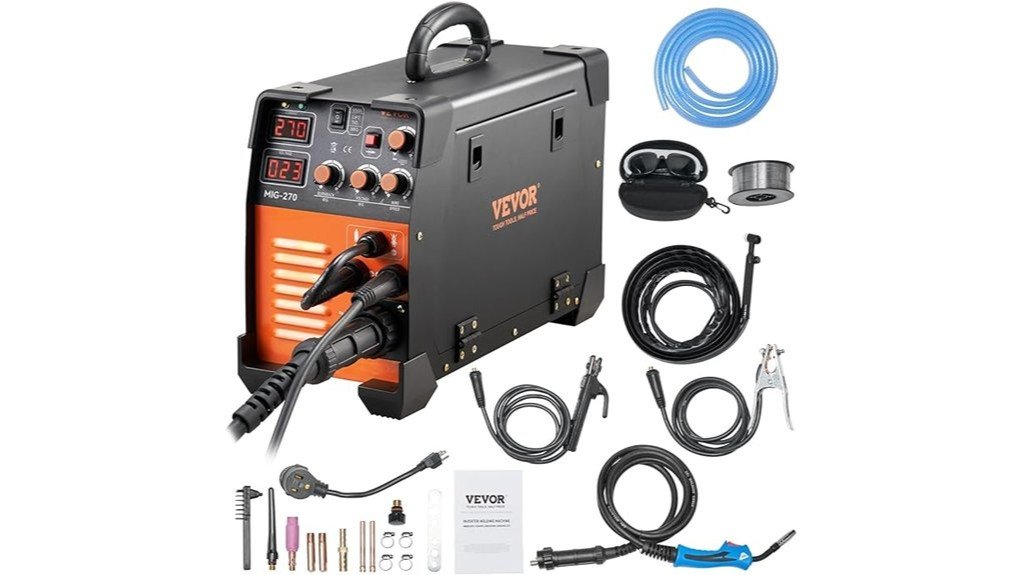
| Included accessories | MIG torch, Lift TIG torch, electrode holder cable, earth clamp cable, argon tube, welding wire, brush or glasses accessory, slag hammer, and manual, with exact bundle contents subject to the live listing |
| Main limitation | VEVOR states that this model cannot weld aluminum |
Key Takeaways
- You get MIG, MMA/Stick, and Lift TIG in one compact machine.
- Dual-voltage 110V/220V input gives you more flexibility across garage and shop circuits.
- The published specification range is 50-220A even though the product title says 270 Amp.
- The machine supports adjustable wire feed, three listed wire diameters, and 2.2 lb or 11 lb spools.
- It is best suited to steel and iron repairs, light fabrication, and occasional project work.
- It is not the right choice for aluminum welding or full-time industrial production.
What Is the VEVOR MIG-270?
The VEVOR MIG-270 is a portable inverter welder designed to cover three common processes without requiring three separate machines. MIG mode handles wire-feed welding, MMA mode covers stick electrodes, and Lift TIG provides a basic scratch-free TIG starting method for suitable work. You can switch modes from the front panel and adjust current, voltage, and wire speed for different materials and thicknesses.
Its main appeal is versatility at a budget-focused price level. You can use smaller flux-core wire for outdoor repairs, solid wire with shielding gas for cleaner MIG work, or stick electrodes when portability and wind tolerance matter. Lift TIG expands the machine’s range, but it does not provide the advanced pulse, high-frequency start, or AC controls found on dedicated TIG welders.
VEVOR lists mild steel, carbon steel, iron, stainless steel, copper, and cast iron among suitable materials. For purchase decisions, the clearest limitation is VEVOR’s explicit note that the MIG-270 cannot weld aluminum.
Who Should Buy It?
Best For
- Home welders who want MIG, Stick, and Lift TIG in one machine.
- Farm, trailer, gate, bracket, and property-repair work on steel or iron.
- DIY fabricators who need dual-voltage input and support for full-size wire spools.
Skip If
- You need aluminum MIG or TIG welding.
- You need advanced TIG controls, pulse settings, or high-frequency starting.
- You run long production welds every day and need published duty-cycle data you can rely on.
Before You Buy: Treat “270 Amp” as the model’s marketing title, not a verified continuous output specification. VEVOR’s current specification table lists a 50-220A range, and the published weight also varies between 21.7 and 30 lb. Confirm the current manual and listing if either figure affects your circuit, cart, or storage plan.
Feature-by-Feature Review
Three Welding Modes
MIG mode is the easiest starting point for many home users because the machine feeds wire through the torch. You can run flux-core wire for gasless work or solid wire with suitable shielding gas. MMA/Stick mode is useful outdoors and on repair jobs where wind or surface condition makes gas-shielded MIG less convenient.
Lift TIG gives you more control on suitable thin steel and stainless work, but it remains a basic TIG process. The included torch and argon tube improve the starter package, yet you should not expect the fine control of a dedicated TIG machine.
Dual-Voltage Power
The 110V/220V design lets you use the welder in more locations. A 110V supply can cover lighter work when that is the only outlet available, while 220V provides more working headroom for thicker material and higher-output settings.
Do not select a breaker, receptacle, adapter, or extension cord by guesswork. Match the current manual, plug configuration, conductor size, and local electrical code. A licensed electrician is the safest choice when you need a new 220V circuit.
Wire Feed and Spool Compatibility
VEVOR lists a 2.2-12 m/min feed range and support for 0.024, 0.031, and 0.039 inch wire. That spread gives you smaller wire for lighter sheet work and larger wire for heavier repair tasks. Support for 2.2 lb and 11 lb spools also lets you choose between a compact setup and longer sessions with fewer spool changes.
Wire size alone does not determine a good setting. Match the drive-roll groove, contact tip, polarity, shielding method, voltage, and feed speed to the wire and base metal. Test on scrap from the same material before welding a critical part.
Control Panel and IGBT Inverter
The front panel uses knobs and an LCD display for current, voltage, and wire-speed adjustments. This is easier to repeat than a panel with unmarked controls because you can record successful settings for common material thicknesses and wire sizes.
The IGBT inverter design helps keep the machine smaller and lighter than many older transformer welders. VEVOR also markets the inverter for stable arc behavior and lower spatter, although final weld quality still depends on clean metal, correct settings, technique, and consumables.
Portability and Included Equipment
The top handle and compact housing make the MIG-270 easier to move between a bench, driveway, trailer, or equipment area. The published weight conflict matters if you plan to carry it often, so use 30 lb as the safer planning figure until you confirm the exact current package.
The listed bundle includes MIG and Lift TIG torches, an electrode holder, earth clamp, argon tube, wire, slag hammer, brush or glasses accessory, and manual. A shielding-gas cylinder is not listed. Confirm whether you also need a regulator, flowmeter, gas bottle, replacement contact tips, and process-specific consumables.
Pro Tip: Before your first project, make a small settings chart for wire type, wire diameter, metal thickness, voltage, and feed speed. Mark the settings that produce a steady arc on clean scrap so you can return to them quickly.
How It Performs in Real Use
Home Garage Repairs
For brackets, lawn-equipment parts, carts, shelves, and mild-steel repairs, the machine’s MIG controls and dual voltage are useful. Flux-core wire keeps the setup simple when you do not want to manage gas, while gas-shielded solid wire can reduce cleanup on suitable indoor jobs.
Farm and Property Work
The handle, Stick mode, and flux-core option suit gates, frames, fencing hardware, and equipment repairs away from a fixed bench. Remove paint, rust, oil, and galvanizing from the weld zone where appropriate, and do not weld sealed tanks, drums, or unknown containers.
Light Fabrication
The MIG-270 is a reasonable match for square tube, sheet metal, small frames, stairs, and metal cages listed in the product applications. Adjustable feed speed helps when moving between thin and thicker pieces, but long, high-output welds require close attention to the manual’s duty-cycle limits and cooling time.
Learning Multiple Processes
A beginner can use one platform to learn MIG, Stick, and basic Lift TIG. That saves space and lets you compare processes, but it also creates more setup variables. Start with one process, practice bead control on scrap, and add the other modes after you understand polarity, consumables, gas flow, and grounding.
Setup Tips Before First Use
- Check the exact manual and plug: Verify input voltage, circuit needs, polarity, and process setup before powering the machine.
- Inspect the wire path: Match the spool, drive roll, liner, contact tip, and tension so the wire feeds without slipping or bird-nesting.
- Prepare the metal: Remove oil, moisture, heavy rust, paint, and coatings from the joint area using safe methods.
- Clamp to clean metal: A poor work-clamp connection can cause an unstable arc and inconsistent starts.
- Run test beads: Use scrap of the same type and thickness before welding a load-bearing or safety-critical part.
- Confirm gas equipment: For solid-wire MIG or Lift TIG, verify that you have the correct gas, cylinder, regulator or flowmeter, hose connection, and leak-free setup.
Safety and Workspace Requirements
VEVOR lists overload and overheat shutdown plus an IP21S protection rating. These features add basic machine protection, but they do not make the welder rainproof or remove the need for safe work practices. Keep the unit dry, maintain clear airflow around the vents, and allow it to cool when the protection system activates.
Welding can expose you to ultraviolet radiation, burns, electric shock, fire, and metal fumes. Use a properly rated welding helmet, flame-resistant clothing, gloves, hearing and eye protection, and adequate ventilation. Keep flammables away from sparks and hot metal, secure gas cylinders, and use local exhaust when needed. OSHA’s welding hazards and solutions guidance provides a useful safety reference.
Do not rely on the small glasses-style accessory listed in the package as your only eye and face protection. Follow the machine manual, consumable instructions, gas supplier guidance, and applicable workplace rules. For load-bearing structures, vehicle frames, pressure vessels, or safety-critical repairs, use a qualified welder or inspector.
Buyer Feedback and Listing Caveats
The source article reports that buyers value the combination of MIG, Stick, Lift TIG, and dual-voltage operation. It also notes that gas-shielded MIG can produce cleaner-looking work than flux-core wire when the metal, gas, and settings are suitable.
The main purchase caveat is accessory expectations. Budget welders often include enough hardware to begin testing, but you may still prefer a better regulator, flowmeter, ground clamp, consumables, or torch parts as your projects become more demanding.
Pros and Cons
Pros
- MIG, MMA/Stick, and Lift TIG modes in one machine
- 110V/220V input for more flexible shop and garage use
- Adjustable wire speed with three listed wire diameters
- Accepts both 2.2 lb and 11 lb wire rolls
- Includes torches, cables, wire, and basic setup accessories
Cons
- VEVOR states that the machine cannot weld aluminum
- Published amperage and weight details are inconsistent
- Lift TIG controls are basic compared with a dedicated TIG welder
- Gas cylinder and regulator or flowmeter are not clearly listed as included
Is It Worth the Price?
The VEVOR MIG-270 offers strong value when your priority is process flexibility rather than premium controls. One machine covers common MIG, Stick, and basic TIG tasks, and its dual-voltage input lets you start on 110V while keeping a 220V option for more demanding work.
You get the most value if you repair steel equipment, build occasional home projects, or want to learn several processes without buying separate machines. It is less compelling if you need aluminum capability, verified production-duty specifications, refined synergic controls, or dependable daily use in a commercial fabrication shop.
How It Compares to Alternatives
If you need aluminum support or more automated setup, compare the MIG-270 with a spool-gun-compatible multi-process model such as the VEVOR Pro 250A 5-in-1 or FEMEROL 250A 6-in-1. Those machines add processes or controls, but they also cost more and require you to confirm torch, spool-gun, and gas compatibility.
If you mainly weld mild steel and want straightforward manual controls, the MIG-270 remains easier to justify. Its strongest advantage is the combination of three processes, dual voltage, and full-size spool support without moving into a premium price tier.
Frequently Asked Questions
Can the VEVOR MIG-270 weld aluminum?
VEVOR’s current product specification page states that this MIG welder cannot weld aluminum. Choose a model with confirmed aluminum and spool-gun support if aluminum work is part of your plan.
Does it run on both 110V and 220V?
Yes. VEVOR lists 110V/220V dual-voltage input. Use the correct plug, circuit, conductor size, and protection required by the current manual and local electrical code.
Is it really a 270-amp welder?
The product title uses 270 Amp wording, but VEVOR and the Amazon specification section list a 50-220A current range. Base your setup and expectations on the published specification table and current manual, not the title alone.
What wire sizes and spools does it accept?
The current specification table lists 0.024, 0.031, and 0.039 inch wire plus 2.2 lb and 11 lb spools. Match the drive roll, liner, contact tip, polarity, and settings to the wire you use.
Can you weld without shielding gas?
You can use suitable self-shielded flux-core wire without an external gas cylinder. Solid-wire MIG and Lift TIG normally require the correct shielding gas and compatible gas-control equipment.
What comes with the MIG-270?
The listing includes the welder, MIG torch, Lift TIG torch, electrode holder, earth clamp, argon tube, wire, cleaning or glasses accessory, slag hammer, and manual. Check the live bundle because accessory details and wire diameter may change.
Is the VEVOR MIG-270 good for beginners?
It can be a useful beginner machine because the LCD panel and manual controls are straightforward. You still need to learn polarity, wire setup, gas flow, electrical safety, ventilation, and joint preparation before welding important parts.
Is it waterproof or safe to use in rain?
No. The listed IP21S rating does not make the machine suitable for rain or wet work. Keep the welder, cables, connections, and work area dry and protected.
The Bottom Line
The VEVOR MIG-270 is a good 8/10 value choice for DIY steel repairs, farm work, home garages, and light fabrication because it combines MIG, Stick, Lift TIG, dual voltage, and flexible spool support. Skip it if you need aluminum welding, advanced TIG controls, or a production welder with clear, consistent output and duty-cycle documentation.
Ready to Buy?
Check the latest price, seller, included accessories, and product details before you decide.