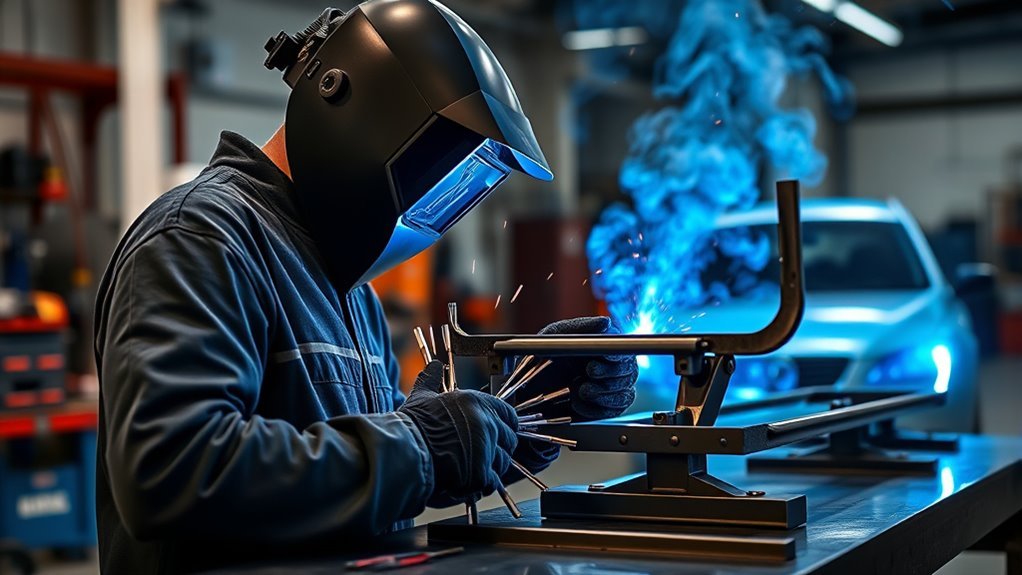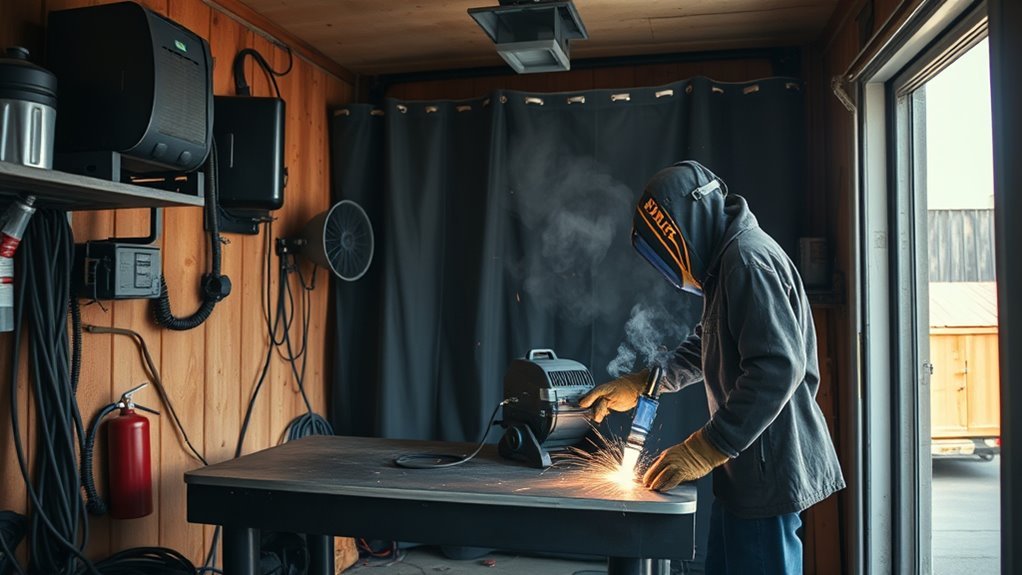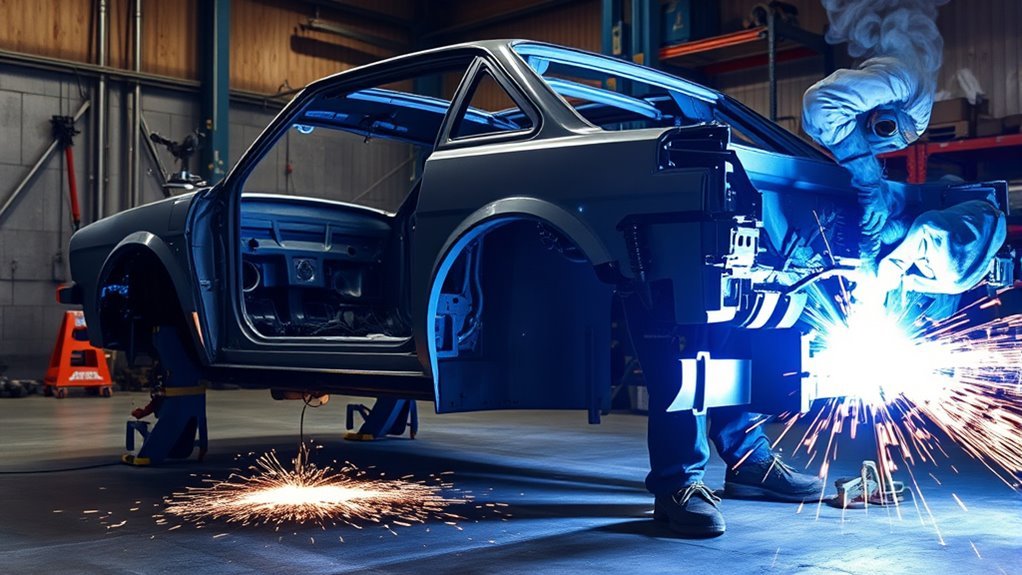
A unibody car may look like one solid shell, but its welded panels, rails, pillars, rockers, and reinforcements work together as the vehicle’s main structure. A poor cut or weld can change alignment and the way crash forces move through the body. This guide explains when unibody welding is allowed, how qualified shops complete the repair, and what proof you should request before the vehicle returns to the road.
Quick Answer
Yes, a unibody car can be welded when the vehicle maker’s repair procedure allows it. Structural work must match the exact model, material, cut location, joint design, and joining method. Because mistakes can affect alignment and crash performance, structural unibody welding belongs in a properly equipped collision repair shop.
Key Takeaways
- A unibody repair must follow the vehicle maker’s procedure for the exact model and damaged part.
- Not every crack, bend, or rust hole should be welded; some parts must be straightened, replaced, or declared nonrepairable.
- Modern repair methods may include resistance spot welding, GMAW/MAG, MIG brazing, adhesives, or rivets.
- The shop should restore corrosion protection and verify measurements, electronics, alignment, and required calibrations.
- Structural welding is not a suitable first welding project, even when the finished bead looks clean.
At a Glance
| Time Required | Varies from a limited repair to several stages of teardown, measuring, parts replacement, refinishing, scanning, and calibration. |
| Difficulty | Advanced structural collision repair; professional training and vehicle-specific repair information are required. |
| Tools Needed | OEM repair data, structural measuring equipment, frame rack or fixtures, approved joining equipment, extraction and fire protection, scan tools, and calibration equipment when required. |
| Cost | Cannot be estimated reliably from a photo. Material, hidden damage, labor, parts, paint, scans, calibration, and corrosion protection all affect the final price. |
Can a Unibody Car Be Welded Safely?
A unibody can be welded safely when the repair is permitted by the vehicle maker and completed with the specified equipment, materials, joint design, and weld locations. The key question is not simply whether metal can be joined. The question is whether that exact component can be repaired without changing its designed strength or crash behavior.
Vehicle makers use different grades of steel, aluminum, adhesives, rivets, reinforcements, and layered assemblies. A repair that is acceptable on one model may be prohibited on another. Even two parts that look alike may have different tensile strengths or internal reinforcements.
A sound-looking weld is not proof of a safe structural repair. The complete repair must match the vehicle’s design, dimensions, joining method, and corrosion protection.
Note: The vehicle identification number, model year, body style, powertrain, and build information should be checked before the shop selects a repair procedure. General welding advice is not a substitute for the exact body repair manual.
How Unibody Welding Differs From Frame Repair
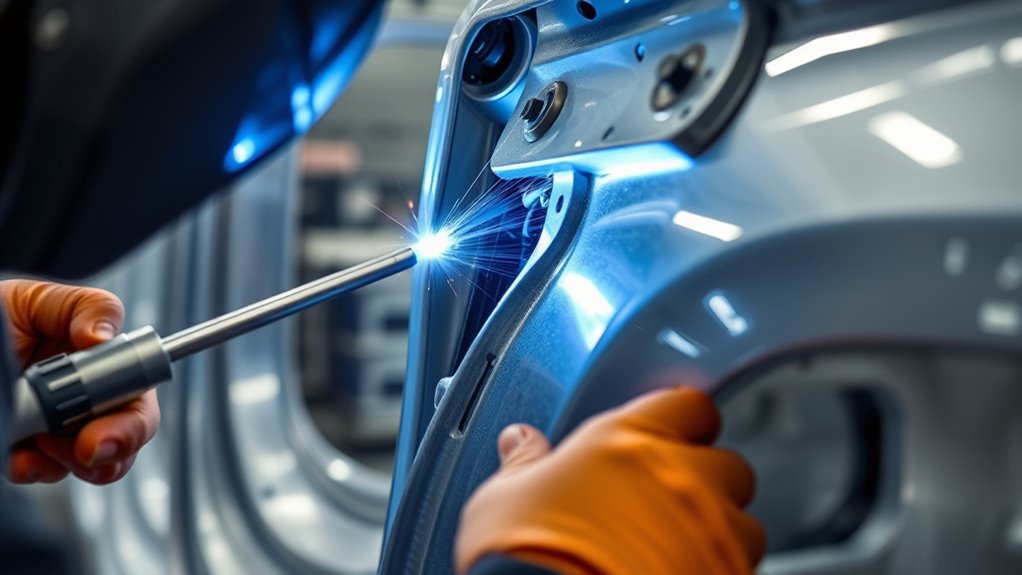
A traditional body-on-frame vehicle has a separate frame that supports most of the vehicle’s load. In a unibody vehicle, welded and bonded body panels form the main supporting structure. Rails, pillars, rocker panels, roof rails, crossmembers, floors, and mounting points can all be part of the load path.
That difference makes cut location and joint design critical. Current Ford structural sectioning guidance published through I-CAR explains that structural parts can carry crash energy, form the occupant safety cell, support vehicle loads, or hold safety-system components. It also directs repairers to the vehicle-specific workshop manual for the permitted sectioning and welding method.
The metal around a weld becomes a heat-affected zone. Excessive heat can distort thin panels or change the properties of heat-sensitive steel. However, reducing heat does not mean a technician can choose any short or intermittent weld pattern. Weld length, spacing, location, penetration, wire, shielding gas, and joint preparation must match the approved procedure.
Crumple zones also need to deform in a controlled way. Making a joint too weak may allow early separation, while adding unapproved reinforcement may make the area too stiff. Either condition can change how collision energy moves toward the passenger compartment.
Which Unibody Damage May Need Structural Repair?
Not every dent or torn panel is structural. A cosmetic outer panel may be repairable without cutting a load-bearing component. Structural evaluation is more likely when damage affects:
- Front or rear rails and rail extensions
- Rocker panels, side sills, pillars, or roof rails
- Floor crossmembers and reinforced floor sections
- Suspension, steering, engine, transmission, seat, or seat-belt mounting points
- Door openings or stationary-glass openings that have changed shape
- Factory seams that have separated
- Corrosion that has perforated a load-bearing panel or reinforcement
- Cracks, kinks, folds, or tears in a structural component
Clues may include doors that no longer fit or latch normally, uneven body gaps, a shifted steering wheel, rapid tire wear, a vehicle that pulls, visible rail damage, or measurements that do not match the maker’s dimensions. These signs do not identify the repair by themselves; they show that the structure needs professional inspection.
Warning: Have the vehicle towed when structural damage may affect steering, suspension, seat-belt or airbag mounts, door latching, wheel clearance, fluid lines, or safe control. Do not rely on a short test drive to prove that a damaged unibody is safe.
When Welding Is Not the Right Repair
Welding is only one possible part of a structural repair. The shop may need to straighten a repairable area, replace a complete component at factory seams, section a part at an approved location, or recommend total-loss evaluation when safe repair is not practical.
Some ultra-high-strength parts have strict limits on heat, straightening, and sectioning. Multilayer reinforcements and load-bearing mounts may also be excluded from sectioning. For example, Acura’s welding and sectioning guidance limits sectioning according to steel strength, layer construction, reinforcement location, and whether the area carries engine, transmission, or suspension loads.
Welding is usually the wrong response when:
- The vehicle maker prohibits repair or sectioning of the damaged part.
- The proposed cut passes through a reinforcement or multilayer load path.
- Corrosion extends beyond the area that can be removed to sound metal.
- The replacement part cannot be fitted to the maker’s specified dimensions.
- Heat or previous repairs have altered the surrounding metal.
- The cost of safe repair approaches or exceeds the vehicle’s economic value.
- The shop cannot obtain the correct procedure or required equipment.
A large “clip” repair that joins substantial portions of two vehicles should never be assumed acceptable. Ford, for example, states that it does not approve joining structures from two separate vehicles as a collision-repair method. Other makes must be checked against their own current position statements.
Materials and Joining Methods Used in Unibody Repair
Modern unibodies may combine mild steel, several grades of high-strength steel, ultra-high-strength steel, aluminum, castings, adhesives, and mechanical fasteners. The technician must identify the material before cutting, heating, straightening, or welding it.
Approved joining methods may include:
- Squeeze-type resistance spot welding: Recreates spot-welded flanges where the procedure and equipment allow it.
- GMAW/MAG: Often called MIG welding, this process may be specified for plug welds, butt joints, or limited repairs.
- MIG brazing: Uses lower-melting filler material and is required only at locations identified by the maker.
- Weld bonding: Combines an approved adhesive with specified resistance spot welds or another approved attachment.
- Rivet bonding: Uses structural adhesive with self-piercing or blind rivets, especially on some aluminum and mixed-material structures.
- Factory-seam replacement: Removes and replaces a component at its original joints instead of adding an unapproved sectioning joint.
The 2026 ASE Collision Repair Study Guide treats structural composition, joint type, welding process, wire, shielding gas, equipment setup, component protection, and weld-defect correction as separate skills. That is why a general instruction such as “use MIG and keep the heat low” is not enough.
Note: Weld-through primer is not universal. Some procedures require it for specific resistance-spot-welded mating surfaces but prohibit it for other joining methods. The technician must follow the vehicle maker’s and product maker’s instructions.
How Professionals Repair a Damaged Unibody
A complete repair involves more than placing a bead over a crack. A qualified shop normally works through the following stages:
- Identify the vehicle and obtain repair information. The estimator or technician checks the exact model configuration and retrieves current body repair procedures, position statements, and calibration requirements.
- Document visible and hidden damage. Trim, covers, mechanical parts, and damaged panels may need removal before the full repair plan is known.
- Measure the structure. Mechanical, electronic, computerized, or laser-based systems compare body points with manufacturer dimensions.
- Anchor and realign repairable structure. A frame rack, bench, fixtures, and controlled hydraulic pulls restore dimensions before replacement parts are permanently attached.
- Remove and fit approved parts. Cuts are made only at permitted locations. The replacement part is test-fitted so gaps, openings, mounting points, and dimensions are correct.
- Complete the specified joining process. The technician follows the required weld, braze, adhesive, rivet, joint, spacing, and equipment instructions.
- Restore protective materials. Exposed metal, seams, cavities, underbody areas, foams, and sound-control materials receive the specified primers, sealers, coatings, or cavity wax.
- Verify the complete vehicle. Final measurements, diagnostic scans, calibrations, wheel alignment, system checks, refinishing, and quality-control inspections are completed as required.
Structural measuring is not only an estimating tool. ASE’s current structural-repair scope includes diagnosing, repairing, verifying, and documenting upper- and underbody damage with three-dimensional measuring equipment and manufacturer-specific procedures.
Pro Tip: Ask for the before-and-after measurement report. It provides better evidence of restored geometry than photographs of a finished weld.
Safety Systems and Hazards That Must Be Managed
Welding current, heat, sparks, cutting tools, and hot metal can damage nearby systems or start a hidden fire. Before work begins, trained technicians must inspect the repair area and follow the vehicle maker’s disabling and protection steps.
Important concerns include:
- The 12-volt battery, electronic modules, grounds, wiring, and sensors
- Airbags, seat-belt pretensioners, impact sensors, and restraint wiring
- Hybrid and electric-vehicle high-voltage batteries, cables, capacitors, and service disconnects
- Fuel tanks, fuel and vapor lines, brake lines, and hydraulic components
- Air-conditioning lines and refrigerant components
- Carpet, trim, insulation, seam sealer, foam, undercoating, and adhesive hidden behind the panel
- Welding fumes, coatings, solvent vapors, sparks, and hot metal
I-CAR’s hybrid and electric-vehicle disable resource directs repairers back to current vehicle-specific high-voltage procedures. Disabling steps, wait times, test equipment, protective equipment, and verification can differ among vehicles.
Ventilation and respiratory protection also matter. OSHA’s ventilation requirements address toxic metal fumes and prohibit welding near solvent-cleaning equipment until dangerous vapors have been cleared.
Warning: Never weld over rust, paint, seam sealer, adhesive, foam, undercoating, or unknown contamination. The damaged area must be exposed and inspected, nearby hazards must be removed or protected, and a fire watch must continue after hot work is complete.
Why You Should Not Weld a Unibody Yourself
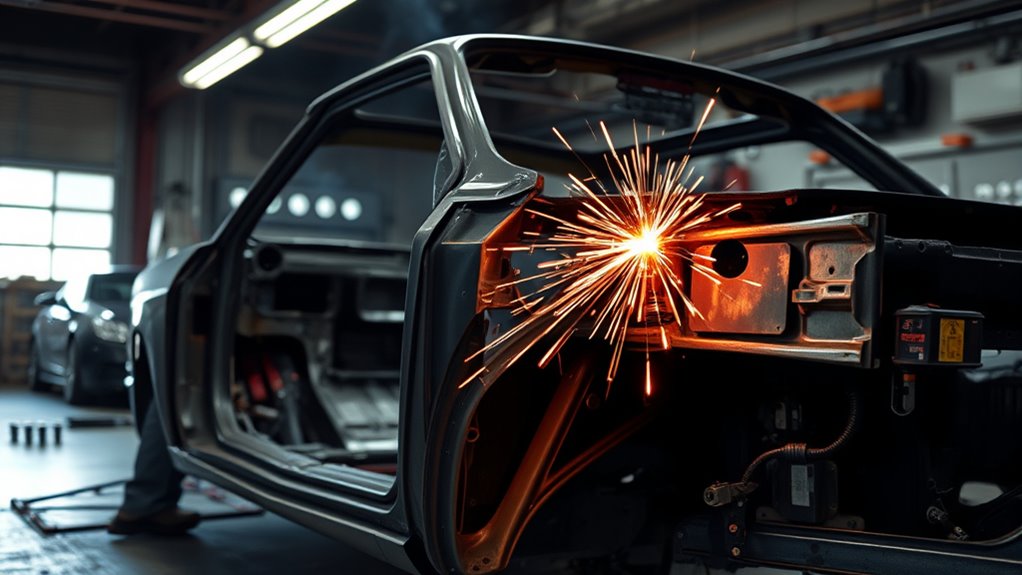
Structural unibody welding is not a good place to learn through trial and error. The work requires more than basic bead control. You must know the material, confirm the repair is permitted, restore three-dimensional alignment, protect vehicle systems, fit replacement parts, reproduce the correct joint, and verify the finished vehicle.
Too much heat can distort metal or change its properties. Too little fusion can leave weak attachment. Incorrect weld spacing can change load transfer. An unapproved backing plate or reinforcement can create a stiff point next to a designed crush area. Gaps and poor fit-up can also cause cracking even when the visible surface looks smooth.
A home garage rarely has the measuring system, anchoring equipment, vehicle-specific data, resistance spot welder, extraction system, scan tools, calibration space, or corrosion-protection equipment needed for a complete structural repair.
Nonstructural restoration work on an older project vehicle is a different decision, but the repair area still needs to be identified correctly. A floor, rocker, pillar, suspension mount, seat mount, or belt anchorage may be structural even when it looks like ordinary sheet metal.
How to Choose a Unibody Repair Shop
Start by asking whether the facility regularly performs structural repairs on your vehicle make. Useful qualifications include current I-CAR Gold Class recognition, technicians trained for steel or aluminum structural work, ASE B4 Structural Analysis and Damage Repair certification, and manufacturer network approval when available.
These credentials are not identical. I-CAR Gold Class recognizes a business that maintains role-based collision training. ASE B4 certifies an individual technician’s knowledge of structural analysis and repair. A manufacturer certification may add make-specific equipment, training, facility, and audit requirements.
Ask the shop the following questions:
- Will you use the current OEM repair procedure for my exact VIN or model configuration?
- Can you show me where the maker permits the proposed cut, section, or replacement?
- Which structural measuring system will you use?
- Does the procedure require resistance spot welding, GMAW/MAG, MIG brazing, adhesives, rivets, or a combination?
- How will you protect electronics, restraints, fuel components, and high-voltage systems?
- Which corrosion-protection materials will be restored?
- Will the vehicle need pre-repair and post-repair scans or ADAS calibration?
- What final measurement, alignment, scan, and calibration records will I receive?
- What parts and labor are covered by the written warranty?
Reviews can help you judge communication and service, but they do not replace technical evidence. A clean lobby and a smooth paint finish cannot prove that hidden structure is correctly measured and joined.
Products Worth Considering

Roll & repair – Heavy-duty casters let you bring the auto body repair puller directly to the damaged vehicle, saving towing and setup time. 90° swing reach – The...
How Much Unibody Welding Costs
There is no dependable nationwide price for unibody welding because the weld is only one part of the repair. A small accessible section on an older steel vehicle is different from a rail, pillar, rocker, mixed-material assembly, suspension mount, or late-model vehicle that needs extensive scanning and calibration.
A structural estimate may include:
- Initial inspection, teardown, and damage documentation
- OEM repair-information access
- Three-dimensional measuring and setup
- Anchoring, pulls, and structural alignment
- New structural components and related fasteners or adhesives
- Welding, brazing, riveting, or bonding labor
- Mechanical, glass, interior, and electrical removal and installation
- Primer, seam sealer, cavity wax, undercoating, and refinishing
- Diagnostic scans, calibrations, wheel alignment, and road testing
- Taxes, shop materials, hazardous-material handling, and sublet work
Hidden damage can change the estimate after teardown. Ask the shop to separate parts, body labor, frame or structural labor, refinishing, materials, scans, calibrations, and sublet operations. Compare the repair plans, not only the bottom-line totals.
Note: A photograph may support an early estimate, but it cannot confirm internal reinforcements, material strength, lower-body measurements, or damage hidden behind trim and panels.
Products Worth Considering

This Body Hammer Set uses high quality fiberglass shaft, covering all body repair and panel beating requirements. High quality fiberglass shaft panel percussion hammer. Long lasting quality.

7 Piece Auto Repair Kit: Each pack comes with a standard bumping hammer, pick & finish hammer, reverse curve hammer, curved dolly, utility dolly, double end hand dolly, and shrink dolly to provide the perfect fit both large and small body car dent repairs.

COMPREHENSIVE KIT - Includes bumping, pick, and reverse curve hammers plus four specialized dollies, providing professional-grade tools for both major collision repair and precision dent removal on vehicles
What to Ask Before Approving Unibody Welding
Before authorizing work, ask the shop to identify every structural component being repaired or replaced. The written plan should explain why welding or another joining method is allowed and should refer to the correct vehicle procedure.
- Request the damage report and initial structural measurements.
- Confirm whether the part will be straightened, fully replaced, or sectioned.
- Ask where the approved cut and joint locations appear in the repair procedure.
- Confirm the required welding wire, gas, adhesive, rivets, equipment, and weld pattern.
- Ask whether the repair affects airbag, seat-belt, steering, suspension, glass, radar, camera, or ultrasonic-sensor mounting points.
- Confirm how bare metal and closed cavities will be protected from corrosion.
- Ask which scans, calibrations, alignments, and final measurements are included.
- Request a written warranty that defines structural workmanship coverage.
After the repair, keep the estimate, supplements, invoices, repair procedures, measurement reports, scan results, calibration records, alignment report, parts documentation, and warranty. These records can support future service, insurance questions, and resale disclosures.
Frequently Asked Questions
Do unibody cars have pinch welds?
Yes. “Pinch weld” can describe a seam where overlapping panel flanges are joined. The term is also commonly used for the reinforced lower-body flange that serves as a lifting point on many vehicles. A crushed lifting flange and a damaged structural seam are different problems, so the shop should inspect the exact location before repairing it.
What is the golden rule for welding a unibody car?
There is no single universal “golden rule” for structural vehicle welding. The controlling rule is to follow the current repair procedure for the exact vehicle and component. Clean metal, proper fit-up, correct equipment, heat control, and weld quality all matter, but none replaces the manufacturer’s instructions.
How much does it cost to have a unibody or car frame welded?
Cost depends on the damaged component, material, access, labor rate, measuring, straightening, replacement parts, refinishing, corrosion protection, scans, and calibration. A shop needs to inspect and measure the vehicle before giving a reliable structural-repair estimate.
Can you repair an unibody frame?
Many damaged unibody structures can be repaired. A qualified shop may straighten permitted areas, replace components at factory seams, or section a part at an approved location. Severe deformation, prohibited repair areas, extensive corrosion, previous poor repairs, or high cost may make replacement or total-loss evaluation more appropriate.
Can welding a unibody affect insurance or resale value?
Yes. Structural damage and repair history may affect an insurance claim, inspection, vehicle-history record, disclosure duty, or buyer decision. The effect depends on the vehicle, repair quality, documentation, insurer, and local law. Keep complete repair records and answer future disclosure questions accurately.
Is a car with unibody damage safe to drive?
It may not be. Tow the vehicle when damage affects steering, suspension, wheel clearance, door latching, seat-belt or airbag mounts, fluid systems, high-voltage components, or visible structural rails and pillars. Only an inspection and measurements can determine whether the vehicle is safe to operate.
Can structural rust be covered with a welded patch?
A patch must not be welded over rust. Corroded metal has to be exposed, and the full weakened area must be identified. The vehicle procedure and remaining sound structure determine whether a section can be replaced safely. Extensive rust in rails, rockers, pillars, mounts, or multilayer areas can make repair impractical.
How can you verify that a unibody repair was completed correctly?
Request the final structural measurement report, itemized invoice, parts records, scan results, calibration documentation, wheel-alignment report, and written warranty. Also ask the shop to document the OEM repair procedure and the corrosion-protection products restored during the repair.
Conclusion
A unibody car can be welded, but only where the vehicle maker permits the repair and only with the correct material, joint, equipment, and process. The safest repair plan begins with complete damage analysis and exact measurements, not a guess based on the visible crack or dent.
Choose a shop that can produce the current repair procedure, explain whether the part will be straightened, sectioned, or replaced, and document every final check. Proper structural work also includes corrosion protection, electrical and restraint-system care, required scans and calibration, alignment, and verified body dimensions. Those steps help protect drivability, crash performance, and the vehicle’s long-term value.
Sources
- I-CAR: Ford/Lincoln Structural Sectioning Procedures — supports structural-part definitions and the requirement to follow vehicle-specific repair information.
- Acura Body Repair Manual Welding and Sectioning Guideline Revisions — supports material, sectioning, joint, wire, and primer restrictions.
- ASE 2026 Collision Repair and Refinish Study Guide — supports current structural measurement, joining, corrosion-protection, SRS, and ADAS repair competencies.
- I-CAR: When Corrosion Protection Should Be Restored — supports restoring coatings wherever repair work disturbs or removes them.
- I-CAR: Post-Repair Calibration Essential for Safety — supports completing OEM-required ADAS aiming and calibration after repair.
- OSHA Ventilation Standard 1926.57 — supports ventilation and vapor-control precautions during welding and hot work.