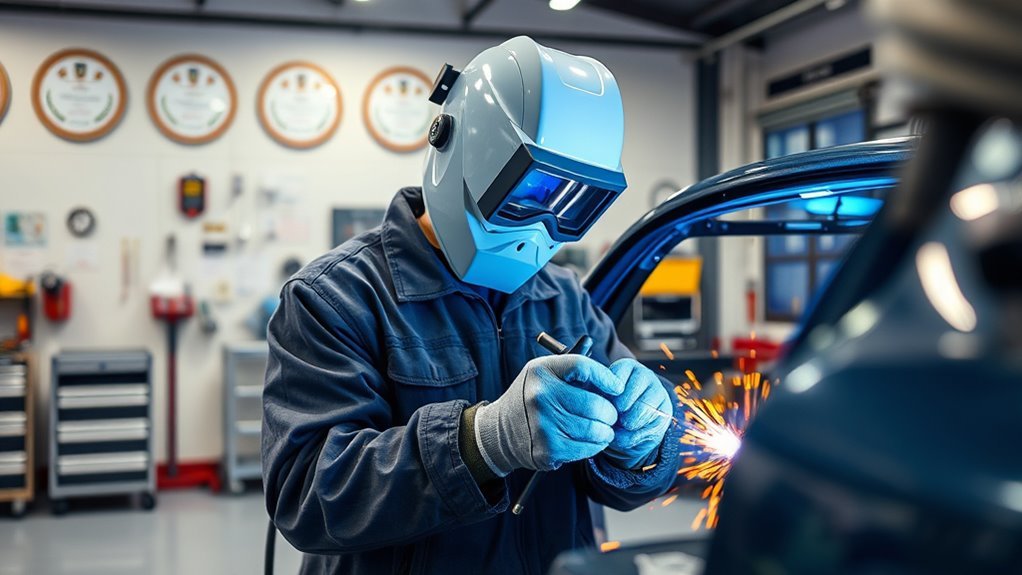
In the U.S., there is no single federal auto body welding license that every collision repair technician must hold. The right credential depends on the shop, the vehicle maker’s repair procedures, the insurer or network program, local rules, and the welding process you use. For most collision repair work, the strongest path is a mix of collision-focused welding training, process-specific testing, and documented renewal.
Quick Answer
Auto body welders most often need proof that they can weld the exact materials and processes used in collision repair, such as steel GMA/MIG, aluminum GMA/MIG, and squeeze-type resistance spot welding. I-CAR welding training, employer or OEM qualification, AWS Certified Welder testing, and ASE Collision Repair credentials can all help, but requirements vary by job.
Key Takeaways
- AWS Certified Welder is a respected performance credential, but it is not a universal U.S. legal requirement for every auto body welder.
- Collision shops often care most about I-CAR welding training, OEM repair procedures, and proof you can pass process-specific weld tests.
- Steel, aluminum, and resistance spot welding may each need separate training or qualification.
- Certifications can expire or require proof of continued welding, so track renewal dates and keep records.
- Credentials never replace vehicle-specific repair procedures, proper equipment, PPE, ventilation, and safe work practices.
At a Glance
| Time Required | A single weld test may take one day, but training and practice can take several weeks or months depending on experience. |
| Difficulty | Moderate to advanced. Thin automotive steel, aluminum panels, and spot welds require tight heat control. |
| Tools Needed | Approved welder, PPE, practice coupons, correct wire and shielding gas, OEM repair procedures, training records, and test paperwork. |
| Cost | Varies by provider, process, prep course, codebook, travel, retest, and renewal. Check the current fee schedule before booking. |
What Certifications Do Auto Body Welders Need?
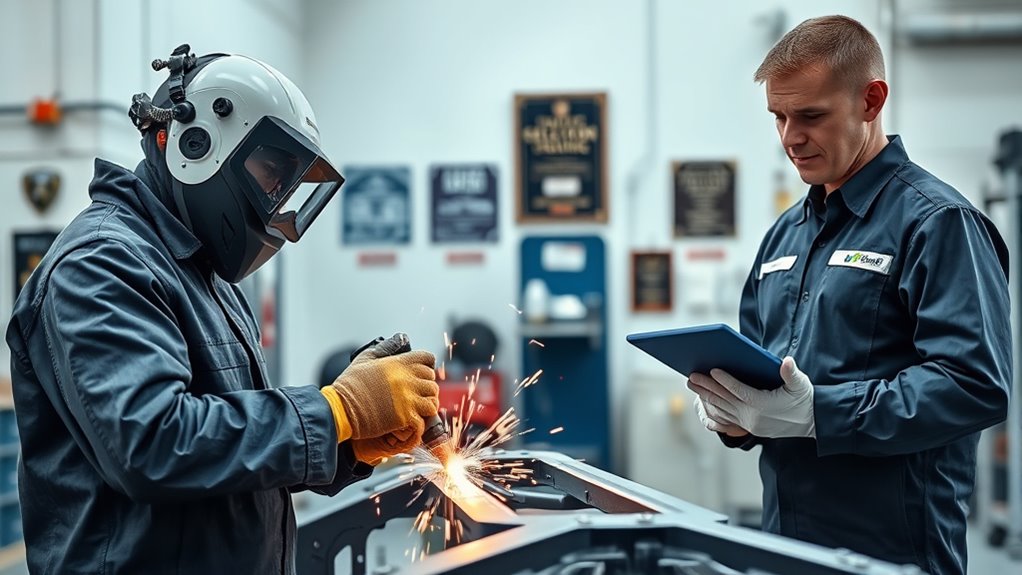
If you want to work as an auto body welder, start by separating three ideas: certification, qualification, and training. A certification usually comes from an outside organization. A qualification proves you passed a specific weld test. Training shows you completed instruction, but it may not prove you can pass a weld test unless a practical assessment is included.
Most collision repair employers want proof that you can weld the exact material and process used on modern vehicles. That may include steel GMA/MIG welding, aluminum GMA/MIG welding, squeeze-type resistance spot welding, and sometimes TIG welding for specialty aluminum work.
Note: A credential that proves skill on one process does not automatically qualify you for every material, thickness, weld position, or vehicle structure. Always match the credential to the job you plan to do.
| Credential or Training | Best For | What It Shows |
| AWS Certified Welder | Third-party proof of welding skill | You passed a performance test for a specific welding procedure, process, and material range. |
| I-CAR Training and Welding Qualification | Collision repair shops | You understand repair procedures, modern vehicle materials, and collision-focused weld testing. |
| ASE Collision Repair and Refinish Tests | Broader technician credibility | You have tested knowledge in collision repair areas, though ASE is not a welding-only credential. |
| OEM or Employer Qualification | Brand-certified or network shops | You can follow the vehicle maker’s approved repair method and shop equipment requirements. |
| AWS Certified Welding Inspector | Inspection, lead, quality, or advanced career paths | You can evaluate weld quality and code compliance. This is usually not an entry-level auto body welder requirement. |
Required vs. Recommended Auto Body Welding Credentials
The word “required” can be confusing in auto body work. A shop may require I-CAR welding qualification. A vehicle maker may require a specific repair procedure, welder type, electrode, adhesive, rivet, or corrosion-protection step. An insurer or shop network may require documented training. A local license rule may also apply in some areas.
That means the safest answer is this: you need the credentials your employer, customer program, and repair procedure require. Beyond that, process-specific certifications help you prove skill and move into better roles.
Warning: Do not weld structural vehicle parts based only on a general welding certificate. Modern vehicles use high-strength steel, aluminum, adhesives, rivets, sensors, and crash-load paths. Follow the current OEM repair procedure, use approved equipment, and confirm the repair is allowed before welding.
AWS Certified Welder Basics for Collision Repair
The AWS Certified Welder credential is useful when you need portable, third-party proof of welding performance. It is not a general “all welding” license. You test to a specific welding procedure, process, position, material, and acceptance standard.
AWS Certified Welder testing is performance-based. You weld test coupons at an AWS Accredited Test Facility, and the test is evaluated against the procedure requirements. For collision repair, this can support your resume, but your shop may still require I-CAR, OEM, or internal weld tests.
A practical AWS path usually looks like this:
- Choose the process you need, such as GMA/MIG steel, GMA/MIG aluminum, or another process your employer requires.
- Confirm the test standard, base metal, thickness, position, and acceptance criteria.
- Practice with the same equipment, wire, gas, settings, and material range.
- Schedule the test at an AWS Accredited Test Facility.
- Keep your test record and submit any required maintenance paperwork on time.
Pro Tip: Before paying for a weld test, ask the shop or program exactly which process and material range they accept. A test that does not match the job may not help you get hired.
Products Worth Considering

AWS D1.1 Compliant Weld Geometry - Limited Thickness Qualification Plate Designed for welder performance qualification and welding procedure testing in accordance with AWS D1.1 standards. Assembled and Ready to Weld with 45 degree bevel and a 1/4" Root Gap

1" Thick Weld Test Plate Set beveled to 22.5 degrees per plate for a total of 45 degree grove. 2" Wide by 1/4 thick backing strip with run-off tabs. 4" Wide (each plate) with 22.5 degre (+/- 3 degrees) bevels on both sides 6" Height on Both Plates Unit is assembled and ready to weld

Richard Finch, Welder's Handbook: A Complete Guide to MIG, TIG, Arc & Oxyacetylene Welding, "Completely Revised and Updated Edition!" paperback
Aluminum and Steel Welding Certifications
Auto body welders often need separate proof of skill for steel and aluminum because the materials behave differently. Thin automotive steel can burn through quickly. Aluminum conducts heat fast, forms oxide, and usually needs cleaner prep and tighter control.
For general structural fabrication, AWS D1.1 covers structural steel and AWS D1.2 covers structural aluminum. Those codes can matter in some welding careers, but they are not automatically the main path for collision repair. Vehicle body repair depends heavily on OEM procedures, automotive materials, and shop-approved processes.
In collision repair, steel and aluminum training usually focuses on:
- Steel GMA/MIG welding: common for sectioning and panel repairs when the OEM procedure allows welding.
- Aluminum GMA/MIG welding: common for aluminum body repair where approved by the vehicle maker.
- Squeeze-type resistance spot welding: important for replacing factory-style spot welds on overlapping panels.
- TIG welding: useful for some aluminum work, custom work, and specialty repairs, but not always the main production process in collision shops.
Do not assume one aluminum or steel credential covers every vehicle. Always check the repair procedure, material grade, weld location, and equipment requirements before starting.
Products Worth Considering

Comprehensive Dent Repair Solution: All-in-one solution for automotive dent repair in any capacity, VEVOR Dual Pro stud welder is designed to work on both steel and aluminum automotive panels, and equipped with tools and accessories to facilitate a seamless, thorough repair that exudes professional quality.

Professional Dent Removal: VEVOR Stud Welder Dent Puller offers a fast and efficient solution for removing dents from aluminum car body panels, all while providing precise dent pulling and controlled force for a professional-grade dent repair every time.

Comprehensive Car Repair Solution: Includes a dent puller repair tool, continuous ejector, and washers, perfect for seamless car body repair and dent removal.
MIG, Spot, and Other Key Welding Processes
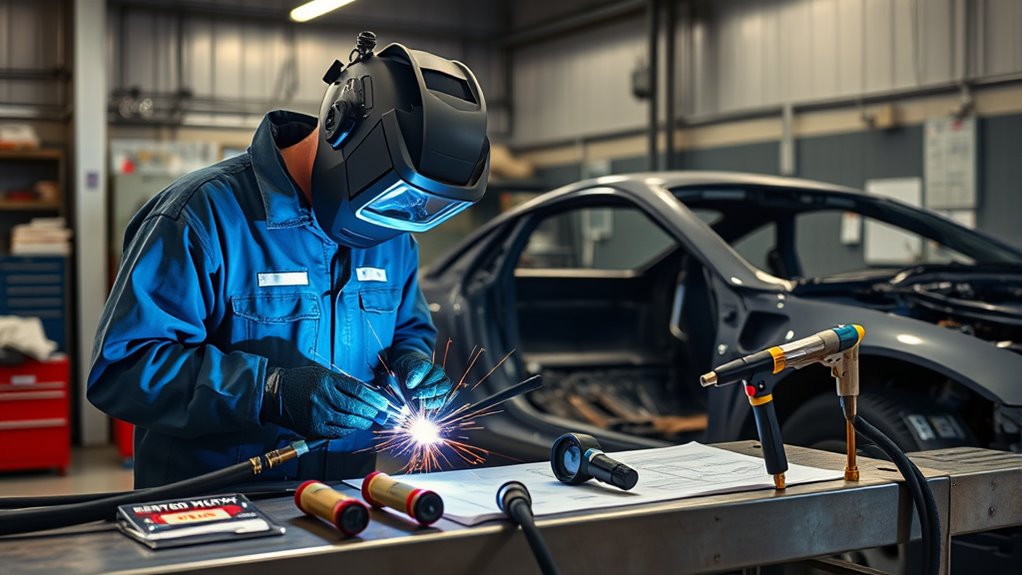
MIG welding, more accurately called GMAW, is one of the main welding processes used in auto body repair because it can join thin sheet metal with controlled heat when set up correctly. You still need the right wire, shielding gas, settings, joint prep, and OEM-approved weld location.
In collision repair, the best credential is the one that proves you can pass the weld test for the exact material, process, and repair procedure the job requires.
- Use steel GMA/MIG for many panel seams, plug welds, and sectioning repairs when approved by the OEM procedure.
- Use aluminum GMA/MIG only with proper cleaning, wire, shielding gas, machine setup, and approved repair steps.
- Use resistance spot welding when replacing factory-style spot welds on overlapping panels and when the equipment can meet squeeze force, current, and access needs.
- Use TIG carefully for specialty repairs where the procedure and material allow it.
When welding coated or galvanized steel, protect yourself from fumes and follow safety controls. OSHA’s welding, cutting, and brazing requirements cover fire prevention, ventilation, and protective measures that help reduce workplace risk.
I-CAR Training for Auto Body Repair
I-CAR training is especially important in collision repair because it is built around modern vehicle materials, repair procedures, and shop roles. Many collision employers recognize I-CAR because it connects welding skill to real repair decisions, not just a generic weld coupon.
I-CAR training can support technicians who work with steel, aluminum, structural repair, non-structural repair, refinishing, estimating, and shop management. For welders, the most valuable training is the kind that includes hands-on welding practice and practical qualification for the process you will use in the shop.
I-CAR Training Levels and Role Paths
I-CAR programs are organized around collision repair knowledge and role-based development. Instead of treating welding as an isolated skill, the training helps you understand where welding fits in the full repair plan.
- Foundation work: learn safety, repair planning, vehicle materials, and basic welding principles.
- Process training: build skill in steel GMA/MIG, aluminum welding, and resistance spot welding where available.
- Advanced repair judgment: learn how to choose repair versus replace, follow OEM procedures, and protect vehicle structure.
- Ongoing updates: keep pace with new materials, joining methods, tools, and repair restrictions.
This path matters because late-model vehicles are not built from one simple sheet metal type. A repair may involve mild steel, high-strength steel, ultra-high-strength steel, aluminum, adhesives, rivets, and corrosion protection in the same job.
Structural Repair Training
Structural repair training builds the hands-on judgment you need when welds affect crash performance. You learn how to identify repair zones, protect nearby components, prepare metal, test welds, and avoid heat damage.
Good structural training should teach you to:
- Read and follow OEM repair procedures before welding.
- Set up the welder for the material and thickness.
- Perform destructive weld tests when required by the shop or procedure.
- Control heat to avoid burn-through, weak fusion, and panel distortion.
- Restore corrosion protection after welding.
- Document the procedure, equipment, settings, and inspection results.
ASE Credentials for Auto Body Welders
ASE credentials are not welding-only certifications, but they can strengthen your profile as a collision repair technician. ASE Collision Repair and Refinish tests cover broader repair knowledge, and employers may value them when hiring or promoting technicians.
For a welding-focused auto body career, ASE is usually best used with practical welding qualification. Think of ASE as proof of collision repair knowledge, while AWS, I-CAR, employer tests, and OEM programs help prove process-specific welding ability.
How to Get Certified at an ATF
An AWS Accredited Test Facility, or ATF, is a testing site that can administer AWS welder qualification tests. This path is useful if your employer wants AWS documentation or if you want a portable credential that shows you passed a recognized performance test.
Before you schedule, ask three questions:
- Which welding process do I need?
- Which material, thickness range, and position will the test cover?
- Will this credential satisfy the shop, OEM program, insurer, or job posting I am targeting?
Find an Accredited Test Facility
Choose an ATF that offers the welding test you need. Not every facility tests every process, material, or code. Ask whether the test matches your target work, whether practice time is available, and how paperwork is handled after the test.
Bring identification, required forms, PPE, and any details the facility requests. If you are testing for a shop, bring the exact test requirement from your employer so the facility can confirm the scope.
Complete Your Welding Test
During the test, you will weld according to the required procedure. A qualified representative or inspector checks whether your weld meets the acceptance criteria. Depending on the test, inspection may include visual review, bend testing, break testing, macroetch, or another method.
If you pass, keep copies of your results and any certification documents. If you do not pass, ask what failed. Common issues include poor fusion, porosity, undercut, burn-through, wrong travel speed, poor fit-up, or contaminated metal.
Note: A facility may explain your test result quickly, but official credential processing time can vary. Ask the testing facility how long documentation usually takes.
How to Choose the Right Auto Body Welding Path
The best certification path depends on where you want to work. A production collision shop, dealership body shop, OEM-certified repair center, custom fabrication shop, and insurance network may each expect different proof.
- Read job postings first. Look for repeated requirements such as I-CAR, ASE, AWS, aluminum welding, or spot welding.
- Ask target shops what they accept. A local employer can tell you which credential actually matters in your market.
- Match the credential to the process. Do not take a steel test if the job needs aluminum welding.
- Practice before testing. Thin auto body material is unforgiving, and failed tests cost time and money.
- Keep records. Save certificates, test reports, welding logs, training transcripts, and renewal dates.
Keeping Your Welding Certifications Current
Keeping your welding certifications current is part of the trade. The AWS Certified Welder program requires ongoing maintenance to show you are still using the qualified welding process. Other credentials, including ASE, I-CAR, OEM, and employer qualifications, may have their own update cycles.
Use a simple system:
- Put every renewal date on your calendar.
- Keep copies of certificates and test records.
- Log the welding processes you use at work.
- Complete update training when new vehicles, materials, or procedures change.
- Submit renewal or maintenance paperwork before the deadline.
If a certification expires, you may need to pay fees, retest, or repeat training. That can delay hiring, promotion, or shop program approval.
Costs, Time, and Career Value
Costs vary widely. A single weld qualification test may cost much less than a full prep course, codebook package, travel, lodging, and retest. CWI is usually a larger investment than a basic welder performance test because it is an inspector credential with more exam preparation.
For career value, ask whether the credential helps you do one of these things:
- Meet a shop or OEM program requirement.
- Qualify for aluminum or structural repair work.
- Move into lead technician, quality control, or inspection work.
- Show documented skill when changing employers.
- Support higher pay through proven capability, not just time in the trade.
A certification is worth more when it matches the work you actually perform. The wrong credential may look impressive but fail to satisfy the shop’s real repair requirements.
Frequently Asked Questions
What type of welder is needed for auto body work?
Most auto body shops use a GMA/MIG welder for steel panel repair. Aluminum repair may need a welder set up for aluminum wire, shielding gas, and clean material prep. Many collision shops also use squeeze-type resistance spot welders to replace factory spot welds when the OEM procedure allows it.
Does every auto body welder need AWS certification?
No. AWS Certified Welder is valuable, but it is not a universal federal requirement for every U.S. auto body welder. Some employers or programs may require AWS documentation, while others focus on I-CAR training, OEM repair procedures, internal weld tests, or brand-specific qualifications.
How much does it cost to get CWI certified?
CWI cost changes based on AWS fees, membership status, exam method, prep courses, books, code requirements, travel, and retesting. Check the current AWS fee schedule before budgeting. For most entry-level auto body welders, CWI is not the first credential; it is usually for inspection, quality control, or lead roles.
Can you make $100,000 a year welding?
Yes, some welders can reach six figures, but it is not typical for every auto body welding job. Higher earnings usually come from specialization, overtime, field or industrial work, aluminum expertise, inspection roles, management, high-cost labor markets, or owning a business. Use BLS wage data as a general benchmark, then compare local collision repair job postings.
How can welders reduce long-term health risks?
Welders reduce risk by using ventilation, respiratory protection when required, eye and face protection, gloves, flame-resistant clothing, safe hot-work controls, and proper training. Avoid welding near flammable materials, protect nearby electronics and trim, and follow OSHA, shop, and OEM safety rules.
How often do auto body welding certifications need renewal?
It depends on the credential. AWS Certified Welder maintenance is tied to continued welding activity and required paperwork. ASE, I-CAR, OEM, and employer qualifications follow their own rules. Keep a renewal calendar and verify dates with the issuing organization.
Conclusion
The best auto body welding certification is the one that matches the repair work you want to do. For many collision technicians, that means I-CAR training, process-specific welding qualification, OEM repair procedure knowledge, and possibly AWS Certified Welder documentation. ASE credentials can add broader collision repair credibility, while CWI is better suited to inspection or leadership paths. Build your path around the shop’s real requirements, keep your records current, and never let a certificate replace safe, vehicle-specific repair procedures.
Sources
- American Welding Society Certified Welder Program — backs up AWS performance-based welder certification and maintenance context.
- American Welding Society Accredited Test Facility Program — backs up ATF testing and facility accreditation context.
- I-CAR — backs up collision repair training and continuing education context.
- ASE Collision Repair and Refinish Tests — backs up ASE collision repair credential context.
- OSHA 1910.252 Welding, Cutting, and Brazing — backs up welding safety, ventilation, fire prevention, and protective measures.
- BLS Occupational Outlook Handbook: Welders, Cutters, Solderers, and Brazers — backs up general wage and career outlook context.