Updated on 2025-12-02
Like matching a torch to a welder, sizing an air compressor for a plasma cutter comes down to CFM, PSI, and duty cycle. You’ll target 1.5× your cutter’s stated CFM at 40–70 PSI for stable arc quality, then size the tank to buffer continuous cuts. Factor moisture management, hose ID, regulator losses, and power draw. Decide between built‑in and external units, then weigh noise, portability, and budget—because the wrong compressor will choke your cut.
To size an air compressor for a plasma cutter, determine the cutter’s CFM requirement (typically 4–6 CFM at 90 PSI) and multiply it by 1.5. This safety margin ensures the compressor can keep up without overheating. Pair this pump with a tank size—20 gallons for light work or 60+ gallons for production—that matches your cutting duration.
Key Takeaways
- The 1.5x Rule: Always choose a compressor that delivers 1.5 times the CFM your plasma cutter requires.
- Pressure Matters: Maintain a steady 90–120 PSI at the inlet to allow the cutter’s internal regulator to hold 40–70 PSI at the torch.
- Dry Air is Critical: Moisture kills consumables. Use a water separator and coalescing filter.
- Duty Cycle: A 60-gallon tank is recommended for any sustained cutting to prevent pressure sag.
Plasma Cutting and Compressed Air Basics
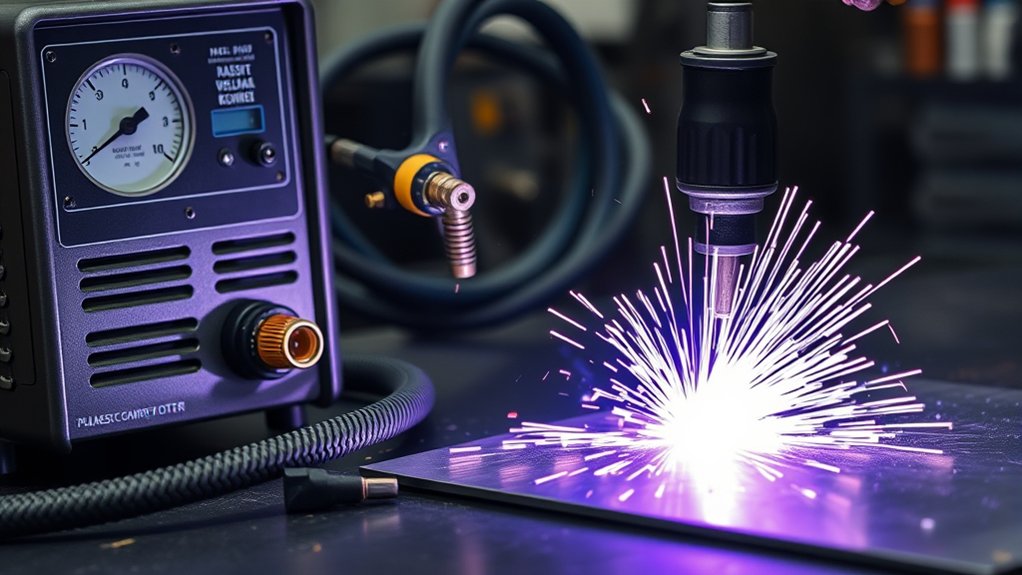
Even though plasma cutters use electricity to create the arc, compressed air does the heavy lifting by constricting, cooling, and ejecting the plasma stream through the torch.
You need clean, consistent air to maintain arc stability, cut quality, and consumable life. Match your compressor to the cutter’s CFM requirement—most units draw 4–12 CFM depending on model and duty cycle.
Undersupply starves the torch; uncontrolled oversupply wastes air and stresses components.
Use a pressure regulator to hold a stable 40–70 PSI at the torch inlet; erratic pressure generates dross, blowouts, and premature nozzle wear. For light to moderate work, choose a tank size of at least 20 gallons to buffer airflow during longer cuts; for sustained production, step up to 60 gallons or more.
Install filtration and moisture separation to block oil and water contamination, which erodes electrodes, scores tips, and shortens maintenance intervals. Keep drains and filters serviced.
Understanding CFM and PSI Requirements
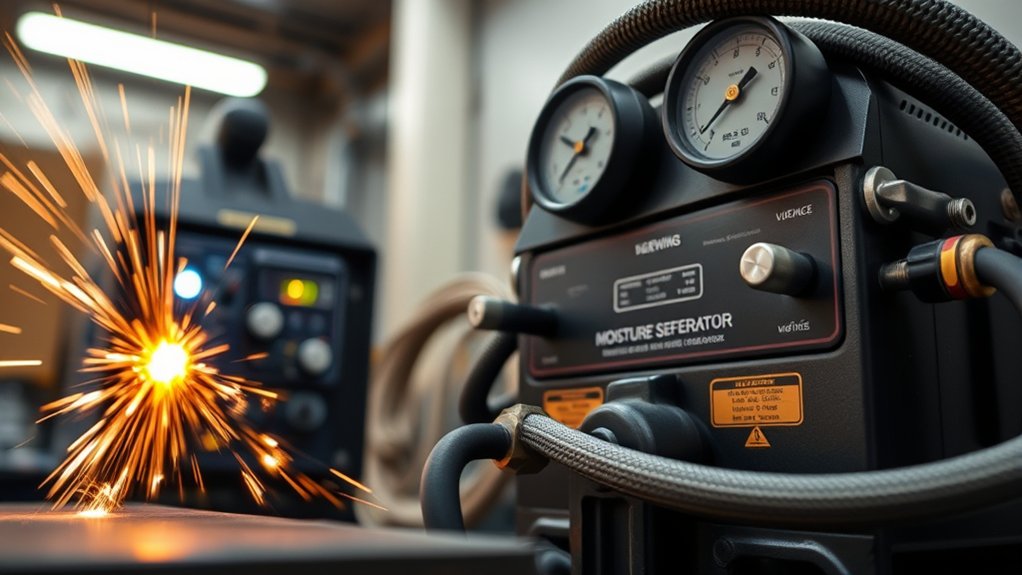
Now that airflow and pressure control are on your radar, quantify them. Your plasma cutter breathes in CFM (cubic feet per minute) and regulates cut quality with PSI (pounds per square inch). Treat CFM as volumetric throughput and PSI as force at the torch.
For most light-to-mid work, baseline demand is 6 CFM at 40 PSI; larger units and long duty cycles push higher. A 50-amp plasma cutter with short cuts may sip 4 CFM at 90 PSI, but it still needs a steady air supply. Build headroom: target compressor output at least 1.5× the cutter’s consumption to avoid starvation during sustained arcs.
| Requirement | Typical Value | Why it Matters |
|---|---|---|
| Airflow (CFM) | 6+ at 40 PSI | Maintains arc stability |
| Pressure (PSI) | 40–50 (Al) | Prevents internal line damage |
| Safety Factor | ≥1.5× CFM | Buffers duty cycle spikes |
Regulate PSI tightly—40–50 PSI for aluminum—to protect internal air lines. At ~3000 ft, derate the compressor’s CFM; thinner air reduces mass flow, so compensate to keep cut quality consistent.
Matching Compressor Output to Your Plasma Cutter
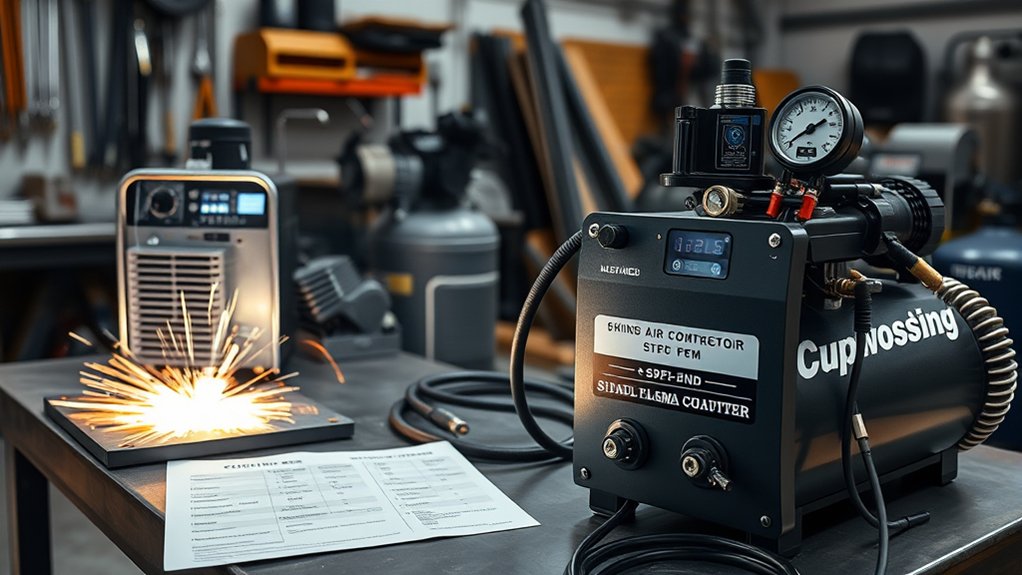
Before you pick a tank size or brand, match the compressor’s delivered CFM and PSI to your cutter’s spec with headroom. Start by verifying the plasma cutter’s rated airflow and pressure at the torch inlet.
Match compressor CFM and PSI to your cutter’s spec—with headroom—verified at the torch inlet.
If your plasma spec calls for 4 CFM at 90 PSI, select an air compressor that delivers at least 6 CFM at 90 PSI (the 1.5x rule) continuously. For example, a Hypertherm Powermax 30 needs 3.5 CFM at 90 PSI; target 5.3 CFM or more to prevent starvation and voltage drop at the arc.
Account for real-world losses—line restrictions, filters, and regulators eat margin. Confirm the compressor’s CFM is stated as delivered at operating pressure, not displacement. For long duty cycles or heavy cutting, step up to 10 CFM at 100 PSI to sustain arc stability. Running CNC plasma? Scale harder: size the compressor 2–2.5x the cutter’s CFM to maintain constant flow during prolonged toolpaths.
Tank Size: How Much Air Storage Do You Need?
You’ll size the tank to your duty cycle: 8–10 gallons can cover quick cuts, 20–30 gallons suits light-to-moderate runs, and 60 gallons supports long, industrial arcs without pressure sag.
Match stored air to the cutter’s CFM so you avoid dropouts and compressor short-cycling. Balance portability vs capacity—small tanks move easily but pause more, while larger tanks sustain flow but add weight and footprint.
Matching Tank to Duty
Although CFM and duty cycle drive the compressor choice, the tank determines how long you can cut without pressure sag. Match tank size to the air compressor’s ability to sustain cubic feet per minute at your torch’s demand.
For light to moderate plasma cutting tasks, 20–30 gallons typically buffers flow and preserves uninterrupted operation. Industrial duty pushes you to 60 gallons or more to stabilize pressure during continuous cuts.
Small 4.5–8 gallon tanks can meet CFM for short, occasional cuts, but they cycle often and interrupt longer runs. Size for the longest continuous cut you expect; calculate air volume required and verify the pump can recover before pressure drops.
Portability Vs Capacity
When you size the tank, balance portability against air reserve because the cut quality depends on steady flow, not just pump rating. Prioritize meeting the plasma cutter’s minimum CFM output—target at least 6 CFM at 40–70 PSI—then right-size tank size to your workflow.
If you need mobility and endurance, pair a compact compressor with an auxiliary tank to boost air volume without sacrificing portability. Match hose ID, regulator flow, and drain strategy to preserve stable delivery.
Duty Cycle and Continuous Cutting Considerations
Even under light shop loads, duty cycle dictates how long the plasma system can stay arc-on before cooldown, so match your compressor strategy to the cutter’s thermal limits.
Treat the duty cycle, compressor size, and CFM requirement as a single system. If your cutter is rated 60% at a given amperage, don’t spec airflow for peak minutes and ignore recovery; size the compressor to sustain continuous cutting without falling off pressure or overheating.
Undersizing forces the pump to chase demand, elevating head temperatures and shortening duty cycles. Hot discharge air exacerbates moisture issues, which can destabilize arc quality and erode consumables.
Air Quality: Filtration, Drying, and Moisture Control
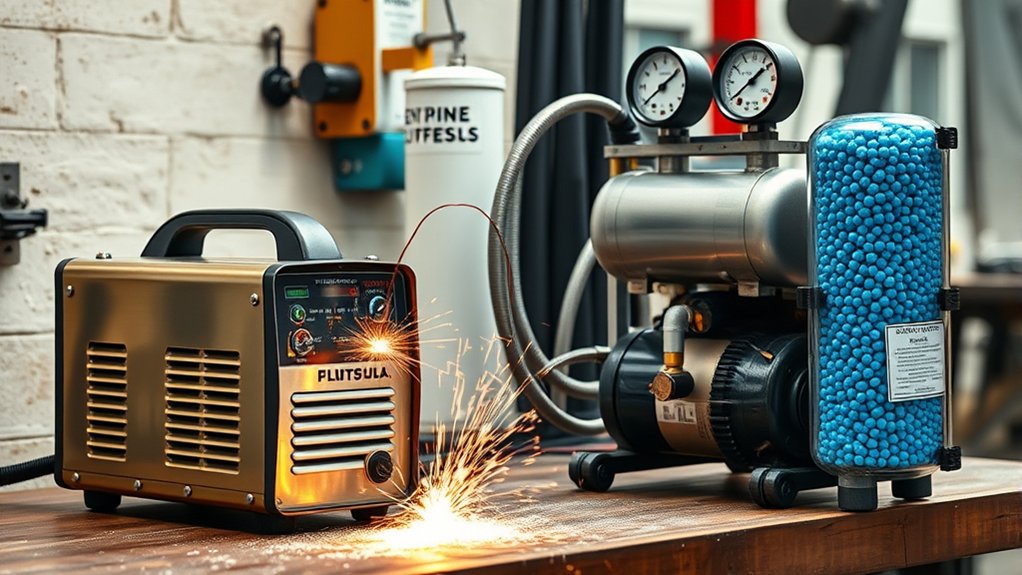
Sizing for duty cycle and sustained SCFM only works if the air you feed the torch is clean, dry, and stable. Air quality directly drives arc stability, cut edge, and consumable life. Contaminants—water, oil, particulates—erode nozzles, destabilize the arc, and spike operating costs.
Start at the source: use a water separator on the compressor discharge to keep bulk moisture out of the tank and lines. Downstream, install filtration devices near the plasma—first a particulate stage, then a coalescing filter with an automatic drain for fine aerosols and oil. This combo delivers reliable moisture control in typical shops.
Use a water separator, then particulate and coalescing filters near the plasma for dependable moisture control.
In high humidity, add a refrigerated air dryer sized to your compressor’s SCFM to drop dew point below line temperature. Keep hose runs short, avoid heat soak, and maintain proper drainage.
Built-In vs. External Compressors
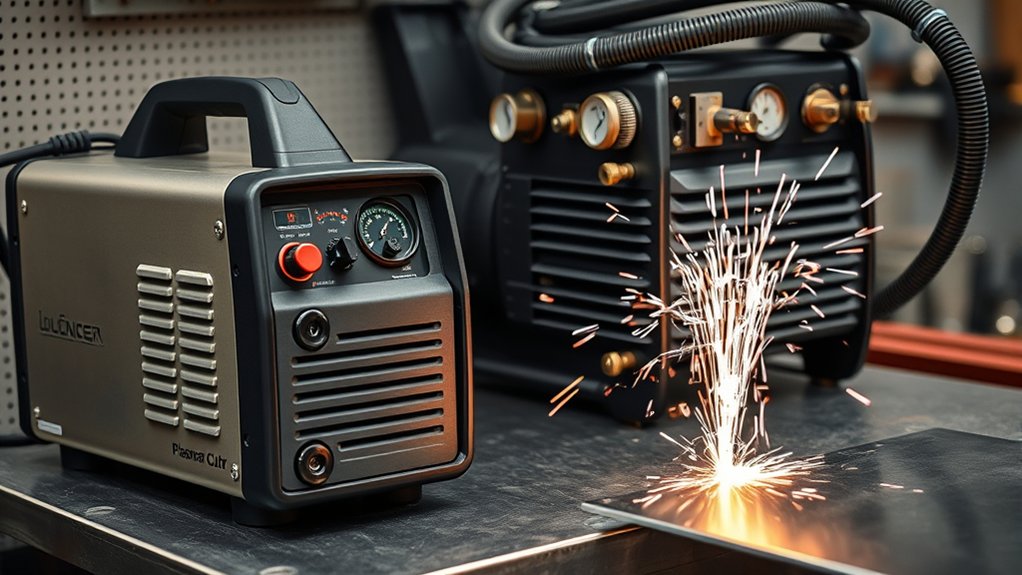
You’ll balance portability against power: built-in units are compact for light-duty work (3–5 CFM), while external compressors deliver higher CFM and tank capacity for continuous, heavy cuts.
Match your workflow: grab built-in for occasional, mobile cuts; spec an external compressor (>10 CFM) for prolonged production with clean, dry air.
Portability and Power Tradeoffs
A built-in compressor favors mobility and quick setup, but it trades away airflow and duty cycle—limits you’ll feel on longer cuts and thicker material. If portability and power are your yardsticks, built-in compressors win the carry game but lose on CFM output and sustained pressure.
| Option | Strength | Best Use |
|---|---|---|
| Built-in | Compact, fast deploy | Light-duty, field fixes |
| Built-in | Minimal hose/gear | Short, thin material cuts |
| External | Higher CFM output | Thick plate, long passes |
| External | Larger tanks | Consistent pressure |
| External | Scalable systems | Shop, production work |
Maintenance and Air Quality
Speed vs. stamina only matters if the air stays clean and dry. Whether you run a built-in unit or an external compressor, maintenance dictates cut quality.
- Specify clean air: target OEM-rated SCFM at required PSI with <10% duty cycle margin, then add filtration capacity.
- Install a staged air filter set: particulate, coalescing, then desiccant or refrigerated drying to strip moisture and oil.
- Audit usage and environment; schedule filter changes, leak checks, and separator service to sustain stable arc performance.
Power, Noise, and Portability Factors
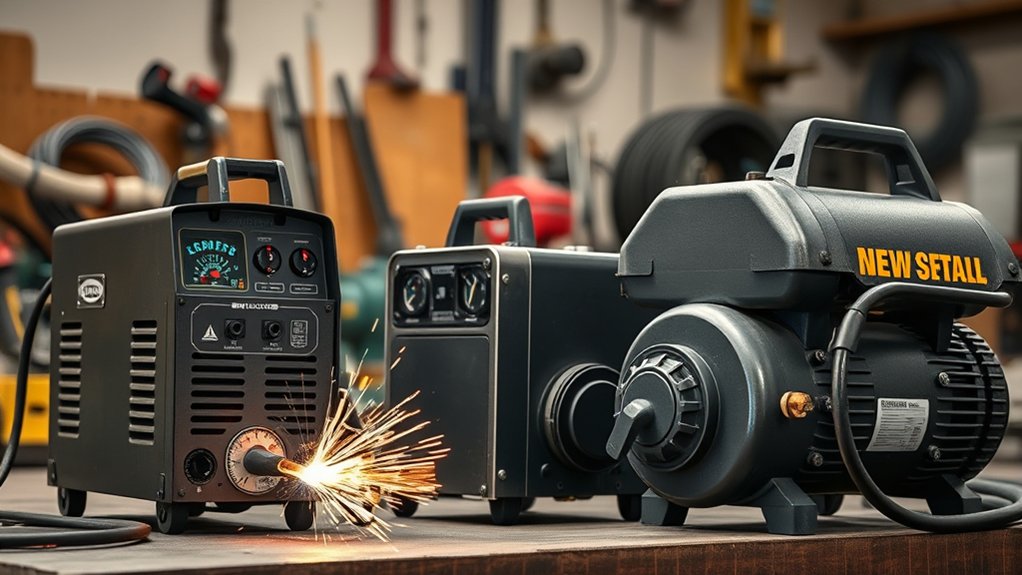
While dialing in a plasma setup, treat the compressor as a matched subsystem—size it for the cutter’s air demand, then constrain by noise and mobility. Target the cutter’s spec: 6 CFM at 40 PSI up to 10 CFM at 100 PSI. That defines power, air supply, and minimum tank size.
Quieter compressors (~40 dB) protect comms and focus; budget units often exceed 60 dB and raise fatigue. If you must wheel it, verify handles, casters, and footprint.
| Use Case | Spec Focus | Tradeoff |
|---|---|---|
| Light fab | 6–7 CFM @ 40–60 PSI | Max portability |
| Jobsite/mobile | 7–9 CFM @ 60–90 PSI | Moderate noise |
| Pro duty | 9–10+ CFM @ 90–100 PSI | Weight/space |
Piping, Regulators, and Hose Setup for Best Flow
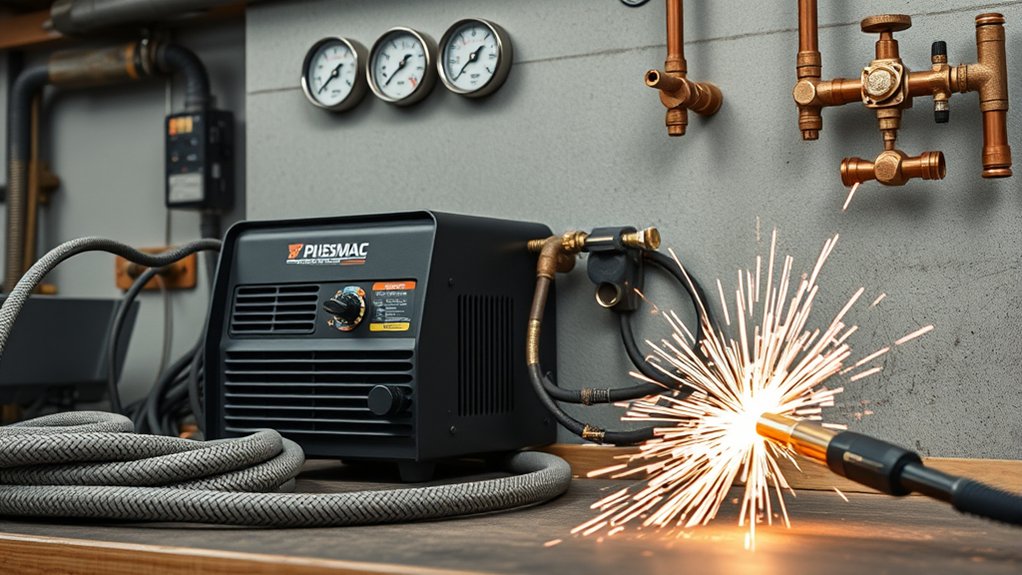
Before chasing more compressor CFM, lock down the air path: run short, direct lines in 3/8-inch copper for under 75 feet and step up to 1/2-inch beyond that to curb pressure drop. Match every fitting to the hose or tubing ID—mixed sizes choke pressure and flow.
Set a quality regulator near the cutter to the spec PSI—most units like ~75 PSI under flow (regulated down internally). Add a water separator and coalescing filter just upstream of the machine to strip bulk water and oil aerosols.
- Oversize lines reduce velocity, moisture carryover, and loss.
- Minimize elbows and quick-connects; each adds equivalent feet.
- Leak-check joints; tiny leaks destroy duty-cycle stability.
Budget, Brands, and Buying Tips
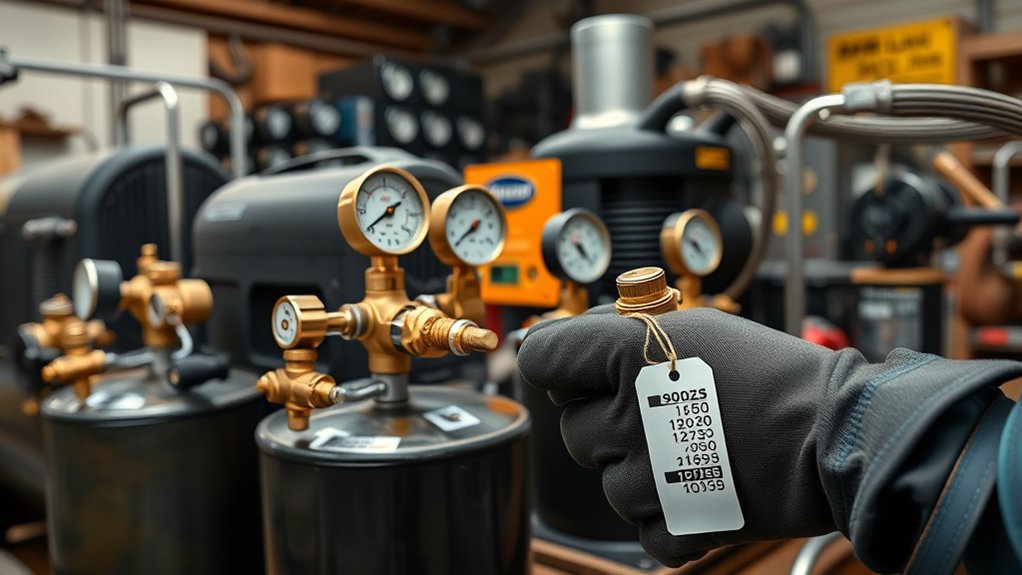
With the air path sorted, focus your dollars where they matter: a compressor that delivers at least 10 CFM at 100 PSI so your cutter holds set pressure under flow.
Note on Budget: While some budget guides suggest spending under $200, realistic prices for compressors capable of 6+ CFM @ 90 PSI typically start around $450–$600 in 2025. Units cheaper than this often rely on inflated “peak HP” numbers and lack the true SCFM required for sustained plasma cutting.
Prioritize tank size and duty cycle—bigger tanks buffer flow and reduce short-cycling, while a 50–100% duty-rated pump sustains long cuts without thermal trips.
Compare pump type (oil-lubed lasts longer, runs quieter) and motor amperage; higher draw typically correlates with honest output. Inspect controls: accurate regulator, readable gauges, and auto drain preferred.
Used compressors can stretch dollars, but be cautious: test cold start, recovery time to 100 PSI, leak-down, pump noise, and oil condition.
Frequently Asked Questions
How much air does a 50 amp plasma cutter need?
You need about 6 CFM at 40–50 PSI for a 50‑amp unit. Prioritize clean, dry air quality, match power requirements, and monitor duty cycle. At altitude, adjust for reduced output to maintain consistent cutting speed.
How many PSI to run a plasma cutter?
Run most plasma cutters at 40–50 PSI at the torch, but supply 90–120 PSI to the inlet. Size your compressor higher to offset line drop. Verify specific air pressure requirements to maintain plasma cutter efficiency without overpressurizing.
What size air compressor do I need for the Titanium Plasma 65?
For the Titanium Plasma 65, you typically need 5–6 CFM at 90–100 PSI and a 20+ gallon tank (ideally 60 gallon). Match plasma cutter specifications and compressor efficiency ratings to sustain performance on thicker metals.
What is the best air compressor for a plasma cutter?
The best air compressor is a rotary screw or quiet oil-lubed unit delivering 10+ CFM at 90–100 PSI. Prioritize stable air pressure, low noise levels, robust filtration, and ease of maintenance.