An air compressor can have a large tank and still starve a plasma cutter if its pump cannot deliver enough air while the torch is running. The right size comes from the cutter’s required SCFM or CFM at a stated PSI, not horsepower or tank gallons alone. Start with the manufacturer’s specification, add practical reserve capacity, and then choose a tank, hose, filtration system, and electrical setup that fit your cutting time.
Quick Answer
Find the cutter’s required airflow and inlet pressure in its manual. Choose a compressor rated to deliver at least that SCFM at the same pressure, then add roughly 25%–50% capacity for hose, filter, heat, and recovery losses. Size the tank for cut length; it cannot make up for an undersized pump.
Updated on 2026-07-20 after checking current manufacturer manuals and compressed-air guidance.
Key Takeaways
- Use the manual first: Airflow and inlet pressure vary by plasma-cutter model, even when two machines have similar amperage.
- Compare delivered airflow: Use the compressor’s SCFM or CFM rating at the required operating pressure, not its displacement, peak horsepower, or tank size.
- Add reasonable reserve: About 25%–50% extra airflow helps cover restrictions, hot conditions, compressor recovery, and other air users.
- Check pressure under flow: A static gauge reading can look normal and still collapse when the torch opens.
- Keep the air clean and dry: Drain the receiver, maintain filters, and add drying equipment when humidity or long air lines cause moisture problems.
At a Glance
| Time Required | 15–30 minutes to check specifications and calculate capacity |
| Difficulty | Moderate |
| Tools Needed | Plasma-cutter manual, compressor specification sheet, calculator, regulator and gauge, leak-detection solution |
| Cost | Sizing is free; compressor, hose, filter, and dryer costs vary with required airflow and duty |
Warning: Never exceed the plasma cutter’s maximum inlet pressure, bypass a compressor relief valve, or use oxygen, acetylene, carbon dioxide, a combustible gas, or another unapproved gas source. Use only the gas allowed by the cutter manufacturer. Depressurize the system before servicing hoses, filters, drains, or fittings, and follow hot-work, ventilation, electrical, eye, hearing, and fire-safety requirements.
Plasma Cutting and Compressed Air Basics
A plasma cutter uses electrical energy to ionize a gas and create a high-temperature plasma arc. On an air-plasma system, compressed air also helps shape the arc, blow molten metal out of the kerf, and cool the torch and consumables.
Cut quality depends on receiving enough clean air at the pressure and flow specified for the exact machine. Too little flow can produce an unstable arc, heavy dross, incomplete cuts, low-pressure faults, or early consumable wear. Excess inlet pressure can damage components or exceed the rating of the filter bowl, regulator, hose, or cutter.
The compressor’s delivered airflow while the torch is open matters more than its horsepower label or the number of gallons printed on the tank.
The required airflow is not the same for every 30-, 45-, 50-, or 65-amp cutter. For example, the Hypertherm Powermax30 XP is rated for 4 SCFM at 80 PSI, while the TITANIUM Plasma 65 owner’s manual specifies 4.2 CFM at 80–110 PSI. Always use the manual for your model rather than assuming airflow from amperage alone.
Understanding CFM, SCFM, and PSI Requirements
CFM means cubic feet per minute and describes airflow volume. SCFM means standard cubic feet per minute, which is airflow converted to a defined set of temperature, pressure, and humidity conditions. The Compressed Air and Gas Institute also distinguishes delivered capacity from compressor displacement, which is only the theoretical volume swept by the pump.
PSI is pressure. A compressor rating such as 6.5 SCFM at 90 PSI tells you how much air the pump can deliver while operating at that pressure. A 6.5-SCFM rating at 40 PSI does not prove that the compressor can deliver the same flow at 90 PSI.
Pressure must also be checked while gas is flowing. A tank may show 120 PSI before a cut but fall below the cutter’s minimum as soon as the solenoid opens. This is called pressure sag and commonly points to inadequate pump output, a restrictive hose or coupler, a dirty filter, a leak, or another tool using the same air supply.
| Exact cutter example | OEM air requirement | Practical compressor target |
|---|---|---|
| Hypertherm Powermax30 XP | 4 SCFM at 80 PSI | About 5–6 SCFM at 90 PSI for reasonable reserve |
| TITANIUM Plasma 65 | 4.2 CFM at 80–110 PSI | About 6–6.5 SCFM at 90 PSI for reasonable reserve |
| Hypertherm Powermax45 SYNC | Current service data lists 212 standard L/min, about 7.5 SCFM, at 85 PSI for cutting | Approximately 9.5–11 SCFM near the required pressure when sizing with reserve |
Note: The compressor targets in the table are planning figures, not manufacturer minimums. Use the current manual for your model, voltage, region, torch, and operating mode.
How to Match Compressor Output to Your Plasma Cutter
Use the following process before comparing tank sizes, brands, or horsepower claims.
- Find the OEM gas specification. Record the required CFM or SCFM, minimum or recommended inlet pressure, maximum inlet pressure, gas-quality requirement, and inlet fitting size.
- Compare airflow at the correct pressure. If the cutter needs 4.2 CFM between 80 and 110 PSI, compare compressors by their delivered rating at approximately 90 PSI, not by a lower-pressure figure.
- Add reserve capacity. Multiply the cutter demand by about 1.25 for intermittent work with a short, unrestricted air path. Use up to 1.5 when the compressor will run hard, the shop is hot, the line is long, filtration is extensive, or other air tools share the system.
- Account for simultaneous demand. Add the SCFM of any tool, table, air blast, or process that may run at the same time.
- Check compressor duty cycle. Confirm that the pump can operate for the required portion of each hour without overheating.
- Verify the result under flow. Run the cutter’s gas test, or open the torch-air circuit according to the manual, and watch the inlet pressure for several minutes.
Planning formula: cutter airflow × reserve factor = target compressor airflow at the required pressure.
For the TITANIUM Plasma 65, 4.2 CFM × 1.5 equals 6.3 CFM. A compressor rated for at least about 6.3 SCFM at 90 PSI offers useful headroom, provided it can operate within its own duty-cycle limit and maintain the cutter’s required 80–110 PSI inlet range.
The 1.5× figure should not be treated as a law. A high-quality continuous-duty compressor with a short, full-flow air path may need less reserve. A hot portable unit feeding a long hose through several filters and small couplers may need more.
Pro Tip: Compare the compressor’s rated SCFM at 90 PSI. Ignore “peak horsepower,” maximum tank pressure, and intake displacement unless the manufacturer also publishes delivered airflow at operating pressure.
Tank Size: How Much Air Storage Do You Need?
The receiver tank stores compressed air and reduces rapid pump cycling. It does not increase the compressor’s continuous airflow. If the cutter consumes 7 CFM and the pump produces only 4 CFM, a larger tank merely delays the pressure drop.
| Tank range | Best fit | Main limitation |
|---|---|---|
| 4–10 gallons | Short cuts, field repair, maximum mobility | Frequent cycling and little reserve for long cuts |
| 20–30 gallons | Home shops and intermittent light fabrication | Still depends on adequate pump output and duty cycle |
| 60 gallons or more | Long sessions, mechanized work, or shared shop air | Greater cost, electrical demand, weight, and floor space |
Matching Tank Size to Cutting Duty
For occasional brackets, sheet-metal trimming, or short repair cuts, a small tank can work when the pump’s delivered airflow already meets the cutter’s demand. Expect the compressor to start frequently.
A 20- to 30-gallon receiver offers more buffer for hobby and light-fabrication work, but it is not a universal minimum. A smaller tank with a strong pump can outperform a large tank connected to a weak pump.
A 60-gallon or larger stationary compressor becomes useful when cuts are long, the plasma cutter runs near its duty-cycle limit, several tools share the line, or a CNC table performs long toolpaths. Confirm the compressor’s continuous output before paying for extra storage.
Portability Versus Capacity
Small portable compressors are easier to load into a vehicle and position near the work. Larger receivers reduce cycling and provide more temporary reserve, but they add weight and may require a dedicated 240-volt circuit.
An auxiliary receiver can extend the time before pressure falls and may reduce rapid cycling. It does not add SCFM, so the main compressor must still recover fast enough to support the average air demand.
Duty Cycle and Continuous Cutting Considerations
The plasma cutter and compressor each have a duty cycle, and the two ratings describe different limits.
- Plasma-cutter duty cycle: How long the power source may cut at a stated output and ambient temperature before it must cool.
- Compressor duty cycle: How much of the operating period the pump may run without overheating or exceeding its design limit.
Intermittent hand cutting gives the receiver and compressor time to recover while you measure, reposition the work, change consumables, or wait for the plasma cutter to cool. CNC cutting can keep the gas flowing for much longer, so the compressor should be capable of sustaining the total continuous demand.
Do not assume that a large tank makes a light-duty pump suitable for production. If the pump runs continuously, gets unusually hot, trips its thermal protection, or never reaches cut-out pressure during use, it may be undersized or overdue for service.
Hot discharge air also carries more water vapor. As the air cools in the receiver, hose, or shop piping, moisture condenses and can reach the plasma cutter unless the receiver is drained and the air is properly treated.
Pro Tip: Perform the gas-flow test after a long cut and again when other shop equipment is using air. A test performed only with a full, cool tank can hide a recovery problem.
Air Quality: Filtration, Drying, and Moisture Control
Clean, dry, oil-free air supports a stable arc, consistent cut edge, and longer consumable life. Water, compressor oil, pipe scale, and dirt can contaminate the torch, damage internal components, and increase pressure drop.
A practical shop-air path is:
Compressor and aftercooler, if fitted → receiver tank and drain → dryer as conditions require → correctly sized particulate and coalescing filtration → regulator and pressure gauge → full-flow hose and fittings → plasma cutter.
The exact filter and dryer order depends on the equipment design. Follow the instructions supplied with the compressor, dryer, filters, and plasma cutter. The CAGI Compressed Air and Gas Handbook explains that filters create pressure loss and must be sized and maintained for the expected flow.
- Drain the receiver often enough to prevent water and oil accumulation.
- Replace clogged filter elements before pressure drop becomes excessive.
- Keep the plasma line separate from tool oilers and lubricated-air branches.
- Do not install an oiler in the plasma cutter’s air supply.
- Use automatic drains where they improve maintenance reliability.
- Add a refrigerated or desiccant dryer when humidity, temperature swings, or long piping cause persistent condensation.
Hypertherm’s air-quality guidance for Powermax systems notes that moisture and impurities can build up as air travels through a shop. A filter at the cutter helps, but it does not replace receiver drainage and adequate upstream moisture control.
Note: More filtration is not automatically better. An undersized or clogged filter can restrict flow enough to create the same low-pressure symptoms as an undersized compressor.
Built-In vs. External Compressors
A plasma cutter with a built-in compressor is an integrated system designed for mobility and fast setup. It avoids a separate receiver, long air hose, and external regulator, but its cutting capacity and duty cycle remain limited by the machine’s internal compressor and thermal design.
An external compressor gives you more choices in airflow, receiver size, filtration, noise, and shop expansion. It is usually the better fit for long cuts, mechanized work, or multiple pneumatic tools, provided the system is sized and maintained correctly.
Products Worth Considering
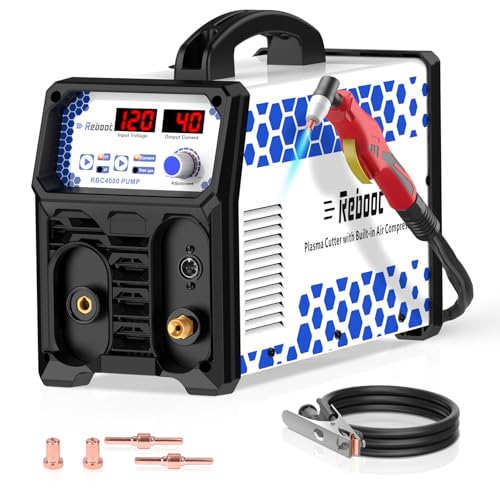
𝐁𝐔𝐈𝐋𝐓-𝐈𝐍 𝐀𝐈𝐑 𝐂𝐎𝐌𝐏𝐑𝐄𝐒𝐒𝐎𝐑, 𝐙𝐄𝐑𝐎 𝐄𝐗𝐓𝐄𝐑𝐍𝐀𝐋 𝐔𝐍𝐈𝐓𝐒 𝐍𝐄𝐄𝐃𝐄𝐃: Integrated high-efficiency air pump eliminates the need for separate air compressors. Start cutting immediately with simplified setup

COMPLETE BUILT-IN AIR SYSTEM: Equipped with an integrated high-performance air pump, this plasma cutter eliminates the need for an external air compressor—simply plug into power and start cutting with no extra equipment or complicated setup required

𝐁𝐔𝐈𝐋𝐓-𝐈𝐍 𝐀𝐈𝐑 𝐂𝐎𝐌𝐏𝐑𝐄𝐒𝐒𝐎𝐑, 𝐙𝐄𝐑𝐎 𝐄𝐗𝐓𝐄𝐑𝐍𝐀𝐋 𝐔𝐍𝐈𝐓𝐒 𝐍𝐄𝐄𝐃𝐄𝐃: Integrated high-efficiency air pump eliminates the need for separate air compressors. Start cutting immediately with simplified setup
Portability and Power Tradeoffs
| Option | Strength | Best use | Tradeoff |
|---|---|---|---|
| Built-in compressor | Compact and quick to deploy | Field repair and short mobile cuts | Fixed airflow and limited expansion |
| Portable external compressor | Flexible and serviceable | Home shops and mobile fabrication | Extra hose, filtration, and setup time |
| Stationary external compressor | Higher sustained capacity | Long cuts, CNC, and shared shop air | Floor space, wiring, and installation cost |
Maintenance and Air Quality
Both arrangements require maintenance. An integrated system may have an internal filter or drain that needs service. An external system adds a receiver, hose, couplers, regulators, filters, and possibly a dryer, giving you more places to inspect for leaks or restrictions.
- Drain tanks and separator bowls according to their manuals.
- Inspect hoses for cuts, burns, cracking, and loose fittings.
- Replace dirty intake and line-filter elements.
- Check regulator accuracy and pressure while air is flowing.
- Keep oil-lubricated tool branches isolated from the plasma line.
Power, Noise, and Portability Factors
After confirming airflow and pressure, compare electrical demand, noise, weight, and mobility. Large compressors and high-output plasma cutters may each require substantial branch-circuit capacity. Running both from the same undersized circuit can cause voltage drop, nuisance trips, poor compressor starting, or reduced cutter output.
Check each nameplate for voltage, phase, running current, starting requirements, and required overcurrent protection. Use a qualified electrician when adding a receptacle, stationary compressor, disconnect, or new branch circuit.
For noise, compare manufacturer dBA ratings only when the measurement method and distance are stated. Two numbers measured at different distances or operating conditions are not directly comparable. Enclosed and low-speed compressors are often easier to work around, but airflow, duty cycle, and service access still come first.
| Use case | Priority | Check before buying |
|---|---|---|
| Field repair | Portability and generator compatibility | Weight, wheels, handles, starting current, and short-cut capacity |
| Home shop | Balanced output, noise, and footprint | SCFM at pressure, receiver size, circuit capacity, and service access |
| Production or CNC | Continuous airflow and air treatment | Compressor duty cycle, total shop demand, dryer capacity, redundancy, and maintenance support |
Piping, Regulators, and Hose Setup for Best Flow
A compressor can meet the published SCFM requirement and still produce low pressure at the cutter if the air path is restrictive. Long small-diameter hoses, narrow quick-connects, dirty filters, excessive elbows, and leaks all reduce available pressure and flow.
Use hose or fixed compressed-air piping rated for the system pressure. Copper can be suitable in a correctly designed fixed installation, but the required diameter depends on flow, length, fittings, and the equipment manufacturer’s instructions.
As one model-specific example, the current Powermax45 SYNC gas-supply guidance calls for at least a 3/8-inch internal diameter on hoses shorter than 50 feet and at least 1/2-inch internal diameter from 50 to 100 feet. Do not apply those dimensions blindly to a different cutter or larger air demand.
- Use full-flow fittings and couplers with an internal passage that matches the hose.
- Keep flexible hose runs as short and direct as practical.
- Minimize unnecessary elbows, adapters, and quick-connects.
- Place the final regulator and gauge where the pressure can be checked near the cutter.
- Adjust and verify pressure while gas is flowing, not only with the torch closed.
- Leak-check threaded joints, couplers, drain valves, filter bowls, and hoses.
- Replace damaged or heat-burned hose immediately.
Troubleshooting Low Air Pressure and Poor Cut Quality
If the plasma cutter loses pressure, stops cutting, produces excess dross, or consumes tips unusually fast, check the system in a consistent order.
- Confirm the correct specification. Verify required airflow, inlet range, maximum pressure, and gas quality in the current manual.
- Fill and drain the receiver. Allow the compressor to reach cut-out pressure, then remove accumulated water according to the compressor instructions.
- Run a gas test. Watch the inlet gauge for three to five minutes while air flows. A rapid pressure drop points to inadequate delivery or a restriction.
- Check for leaks. Inspect hoses, quick-connects, filters, regulator fittings, drains, and threaded joints.
- Inspect hose and coupler size. Replace narrow, kinked, crushed, or excessively long air lines.
- Check filters and dryers. Drain bowls and replace clogged elements. Temporarily bypass only when the equipment manufacturer permits a safe diagnostic test.
- Observe compressor recovery. If tank pressure continues falling while the pump runs, the compressor may be too small, overheated, worn, or sharing too much demand.
- Check air quality. Water or oil in the cutter’s filter bowl means the upstream drainage and treatment system needs attention.
At higher elevations, compressor output and cooling performance can decrease because the incoming air is less dense. High ambient temperature can also reduce effective capacity and increase moisture load. Use additional reserve when conditions are severe and follow any altitude limits or derating instructions from the cutter and compressor manufacturers.
Budget, Compressor Types, and Buying Tips

Prices change too quickly for a reliable universal budget. Compare compressors by verified output, operating duty, electrical needs, noise data, tank size, warranty, parts availability, and the cost of the required air-treatment equipment.
| Specification | What to look for |
|---|---|
| Delivered airflow | SCFM or CFM at the cutter’s required pressure, with 25%–50% planning reserve |
| Compressor duty cycle | Enough run time for the longest expected cuts and recovery period |
| Receiver | Enough storage to reduce rapid cycling without using gallons as a substitute for pump output |
| Electrical supply | Correct voltage, phase, receptacle, branch circuit, and starting-current capacity |
| Air treatment | Serviceable drains, filters, regulator, and dryer capacity matched to total airflow |
| Noise and mobility | Comparable dBA test data, usable handles, wheels, weight, and footprint |
| Support | Replacement filters, valves, pump parts, service information, and warranty coverage |
Oil-free compressors avoid crankcase-oil carryover and can be convenient for portable use, but their noise, life, and duty ratings vary widely. Oil-lubricated reciprocating compressors can provide long service when maintained correctly, but the plasma line needs effective oil and moisture separation. Neither design is automatically best.
A rotary-screw compressor can be a strong production choice when a shop has long, steady air demand. It is usually unnecessary for occasional hand cutting unless other equipment also justifies the capacity and cost.
When considering a used compressor, test a cold start, listen for knocking or belt problems, time recovery between two known pressures, check leak-down after shutdown, inspect the receiver for corrosion, verify relief-valve and gauge condition, examine oil quality where applicable, and confirm that the data plate provides enough delivered airflow.
Products Worth Considering
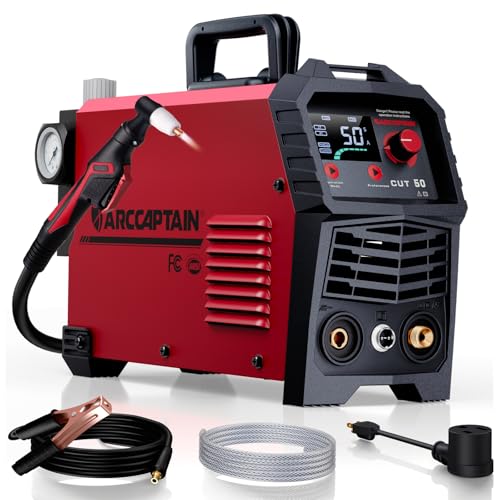
【Powerful Cutting Ability】Switch effortlessly between 110V and 220V for home or workshop use. Achieve professional 1/2" clean cuts on steel, aluminum, and copper with advanced LGBT technology. Perfect for DIY projects and heavy-duty tasks. Recommended maximum cutting thickness: 12mm @ 35A / 110V / 55 PSl; 18mm @ 50A / 220V / 75 PSI. Note: Requires compressed air (compressor sold separately).

CUTTING THICKNESS UP TO 20MM: Featuring a brand-new MCU technology upgrade, the plasma cutter machine has a high degree of internal integration, combining full digitalization for more precise control of cutting parameters such as current and voltage. This results in better cutting effects and improved stability. Cutting thickness: Quality 12mm (1/2"), maximum 20mm (3/4").

BUILT-IN AIR COMPRESSOR: With this plasma cutter machine, you're ready to cut as soon as you connect it to a power source, no additional air compressor needed. Designed for effortless outdoor work, it also offers compatibility with external compressors for versatile use
Frequently Asked Questions
How much air does a 50-amp plasma cutter need?
There is no universal airflow requirement for every 50-amp cutter. Machines in this range may require roughly 5–8 SCFM, but the exact flow and inlet pressure must come from the model’s manual. Add approximately 25%–50% compressor capacity after confirming the OEM figure.
How many PSI should I use for a plasma cutter?
Use the inlet-pressure range in the cutter’s manual and check it while gas is flowing. Published requirements vary: the Powermax30 XP is specified at 80 PSI, the TITANIUM Plasma 65 allows 80–110 PSI, and Powermax45 SYNC guidance calls for higher flowing inlet pressure. Never exceed the model’s maximum.
What size air compressor do I need for the TITANIUM Plasma 65?
The TITANIUM Plasma 65 owner’s manual specifies 4.2 CFM at 80–110 PSI. For useful reserve, look for roughly 6–6.5 SCFM at 90 PSI or more. Choose the tank by cut duration: a smaller tank may handle short cuts, while 20–30 gallons or more reduces cycling during longer work.
What is the best air compressor for a plasma cutter?
The best compressor is one that delivers the required SCFM at the correct pressure, has enough duty cycle for the planned cuts, and supplies clean, dry air through an unrestricted hose. It does not have to be a rotary-screw unit or have a specific tank size.
Can a 6-gallon compressor run a plasma cutter?
It can support short, occasional cuts if the pump’s delivered SCFM meets the cutter’s requirement. The small tank will cycle frequently and provide little reserve. If pressure falls while the pump runs, adding a larger tank will delay the drop but will not correct inadequate pump output.
What air-hose size should I use for a plasma cutter?
Follow the cutter manual because hose size depends on airflow and length. For the Powermax45 SYNC, Hypertherm recommends at least a 3/8-inch internal diameter below 50 feet and at least 1/2 inch from 50 to 100 feet. Use full-flow fittings and verify pressure under flow.
Sources
- Hypertherm Powermax30 XP specifications — verifies the 4 SCFM at 80 PSI gas requirement.
- Hypertherm Powermax45 SYNC gas-pressure troubleshooting — supports flowing-pressure checks and hose-ID guidance.
- TITANIUM Plasma 65 Owner’s Manual and Safety Instructions — verifies airflow, inlet pressure, gas type, duty cycle, and safety requirements.
- Hypertherm Powermax air-quality guidance — explains the effects of moisture and contaminants.
- CAGI Compressed Air and Gas Handbook, Chapter 3 — supports filtration, drying, moisture, dew-point, and pressure-drop guidance.
- OSHA welding and cutting requirements and OSHA air-receiver requirements — support hot-work, fire-prevention, gauge, drain, and relief-valve safety.