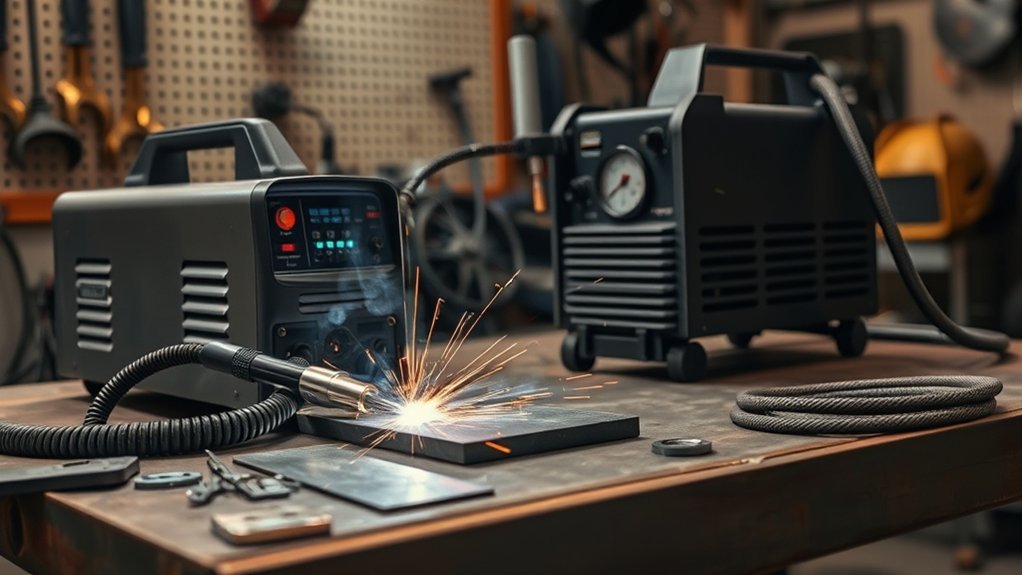
Air plasma cutters need a steady gas stream to form the arc, cool the torch, and blow molten metal out of the kerf. For most shop and garage machines, that gas stream is clean, dry compressed air from an external compressor. The main exception is a plasma cutter with a built-in compressor, which is convenient for light work but limited for long cuts and thicker steel.
Quick Answer
Yes, most plasma cutters need an air compressor unless the machine has one built in. Size the compressor by the cutter’s required SCFM or CFM at the stated PSI, then add about 25–50% airflow headroom. Tank size helps with short bursts, but sustained SCFM keeps the arc stable.
Key Takeaways
- Most air plasma cutters need an external compressor unless the cutter has an integrated air compressor.
- Use the cutter manual as the final source for SCFM/CFM and PSI, then choose a compressor with extra airflow capacity.
- A larger tank gives a longer buffer, but it cannot make up for a compressor that lacks sustained airflow.
- Dry, filtered air protects electrodes, nozzles, swirl rings, and cut quality.
At a Glance
| Time Required | 10–30 minutes to check the cutter manual, compare compressor SCFM, inspect the line, and set pressure under flow. |
| Difficulty | Beginner to intermediate. |
| Tools Needed | Plasma cutter manual, compressor spec plate, pressure regulator, air hose, coalescing filter, drain valve check, and basic PPE. |
| Cost | $0 if your current compressor already meets the required SCFM and PSI; often $150–$800+ for a suitable compressor and $30–$300+ for filters, regulators, or dryers. |
Why Plasma Cutters Require Compressed Air

A plasma cutter uses compressed gas to help create a narrow, hot plasma stream. In an air plasma cutter, that gas is usually shop air. The airflow constricts the arc, cools torch parts, and pushes molten metal out of the cut.
If the air supply drops, the arc can sputter, the kerf can widen, and dross can build up along the bottom edge. If the air is wet or oily, consumables can wear faster and starts can become erratic.
That is why the compressor is not just an accessory. It is part of the cutting system. The cutter, compressor, regulator, hose, filters, and dryer all work together.
Warning: Plasma cutting produces intense light, sparks, hot metal, noise, and airborne metal fume. Wear proper eye, face, hand, body, and hearing protection, and use ventilation that fits the material and workspace. OSHA treats welding, cutting, and brazing as safety-sensitive operations.
Built-In vs. External Compressors

The first question is whether your plasma cutter already has a compressor inside it. Some portable units include an internal compressor, so you only need electrical power and the correct consumables. These machines are useful for mobile repair, thin sheet metal, short cuts, and quick setup.
The trade-off is airflow. A built-in compressor is usually smaller than a separate shop compressor, so it may struggle with long cuts, thicker steel, repeated pierces, or production work.
An external compressor is the better choice when you need longer duty cycles, cleaner edges, higher amperage, or thicker cuts. It also gives you more control over filtration, drying, hose routing, and pressure regulation.
Choose a built-in compressor model for portability. Choose an external compressor when cut quality, runtime, and consumable life matter more than compact size.
Understanding CFM, SCFM, and PSI

Before you size a compressor, separate three terms: CFM, SCFM, and PSI. They work together, but they do not mean the same thing.
| CFM | Cubic feet per minute. This is airflow volume. The cutter needs enough volume to keep the arc stable during the cut. |
| SCFM | Standard cubic feet per minute. This is airflow corrected to standard conditions, which makes compressor specs easier to compare. |
| PSI | Pounds per square inch. This is pressure. The pressure must be high enough at the cutter inlet while air is flowing. |
Do not size by maximum PSI alone. A compressor may advertise 150 PSI but still deliver too little SCFM at the working pressure your plasma cutter needs. For plasma cutting, the useful number is the compressor’s delivered SCFM or CFM at the same PSI listed in the cutter manual.
Matching Compressor Output to Your Plasma Cutter
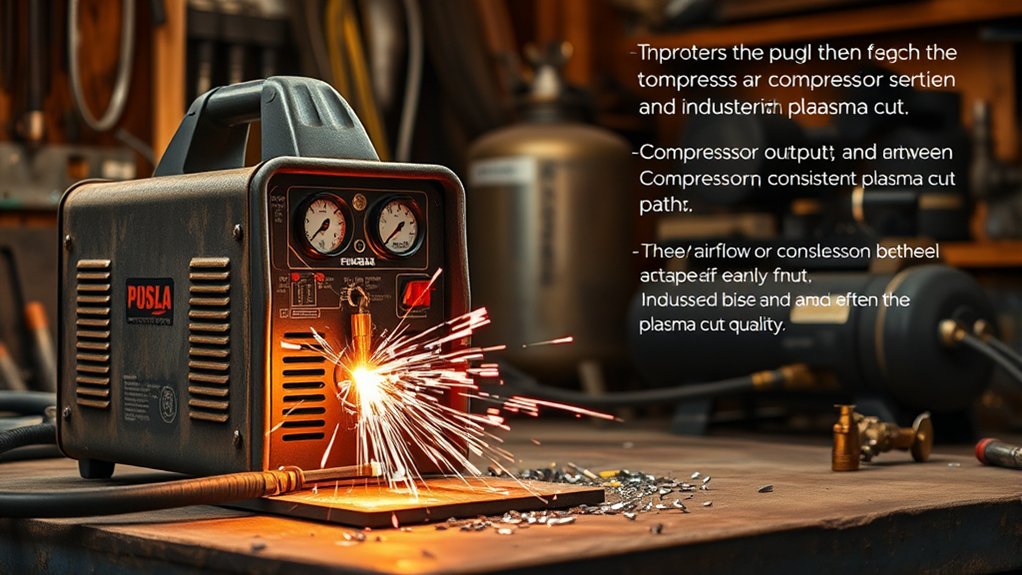
Start with the plasma cutter manual or nameplate. Find the required airflow and pressure, then choose a compressor that can deliver that airflow continuously at the required pressure.
A safe sizing rule is:
Required cutter airflow × 1.25 to 1.5 = recommended minimum compressor airflow.
For example, if your cutter requires 4 SCFM at 90 PSI, a compressor rated around 5–6 SCFM at 90 PSI gives useful headroom. That margin helps cover hose losses, filter restriction, warm compressor performance, and long cuts.
Note: The table below is a planning guide, not a replacement for your cutter manual. Always follow the exact SCFM/CFM and PSI listed by your machine manufacturer.
| Cutter Type | Common Airflow Planning Range | Common Pressure Planning Range | Best Compressor Fit |
| Built-in compressor plasma cutter | Internal compressor handles the air supply | Set by the machine | No external compressor for normal use; best for short, light cuts |
| 20–30 amp portable cutter | Often around 3.5–5 SCFM | Often around 80–90 PSI supply or inlet requirement | Small to mid-size compressor for short cuts; larger tank for fewer pauses |
| 40–50 amp cutter | Often around 5–7+ SCFM | Often around 80–100 PSI supply or inlet requirement | 20–30 gallon tank for intermittent use; 60 gallon for frequent cutting |
| 60 amp and larger cutter | Often 6–9+ SCFM, sometimes more | Often 90–120+ PSI supply capacity, depending on model | High-output compressor with strong duty cycle; 60 gallon or larger for long cuts |
Check pressure while the air is flowing, not only when the system is sitting still. Static pressure can look fine even when the line sags during a cut.
Tank Size and Duty Cycle Considerations
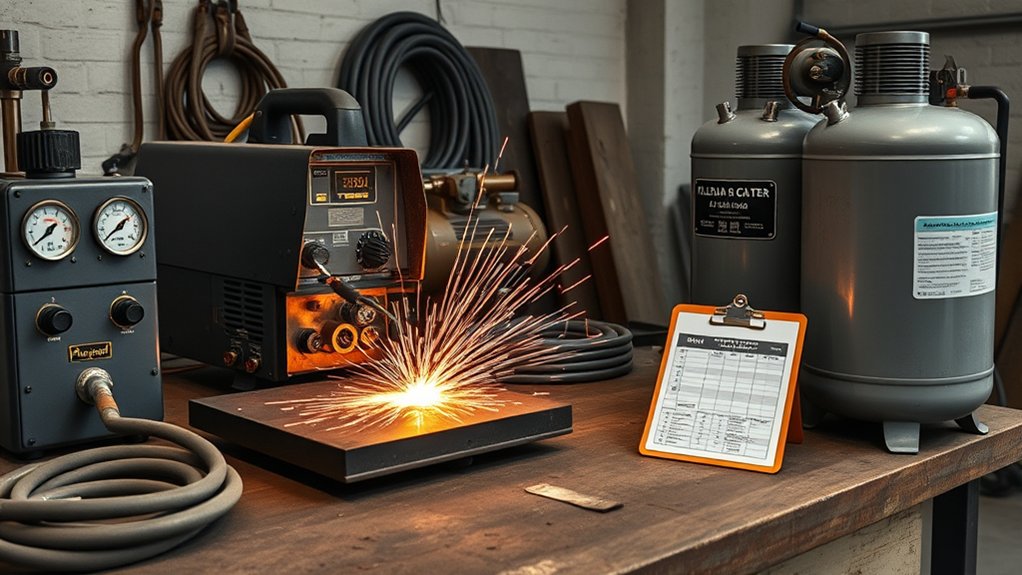
The tank is a buffer. It stores compressed air so pressure does not drop immediately when the torch starts flowing. A bigger tank can make cutting smoother, but it does not replace the need for enough compressor output.
A 6-gallon compressor may handle very short cuts on thin metal if the plasma cutter’s airflow demand is low. It usually falls short for long seams because the pump runs constantly, pressure drops, and moisture builds as the compressor gets hot.
An 8-gallon tank can work for occasional light cutting. A 20–30 gallon tank is more comfortable for hobby and repair work. A 60-gallon compressor is a better baseline for frequent cutting, thicker material, or long continuous passes.
- Light, short cuts: small tank may work if SCFM is adequate.
- Garage fabrication: 20–30 gallons usually gives a better balance of runtime and space.
- Frequent or thick cutting: 60 gallons or more reduces recovery pauses and heat buildup.
Pro Tip: When comparing compressors, look for delivered SCFM at 90 PSI before you look at tank gallons. Gallons help with reserve air; SCFM keeps the cutter fed.
Air Quality: Filtration, Dryers, and Aftercoolers
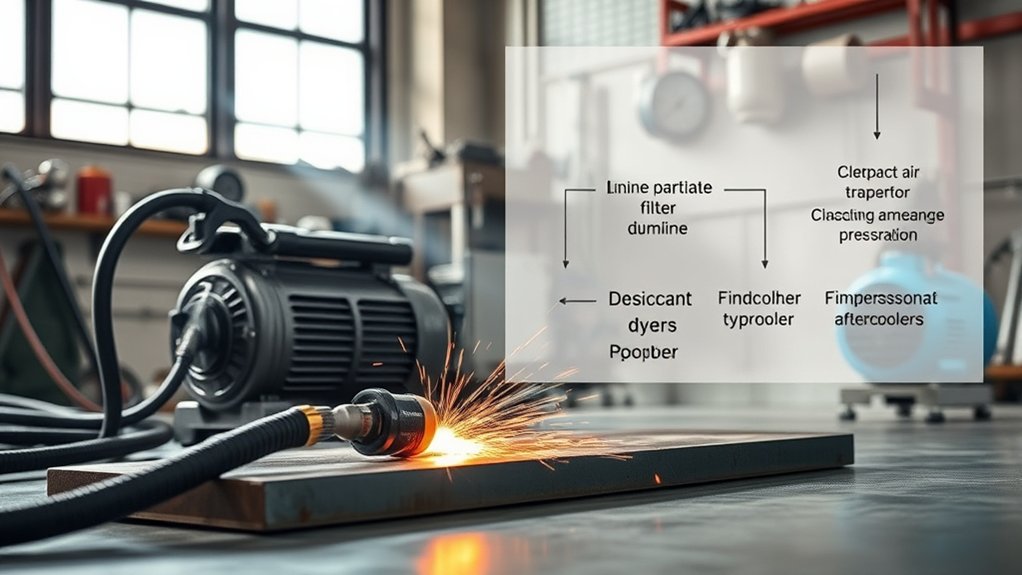
Air quality affects every cut. Moisture, oil, rust, and dust can shorten consumable life, cause rough starts, and leave dross that should have blown clear. The compressed-air purity standard ISO 8573-1 classifies compressed-air contaminants by particles, water, and oil, which are the same contamination categories that matter in a plasma cutting air line.
For a small shop, the goal is simple: remove bulk water, remove oil mist, trap fine particles, and regulate pressure close to the cutter.
Filtration Stages Explained
A good line is built in stages. Each stage handles a different problem, and each one should be sized for the cutter’s airflow demand so it does not create a pressure drop.
- Tank drain and water separator: drain the compressor tank often and remove bulk water before it travels down the hose.
- Particulate filter: catches rust, scale, and dirt from the tank, hose, and piping.
- Coalescing filter: removes fine water droplets and oil aerosol that can damage consumables.
- Final filter/regulator near the cutter: stabilizes pressure and catches remaining contamination before the torch.
Place the final filter and regulator as close to the plasma cutter as practical. Long dirty hoses after the filter can reintroduce debris or moisture.
Drying Methods Compared
Drying needs depend on climate, cut length, and compressor workload. In dry climates with short cuts, a drained tank plus separator and coalescing filter may be enough. In humid shops or long cutting sessions, add stronger moisture control.
- Aftercooler plus separator: helps condense and remove bulk moisture after the compressor.
- Refrigerated dryer: useful for humid shops and frequent use where lines need steady moisture control.
- Desiccant dryer: useful as a final polishing stage when very dry air is needed, but cartridges must be maintained or replaced.
Do not use oxygen, flammable gas, or an unapproved bottled gas with an air plasma cutter unless the machine manual specifically allows it. Using the wrong gas can create fire risk, damage consumables, or produce poor cuts.
Power, Phase, and Voltage Requirements
Air is only half of the setup. You also need enough electrical capacity for the plasma cutter and compressor. Light-duty cutters may run on 120V, while higher-output cutters often need 240V. Compressors may also be 120V, 240V single-phase, or three-phase in industrial settings.
The compressor and cutter do not always need the same voltage, but both must match the circuits available in your shop. Check breaker size, wire gauge, plug type, extension cord limits, and starting amperage. A compressor can draw a high surge when it starts, which may trip a weak circuit if the plasma cutter is already running.
- Small garage setup: confirm the cutter and compressor can run without overloading the same circuit.
- 240V setup: use the correct plug, breaker, and wire size for both machines.
- Industrial setup: confirm whether the compressor is single-phase or three-phase before buying.
If you need a new circuit or hardwired compressor, use a qualified electrician.
Noise, Size, and Portability Trade-Offs
Compressor choice is also about comfort and workspace. A small portable compressor is easy to move, but it may cycle often. A larger stationary compressor is less convenient, but it usually delivers steadier air for longer cuts.
Check the published dBA rating before you buy. OSHA notes that noise exposure over 85 dBA can damage hearing, and many compressors can reach or exceed that level in a garage or enclosed shop. Use hearing protection when noise is high, especially during long cutting sessions.
Products Worth Considering
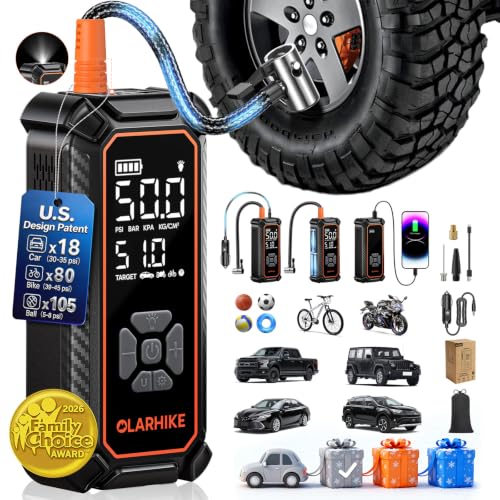
[Fast & Efficient Inflation] The OlarHike tire inflator features a high-performance motor that delivers rapid airflow—inflate a standard car tire (195/65 R15) from 30 to 35 PSI (+5 PSI) in just 55 seconds, or a larger SUV tire (235/65 R17) from 30 to 35 PSI (+5 PSI) in only 2.2 minutes. Ideal for cars, SUVs, light Pickup(Within 51 PSI), motorcycles, bicycles, and sports balls. Its practical everyday usefulness also makes it a thoughtful car gift for men who value reliable tools for their vehicles. Important Note: The unit can only inflate car and pickup truck tires up to 51 PSI and is not compatible with heavy-duty pickup trucks or RVs.

3.0 SCFM delivered @ 90 PSI pump, 2.5 gallon tank and 200 max PSI of the portable air compressor enables large amount of nails to be fired and provides quick recovery

𝗦𝘁𝗿𝗼𝗻𝗴 𝗣𝗼𝘄𝗲𝗿 𝗢𝘂𝘁𝗽𝘂𝘁: Equipped with a high-efficiency motor which generates 3/4 horsepower power; SAQ-1234 Air Compressor can be inflated quickly and stably provide a strong air pressure of up to 125 PSI to meet all kinds of high-demand operations.
Decibel Ratings Matter
Quiet compressors cost more, but they reduce fatigue and make garage work easier. Do not rely only on marketing terms like “quiet” or “ultra quiet.” Look for the measured dBA rating and the distance used for that measurement.
Remember that walls, concrete floors, and small rooms can make the compressor seem louder than the rating suggests.
Footprint vs. Capacity
A compact compressor saves space, but it often has less reserve air and a lower duty cycle. A larger unit takes more floor space but can reduce recovery pauses, heat, moisture, and pressure sag.
For occasional sheet-metal work, portability may matter more. For frequent cuts, thicker material, or CNC use, capacity matters more.
Mobility vs. Stability
Portable compressors are useful for jobsite repairs and quick work. Stationary compressors are better for steady airflow and repeated cutting. If you move between locations, choose the smallest compressor that still meets the cutter’s required SCFM at working pressure.
- Choose portability for thin material, short cuts, and mobile repairs.
- Choose stability and capacity for long seams, thick plate, or repeated pierces.
- Choose lower noise if you work in a garage, shared building, or neighborhood setting.
Budget and Buying Options: New vs. Used

You can buy a new or used compressor for plasma cutting, but do not buy by price alone. The compressor must meet the cutter’s airflow and pressure requirements under real use.
A new compressor gives you clearer specs, warranty coverage, and easier returns. A used compressor can save money, but only if it builds pressure quickly, holds pressure, drains cleanly, and runs without overheating or strange noise.
Before buying used, ask for a cold-start demo. Watch how long it takes to reach cut-out pressure. Listen for knocking, bearing noise, or air leaks. Check the tank for rust, the drain for heavy water/oil, the regulator for smooth adjustment, and the pump for excessive heat.
If the seller cannot show the compressor running, treat it as a risk. Plasma cutting punishes marginal air systems.
Products Worth Considering

[55A 110V/220V Cutting Power]: The SILATU STC550P plasma cutter delivers up to 55A of cutting power with advanced IGBT inverter technology. Use 110V at 15-40A for home garage and lighter-duty jobs, or switch to 220V at 15-55A for thicker metal and more demanding projects. Maximum cutting capacity reaches 1/2" (12mm) at 110V/40A and 7/10" (18mm) at 220V/55A under recommended air pressure (Note: For circuit protection, this machine must be used with 40A circuit breaker)

CUTTING THICKNESS UP TO 20MM: Featuring a brand-new MCU technology upgrade, the plasma cutter machine has a high degree of internal integration, combining full digitalization for more precise control of cutting parameters such as current and voltage. This results in better cutting effects and improved stability. Cutting thickness: Quality 12mm (1/2"), maximum 20mm (3/4").

BUILT-IN AIR COMPRESSOR: With this plasma cutter machine, you're ready to cut as soon as you connect it to a power source, no additional air compressor needed. Designed for effortless outdoor work, it also offers compatibility with external compressors for versatile use
Setup Tips: Regulators, Hoses, and Line Layouts
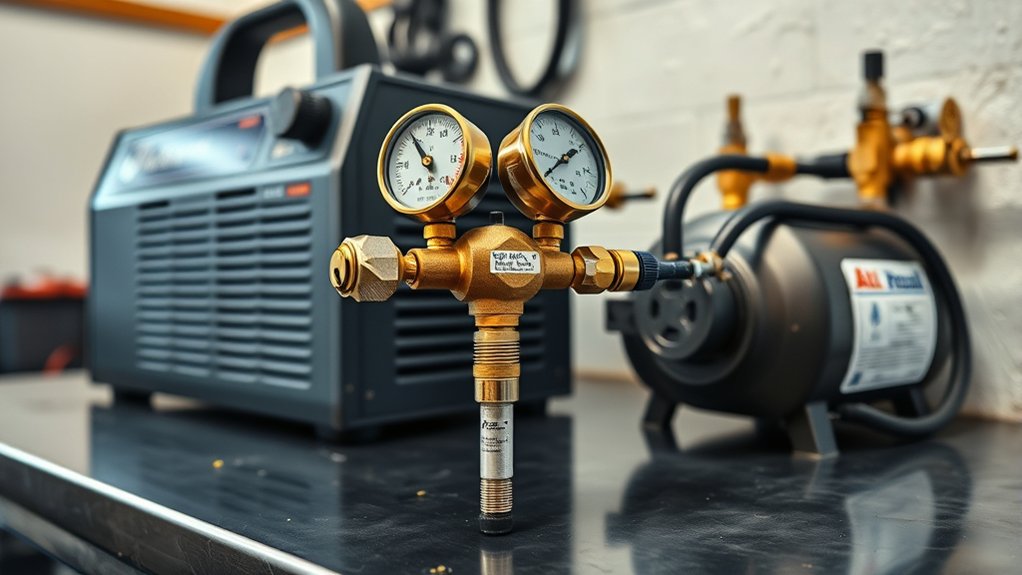
A good compressor can still perform poorly if the line setup is restrictive. Use a hose and fittings large enough to carry the required airflow without a major pressure drop.
Keep the air route short and direct. Avoid tight coils, crushed hoses, undersized quick-connects, and extra elbows. Every restriction reduces delivered air at the cutter.
Regulator Placement and Settings
Use a regulator between the compressor and plasma cutter. For many setups, the compressor outlet is set higher than the cutter’s working inlet pressure, then the final regulator near the cutter controls the exact inlet pressure.
The correct setting depends on your machine, torch, consumables, and material thickness. Set the pressure according to the manual while air is flowing. A static reading can be misleading because pressure may drop once the torch starts.
- Set compressor pressure high enough to feed the system safely within its rated limits.
- Set the cutter inlet pressure to the manual’s recommended value while air is flowing.
- Recheck the gauge during a test cut. If pressure falls, look for low SCFM, leaks, clogged filters, or undersized hose fittings.
Hose Diameter and Routing
For short runs, a quality 3/8-inch air hose is often enough for many small and mid-size cutters. For long runs or higher airflow machines, a 1/2-inch line can reduce restriction. Always match fittings and couplers to the hose size, because a small coupler can choke a large hose.
Use the shortest practical line. Keep it away from sparks, hot slag, sharp edges, and pinch points. If you run fixed piping, slope the line and place drains so water does not collect near the plasma cutter.
Troubleshooting Poor Air Supply
If the cut looks worse than expected, check the air system before blaming the torch or the metal. Many plasma cutting problems start with weak, wet, or unstable air.
| Symptom | Likely Air-System Cause | Fix |
| Arc sputters or stops mid-cut | Compressor cannot sustain required SCFM | Use a higher-SCFM compressor, shorten the cut, or pause for recovery. |
| Heavy dross and rough edge | Low flowing pressure, wet air, wrong travel speed, or worn consumables | Check pressure under flow, drain tank, inspect filters, and replace worn consumables. |
| Water appears at the torch or filter bowl | Tank not drained, humid shop, hot compressor, or no dryer | Drain tank, add separator/coalescing filter, and use a dryer for humid or frequent cutting. |
| Compressor runs nonstop | Air demand exceeds compressor duty cycle | Use a larger compressor, reduce cut length, or allow cooling and recovery time. |
Pre-Cut Air System Checklist
Run through this quick checklist before important cuts:
- Confirm the cutter’s required SCFM/CFM and PSI in the manual.
- Confirm the compressor’s delivered SCFM at that same working pressure.
- Drain the compressor tank.
- Check filter bowls and dryer condition.
- Inspect hoses for kinks, leaks, burns, and undersized fittings.
- Set pressure while air is flowing.
- Wear eye, face, hand, body, and hearing protection.
- Use ventilation, especially on coated, painted, galvanized, stainless, or unknown metal.
Frequently Asked Questions
Do you need a compressor to use a plasma cutter?
Yes, most air plasma cutters need a compressor. The exception is a plasma cutter with a built-in compressor. If your cutter does not have one built in, you need an external source of clean, dry compressed air that meets the cutter’s SCFM/CFM and PSI requirements.
How much air pressure do I need to run a plasma cutter?
Use the pressure listed in your plasma cutter manual. Many portable cutters need a supply or inlet range around 80–100 PSI, while some larger machines may require more. The key is to set and verify pressure while air is flowing, because static pressure can look fine even when the cutter is starving during a cut.
Is a 6-gallon air compressor enough for a plasma cutter?
Usually, a 6-gallon compressor is only enough for short, light cuts if it meets the cutter’s required SCFM at the required PSI. It often short-cycles during longer cuts, which can cause pressure drop, heat, moisture, rough edges, and shorter consumable life.
What do I need to run a plasma cutter?
You need the plasma cutter, correct electrical power, clean and dry compressed air, a regulator, suitable hose and fittings, good consumables, a proper work clamp, and PPE. For best results, add filtration and moisture control close to the cutter.
Can I use bottled gas instead of an air compressor?
Only use gases approved by your plasma cutter manufacturer. Many shop air plasma cutters are designed for compressed air. Do not substitute oxygen, flammable gas, or random bottled gas unless the manual specifically allows it and you have the correct regulators and safety setup.
What happens if the air is wet or oily?
Wet or oily air can cause erratic starts, rough cuts, heavy dross, double-arcing, and faster wear on nozzles, electrodes, and swirl rings. Drain the tank, use a water separator and coalescing filter, and add a dryer when humidity or long cutting sessions create moisture problems.
Conclusion
You need clean, dry compressed air for most plasma cutters unless your machine has a built-in compressor. The right compressor is not chosen by tank size alone. Start with the cutter manual, match the required SCFM or CFM at the stated PSI, add airflow headroom, and verify pressure while air is flowing.
For short light cuts, a compact setup may work. For longer cuts, thicker metal, or frequent shop use, choose higher sustained SCFM, a larger tank, better drying, and a clean line layout. Get the air system right, and your plasma cutter will start cleaner, cut smoother, and use consumables more efficiently.
Sources
- OSHA — Welding, Cutting, and Brazing — safety context for cutting operations and applicable OSHA resources.
- OSHA Fact Sheet: Controlling Hazardous Fume and Gases during Welding — backs fume, ventilation, and exposure cautions for welding and plasma cutting.
- OSHA — Occupational Noise Exposure — backs hearing-risk guidance for noisy shop equipment.
- ISO 8573-1:2010 — Compressed air contaminants and purity classes — backs the focus on particles, water, and oil contamination in compressed-air systems.