Last updated: July 28, 2026 — added manufacturer-published airflow specifications, consumable-life figures, shield-gas pairings, and cylinder-duration guidance.
Yes — every plasma cutter needs gas. The arc is electrical, but it only becomes a cutting jet when gas flows through the nozzle. What you do not always need is a gas cylinder. Most home and small-shop machines run on clean compressed air from a shop compressor, and a few carry a compressor inside the case. Industrial multi-gas systems add oxygen, nitrogen, F5, or argon-hydrogen blends to gain speed or edge quality on specific metals.
How much gas depends entirely on the machine. Two 30-amp handheld cutters from different manufacturers can call for different flow rates and different pressure windows, so the number that matters is the one printed in your own manual — not a shop rule of thumb.
Quick Answer
Yes. Every plasma cutter needs a process gas, but not every cutter needs a separate gas cylinder or external air compressor. Most portable units use compressed air, and some have a built-in compressor. Multi-gas industrial systems may use oxygen, nitrogen, or argon-hydrogen for specific materials and thicknesses.
Key Takeaways
- A plasma cutter needs gas flow to form the plasma jet, cool torch parts, and clear molten metal from the kerf.
- Clean, dry, oil-free compressed air is the most practical gas for many mild steel, stainless steel, and aluminum jobs.
- Oxygen is commonly used for high-quality mild-steel cutting on compatible multi-gas systems.
- Nitrogen and argon-hydrogen can improve results on selected stainless steel and aluminum applications, but only on approved equipment.
- Gas choice also affects parts life. Hypertherm publishes parts life up to 600 starts on air, more than 1,000 starts on nitrogen, and 800 to 1,500 starts on modern oxygen systems that use an inert starting gas.
- Pressure and airflow are machine-specific. Size the supply from the manufacturer’s SCFM and PSI requirements, not a universal rule.
What’s in This Article
Why Plasma Cutters Need Gas

The torch sends gas through a small nozzle while an electric arc heats that gas until part of it becomes plasma. The constricted plasma jet melts conductive metal, and the fast-moving gas blows the molten material out of the cut.
Gas flow also helps cool the torch and consumables. If flow is too low, contaminated, or interrupted, the machine may fail to start, show a pressure fault, lose the arc, leave heavy dross, or shorten nozzle and electrode life. Modern systems often stop or refuse to fire when pressure falls outside their safe range, but you should never depend on that protection instead of fixing the supply problem.
Some industrial torches use two flows: a plasma gas that forms the cutting arc and a shield gas or shield fluid that surrounds the arc, cools the torch, and affects the cut face. Portable air-plasma cutters often use air for both functions inside the torch.
A plasma cutter always needs gas, but the gas source may be shop air, a built-in compressor, bottled air, or a machine-approved specialty gas.
Follow the gas type, pressure, flow, consumable, amperage, standoff, and travel-speed values in the cut chart supplied with your machine. Those settings work together; changing one can affect kerf width, edge angle, dross, and consumable wear.
Common Plasma Cutter Gases

The best gas depends on the plasma system, metal, thickness, finish requirement, and operating cost. According to Hypertherm’s plasma gas selection guide, clean shop air is the most economical all-purpose choice, while oxygen, nitrogen, and argon-hydrogen are used for more specialized results.
The table below is a decision summary aimed at the question this page answers: what supply your machine needs. For a fuller breakdown of which gas suits each metal and thickness, see our dedicated gas-selection guide.
| Gas | Typical Best Use | Typical Shield / Secondary Gas | Published Parts Life (Hypertherm) | Main Advantages | Main Trade-Offs |
|---|---|---|---|---|---|
| Compressed air | General cutting of mild steel, stainless steel, and aluminum | Air | Up to 600 starts | Low cost, easy supply, broad compatibility | Can oxidize or nitride cut edges; requires drying and filtration |
| Oxygen | Mild or carbon steel on approved multi-gas systems | Air | 800 to 1,500 starts on systems using an inert starting gas | Fast cutting, low dross, clean steel edges | Not recommended as the plasma gas for stainless steel or aluminum; added fire controls and gas cost |
| Nitrogen | Selected stainless steel and aluminum processes | Air, CO2, or water shield where the system allows | More than 1,000 starts | Excellent parts life and useful surface-finish control on compatible systems | Higher cost than air; results vary by torch and may include more dross on some air-plasma setups |
| Argon-hydrogen (H-35) | Thick stainless steel and aluminum, often over 1/2 inch, on industrial equipment | Nitrogen | Not published as a start count; depends on torch and cooling | High arc energy and smooth, straight cut faces | Expensive; can leave bottom dross; requires hydrogen-rated equipment and strict ventilation |
Note: A gas that works well on one industrial torch may be unsafe or ineffective on a small air-plasma cutter. Never connect specialty gas unless the manufacturer lists that gas, torch, consumables, and pressure range as approved. Parts-life figures are Hypertherm’s published ranges for their own systems and will differ on other equipment.
What About Argon, CO2, F5, and Water Shield?
Four gases come up constantly in shop conversation but are widely misunderstood.
- Argon on its own is not a cutting gas. It is chemically inert and lacks the energy to cut effectively. On some systems it is used for plate marking rather than cutting, and for that job it produces narrower, shallower grooves than air. Argon becomes a cutting gas only when blended with hydrogen, as in H-35.
- CO2 is used as a secondary gas alongside nitrogen plasma. Hypertherm notes it slightly improves surface finish, cutting speed, and parts life compared with air, but it costs more and needs multiple manifolded cylinders or a bulk system to deliver adequate flow.
- F5 is a blend of roughly 95% nitrogen and 5% hydrogen. Reporting in The Fabricator describes F5 as producing a silver-colored edge with a good cut angle and a sharp edge, and notes it is recommended for stainless steel only.
- Water shield uses water rather than a gas as the secondary flow with nitrogen plasma. Hypertherm reports this produces a very smooth, shiny cut surface on aluminum and stainless steel, but water must be used as a secondary only with a water table designed for it.
None of these should be connected to a machine that does not list them as approved. A small air-plasma cutter usually accepts air, sometimes nitrogen, and nothing else.
Compressed Air

Compressed air is the default choice for many portable plasma cutters because it can cut mild steel, stainless steel, and aluminum without separate specialty-gas cylinders. It is flexible and economical, but the air still needs to meet the cutter’s quality and flow requirements. Hypertherm publishes parts life of up to 600 starts on air, which sets a useful baseline when you compare gases on running cost rather than sticker price.
Moisture, oil mist, dirt, rust, and compressor contamination can destabilize the arc and damage the power supply, torch, or consumables. Hypertherm instructs users to supply clean, dry, oil-free air and to filter out dirt, water, and oil. Its recommended setup for air plasma systems is a good-sized dedicated air compressor, a refrigerated dryer, and a bank of filters that remove particulate, oil mist, and any remaining moisture.
| Component | Purpose | Selection Target |
|---|---|---|
| Compressor | Supplies airflow | Meet or exceed the cutter’s SCFM at its required operating PSI |
| Aftercooler or dryer | Removes water vapor and condensation | Air quality within the machine manual’s limits; Hypertherm recommends a refrigerated dryer for air plasma |
| Particulate filter | Captures dirt and pipe scale | Manufacturer-approved filtration without excessive pressure drop |
| Coalescing filter | Removes fine oil aerosols | Oil-free air at the cutter inlet. As a published example, Miller’s in-line filter kit for the Spectrum 375 X-TREME filters to 0.85 microns and removes 99.9% of water, dirt, and oil |
| Regulator and gauge | Controls inlet pressure | Pressure set and checked while gas is flowing |
Check an air-cut edge before welding. Air plasma leaves some nitriding and oxidation on the cut surface, which Hypertherm notes can cause porosity in welds. The company reports the problem is usually corrected by using good-quality weld wire containing denitriders and deoxidizers. Depending on the metal, welding process, and quality requirement, you may still need to grind or otherwise prepare the cut face before joining it.
Pro Tip: Place the final filter and regulator close to the plasma cutter, use a hose large enough to avoid pressure loss, and check the gauge while air is flowing—not only when the system is idle.
Warning: Wear the eye, face, hearing, hand, foot, and flame-resistant protection required by your machine and workplace. Check hoses and fittings for leaks, keep sparks away from cylinders and flammables, and never service the torch while power is connected.
Oxygen
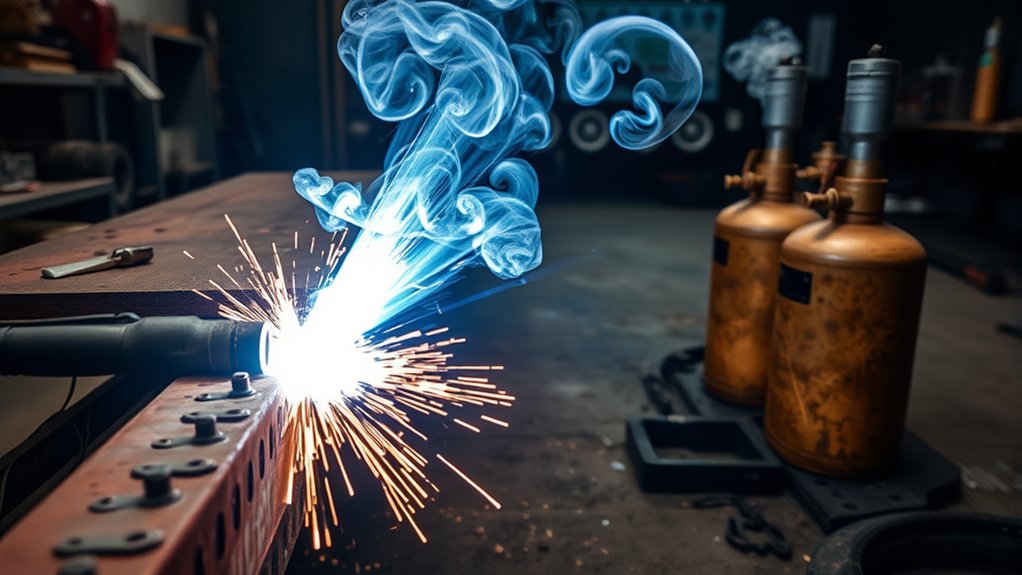
Oxygen is widely used as a plasma gas for mild or carbon steel on compatible industrial and multi-gas systems. It reacts with the steel and helps eject a fine stream of molten metal, which can produce fast travel speeds, low dross, and a clean cut face.
Do not treat oxygen as a universal upgrade. Hypertherm does not recommend oxygen plasma gas for aluminum or stainless steel in its general gas-selection guidance. Use only the oxygen process, torch parts, pressures, shield gas, and cut charts approved for your system.
Best for Mild Steel
Oxygen is often the best process gas when high cut quality and productivity matter on mild steel. Many systems pair oxygen plasma with an air shield. Correct amperage, pierce height, torch standoff, gas flow, and travel speed help control edge angle and dross.
Wrong settings can cause rough cuts, double-arcing, failed pierces, and rapid consumable wear. Start with the manufacturer’s cut chart instead of copying settings from a different torch or amperage class.
Cost, Consumables, and Oxygen Safety
Oxygen adds cylinder or bulk-gas cost, regulators, gas-rated plumbing, storage controls, and maintenance. The old assumption that oxygen always burns through consumables faster no longer holds on current equipment: Hypertherm reports that systems using an inert starting gas such as nitrogen with oxygen plasma achieve parts life comparable to nitrogen or air systems, in the 800 to 1,500-start range, and that the higher gas and consumable costs are usually offset by less secondary work removing dross and straightening beveled parts. Track pierce counts, arc-on time, cut quality, and inspection results on your own machine rather than assuming either way.
Oxygen-enriched areas increase fire risk. Keep oxygen cylinders, valves, regulators, hoses, and fittings away from oil and grease. OSHA’s construction standard requires oxygen equipment to be kept free from oily or greasy substances and prohibits handling it with oily hands or gloves. The same standard requires oxygen cylinders in storage to be separated from fuel-gas cylinders or combustible materials such as oil or grease by at least 20 feet, or by a noncombustible barrier at least 5 feet high with a fire-resistance rating of at least one-half hour, and requires gas hose in use to be inspected at the start of every working shift. Hypertherm additionally calls for ventilation where oxygen-enriched atmospheres could collect.
Warning: Use oxygen-rated equipment only. Never handle oxygen fittings with oily gloves, use petroleum products on oxygen connections, or substitute an unapproved regulator or hose.
Nitrogen
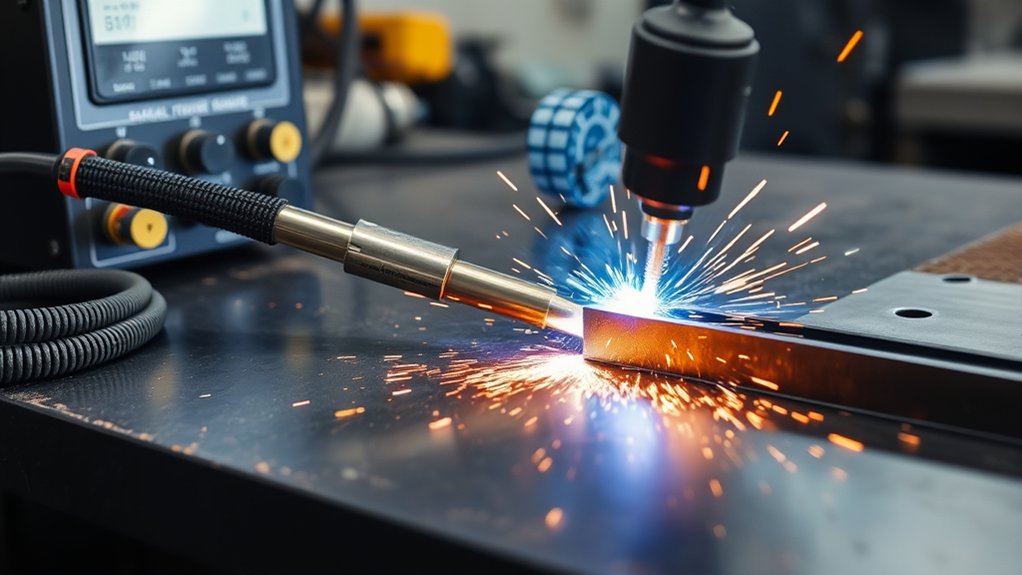
Nitrogen can serve as a plasma gas or shield gas on systems designed for it, and it is the standing choice for shops that cut a lot of stainless steel and aluminum. Hypertherm reports excellent cut quality and consumable life with nitrogen plasma, with the electrode and nozzle lasting more than 1,000 starts. Air is generally the best secondary gas with nitrogen plasma; CO2 slightly improves finish, speed, and parts life at higher cost, and a water shield gives the best edge quality where the system allows it.
Its benefits are process-specific. Nitrogen may reduce the dark oxidized finish produced by air on stainless steel, but it can cost more and may create more dross on some air-plasma systems. Do not promise a cleaner edge without checking the exact cut chart and making a test cut.
Industrial power supplies can use nitrogen for thicker sections when amperage, torch height, speed, gas purity, and flow match the manufacturer’s data. Some portable machines allow it too — Miller publishes the plasma gas for the Spectrum 375 X-TREME as air or nitrogen only, which is exactly the kind of line to look for in your own specifications before you buy a cylinder. Other small cutters allow air and nothing else.
Confirm gas purity, secure cylinders upright, leak-test the supply as directed, and ventilate the work area. Nitrogen can displace oxygen in an enclosed space even though it is not flammable.
Watch nozzle and electrode wear, pressure under flow, and duty cycle. Incorrect pressure, restricted hoses, or contaminated gas can shorten consumable life and reduce cut quality.
Argon-Hydrogen

Some industrial systems use H-35, a blend of 65% argon and 35% hydrogen, for thick stainless steel and aluminum. Hypertherm identifies argon-hydrogen as the hottest-burning plasma gas and a strong choice for material over about 1/2 inch when the plasma system is equipped for it.
H-35 creates a high-energy arc that can produce straight, smooth cut faces. Many multi-gas setups pair it with a nitrogen shield. The process costs more than air or nitrogen and may leave jagged dross along the bottom edge.
H-35 Mix Benefits
The ceiling on this process is high. Hypertherm notes argon-hydrogen is used in water-injection torches at up to 1,000 amps to cut stainless steel up to 6 inches thick — far beyond anything a handheld air-plasma machine can approach. On approved industrial equipment at ordinary amperages, H-35 improves cutting capability, heat transfer, edge squareness, and surface finish on thick stainless steel and aluminum, and can reduce rework when the system, torch cooling, consumables, and motion controls are in good condition.
Results still depend on cut speed, thickness, alloy, pierce method, torch-to-work distance, and consumable condition. Make a trial cut before production and inspect both the top edge and bottom dross.
Thick Stainless Performance
On the cut face itself, argon-hydrogen maintains a hot, stable arc through thick stainless steel and produces what Hypertherm describes as a very smooth, almost polished surface in multi-gas torches. Do not promise a tiny heat-affected zone or dross-free edge; those outcomes depend on the complete cutting system and process settings, and some jagged dross along the bottom edge is normal.
Check torch cooling before long cuts, inspect the nozzle and electrode, and use automatic height control where the system requires it. Record gas use, consumable life, and test-cut results because H-35 is a high-cost process.
Shield Gas Pairing and Hydrogen Controls
A common premium combination is H-35 plasma gas with nitrogen shield gas. The plasma gas supplies arc energy, while the shield flow helps shape and protect the cutting zone and cool torch components.
Set both flows from the torch manufacturer’s chart. Use hydrogen-rated hoses, regulators, valves, seals, and any required flashback arrestors. Hypertherm warns that hydrogen is flammable and recommends exhaust ventilation to prevent a hydrogen-enriched atmosphere from collecting.
Warning: Do not connect H-35 to a standard air-plasma cutter. Hydrogen service requires a system specifically designed for the gas, compliant storage and ventilation, leak controls, and manufacturer-required flashback protection.
Plasma Cutter Air and Gas Supply Options

A plasma cutter needs gas, but the source can take several forms. Choose the source that the manufacturer approves and that can hold the required flow and pressure through the full cut.
Products Worth Considering
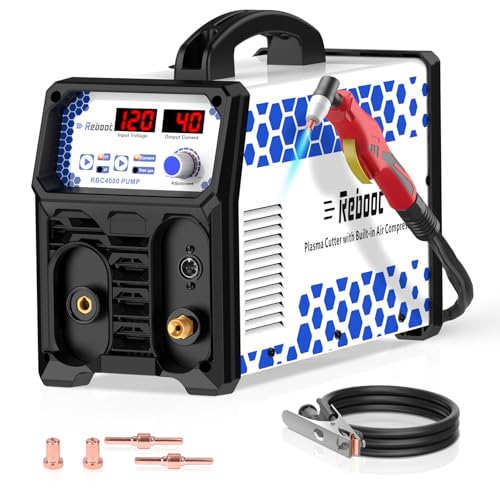
𝐁𝐔𝐈𝐋𝐓-𝐈𝐍 𝐀𝐈𝐑 𝐂𝐎𝐌𝐏𝐑𝐄𝐒𝐒𝐎𝐑, 𝐙𝐄𝐑𝐎 𝐄𝐗𝐓𝐄𝐑𝐍𝐀𝐋 𝐔𝐍𝐈𝐓𝐒 𝐍𝐄𝐄𝐃𝐄𝐃: Integrated high-efficiency air pump eliminates the need for separate air compressors. Start cutting immediately with simplified setup

COMPLETE BUILT-IN AIR SYSTEM: Equipped with an integrated high-performance air pump, this plasma cutter eliminates the need for an external air compressor—simply plug into power and start cutting with no extra equipment or complicated setup required

𝐁𝐔𝐈𝐋𝐓-𝐈𝐍 𝐀𝐈𝐑 𝐂𝐎𝐌𝐏𝐑𝐄𝐒𝐒𝐎𝐑, 𝐙𝐄𝐑𝐎 𝐄𝐗𝐓𝐄𝐑𝐍𝐀𝐋 𝐔𝐍𝐈𝐓𝐒 𝐍𝐄𝐄𝐃𝐄𝐃: Integrated high-efficiency air pump eliminates the need for separate air compressors. Start cutting immediately with simplified setup
External Air Compressor
Most portable air-plasma cutters connect to a shop compressor. This is the most common setup for general fabrication. The compressor must supply enough SCFM at the cutter’s operating PSI, and the system needs suitable drying, filtration, hose size, and regulator capacity.
Built-In Air Compressor
Some portable cutters include an internal compressor. For example, the Hypertherm Powermax30 AIR lists its internal compressor as eliminating the need for an external air compressor and filter. It still uses air as its process gas; the difference is that the machine supplies and manages that air internally.
Built-in-compressor models are convenient for field repairs and mobile work, but their cutting capacity and duty cycle are still limited by the machine’s specifications. If you are weighing this against a compressor purchase, our roundup of portable plasma cutters covers how the trade-off plays out in practice.
Bottled Air or Specialty Gas Cylinders
Some systems can run on bottled air, nitrogen, F5, oxygen, argon-hydrogen, or other approved gases. Cylinders can provide clean gas where a compressor is unavailable, but they add regulator compatibility, storage, transport, securing, leak-checking, and refill requirements.
Use only gas-rated regulators and hoses. Secure cylinders upright, keep them away from sparks and heat, close valves when not in use, and follow local fire, building, and workplace rules.
How Long Will a Gas Cylinder Last?
This is the question that decides whether bottled gas is practical for your workload, and the arithmetic is simple:
Approximate arc-on minutes = cylinder contents (cubic feet) ÷ machine flow requirement (SCFM)
Two adjustments matter. First, most machines run a post-flow after every trigger release to cool the torch, so real runtime comes in below the calculation — short, frequent cuts lose proportionally more than long ones. Second, cylinder contents vary by size and by supplier, and the number stamped or listed on the cylinder is the one to use. Ask your gas supplier for the exact contents of the size you buy rather than assuming a figure.
Run that calculation before committing to cylinders. For a machine that draws 4 to 6 SCFM, a single cylinder often covers well under two hours of arc-on time, which is why a compressor usually wins for anything beyond occasional field work.
Compressor Specifications and Recommendations
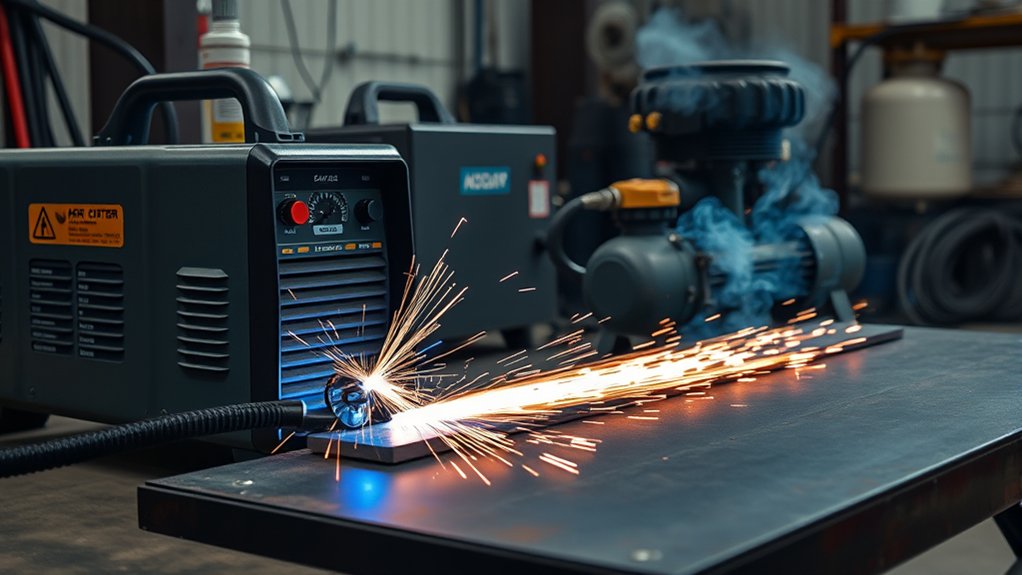
A compressor should be selected by airflow at pressure, not only by tank size, horsepower, or maximum PSI. Find the cutter’s required SCFM or L/min at the stated PSI, then choose a compressor that can maintain at least that output during your normal cutting cycle.
Products Worth Considering
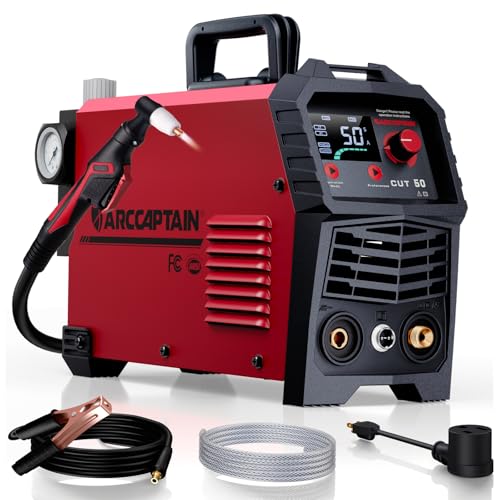
【Powerful Cutting Ability】Switch effortlessly between 110V and 220V for home or workshop use. Achieve professional 1/2" clean cuts on steel, aluminum, and copper with advanced LGBT technology. Perfect for DIY projects and heavy-duty tasks. Recommended maximum cutting thickness: 12mm @ 35A / 110V / 55 PSl; 18mm @ 50A / 220V / 75 PSI. Note: Requires compressed air (compressor sold separately).

CUTTING THICKNESS UP TO 20MM: Featuring a brand-new MCU technology upgrade, the plasma cutter machine has a high degree of internal integration, combining full digitalization for more precise control of cutting parameters such as current and voltage. This results in better cutting effects and improved stability. Cutting thickness: Quality 12mm (1/2"), maximum 20mm (3/4").

BUILT-IN AIR COMPRESSOR: With this plasma cutter machine, you're ready to cut as soon as you connect it to a power source, no additional air compressor needed. Designed for effortless outdoor work, it also offers compatibility with external compressors for versatile use
How Much Air Pressure Does a Plasma Cutter Need?
There is no single answer, and the clearest way to see that is to compare two machines from the same amperage class. Both of the systems below are 30-amp handheld cutters. Their published air requirements are not the same:
| System (30 A handheld) | Manufacturer-Published Air Requirement | What It Tells You |
|---|---|---|
| Hypertherm Powermax30 XP | 113.3 l/min (4.0 SCFM) at 80 psi (5.5 bar) | A small handheld unit can operate below 100 psi. Superseded by the Powermax33 XP, so confirm the spec for the model you actually own |
| Miller Spectrum 375 X-TREME | 5.0 SCFM (142 l/min) at 90 psi minimum, 120 psi maximum | Same amperage class, 25% more airflow, a higher minimum, and a hard maximum inlet pressure. Plasma gas listed as air or nitrogen only |
That spread is the entire point. A compressor sized for the first machine will stall the second. Anyone quoting a universal “90 to 120 PSI” figure is quoting one manufacturer’s window and calling it a standard.
- Read the machine specification: Find the required gas quality, minimum and recommended flow, operating pressure, and maximum inlet pressure.
- Compare delivered SCFM: Use the compressor’s rated SCFM at the relevant PSI. A high maximum-PSI label does not prove the compressor can supply enough volume.
- Build in headroom: A compressor matched exactly to the cutter’s rating will run continuously and lose pressure as the tank draws down. Shop practice is to specify meaningful headroom above the published figure rather than matching it.
- Allow for pressure loss: Long, narrow hoses, clogged filters, undersized fittings, and dryers can reduce pressure at the cutter.
- Consider duty cycle: The compressor must recover fast enough for the length and frequency of your cuts. A larger tank can reduce cycling, but it cannot make an undersized pump produce more continuous airflow.
- Condition the air: Install the drying and filtration required for your climate, compressor type, and machine.
- Maintain the system: Drain the receiver, inspect hoses, service filters and dryers, and check pressure while gas is flowing.
Note: SCFM is a standardized figure corrected for pressure and temperature at sea-level conditions. Delivered airflow drops at altitude and in hot intake air, so a compressor rated at the machine’s exact requirement may fall short in a hot shop or at elevation. Your own manual remains the controlling source for the machine side.
Set pressure at the cutter inlet while the machine is flowing gas. Static pressure can look acceptable even when the hose, filter, or compressor cannot keep up under load.
Safety, Ventilation, and Shop Conditions

Temperature, humidity, compressor condition, ventilation, and gas storage all affect plasma cutting. Humid air can overload a basic moisture separator, while cold piping and receiver tanks can create condensation that reaches the torch later.
Use stronger air treatment in humid shops and drain tanks regularly. Keep filters and hoses clean, and protect gas cylinders from impact, heat, sparks, and unstable storage. OSHA requires compressed gas cylinders to be secured upright at all times except briefly while being hoisted or carried, and requires valves to be closed whenever work is finished or a cylinder is moved.
Plasma cutting produces metal fumes, ultraviolet radiation, hot slag, noise, and electrical hazards. OSHA notes that plasma cutting melts metal and creates airborne fume, and it recommends ventilation or local exhaust to keep fumes away from the breathing zone. Coatings, plated metals, stainless steel, and unknown scrap can add serious exposure risks.
Do not cut sealed containers, tanks, drums, hollow parts, or material with unknown residues until a qualified procedure has made them safe. Clean coatings only with methods that do not create a new fire or toxic-exposure hazard.
Compressed air is usually the lowest-cost gas source, but it still requires energy, maintenance, drying, and filtration. Nitrogen, oxygen, and H-35 can improve selected cuts, yet they add cylinder logistics, gas loss, storage controls, and process-specific safety requirements.
Pro Tip: Make one test cut after changing gas, pressure, filters, hose length, consumables, amperage, or material. Inspect dross, edge angle, top rounding, and cut-face color before production.
Water Table Safety
Some mechanized systems cut over or near water to control fumes and heat, but the cutting table and plasma system must be designed for that use. Do not submerge a hand-held cutter, power supply, or torch unless the manufacturer explicitly approves the configuration.
Aluminum needs special attention, and the mechanism is worth understanding. Hypertherm explains that cutting aluminum over water produces small aluminum and aluminum oxide particles that sink to the bottom of the table, where the aluminum oxide absorbs the oxygen from the water and leaves hydrogen behind. In most tables that hydrogen bubbles to the surface and dissipates harmlessly. The risk is in designs that use a submerged tank or chamber to raise and lower the water level: particles trapped inside can, over time, build a large hydrogen bubble that could detonate in the presence of an ignition source.
Hypertherm’s guidance is that with proper mitigation most aluminum alloys can be plasma cut on a water table, but not to cut aluminum alloys underwater or on a water table unless you can prevent hydrogen accumulation. Consult the table manufacturer for a risk assessment, and confirm the table and fume extraction were designed with aluminum in mind. The one absolute exception is aluminum-lithium alloys, which must never be cut in the presence of water.
How to Choose the Right Plasma Cutter Gas
Use this order of decisions:
- Check the manual first. List only gases approved for your exact power supply, torch, gas console, and consumables.
- Identify the metal. Air works for broad shop use; oxygen is commonly selected for mild steel; nitrogen and hydrogen-containing blends are used for selected stainless steel and aluminum processes.
- Check thickness. Thin and medium work may be economical with air, while thick stainless or aluminum may justify a compatible H-35 or newer manufacturer-specific process.
- Define the finish requirement. Decide how much dross, oxidation, edge angle, discoloration, and secondary cleanup the job allows.
- Compare total cost, including parts life. Include gas, compressor power, filters, dryers, cylinders, regulators, consumables, handling, downtime, and cleanup. Parts life differs enough between gases to change the answer on a high-volume job.
- Run a test coupon. Confirm the cut chart before using expensive material or starting a production run.
For most owners of portable air-plasma machines, clean compressed air remains the right answer. Specialty gases make sense only when the machine supports them and the quality or productivity gain justifies the added cost and safety controls.
Gas-Flow Troubleshooting
| Symptom | Possible Gas-Supply Cause | Safe Check |
|---|---|---|
| Hard start or pressure fault | Low inlet pressure, closed valve, restricted filter, undersized hose, compressor not recovered | Check pressure while gas flows; inspect the filter and supply path according to the manual |
| Arc drops during a long cut | Insufficient continuous SCFM, compressor cycling, leak, frozen or saturated dryer | Stop cutting; verify compressor output, leaks, duty cycle, and filter condition |
| Heavy dross or rough kerf | Wrong gas, pressure, or flow; wet air; worn consumables | Return to the cut chart, inspect consumables, and make a test cut |
| Water or oil in filter bowl | Poor compressor maintenance, saturated dryer, hot humid intake air, oil carryover | Shut down safely, drain and service the air system, and replace contaminated elements as directed |
| Consumables fail unusually fast | Contaminated gas, incorrect pressure, poor cooling flow, wrong consumables or process | Verify part numbers, gas quality, pressure, flow, pierce technique, and torch condition |
Do not bypass pressure switches, interlocks, covers, or safety circuits to make a cutter run. If the approved checks do not fix the problem, stop and use the manufacturer’s service procedure or a qualified technician.
Frequently Asked Questions
Is gas needed for a plasma cutter?
Yes. Gas forms the plasma stream, helps cool torch parts, and blows molten metal out of the kerf. The gas may come from an external compressor, an internal compressor, bottled air, or an approved specialty-gas system.
What happens if a plasma cutter runs without gas?
Most modern cutters will fail to start, lose the arc, or show a gas-pressure fault. Repeated attempts with poor or missing flow can create bad cuts and shorten consumable life. Stop and correct the supply instead of bypassing an interlock.
Can you use regular air on a plasma cutter?
Many portable plasma cutters use ordinary compressed air, but it must be clean, dry, oil-free, filtered, and supplied at the flow and pressure listed in the manual. Do not assume an unfiltered jobsite compressor is suitable.
Can you run a plasma cutter without an air compressor?
Yes, in two ways. Some models include a built-in compressor, so the machine makes its own air. Others can run from bottled air or an approved cylinder gas such as nitrogen. Both routes still supply a process gas; they only replace the shop compressor as the source.
Do plasma cutters need a gas bottle?
Usually not. Most small shop units use compressed air, and some models include a built-in compressor. A bottle is needed only when you use bottled air or a machine-approved specialty gas such as nitrogen, oxygen, F5, or H-35.
How much air pressure does a plasma cutter need?
There is no single pressure for all machines, and airflow matters as much as PSI. Two 30-amp handheld cutters illustrate the spread: Hypertherm lists 4.0 SCFM at 80 psi for the Powermax30 XP, while Miller lists 5.0 SCFM at a 90 psi minimum and 120 psi maximum for the Spectrum 375 X-TREME. Read the required SCFM at operating pressure and the maximum inlet pressure in your own manual.
Can you use argon in a plasma cutter?
Not on its own for cutting. Argon is inert and does not carry enough energy to cut well, so some systems use it for plate marking instead. Argon becomes a cutting gas only when blended with hydrogen, as in the H-35 mixture used for thick stainless steel and aluminum on hydrogen-rated equipment.
What is F5 gas in plasma cutting?
F5 is a blend of roughly 95% nitrogen and 5% hydrogen used on systems approved for it. Reporting in The Fabricator describes F5 as producing a silver-colored edge with a good cut angle and a sharp edge, and notes it is recommended for stainless steel only.
How long will a gas cylinder last on a plasma cutter?
Divide the cylinder’s contents in cubic feet by the machine’s required SCFM to estimate arc-on minutes. Post-flow cooling after each trigger release reduces the real figure, and short frequent cuts lose proportionally more than long ones. Ask your gas supplier for the exact contents of the cylinder size you buy.
What are common mistakes with plasma-cutting gas?
Common mistakes include using wet or oily air, selecting an unapproved gas, sizing a compressor by tank capacity instead of SCFM, checking only static pressure, using a restricted hose, ignoring leaks, and copying another machine’s settings.
Can you use a plasma cutter in water?
Only use water tables, underwater cutting, or water-shield processes when the plasma and table manufacturers approve the setup. Never wet or submerge a standard hand-held cutter. Aluminum over water needs controls that prevent hydrogen accumulation, and aluminum-lithium alloys must not be cut in the presence of water.
Which gas gives the cleanest plasma cut?
It depends on the machine, metal, and thickness. Oxygen is often preferred for mild steel. Nitrogen, F5, H-35, water-shield, and newer manufacturer-specific processes may improve selected stainless steel or aluminum cuts. The machine’s cut chart is the safest starting point.
Safety Disclaimer: This article is for informational purposes only and does not replace the plasma cutter manufacturer’s manual, workplace safety rules, local fire and building codes, or professional training. Always use approved personal protective equipment, ventilation, electrical safety controls, and gas-rated parts before cutting.
Conclusion
A plasma cutter always needs gas flow, but many owners only need clean compressed air. The cutter may use an external compressor, a built-in compressor, bottled air, or an approved specialty gas system.
Match the gas to the machine, material, thickness, and required finish. Verify pressure and SCFM under flow, keep air dry and oil-free, inspect consumables, control fumes, and follow the manufacturer’s cut chart.
Specialty gases can improve selected cuts, but they add cost and safety controls. When in doubt, use the gas process listed in your exact manual and test it on scrap before production.
Next steps: if you are still deciding which gas suits your material, read our guide to what type of gas is used for plasma cutting. If you are choosing the machine itself, compare current options in our plasma cutters for home shops roundup or our breakdown of Miller plasma cutters.
Sources
- Hypertherm: Gas Selection Guide for Plasma Cutting — gas choices, shield-gas pairings, and published parts-life figures for mild steel, stainless steel, and aluminum.
- Hypertherm: Powermax30/33 XP Operator Manual — example air-quality, SCFM, and PSI specifications.
- Hypertherm: Powermax30 AIR — confirms that some plasma cutters include an internal compressor that removes the need for an external compressor and filter.
- Hypertherm: Plasma Cutting Aluminum on a Water Table — hydrogen-accumulation mechanism and aluminum-lithium warnings.
- Miller: Spectrum 375 X-TREME — published plasma gas options (air or nitrogen only) and in-line filter specifications.
- The Fabricator: What Gas Should Welders Use for Manual Plasma Cutting — F5 blend composition and stainless-steel-only recommendation.
- OSHA: Welding, Cutting, and Brazing Hazards and Solutions — fumes, radiation, burns, electrical shock, and PPE hazards.
- OSHA 29 CFR 1926.350 (construction standard) — compressed-gas cylinder storage separation, upright securing, hose inspection, and oxygen oil-and-grease precautions. General-industry shops should refer to the equivalent 1910 subpart Q provisions.