A plasma cutter needs more than a compressor that can reach a high gauge reading. It needs enough airflow at the pressure listed in the cutter’s manual, plus clean, dry, oil-free air throughout the cut. Match the delivered SCFM first, confirm pressure while air is flowing, and treat tank size as a buffer rather than the main sizing number.
Quick Answer
Most external-air handheld plasma cutters need clean, dry, oil-free air at roughly 4–8 SCFM and about 80–110 PSI, but the exact requirement is model-specific. Choose a compressor that meets the cutter’s SCFM at the stated pressure, with practical airflow and duty-cycle headroom for the length of cuts you plan to make.
Key Takeaways
- Use the manual’s numbers: Plasma cutters do not share one universal PSI or SCFM setting.
- Size by delivered SCFM: The compressor must supply the required airflow at the listed pressure, not merely reach a high maximum PSI.
- Add useful headroom: About 25%–50% extra delivered airflow can reduce pressure sag and compressor overwork during longer cuts.
- Do not size by tank alone: A larger tank adds reserve time and reduces cycling, but it cannot make an undersized pump produce enough continuous air.
- Protect the torch: Drain the tank and use the filtration and drying equipment required by the cutter manufacturer.
At a Glance
| Time Required | 15–30 minutes to verify specifications and inspect the air path |
| Difficulty | Beginner to intermediate |
| Tools Needed | Cutter manual, compressor data plate, regulator/gauge, suitable air hose, filter or dryer, and leak-check solution |
| Cost | Low when the compressor already meets the specification; higher if you need a larger compressor or additional drying equipment |
Warning: Plasma cutting combines high voltage, hot metal, sparks, compressed gas, ultraviolet radiation, and hazardous fumes. Read the cutter and compressor manuals, provide ventilation, remove combustibles, wear the specified eye and body protection, and disconnect both electrical power and air before servicing the torch or air system.
Why Plasma Cutters Rely on Compressed Air
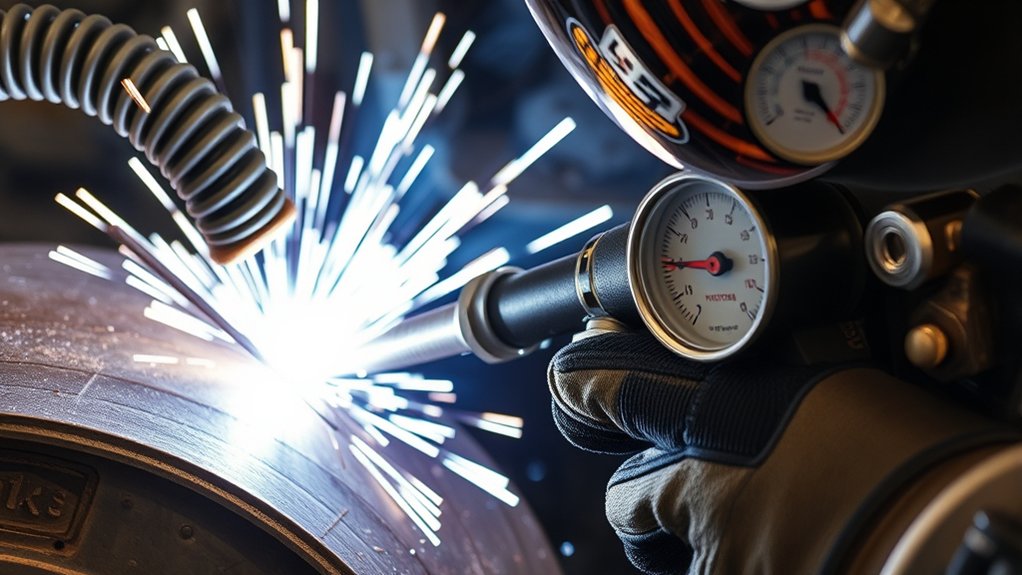
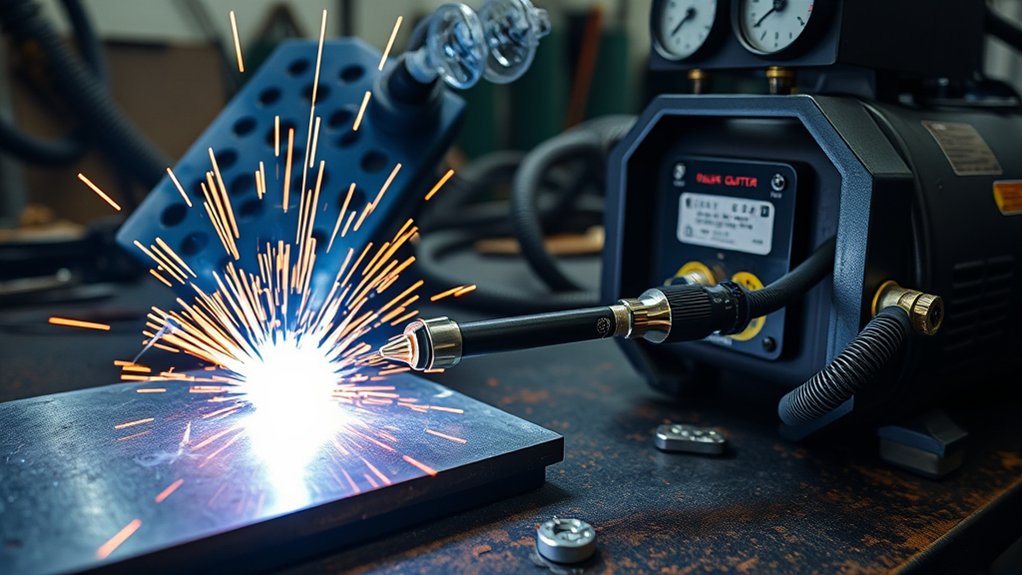
Most handheld air-plasma cutters use compressed air as both the plasma gas and the high-speed stream that ejects molten metal from the kerf. Air is widely available and works well on common conductive metals, including mild steel, stainless steel, and aluminum.
Compressed air is not the only possible plasma gas. Some systems can use nitrogen or other gases, and industrial equipment may use oxygen or specialized gas mixtures for particular materials. Use only gases approved in the machine’s manual. For example, the TITANIUM Plasma 65 manual permits clean, dry, regulated, oil-free compressed air or nitrogen and warns against unapproved bottled gases.
The air supply has three jobs:
- Support the arc: The electrical energy ionizes the gas and creates a conductive plasma stream.
- Constrict and direct the jet: The torch nozzle and swirl components focus the stream into a narrow cutting path.
- Clear the kerf and cool torch parts: Correct flow removes molten metal and helps keep the nozzle and electrode within their designed temperature range.
The correct air specification is the SCFM delivered at the pressure stated in the cutter manual—not the compressor’s maximum tank pressure.
Clean, dry, oil-free air is essential. Moisture, oil mist, and particles can cause hard starting, arc instability, poor cut quality, and faster consumable wear. Hypertherm specifically identifies contaminated compressed air as a cause of reduced consumable and torch life.
How Compressed Air Creates the Plasma Arc

The cutter applies electrical energy to the gas flowing through the torch. That energy frees some electrons from the gas atoms, creating an electrically conductive plasma. The nozzle then concentrates the hot, fast-moving stream so it can melt the workpiece and blow the molten metal out of the cut.
Ionization in the Nozzle
When compressed air enters the plasma cutter‘s torch, the starting circuit creates a pilot arc or another approved arc-starting process. The gas becomes ionized and conducts current between the electrode and the workpiece after the arc transfers.
The operator does not improve ionization by guessing at a higher pressure. The correct approach is to:
- set the inlet pressure exactly as the manufacturer directs;
- supply at least the required SCFM at that pressure;
- keep filters, drains, hoses, and fittings from restricting flow; and
- use clean, dry, oil-free air or another approved gas.
Arc Constriction Dynamics
The nozzle opening and swirl components force the plasma through a small, controlled path. This raises the stream’s speed and energy density, which produces a narrower kerf than an unconstricted arc. Worn, damaged, or incorrectly assembled consumables disturb that flow and can increase bevel, dross, and arc wander.
Air pressure that is too low can weaken the jet and allow molten metal to remain in the kerf. Pressure that is too high can also cause starting and consumable problems. Hypertherm lists excess gas pressure as a cause of hard starting and rapid electrode deterioration, so more pressure is not automatically better.
Gas Flow Control
Dynamic pressure means the pressure observed while air is flowing through the system. Static pressure can look acceptable when the trigger is idle, then collapse as soon as the cutter demands full flow.
- Find the required inlet flow and pressure in the cutter’s manual or data plate.
- Check the compressor’s delivered SCFM at that same pressure.
- Connect the recommended hose, fittings, filter, dryer, and regulator.
- Run the cutter’s air-test mode, when available, and set pressure under flow.
- Watch for pressure sag during a cut that lasts as long as your normal work.
Pro Tip: Check pressure at the cutter inlet or with the machine’s air-test function after the hose, quick couplers, filters, and dryer are installed. Every restriction between the compressor and cutter can reduce the pressure and flow that actually reach the torch.
Built-In vs. External Air Compressors

Built-in and external compressors offer different trade-offs. An integrated unit reduces setup time and works where shop air is unavailable. An external compressor usually gives you more airflow capacity, a larger reserve, and more options for filtration and drying.
Products Worth Considering
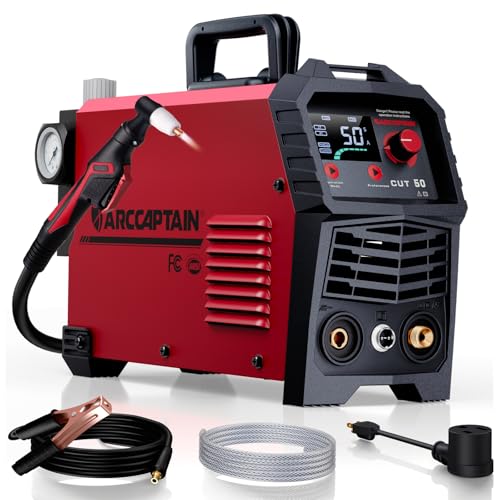
【Powerful Cutting Ability】Switch effortlessly between 110V and 220V for home or workshop use. Achieve professional 1/2" clean cuts on steel, aluminum, and copper with advanced LGBT technology. Perfect for DIY projects and heavy-duty tasks. Recommended maximum cutting thickness: 12mm @ 35A / 110V / 55 PSl; 18mm @ 50A / 220V / 75 PSI. Note: Requires compressed air (compressor sold separately).

BUILT-IN AIR COMPRESSOR: With this plasma cutter machine, you're ready to cut as soon as you connect it to a power source, no additional air compressor needed. Designed for effortless outdoor work, it also offers compatibility with external compressors for versatile use

COMPLETE BUILT-IN AIR SYSTEM: Equipped with an integrated high-performance air pump, this plasma cutter eliminates the need for an external air compressor—simply plug into power and start cutting with no extra equipment or complicated setup required
Portability and Power
A cutter with an integrated compressor is a practical choice for service work, thin material, and short cuts. The Hypertherm Powermax30 AIR, for example, contains its own compressor and operates from single-phase power.
The trade-off is that the cutter’s internal compressor and power supply share a compact package. The machine’s rated output and duty cycle still limit how long and how heavily it can cut. An external system is usually better when you need longer cuts, higher-amperage operation, or air for other tools.
- Choose built-in air for: portability, quick setup, field repairs, and lighter cutting.
- Choose external air for: longer duty cycles, higher airflow demand, multiple shop tools, and more control over air treatment.
- Check both duty cycles: The plasma cutter and the compressor each have separate runtime limits.
Air Quality Control
A standalone compressor does not automatically provide cleaner air. Oil-lubricated pumps can pass oil aerosols, and any compressor can send condensed water downstream. The advantage of an external system is that you can install a complete treatment train and maintain each part separately.
A practical shop arrangement is:
- compressor and receiver tank with a working drain;
- aftercooling or enough pipe length for hot air to cool;
- water separator with drain;
- coalescing filtration when oil aerosol is possible;
- refrigerated or desiccant dryer when humidity demands it; and
- point-of-use filter/regulator close to the plasma cutter.
Use the filter rating specified by your cutter manufacturer. Hypertherm’s Powermax point-of-use kit uses a 1-micron filter with an automatic moisture separator, but that does not mean one filter rating fits every cutter or every shop.
Cost and Versatility
A built-in compressor simplifies the package but may limit you to that cutter’s airflow and duty cycle. A separate compressor costs more when you add the tank, hose, filtration, and electrical supply, yet it can serve other pneumatic tools and can be upgraded independently.
Compare the full system rather than the compressor price alone. Consumables, filter elements, drains, hose size, electrical work, noise, and maintenance all affect long-term cost.
Key Specs: CFM, PSI, and Tank Size

For reliable plasma cutting, compare SCFM, PSI, duty cycle, and tank capacity in that order. Horsepower and tank gallons alone do not tell you whether a compressor can keep up.
Products Worth Considering

6.3 Gallon Air Compressor: Our 1450W oil-free motor drives the compressor up to a speed of 3500 r/min and 3.35 CFM@ 90PSI air delivery. It is ideal for supporting a variety of pneumatic and air tools, such as nail gun, impact wrench, spray gun, pneumatic screwdriver, best for tire inflation, auto repair, spray painting, woodwork nailing, etc.

Built to Last: The 13-gallon large-capacity tank paired with a 2HP motor delivers fast air buildup in under 3 minutes. The reinforced, leak-proof valve system ensures stable output, easily handling high-intensity and long-duration tasks

ULTRA-QUIET OPERATION: The Metabo HPT Quiet Air Compressor operates at only 59 dB, so quiet that a normal conversation can take place while the compressor is cycling. The barely noticeable sound ensures a peaceful work environment.
CFM vs. SCFM
CFM describes cubic feet per minute under stated conditions. SCFM normalizes airflow to a standard temperature and pressure so equipment can be compared more consistently. Product listings do not always use the terms perfectly, so match the wording and test pressure shown by the cutter and compressor manufacturers.
Real Manufacturer Air Requirements
| Plasma cutter | Published air requirement | Practical sizing lesson |
| Hypertherm Powermax30 XP | 4 SCFM at 80 PSI | A small cutter may require less than 90 PSI. |
| Hypertherm Powermax45 SYNC | 6.7 SCFM at 90 PSI | Compare compressor output at 90 PSI, not at a lower test pressure. |
| Hypertherm Powermax65 SYNC | 7.5 SCFM at 85 PSI | Higher amperage often raises airflow demand, but not always inlet pressure. |
| TITANIUM Plasma 65 | 4.2 CFM at 80–110 PSI | Two cutters with the same amperage can have different air requirements. |
How Much Compressor Headroom Do You Need?
The compressor must deliver at least the cutter’s required airflow at the specified pressure. For intermittent hobby work, exact capacity may be workable if the pump duty cycle allows it and the tank provides enough reserve. For longer cuts, a practical target is about 25%–50% more delivered airflow than the cutter requires.
Example: if the cutter requires 6.7 SCFM at 90 PSI, a compressor rated around 8.4–10 SCFM at 90 PSI gives useful headroom. Do not compare that demand with a compressor rating measured at 40 PSI.
What Tank Size Do You Need?
A tank stores air; it does not create airflow. A larger receiver can:
- give you more cutting time before pressure falls;
- reduce rapid motor starts;
- help cool compressed air so moisture can condense before filtration; and
- smooth short demand changes.
There is no universal 20-, 30-, or 60-gallon minimum for plasma cutting. A small tank may work for brief cuts when the pump meets the required SCFM. A large tank can still run down if the pump produces less air than the cutter consumes. For continuous work, prioritize a compressor with enough delivered SCFM and an appropriate duty cycle; then choose a tank large enough to reduce cycling for your work pattern.
Note: Compressor horsepower is not a reliable shortcut. Compare the published SCFM at the required PSI, the pump duty cycle, and the electrical requirements.
Common Air Supply Mistakes to Avoid
Air-supply errors often look like torch, consumable, or technique problems. Check the full air path before replacing parts.
- Using maximum PSI as the sizing number: A compressor may reach 150 PSI but still fail to deliver enough SCFM at 90 PSI.
- Setting one universal pressure: The correct setting may be 80, 85, 90, or another value depending on the cutter.
- Checking only static pressure: Confirm pressure while air is flowing through the torch or the machine’s test mode.
- Using undersized hose or restrictive couplers: Follow the manual. A 3/8-inch inside-diameter hose is a common choice for many 4–8 SCFM systems, especially on longer runs, but the required size depends on flow, length, and fittings.
- Skipping drains and drying: Water can condense in the receiver, hose, and downstream piping even when the compressor is oil-free.
- Installing an oiler: Plasma cutters need oil-free air. Do not connect them downstream of a lubricator used for pneumatic tools.
- Ignoring both duty cycles: The compressor may overheat or lose pressure before the plasma cutter reaches its own duty-cycle limit.
- Assuming a larger tank fixes low CFM: It only delays the pressure drop.
Ensuring Clean, Dry Air for Longer Consumable Life

Even with the correct SCFM and PSI, the arc can suffer when the air carries liquid water, oil aerosol, or particles. Hypertherm notes that contamination can reduce consumable life, harm cut quality, and damage the torch or power supply.
Recommended Air-Treatment Order
- Drain the receiver: Use the manual drain or confirm the automatic drain works.
- Cool the compressed air: An aftercooler or properly designed piping helps water vapor condense where it can be removed.
- Separate bulk water: Install a water separator in a location where the air has cooled enough for moisture to condense.
- Remove aerosols and fine particles: Add the filter stages required by the cutter and compressor manufacturers.
- Dry the air when needed: Humid shops and long air lines may require a refrigerated or desiccant dryer.
- Filter and regulate at the cutter: A final point-of-use filter catches contamination that forms or enters downstream.
Replace filter elements based on the manufacturer’s schedule or pressure-drop indicator. A clogged filter can create the same low-flow symptoms as an undersized compressor.
Quick Moisture Check
Disconnect the cutter according to its manual, then inspect the separator bowl and drain the receiver. If water repeatedly appears near the cutter, improve cooling, drainage, and drying upstream rather than relying on a tiny disposable filter as the only treatment stage.
Matching Compressor Power and Voltage to Your Cutter
Match airflow first, then verify that your electrical service can safely power both machines. A compressor’s voltage does not need to match the cutter’s voltage, but each machine must be connected to a correctly sized circuit that meets its own manual and local electrical code.
- Read the cutter’s required SCFM and inlet-pressure range.
- Find the compressor’s delivered SCFM at that pressure.
- Check compressor duty cycle against your expected cutting time.
- Verify the voltage, full-load current, plug, breaker, and extension-cord limits for both machines.
- Do not run both machines from one undersized circuit or improvised adapter.
A 120-volt compressor can be adequate when it delivers the required SCFM. A 240-volt compressor is not automatically better, but larger continuous-duty pumps often require 240-volt service.
Warning: Plasma cutters can retain dangerous internal voltage after power is disconnected. Do not open the cutter or compressor enclosure unless you are qualified and the service manual specifically directs the procedure.
Practical Tips for Noise, Portability, and Budget

Noise, portability, and price matter, but none should override the required SCFM, PSI, duty cycle, and air quality.
- Compare dBA ratings consistently: Check the test distance and operating condition because manufacturers may measure noise differently.
- Measure the combined work area: The compressor, plasma arc, exhaust, and grinding can create more exposure than the compressor alone.
- Protect hearing based on exposure: OSHA’s workplace hearing-conservation action level is an 8-hour time-weighted average of 85 dBA, while its permissible exposure limit is 90 dBA over 8 hours. Use suitable hearing protection whenever measured exposure or the equipment manual calls for it.
- Keep portable systems honest: Small compressors may be easy to move but can require pauses between cuts. Check delivered SCFM and duty cycle before buying.
- Budget for air treatment: A less expensive compressor can become costly if you still need a dryer, filters, larger hose, electrical upgrades, or frequent consumables.
Troubleshooting Air-Related Plasma Cutter Problems
| Symptom | Possible air cause | What to check |
| Arc will not start | Pressure too low or too high; blocked filter; wet air | Use air-test mode, inspect filter restriction, drain water, and reset pressure to the manual’s value. |
| Arc starts, then stops | Compressor cannot sustain flow; leak; duty-cycle limit | Watch dynamic pressure, check SCFM at the required PSI, inspect for leaks, and compare both duty cycles. |
| Heavy dross or wide kerf | Low or unstable flow; contaminated air | Confirm air first, then inspect consumables, travel speed, torch height, amperage, and work-clamp contact. |
| Consumables wear quickly | Water, oil, particles, or excessive pressure | Service drains and filters, verify approved gas, set correct dynamic pressure, and inspect torch assembly. |
| Pressure falls only on long cuts | Pump output below demand or compressor duty cycle exceeded | Shorten cuts or upgrade delivered SCFM; a larger tank alone will only extend the delay. |
Frequently Asked Questions
Do plasma cutters need compressed air?
Most handheld air-plasma cutters need compressed air from an external compressor. Some portable models include a built-in compressor, and some systems permit approved bottled gases such as nitrogen. Follow the machine’s manual and never substitute an unapproved gas.
How much air pressure do you need for a plasma cutter?
Many handheld cutters specify roughly 80–110 PSI at the inlet, but there is no universal setting. Published examples include 80 PSI for the Powermax30 XP, 90 PSI for the Powermax45 SYNC, and 85 PSI for the Powermax65 SYNC. Set pressure under flow according to your manual.
Is a 6-gallon air compressor enough for a plasma cutter?
It can be enough for brief, intermittent cuts when the pump delivers the cutter’s required SCFM at the stated PSI. The small tank will empty quickly if pump output is below demand, so the compressor may cycle often and you may need pauses. Tank gallons alone cannot answer the question.
What size air compressor do I need for the Titanium Plasma 65?
The TITANIUM Plasma 65 manual calls for a compressor capable of 4.2 CFM at 80–110 PSI. For longer cuts, choose useful airflow headroom and a compressor duty cycle suited to your workload. The manual does not establish a universal 20-, 30-, or 60-gallon tank requirement.
How much CFM does a 45-amp plasma cutter need?
It depends on the model. The Powermax45 SYNC specifies 6.7 SCFM at 90 PSI, while other 45-amp cutters may differ. Read the exact model’s manual and compare that demand with the compressor’s output at the same pressure.
Can a larger air tank make up for low compressor CFM?
Only temporarily. A larger tank stores more air and delays the pressure drop, but the pressure will still fall when the cutter consumes air faster than the pump replaces it. Continuous cutting requires enough delivered SCFM and duty cycle.
What happens when plasma-cutter air is wet or oily?
Moisture, oil, and particles can cause hard starting, unstable cuts, dross, shorter consumable life, and possible torch or power-supply damage. Drain the receiver, service filters, and add suitable drying equipment instead of increasing pressure.
Wrapping Up
Most external-air plasma cutters need a compressor, but the correct compressor is determined by the exact model’s airflow and pressure specification. Compare delivered SCFM at the stated PSI, allow practical headroom for longer cuts, and make sure both the compressor and cutter stay within their duty cycles.
Tank capacity helps with reserve time and cycling, but it cannot replace adequate pump output. Keep the air clean, dry, regulated, and oil-free; verify dynamic pressure after all hoses and filters; and stop to correct moisture, leaks, or pressure sag before they damage cut quality or consumables.
Sources
- Hypertherm Powermax30 XP specifications — confirms 4 SCFM at 80 PSI and the requirement for clean, dry, oil-free air.
- Hypertherm Powermax45 SYNC specifications — confirms 6.7 SCFM at 90 PSI.
- Hypertherm Powermax65 SYNC specifications — confirms 7.5 SCFM at 85 PSI.
- Harbor Freight TITANIUM Plasma 65 Owner’s Manual — confirms 4.2 CFM at 80–110 PSI, approved gases, filtration, drying, and shutoff guidance.
- Hypertherm: Air Quality and Powermax Performance — explains how moisture and contamination affect cut quality, consumables, and equipment.
- OSHA 29 CFR 1910.95, Occupational Noise Exposure — supports workplace hearing-conservation and exposure benchmarks.