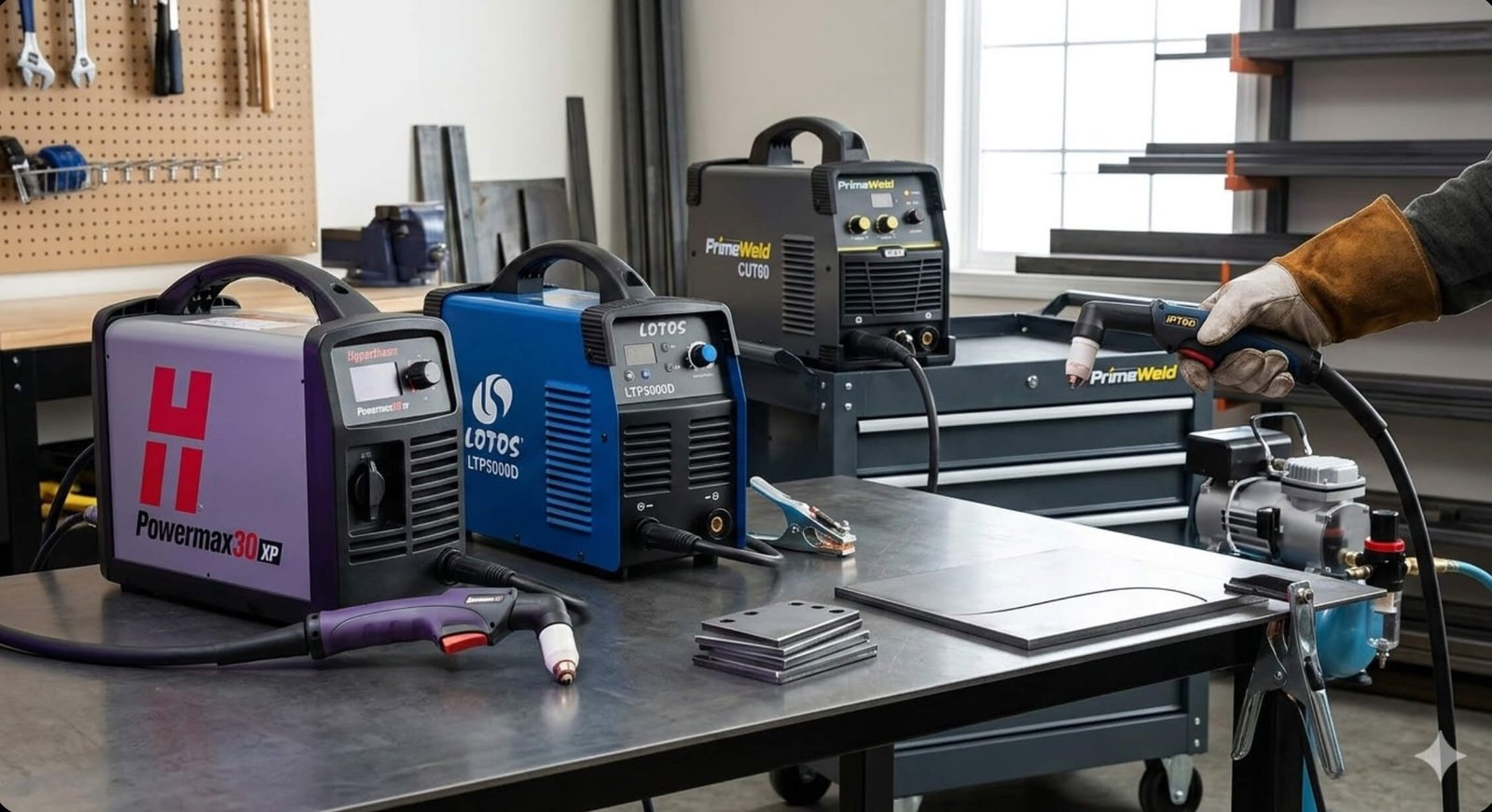
Cut capacity, portability, ease of use, and long-term costs vary quite a bit between models. Knowing what to prioritize helps you get better results and fewer headaches over time.
Who is this guide for? Home shop owners, hobbyists, DIY fabricators, and small-shop professionals cutting up to roughly 3/4″ material, with a couple of picks rated a little higher. If you need industrial production-level cutting or automated multi-torch systems, this roundup is not aimed at you: look at dedicated industrial plasma systems from Hypertherm, Lincoln, or Miller instead.
Top Picks
Product listings, bundles, and seller availability can change. Use the Amazon links to confirm the current model, included torch, warranty terms, and electrical requirements before ordering.
Affiliate disclosure: This article contains Amazon affiliate links. If you buy through a qualifying link, we may earn a commission at no extra cost to you.
How We Evaluated Each Cutter
We compared each machine by the factors that matter most in a home shop:
- Cut capacity and cut quality: the manufacturer-listed clean-cut range, severance limit, and likely cleanup required.
- Arc-start design: pilot arc, blowback or high-frequency starting, and whether the design is suitable around CNC electronics.
- Power and air needs: input voltage, circuit demand, airflow, pressure, and how much performance drops on 120V.
- Ease of ownership: controls, torch design, consumable access, warranty terms, and customer support.
- Best-fit use: occasional DIY work, frequent fabrication, mobile repairs, detail cutting, or CNC-table plans.
Important: Manufacturer cut ratings are usually best-case figures. Metal type, input voltage, air quality, torch speed, consumable condition, and operator skill all affect the real result.
Selection Criteria
You need a machine that fits the metal you cut and the way you work. We focused on factors that affect day-to-day use.
The most important metrics were cut quality and maximum clean-cut thickness, since they determine how much finishing work you need after each cut. We also weighed pilot arc or blowback start features (great for rusted or expanded metal), duty cycle and cooling for sustained jobs, and dual-voltage compatibility for shop or jobsite use.
Portability and torch durability matter if you move the unit often. Consumable cost and availability affect long-term ownership. We also considered warranty and manufacturer support so you are covered when something goes wrong.
Model-name warning: Plasma-cutter listings can keep the same ASIN or similar name while the front panel, torch, amperage claim, bundle, or internal revision changes. Match the listing photos and manual to the exact unit you receive.
Quick Buyer’s Guide: How to Choose
Before comparing specific models, answer these three questions to narrow your search fast:
- What thickness do you cut most often? If you rarely go past 1/4″, a 30A to 50A unit is plenty. For regular 1/2″ to 3/4″ work, look at 60A models. This avoids overspending on capacity you will not use.
- What power do you have? A standard 120V/15A household outlet limits you to about 20-30A of cutting output. If you have or can add a 240V circuit, you unlock the full power of dual-voltage machines.
- Handheld or CNC? Most cutters here work great by hand. If you plan to add a CNC plasma table later, choose a blowback/non-HF model (like the PrimeWeld CUT60 or YESWELDER CUT-60DS PRO) so you reduce high-frequency interference around electronics.
For essential safety practices when operating a plasma cutter, the American Welding Society’s safety resources provide a solid starting point.
Safety note: Plasma cutting creates intense arc radiation, hot sparks, molten metal, noise, fumes, and fire risk. Wear suitable eye and face protection, flame-resistant clothing,
gloves, and
hearing protection. Ventilate the work area, remove flammables, secure the work clamp, and follow the machine manual. Never cut sealed containers or unknown coated metals.
LOTOS LTP5000D
LOTOS LTP5000D 50Amp Non-Touch Pilot Arc Plasma Cutter, Dual Voltage 110V/220V, 5/8″ Clean Cut, 3/4″ Severance Cut
Best for: Homeowners and hobbyists who want a reliable, easy-to-use cutter without a steep learning curve.
Plug it into 110V or 220V power, fire up the pilot arc on painted or rusty metal, and move it around your shop without wrestling a heavy machine. It handles everyday tasks like cutting 1/4″ plate and light fabrication, and it can push through heavier cuts when you need them.
Why it’s worth it: You get non-touch pilot arc starting, dual-voltage flexibility, and a long-running model with widely available consumables. Confirm the exact revision and current warranty terms on the listing before you buy.
Pick this if you want a straightforward unit that gets the job done and will not take up half your bench.
What People Say
Customers praise how easy the unit is to set up and use. The pilot arc and dual-voltage flexibility simplify routine jobs. Many call out the lightweight, compact design and reliable performance on 1/4″ material. The most common caveat: plan for consumable wear and replacement costs over time.
Feedback trend: Positive at the time of the source review analysis. Current feedback may differ.

This is a historical review-theme graphic, not a live rating or current review count.
Long-Term Costs
The machine is reliable and simple to maintain, so you often save time and money on prep and rework. The main ongoing cost is consumables. Stock compatible tips and electrodes to keep downtime low and ownership economical.
Value Over Time
Regular shop users may justify the purchase because the cutter reduces grinding and manual cutting time. Occasional users still benefit from cleaner cuts, saving both labor and scrap.
Situational Benefits
Versatility
The dual-voltage design and pilot arc handle mild steel, stainless, and painted surfaces for a wide range of shop and repair tasks. Not aimed at industrial production, but it covers most DIY and small fabrication needs comfortably.
Safety
Non-touch pilot arc reduces the chance of electrode sticking and shorting. The unit uses compressed air rather than combustible gases. Standard grounding and proper torch handling remain important for safe operation.
Durability
Build quality is solid for the price. Users report years of reliable service when they stick to recommended consumables and maintenance. The torch and consumables wear fastest, so keep spares on hand.
Problem Solving
Cuts through corroded or painted metal without hours of grinding. Delivers repeatable, cleaner cuts that reduce fitting and finishing time.
Speed & Startup
Startup is quick. Once you dial in air pressure and amperage, the pilot arc lets you begin cutting right away without touching the nozzle to the workpiece.
Air Requirements
The LOTOS setup guidance calls for about 65–70 PSI. Choose a compressor by its delivered CFM at the required pressure, not by tank size alone. Use a regulator, inline moisture trap, and filter to protect the torch and consumables.
Key Benefits
- Non-touch pilot arc for cutting rusted or painted metal
- Dual voltage (110V/220V) for standard shop outlets or 240V circuits
- Lightweight and portable for easy movement around the shop
- Manufacturer-listed capacity up to a 5/8″ clean cut and 3/4″ severance under suitable conditions
- Established model with replacement consumables that are generally easy to find
Check Product Details on Amazon
EDITOR’S PICK
PrimeWeld CUT60
PrimeWeld CUT60 60Amp Non-Touch Pilot Arc Plasma Cutter, IPT60 Blowback Torch, Dual Voltage 110V/220V, 60% Duty Cycle, 3-Year Warranty
Best for: Serious hobbyists and light professionals who want strong home-shop cuts, a robust torch, and room to grow into CNC use.
This compact machine bridges the gap between higher-capacity shop equipment and a DIY-friendly unit. You get an IPT60 blowback torch with a 20-foot lead, continuous pilot arc for cutting rusty or painted metal, and a 60% duty cycle that keeps you cutting through longer sessions. It can cut electrically conductive metals, and PrimeWeld lists steel capacity up to 7/8″ under suitable conditions. For cleaner edges and faster travel, plan regular work below the maximum rating.
Why it’s worth it: US-based customer support, a 3-year warranty, and CNC compatibility make this the cutter you can count on for years. Few machines at this price offer all three.
Pick this if you want higher-capacity cut quality with approachable controls, whether you are doing repairs, fabrication, or decorative metalwork.
What People Say
Users note the solid build and smooth controls right out of the box. Many appreciate the quality of the supplied torch. Reviews highlight reliable cut performance across different metals and quick, helpful customer support when questions come up.
Feedback trend: Positive at the time of the source review analysis. Current feedback may differ.

This is a historical review-theme graphic, not a live rating or current review count.
Long-Term Costs
The three-year warranty and steady parts availability reduce the risk of surprise repair bills. Durable torch components mean fewer replacements during routine use. That combination keeps ownership costs predictable.
Value Over Time
You get faster project turnaround and less time prepping or reworking edges. That adds up quickly if you cut often. For hobbyists stepping up to paid work, the improved throughput and reliability help recoup your investment sooner.
Situational Benefits
Versatility
Handles a wide range of metals and conditions, from clean sheet steel to painted or corroded pieces. Useful for repairs, fabrication, creative projects, and CNC table integration.
Safety
Uses compressed air instead of combustible gases. Offers standard grounding and thermal protection. Blowback start reduces torch contact risks. Proper PPE and grounding remain essential.
Durability
Built to a higher standard than entry-level models. Users report reliable service with well-made torch components. Regular consumable changes are the main maintenance point.
Problem Solving
Solves the common DIY headache of cutting through rusted or painted metal cleanly. Speeds up repetitive cuts so fitting and assembly require less cleanup.
Speed & Startup
Startup is quick. Cutting begins almost immediately thanks to blowback/pilot arc technology, letting you move through tasks without long warm-up or setup.
Air Requirements
PrimeWeld specifies 5 CFM at 90 PSI, with an operating pressure range of 40–75 PSI. Use a compressor that can deliver that airflow continuously, plus a regulator and moisture separator. Full 60A output also requires the proper 240V circuit.
Key Benefits
- Continuous pilot arc for rusted, painted, or expanded metal
- IPT60 blowback torch with 20-foot lead and Euro central connection
- Dual-voltage flexibility (110V/220V) for shop or generator use
- 60% duty cycle at 60A supports longer cutting runs
- CNC-compatible blowback start (no HF interference)
- Strong US-based support and 3-year no-hassle warranty
Check Product Details on Amazon
TOOLIOM 50Amp Non-Touch Pilot Arc Plasma Cutter, Large LED Display, IGBT Inverter, Dual Voltage 110V/220V, manufacturer-listed 1/2″ clean cut and up to 3/4″ maximum severance
Best for: First-time buyers and occasional users who want a low-cost entry into plasma cutting.
You get a compact, feature-packed unit aimed at hobbyists and light-shop users. The large LED display and dual-voltage support make setup straightforward. The inverter design keeps the weight manageable. It handles routine sheet metal work and small fabrication tasks, though its torch and air fittings may need extra care.
Why it’s worth it: This is positioned as a budget pilot-arc cutter with a digital display. It can lower the entry cost, but the newer listing has a shorter track record than the established picks.
Pick this if you need a budget-friendly machine for occasional cutting and learning the ropes, and you are ready to manage consumables and connections.
What People Say
Users like the clear LED controls and the idea of a portable, dual-voltage cutter for small projects. Common praise centers on ease of use for light tasks. Recurring complaints mention torch fragility, air inlet or regulator leaks, and occasional damaged parts on arrival.
Opinions vary depending on expectations and how hard the unit is pushed.
Feedback trend: Neutral at the time of the source review analysis. Current feedback may differ.

This is a historical review-theme graphic, not a live rating or current review count.
Long-Term Costs
Occasional users can avoid heavy maintenance costs. Frequent use may increase spending on consumables and replacement torch parts. Being proactive about spares and careful with air fittings keeps expenses lower over time.
Value Over Time
For light fabrication, hobby projects, or learning plasma cutting, the convenience and portability offer decent value. Heavy or professional use limits the ROI unless you upgrade consumables and reinforce weaker components.
Situational Benefits
Versatility
Covers basic needs across mild steel, stainless, and painted surfaces for hobby and light fabrication. Not optimized for continuous heavy-duty cutting.
Safety
Pilot arc reduces torch contact with the workpiece. The inverter design includes standard electrical protections. You still need proper grounding, eye protection, and ventilation.
Durability
Average for its price class. The torch and air fittings are the weakest points. Expect to replace consumables and possibly reinforce connectors with frequent use.
Problem Solving
Good at reducing prep time on painted or lightly rusted metal and speeding up simple cuts. Struggles when pushed to thicker plate or sustained duty cycles.
Speed & Startup
Startup is quick once air pressure and amperage are set. Inconsistent torch performance can slow some jobs.
Air Requirements
Check the current manual for the required pressure and airflow because model revisions can differ. Use a compressor that meets the stated CFM at working pressure, and add a regulator, filter, and moisture trap.
Key Benefits
- Large LED display for easy settings adjustment
- Dual-voltage flexibility for home and jobsite outlets
- Compact inverter design for portability
- Non-touch pilot arc for cutting painted or lightly corroded metal
Check Product Details on Amazon
All three are 50A, dual-voltage cutters aimed at home shops. Here is what separates them:
- LOTOS LTP5000D: The established all-around pick. It combines non-touch pilot arc, dual voltage, and widely available consumables. Confirm the current model revision and warranty terms.
- hynade PLC-50D: A compact handheld-focused option. The front air gauge and post-flow cooling are useful, but HF starting can interfere with CNC electronics. Choose it only after confirming the exact revision and torch system.
- TOOLIOM CUT-50: A newer budget option with simple digital controls. The shorter product history and mixed durability feedback make it better for light, occasional use than daily production.
Bottom line: Unless price is the sole deciding factor, the LOTOS LTP5000D is the best 50A pick for most buyers.
hynade PLC-50D
hynade PLC-50D 50Amp High Frequency Digital Plasma Cutter, DC Inverter, Dual Voltage 110V/220V, Post-Flow Cooling, Front Air Gauge
Best for: Hobbyists and small shops that want a portable, no-fuss machine for everyday metalwork at a great price.
You get dual-voltage flexibility, a front air gauge for quick setup, and light weight for easy movement between the garage and a jobsite. It handles 1/4″ and thinner plate very well and is handy for repair work, brackets, and decorative cuts.
Note: This model uses a high-frequency (HF) arc-start system. HF starting can create a non-touch arc, but the electrical noise may interfere with CNC controllers, computers, and other sensitive electronics. Treat it as a handheld cutter unless the current manufacturer documentation clearly approves your CNC setup.
Why it’s worth it: The front-panel air gauge, post-flow cooling, and compact layout make it convenient for handheld shop work. Confirm the exact PLC-50D revision, torch type, and consumable compatibility before ordering.
Pick this if you mainly do routine fabrication, occasional heavier cuts, and want a practical, space-saving cutter for handheld use.
What People Say
Customers like how easy the unit is to set up and how portable it is for light fabrication. Many mention the front air gauge and steady cutting on thinner steel as positives. Recurring concerns focus on consumable wear and occasional difficulty with thicker plate or inconsistent parts out of the box.
Feedback trend: Positive at the time of the source review analysis. Current feedback may differ.

This is a historical review-theme graphic, not a live rating or current review count.
Long-Term Costs
Keep ownership costs reasonable by stocking compatible consumables and replacing worn parts proactively. For light to moderate use the maintenance is straightforward. Heavy cutting will increase consumable spending.
Value Over Time
Regular use for garage projects, repairs, or small fabrication jobs can save time through faster cuts and less manual finishing. Less of a fit for high-volume industrial work.
Situational Benefits
Versatility
Good for mild steel, some stainless, and painted surfaces at sheet and light-plate thicknesses. Not designed for sustained heavy-duty production cutting.
Safety
Includes standard electrical protections and an accessible air gauge to help keep pressures correct. Use proper grounding, PPE, and ventilation when cutting.
Durability
Durable for its class if you maintain consumables and avoid pushing beyond recommended thicknesses. Some users report occasional component issues requiring replacement parts.
Problem Solving
Can reduce prep time on conductive metal when the arc starts reliably, but clean work-clamp contact is still required. Speeds up repetitive cuts, though it can struggle with thicker sections and may consume parts faster under heavy use.
Speed & Startup
Start cutting quickly once air and amperage are set. The unit responds well for short runs and quick repair jobs.
Air Requirements
Check the current manual for the exact airflow and pressure because PLC-50D revisions and listings can differ. The front gauge helps with setup, but you still need a compressor that meets the required CFM, plus an upstream filter and moisture trap.
Key Benefits
- Dual-voltage operation (110V/220V) for shop or generator use
- Compact, lightweight design for portability
- Front air gauge simplifies setup and tuning
- Good performance on 1/4″ and thinner materials
- Post-flow cooling extends consumable life
Check Product Details on Amazon
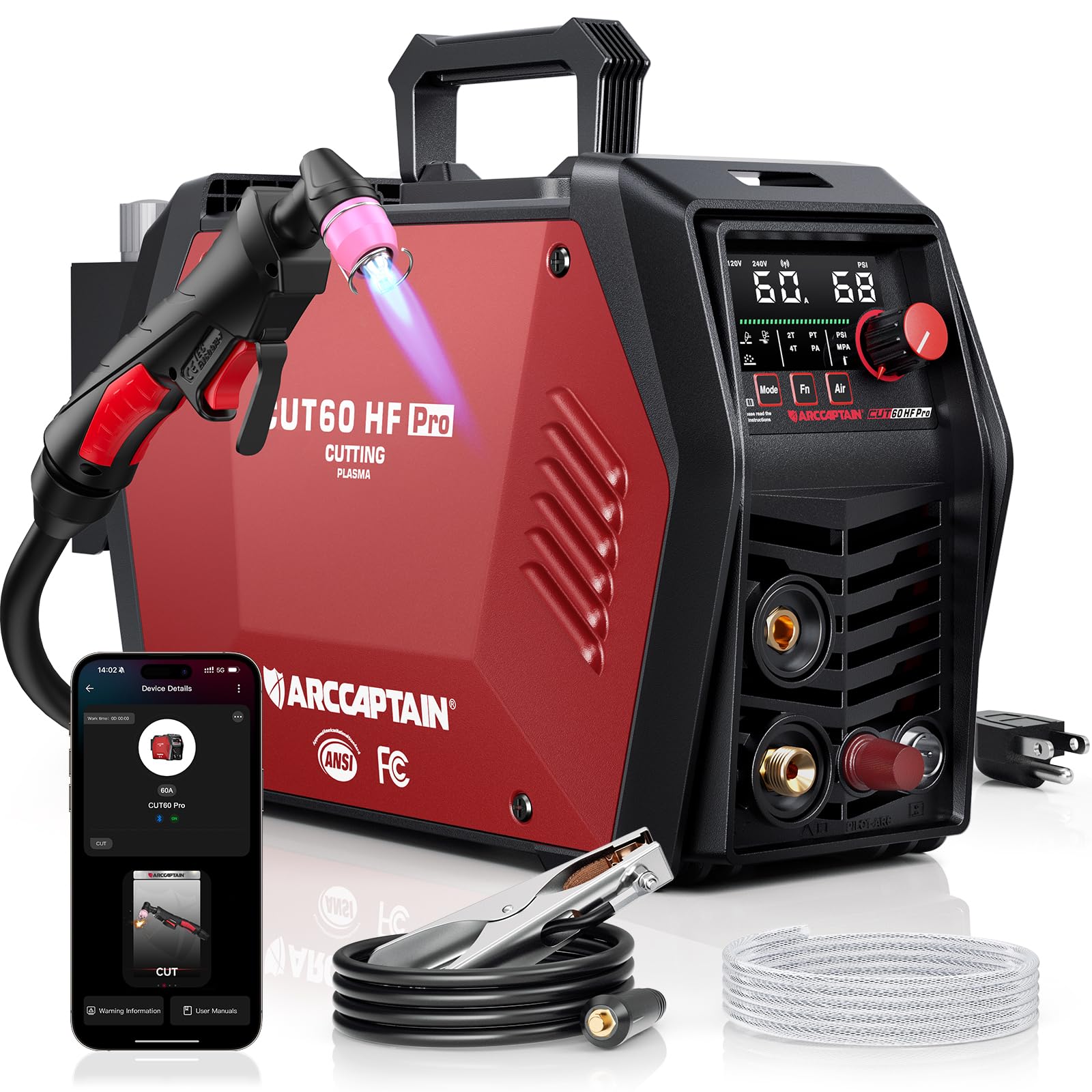
ARCCAPTAIN iControl CUT60 Pro
ARCCAPTAIN iControl CUT60 Pro 60Amp Pilot Arc Plasma Cutter, APP Control, LED Display, AG60 Torch, Dual Voltage 120/240V, Modes for Rust Removal and Expanded Metal
Best for: Tech-savvy users who want app-based control, multiple cutting modes, and strong capacity in a portable package.
This compact cutter gives you a surprising set of options. Control settings from the LED panel or the companion app (up to 10 meters away), switch between 2T/4T modes, and use the pilot arc to cut painted or rusty pieces without a lot of prep. It targets serious hobby and light-shop work with app control and multiple cutting modes. The listing gives a 5/8″ clean-cut figure and up to 15/16″ maximum cutting on 240V for carbon steel under stated conditions.
Why it’s worth it: The app control, air-pressure detection, and dedicated expanded-metal and rust-related modes set it apart from simpler 60A cutters. Because it is a newer model, long-term parts and app support deserve extra checking.
Pick this if you want flexible controls, useful modes for different materials, and something easy to move around the shop or farm.
What People Say
People praise the feature set and cutting ability for its size. The app control and multiple modes make dialing in cuts easier. Many mention clean cuts on sheet metal and thicker plate when settings are right. A few point out short lead length and that the unit feels lightweight compared with heavier pro gear.
Feedback trend: Positive at the time of the source review analysis. Current feedback may differ.

This is a historical review-theme graphic, not a live rating or current review count.
Long-Term Costs
Reliable cut quality and accessible controls reduce time on prep and rework, saving labor over time. Consumables and occasional replacement parts are the main ongoing cost. Keep spares handy to minimize downtime.
Value Over Time
Value comes from faster, cleaner cuts and less finishing work, especially with regular use for repairs, fabrication, or small paid jobs. The versatility and app features help you get consistent results faster.
Situational Benefits
Versatility
Works across mild steel, stainless, and painted surfaces. Offers modes for quick structural cuts and more detailed work. Useful for repairs, fabrication, and creative projects.
Safety
Pilot arc reduces torch contact with the workpiece. The unit uses compressed air rather than combustible gases. Built-in protections cover overcurrent, overvoltage, overload, and overheating. Standard PPE and proper grounding are still required.
Durability
Build feels lighter than heavy-duty pro units, but users report consistent performance within the intended duty cycle. Torch consumables are the primary wear items and should be stocked.
Problem Solving
Addresses common DIY headaches like cutting painted or rusty parts and working with expanded metal. The app and mode options help you adapt to different materials with less trial and error.
Speed & Startup
Startup and setup are quick. The pilot arc lets you begin cutting immediately without touching the nozzle to the workpiece.
Air Requirements
The listing calls for roughly 55 PSI for clean-cut examples and 55–75 PSI near the maximum range. Confirm the required CFM in the current manual, size the compressor for continuous flow, and use a moisture trap and inline filter.
Key Benefits
- App and LED control for quick setup and remote adjustments (up to 10m)
- Pilot arc handles painted, rusted, and expanded metal
- Dual-voltage 120/240V for shop or generator use
- AG60 torch and accessories included for immediate work
- Multiple modes: 2T/4T, PA/PT, rust removal, expanded metal
- Air-pressure detection to help identify setup problems
Check Product Details on Amazon
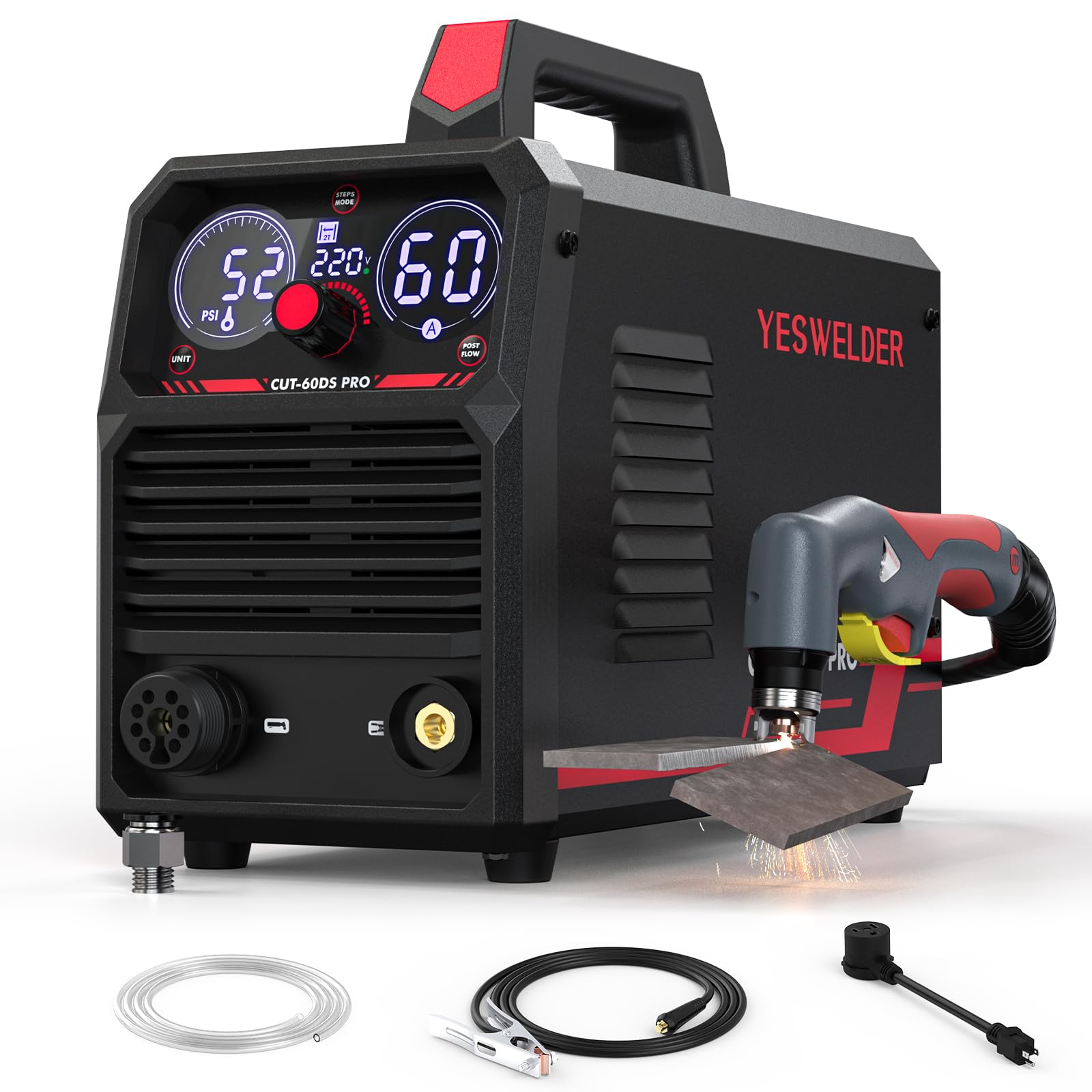
Best for: DIY fabricators who want a portable, CNC-friendly cutter that handles everyday shop tasks without a steep learning curve.
You get a digital display to tune amperage, a pilot arc that helps with painted or scaled metal, and a compact design that makes it simple to shift between a bench, cart, or plasma table. The non-HF blowback start means it works safely near electronics and CNC equipment.
Why it’s worth it: A practical combination of 60A output, non-HF blowback starting, and digital controls. The linked listing identifies an IPT40 torch, but bundles can change, so verify every included item before ordering.
Pick this if you need an approachable cutter for repairs, light fabrication, and the option to pair with a plasma table later.
What People Say
Customers praise the portability and the clean cuts on 1/4″ plate and thinner metals. Many mention the convenience of the digital display and how quickly the unit gets going. A smaller number point out that instructions could be clearer and that some fittings may need attention during setup.
Feedback trend: Positive at the time of the source review analysis. Current feedback may differ.

This is a historical review-theme graphic, not a live rating or current review count.
Long-Term Costs
You save time on prep and finish work, reducing labor hours over multiple projects. Consumables are the main ongoing expense, but routine replacement is straightforward and keeps the unit efficient.
Value Over Time
Regular use for repairs, hobby fabrication, or small paid jobs can justify the cost through reduced rework and faster turnaround.
Situational Benefits
Versatility
Handles mild steel, some stainless, and painted surfaces at typical DIY thicknesses. Suitable for repairs, small fabrication, and CNC table integration.
Safety
Non-touch pilot arc reduces contact-related faults. Uses compressed air instead of flammable gases. Non-HF blowback starting reduces high-frequency interference around electronics. Standard PPE, grounding, and ventilation remain essential.
Durability
Build is solid for its class. Many users report long service when consumables are changed as recommended. The torch and fittings are typical wear points to monitor.
Problem Solving
Cuts through scaled or painted metal without extensive prep. Speeds up repetitive cutting tasks, reducing fitting and finishing time.
Speed & Startup
Startup is quick once air pressure and amperage are set. The pilot arc minimizes the need to touch the nozzle to the workpiece, so you move into cutting faster.
Air Requirements
Use the pressure and airflow stated in the current manual. The linked listing gives manufacturer cut figures at 110V and 220V, but full output depends on the correct circuit and steady dry airflow. Use a regulator, filter, and moisture separator.
Key Benefits
- Non-touch pilot arc for cutting painted or scaled metal
- Digital display for quick, repeatable settings
- Dual-voltage design (110V/220V) for flexibility across outlets and generators
- Non-HF blowback start for lower-interference CNC setups
- Lightweight and portable for small shops and mobile use
- Manufacturer-listed ideal clean cut up to 5/8″ on 220V under suitable conditions
Check Product Details on Amazon
Head-to-Head: PrimeWeld CUT60 vs ARCCAPTAIN iControl CUT60 Pro vs YESWELDER CUT-60DS PRO
These are dual-voltage 60A-class cutters, but their start systems and best uses are not identical:
- PrimeWeld CUT60: Best overall. It has documented non-HF blowback starting, CNC support, 5 CFM at 90 PSI airflow guidance, a 60% duty cycle, and U.S.-based support.
- ARCCAPTAIN iControl CUT60 Pro: Best smart controls. App adjustments, air-pressure detection, and expanded-metal modes are useful, but the linked listing does not clearly document a non-HF CNC interface. Treat it as a handheld-focused smart cutter unless the manufacturer confirms your setup.
- YESWELDER CUT-60DS PRO: Best simple non-HF alternative. It uses blowback starting and a digital display, with manufacturer-listed clean-cut figures that differ between 110V and 220V.
Bottom line: For most buyers, the PrimeWeld CUT60 offers the best balance of performance, support, and long-term value. Choose the ARCCAPTAIN when app control and specialty modes matter more than documented CNC support. Choose the YESWELDER when you want a simpler non-HF alternative.
Before You Buy: Five Checks
- Confirm the exact model and revision. Similar model names can use different torches, start systems, and cut ratings.
- Check your circuit. Full 50A or 60A output normally needs the correct 220V or 240V branch circuit and breaker.
- Check compressor output. Compare CFM at the required PSI, not only tank size or peak horsepower.
- Price consumables first. Confirm the correct electrodes, nozzles, cups, and torch parts are easy to source.
- Plan for CNC now. Choose documented non-HF blowback starting and verify the CNC interface if a table may be added later.
FAQ
Which Plasma Cutter Should I Choose for a Home Shop?
Pick a machine that matches the thickness and type of metal you cut most often.
If you cut mostly sheet metal and occasional 1/4″ plate, a compact dual-voltage unit with a good pilot arc and reliable torch gives you the best mix of portability and performance. Look for dual voltage if you want to run from 120V outlets, 240V circuits, or a generator. Check the duty cycle if you plan longer sessions. Prefer brands with accessible consumables and customer support so you can keep working with minimal downtime.
What Power and Air Setup Do I Need?
Confirm whether the cutter is 110/120V, 220/240V, or dual voltage and make sure your shop circuit can supply the required amperage. Smaller units run fine on standard shop outlets, while higher-amp cutters need a 240V circuit.
For compressed air, aim for clean, dry air at the pressure and flow the manufacturer specifies. Use a regulator, filter, and moisture trap to protect consumables and improve cut quality.
A typical hobby setup works at moderate pressures with a small compressor for light cutting. Heavier or continuous cutting needs higher flow and a sturdier compressor. As a general range, machines in this class call for roughly 4-5 CFM at 60-90 PSI, but the exact figure varies by model: PrimeWeld specifies 5 CFM at 90 PSI for the CUT60, while LOTOS setup guidance is around 65-70 PSI. Always use the number in your own manual.
How Do I Maintain Consumables and Reduce Long-Term Costs?
Keep spare nozzles and electrodes that match your model so you do not stop mid-project. Follow the recommended air pressure and amperage to avoid premature wear.
Clean the torch and leads after use. Avoid dragging the nozzle on the workpiece. Replace consumables at the first sign of degraded cut quality to prevent damage to the torch.
Choose a machine with easy-to-find parts and decent manufacturer support. Check consumable availability before you commit, and stock spares for anything you use regularly.
What Is the Difference Between Pilot Arc, Blowback Start, and High-Frequency Start?
Pilot arc: A pilot arc is the small arc formed at the torch before the main cutting arc transfers to the workpiece. Both HF and blowback systems can support a non-touch pilot arc.
Blowback, non-HF start: Air pressure moves the electrode inside the torch to start the arc without a high-frequency pulse. This design is usually preferred around CNC controllers and other sensitive electronics, but you still need a compatible CNC interface and proper wiring.
High-frequency (HF) start: The machine uses a high-voltage, high-frequency pulse to start the arc without touching the metal. It works well for handheld cutting, but the electrical noise can interfere with CNC controllers, computers, and nearby electronics.
If you plan to use a CNC plasma table, choose a documented non-HF blowback model and confirm the torch trigger, CNC port, voltage-divider, and grounding requirements before purchase.
What Size Compressor Do I Need for Plasma Cutting?
Match the compressor to the cutter’s required CFM at the stated PSI. Tank size alone does not tell you whether the compressor can keep up. A larger tank may reduce cycling, but continuous airflow is what prevents pressure drops. PrimeWeld, for example, specifies 5 CFM at 90 PSI for the CUT60. Always use clean, dry air with a regulator, filter, and moisture separator.
What Customers Prefer
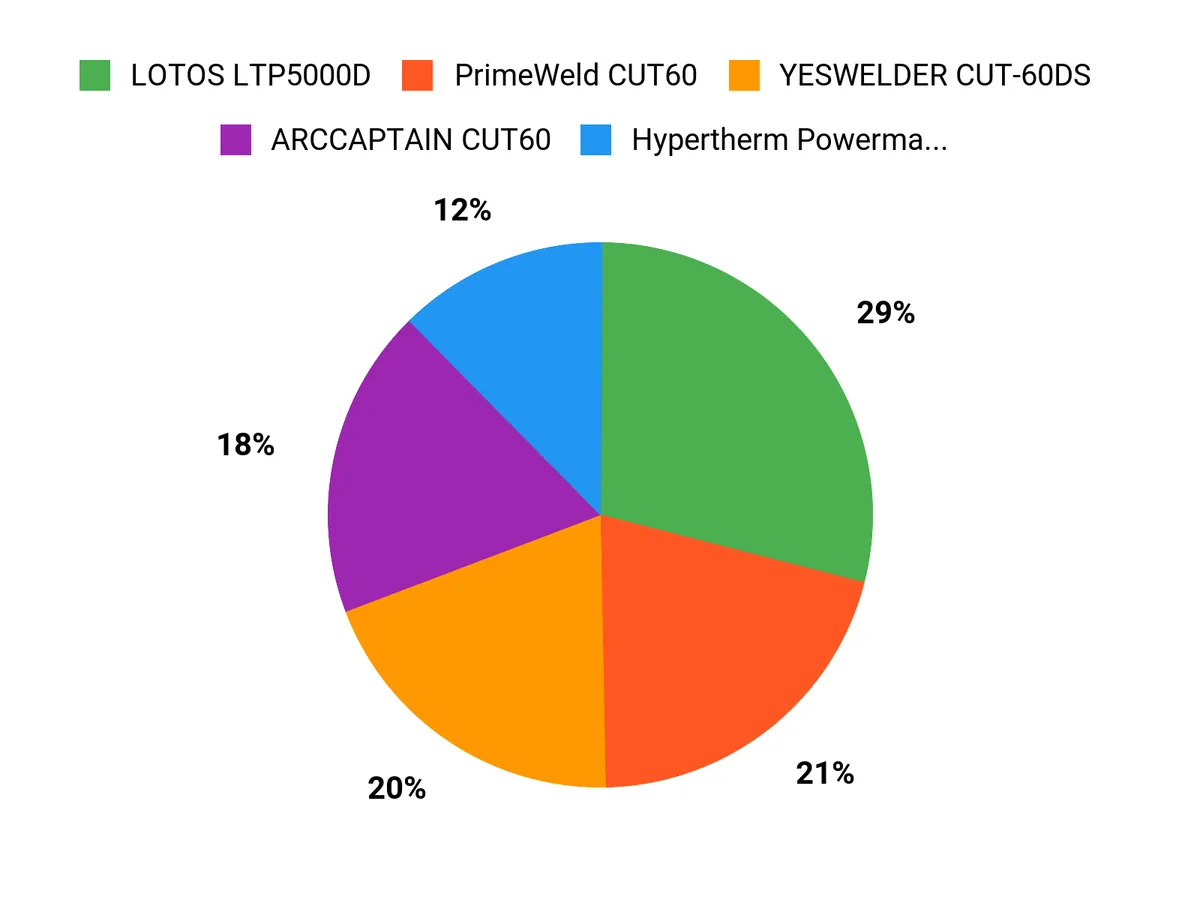
When choosing between the LOTOS LTP5000D, PrimeWeld CUT60, and TOOLIOM CUT-50, most buyers weigh cut quality and reliability against portability and ease of use. Many pick the PrimeWeld for consistent, strong home-shop cuts and a robust torch. Others choose the LOTOS for a dependable pilot-arc unit with dual-voltage flexibility. Budget-conscious buyers opt for the TOOLIOM when basic portability and simple operation are the priority, accepting some trade-offs in torch durability.
Common Mistakes to Avoid
- Skipping the moisture trap. Water in your compressed air kills consumables fast and degrades cut quality. Always use an inline filter and moisture separator.
- Running too much or too little air pressure. Check the manufacturer’s recommended PSI for your amperage setting. Wrong pressure causes a wide, sloppy arc or blows out the pilot.
- Ignoring consumable wear. A worn nozzle or electrode does not just cut poorly; it can damage the torch head. Swap them at the first sign of degraded cuts.
- Buying without checking consumable availability. Some torches use proprietary parts that are harder to find. Confirm parts are in stock and reasonably priced before you buy.
- Choosing HF start for a CNC table. High-frequency arc starts interfere with computers and CNC controllers. If you plan to add a cutting table, get a blowback or non-HF unit.
- Undersizing your compressor. A compressor that cannot keep up with your cutter’s CFM demand leads to pressure drops, inconsistent cuts, and faster consumable wear. Match your compressor to the cutter’s requirements before you buy.
Wrapping Up
Choose the cutter that matches your normal metal thickness, available power, compressor output, and future CNC plans.
For most home shops, the PrimeWeld CUT60 is the strongest all-around choice because it combines documented airflow requirements, non-HF blowback starting, CNC support, a 60% duty cycle, and U.S.-based service. The LOTOS LTP5000D remains a practical handheld value pick for routine repairs and fabrication.
Choose the TOOLIOM or hynade only when budget and occasional use matter more than long-term product history. Pick the ARCCAPTAIN for app control and specialty modes, or the YESWELDER when you want a simpler non-HF 60A design.
Before ordering, confirm the current listing, model revision, included torch, input circuit, compressor demand, consumables, warranty, and return terms.
For more on proper plasma cutting technique and safety practices, review the OSHA plasma arc welding safety guidelines.
This roundup is reader-supported. As an Amazon Associate, we may earn from qualifying purchases made through affiliate links.
Related reading: 10 Best Welding Helmets in July 2026: Tested for Safety, Comfort & Clarity