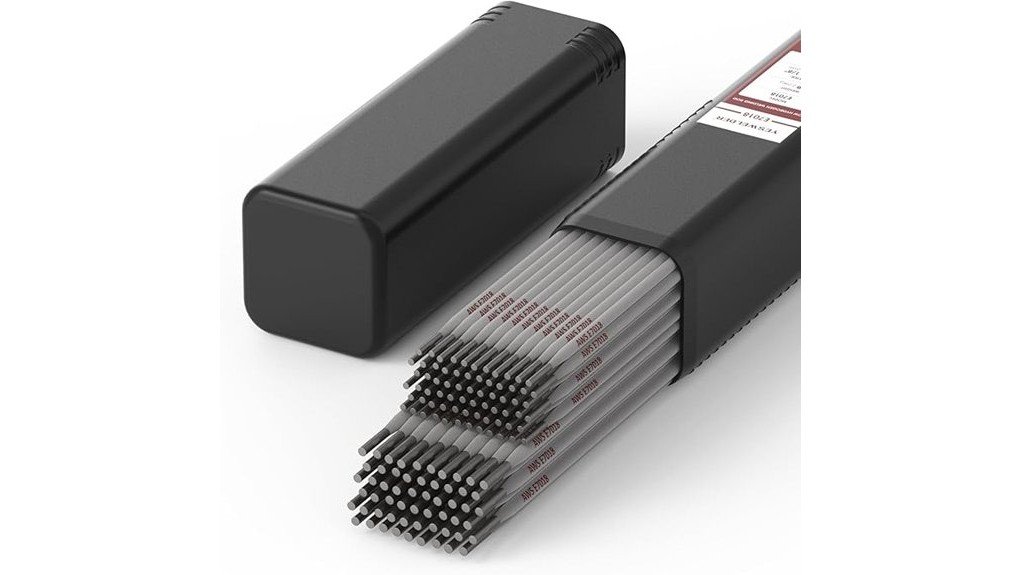
Choosing an E7018 rod is less about finding the flashiest package and more about matching the electrode to your steel, power source, welding position, and storage routine. The YESWELDER E7018 Welding Rod bundle combines 3/32-inch and 1/8-inch electrodes in one 5-pound package, which can be useful when your work moves between lighter and heavier steel. Its main strengths are AC or DCEP compatibility, all-position use, a steady arc, and low-spatter performance. Its main limitation is that low-hydrogen electrodes demand dry storage, and the listing’s single 115A to 165A range should not be treated as the correct setting for every rod size and joint.
Editorial note: This review is based on the verified product listing, article-supported specifications, and buyer feedback themes available at review time. For code work or load-bearing welds, your welding procedure specification, electrode package, and project requirements take priority.
Quick Verdict
Editorial Rating: 8.4/10, recommended with caveats
Best For: Welders who want a dual-size E7018 package for carbon steel repairs, fabrication, practice coupons, and shop work.
Bottom Line: This YESWELDER bundle gives you two common E7018 diameters, AC or DCEP operation, and source-reported steady arc behavior. It is a practical buy when you can store low-hydrogen rods correctly, but you still need to confirm the correct amperage and procedure for each diameter.
Key Takeaways
- The verified package combines 2.5 pounds of 3/32-inch rods and 2.5 pounds of 1/8-inch rods.
- The listing describes E7018 low-hydrogen iron powder electrodes for all-position welding with AC or DCEP.
- Dry storage, clean steel, correct polarity, and diameter-specific amperage matter more than the brand name alone.
Key Specifications
| Specification | Detail |
|---|---|
| Brand | YESWELDER |
| Listed model | E7018-5LB-2.4/3.2 |
| ASIN | B0DK8JQJ66 |
| Product type | Carbon steel stick welding electrodes for shielded metal arc welding |
| Electrode type | E7018 low-hydrogen iron powder |
| Diameter mix | 3/32 inch and 1/8 inch |
| Package quantity | 2.5 lb of 3/32-inch rods plus 2.5 lb of 1/8-inch rods |
| Rod length | 14 inches |
| Listed net weight | 5 lb total |
| Package weight | About 5.19 lb, which may include packaging |
| Current and polarity | AC or DCEP, also called DC reverse polarity |
| Welding positions | All-position use per the product listing |
| Listed amperage | 115A to 165A, verify the correct range for the diameter and procedure you use |
| Compatible base metals | Low, medium, and high carbon steel, cold-rolled steel, and some low-alloy structural steel applications |
| Storage need | Keep sealed and dry, then follow the electrode package, applicable code, and shop procedure after opening |
What Is the YESWELDER E7018 Welding Rod?
The YESWELDER E7018 is a covered stick electrode for carbon steel welding. Its flux coating is described as a low-hydrogen iron powder formulation, and the verified listing identifies the package as model E7018-5LB-2.4/3.2. The bundle includes two common diameters instead of one full 5-pound box of a single size.
The 3/32-inch rods give you a smaller electrode for lighter sections, smaller joints, and lower-output machines when the procedure allows it. The 1/8-inch rods suit thicker material and higher deposition work when your machine can supply the required current. This mixed pack is most useful when you regularly switch between project sizes or want both diameters for practice.
The listing also states that the rods can run on AC or DCEP and are intended for all-position welding. That broad compatibility is useful, but it does not replace a qualified welding procedure, especially for structural, pressure, lifting, vehicle, or other safety-critical work.
Who Should Buy It?
Best For
- Home-shop welders who work mainly with carbon steel and want two rod diameters in one order.
- Fabricators who value AC or DCEP compatibility and need flat, horizontal, vertical, or overhead options.
- Students and occasional users who want to practice E7018 starts, restarts, slag control, and bead placement.
Skip If
- You need rods for aluminum, stainless steel, cast iron, or a base metal not covered by your procedure.
- You want a full 5-pound quantity of only 3/32 inch or only 1/8 inch.
- You cannot keep low-hydrogen electrodes dry after opening or your welder lacks the required output.
Before You Buy: The listing gives one 115A to 165A range for a package containing two rod diameters. Do not assume that range applies equally to every 3/32-inch and 1/8-inch weld. Check the rod package, your machine chart, and the welding procedure for the exact diameter, position, joint, and base-metal thickness.
Feature-by-Feature Review
Low-Hydrogen Iron Powder Coating
The E7018 classification is the main reason to consider this product. A low-hydrogen coating is designed to limit moisture-related hydrogen entering the weld when the rods are stored and handled correctly. That matters most on restrained joints, thicker sections, higher-strength steels, and other work where hydrogen cracking is a concern.
The tradeoff is storage discipline. Once the package is open, leaving rods exposed in a damp garage, truck box, or unheated shop can undermine the benefit you bought them for. For code work, follow the applicable storage and exposure rules rather than using a casual “keep them somewhere dry” approach.
Dual-Diameter 5-Pound Package
The package contains 2.5 pounds of 3/32-inch rods and 2.5 pounds of 1/8-inch rods. This is convenient when your projects vary, but it also means each size runs out sooner than a single-diameter 5-pound box. Buyers who mostly use one size may get better value from a dedicated package.
The smaller 3/32-inch diameter is generally easier to match to lighter work and machines with less output. The 1/8-inch diameter deposits more metal and suits heavier work, but it also demands more amperage and more control of the molten puddle.
Steady Arc, Low Spatter, and Restarts
The product listing highlights a steady arc, low spatter, high deposition efficiency, and good re-striking. Those traits are useful for stringer beads, tack welds, and multi-pass joints because you spend less time fighting an unstable arc or cleaning scattered spatter.
Restart quality still depends on technique. Break or file the glazed flux tip when needed, clean the crater and slag, and restart far enough back to tie into sound weld metal. A product claim cannot compensate for a contaminated joint, long arc, poor work angle, or incorrect current.
All-Position Use and Power-Source Flexibility
The listing states that the rods can run on AC or DCEP. AC compatibility can help when your machine has limited DC options or when arc blow becomes a problem on magnetized work. DCEP is a common choice for E7018 and should be used when your procedure or package calls for it.
“All position” does not mean every technique works in every direction. Flat welds are usually the easiest. Vertical and overhead welds demand a shorter arc, controlled puddle size, correct travel angle, and settings that match the joint. Do not assume vertical-down is acceptable unless your procedure expressly permits it.
Carbon Steel and Structural Applications
The listing names low, medium, and high carbon steels, cold-rolled steel, low-alloy structural steel, steel structures, power plants, offshore rigs, and tubular tack work. These examples show the intended category, but they are not blanket approval for any critical application.
For a gate, bracket, frame, or noncritical repair, the main checks are clean steel, sound joint preparation, suitable rod size, and enough machine output. For structural or engineered work, confirm the electrode classification, storage condition, procedure, welder qualification, preheat, joint design, and inspection requirements before welding.
How It Performs in Real Use
For Home-Shop Repairs
On clean carbon steel, the dual-size pack gives you useful flexibility for brackets, frames, equipment repairs, and practice coupons. The 3/32-inch rods help when the joint is smaller or your machine is more comfortable at lower output, while the 1/8-inch rods make more sense on thicker sections. The mixed package reduces the need to order two separate boxes.
For Fabrication and Multi-Pass Welds
The stated steady arc and re-strike performance fit jobs that require several starts and stops. You still need to remove slag completely between passes and inspect the toes, crater, and tie-in before adding another bead. Trapped slag or poor fusion will not be fixed by the next pass.
For Vertical and Overhead Work
The all-position claim makes these rods more versatile than flat-only electrodes. Out-of-position results depend heavily on controlling amperage, arc length, travel speed, and puddle size. A smaller diameter may feel easier when you are learning, but the correct choice must still match the required weld size and procedure.
For Field and Maintenance Work
AC or DCEP compatibility broadens the range of machines you can use. The bigger challenge in field work is moisture control. Carry only the quantity you expect to use, protect opened rods from weather, and follow your job’s exposure-time and storage rules.
Setup and Usage Tips
- Confirm the base metal. These rods are intended for carbon steel and supported low-alloy steel applications, not aluminum or stainless steel.
- Prepare the joint. Remove paint, oil, heavy rust, moisture, and other contamination from the weld area. Be cautious with plated or coated metals because heating them can create hazardous fumes.
- Choose the diameter first. Match 3/32 inch or 1/8 inch to the material thickness, weld size, position, machine output, and written procedure.
- Set current from a reliable source. Use the electrode package, machine chart, or WPS as your starting point. Fine-tune only within the permitted range.
- Keep a short, controlled arc. A long arc can increase spatter, reduce shielding, and make the puddle harder to manage.
- Clean every pass. Chip and brush the slag before restarting or depositing another bead.
- Protect opened rods. Follow the package and applicable code for storage, atmospheric exposure, holding ovens, and reconditioning.
Pro Tip: Before welding the actual project, run a short bead on scrap of the same material and thickness. It lets you check arc stability, puddle control, slag release, and bead profile without risking the finished part.
Safety, Storage, and Procedure Notes
Use a welding helmet with the correct shade, safety glasses, dry welding gloves, flame-resistant clothing, and protective footwear. Keep combustible material away from the work area, provide suitable ventilation or fume extraction, and use fire watch procedures when the job requires them.
Do not weld on containers, tanks, drums, pressurized parts, or unknown coated metals without the correct cleaning, testing, and professional procedure. For load-bearing, vehicle, pressure, lifting, or structural work, use an approved procedure and qualified personnel. A retail electrode listing does not establish that a weld is safe for service.
Low-hydrogen storage is part of weld quality, not an optional care step. Keep unopened rods sealed until needed. After opening, follow the manufacturer’s package directions and the governing code or WPS. Use equipment intended for electrode storage, and do not place welding rods in an oven used for food.
What Buyers Are Saying
The source article’s buyer-feedback summary points to two recurring positives and one evidence gap:
- Praise: Buyers mention steady arc behavior that can make bead placement easier.
- Praise: Low spatter is another positive theme, which can reduce cleanup on steel projects.
- Watch-out: The source does not provide a strong recurring complaint theme. Read the newest reviews for packaging damage, moisture exposure, diameter labeling, and recent seller fulfillment issues.
Pros and Cons
Pros
- Two useful diameters in one 5-pound package
- Low-hydrogen E7018 iron powder design for supported carbon steel work
- Runs on AC or DCEP according to the verified listing
- All-position capability broadens shop and field use
- Source-reported steady arc, low spatter, and good re-striking
Cons
- You receive only 2.5 pounds of each diameter, not 5 pounds of one size
- Low-hydrogen rods require controlled dry storage after opening
- The listing’s single amperage range needs diameter-specific verification
Is It Worth the Price?
This bundle offers strong value for the price when you genuinely use both 3/32-inch and 1/8-inch E7018 rods. You get two sizes without buying two full packages, which makes sense for mixed shop work, training, repairs, and occasional fabrication.
It is less compelling when one diameter covers nearly all your jobs. In that case, a single-size 5-pound box may reduce leftovers and give you a lower cost per usable rod. Storage also affects value because moisture-damaged low-hydrogen electrodes can turn an inexpensive purchase into wasted material.
How It Compares to Alternatives
Lincoln Electric, Forney, and Hobart all sell E7018 electrodes that are worth comparing for availability, packaging, published data, and local support. A single-diameter box from one of those brands may be the better choice when you already know the exact rod size you use most.
The YESWELDER package makes the most sense when the dual-size mix is the main benefit you need. Compare the electrode designation, package condition, storage instructions, polarity, and published amperage guidance rather than choosing by brand name alone.
Frequently Asked Questions
Can the YESWELDER E7018 rods run on AC?
Yes. The verified listing states that these rods can run on AC or DCEP. Use the polarity required by the electrode package, your machine, and the welding procedure.
What amperage should you use for the 3/32-inch and 1/8-inch rods?
The listing gives 115A to 165A, but that broad range should not be applied blindly to both diameters. Check the package chart or WPS for the exact rod size, position, material thickness, and joint before you weld.
Is this a full 5-pound box of each diameter?
No. The package contains 2.5 pounds of 3/32-inch rods and 2.5 pounds of 1/8-inch rods, for 5 pounds total. Choose a single-size box instead when you need a full 5 pounds of one diameter.
Can you use these rods in vertical and overhead positions?
The product is listed for all-position welding. Vertical and overhead work require tighter puddle control, a short arc, and settings that fit the joint. Do not use a vertical-down technique unless the procedure permits it.
How should you store opened E7018 rods?
Keep them dry and follow the electrode package, applicable code, and shop procedure for exposure limits and heated storage. Do not guess at reconditioning temperatures, and do not use a food oven for welding consumables.
Can you use YESWELDER E7018 rods on aluminum or stainless steel?
No. This product is intended for carbon steel and supported low-alloy steel applications. Aluminum and stainless steel require compatible filler metal and a process suited to the exact alloy and joint.
Are these rods suitable for beginners?
They can be useful for learning E7018 technique because the source reports a steady arc and low spatter. Beginners should practice on scrap, learn correct amperage and polarity, and get instruction before welding anything safety-critical.
Are these rods automatically approved for structural welding?
No retail product listing can approve a weld for a specific structure. Structural work may require a qualified WPS, verified consumable classification, controlled storage, qualified welders, preheat, inspection, and compliance with the governing code.
The Bottom Line
The YESWELDER E7018 dual-size bundle is a good fit when you weld carbon steel, can use both 3/32-inch and 1/8-inch rods, and have a reliable dry-storage plan. Its strongest advantages are package flexibility, AC or DCEP compatibility, and source-reported steady, low-spatter performance.
Skip it when you need a full 5-pound box of one diameter, a filler metal for a different alloy, or a product that can be stored casually after opening. Recommended with caveats, especially for buyers who verify diameter-specific settings before striking an arc.
Ready to Buy?
Check the latest price, seller, package details, and current product information before you decide.