YESWELDER Firstess DP200 Welder Review
Choosing a multi-process welder gets difficult when you need simple setup for routine jobs but still want enough control for pulse MIG, aluminum, and repeat fabrication work. The YESWELDER Firstess DP200 tries to cover both needs with 120V/240V input, a 7-inch display, automatic parameter matching, manual adjustments, and saved programs. Its strongest case is flexible MIG welding, including pulse and Dual Pulse modes, while its main limit is that TIG is DC Lift TIG rather than full AC or high-frequency TIG. This review explains the verified specifications, included equipment, setup considerations, and the type of buyer who will get the most value from it.
Quick Verdict
Rating: 8.6/10, recommended with caveats
Best For: Garage welders, serious DIY users, and small fabrication shops that want dual-voltage pulse MIG with guided and manual controls.
Bottom Line: The DP200 combines a useful 200A-class MIG platform, a large interface, memory channels, and broad process support in a 28.2 lb machine. It is less suitable if your priority is AC TIG aluminum, high-frequency TIG starts, or a basic low-cost flux-core welder.
Key Takeaways
- Flexible power: The DP200 runs on 120V or 240V, with higher output available on 240V.
- MIG-focused versatility: It supports standard MIG, pulse MIG, Dual Pulse MIG, flux-cored, DC Lift TIG, and stick welding.
- Useful control options: You can use automatic parameter matching or adjust voltage, wire feed speed, inductance, burn-back, crater settings, and other controls manually.
- Important limitation: The machine does not provide AC TIG for aluminum, and the optional TIG torch, foot pedal, and spool gun are not part of the standard package.
At a Glance: Key Specifications
| Specification | Detail |
|---|---|
| Brand | YESWELDER |
| Model | Firstess DP200 |
| ASIN | B0DC9Q7K8S |
| Product Type | Dual-voltage multi-process inverter welder |
| Input Power | 120V or 240V ±10%, single phase, 50/60 Hz |
| Welding Processes | MIG and pulse MIG, flux-cored, DC Lift TIG, and stick |
| MIG Output Range | 30-120A at 120V; 30-200A at 240V |
| TIG Output Range | 10-120A at 120V; 10-200A at 240V |
| Stick Output Range | 10-120A at 120V; 10-180A at 240V |
| Rated Duty Cycle at 240V | MIG/TIG: 60% at 130A and 100% at 100A; Stick: 60% at 117A and 100% at 90A |
| Recommended Thickness | Up to 1/8 inch (3 mm) at 120V and 3/8 inch (10 mm) at 240V, depending on process and setup |
| Supported Materials | MIG: steel, stainless steel, and aluminum; DC Lift TIG: steel and stainless steel; flux-cored and stick: steel |
| MIG Wire Types | ER70S-6, E71T, ER308L, ER4043, and ER5356 |
| Wire Diameters | 0.023, 0.030, 0.035, and 0.045 inch |
| Spool Gun | Compatible with the optional YESWELDER LBT150 spool gun; not included |
| Display and Interface | 7-inch LCD with IntuiWeld interface, adjustable brightness, and light or dark display themes |
| Memory Channels | Up to 50 for MIG/MAG and 20 for flux-cored, TIG, and stick |
| Dimensions and Weight | 17.7 × 9.4 × 8.1 inches; 28.2 lb |
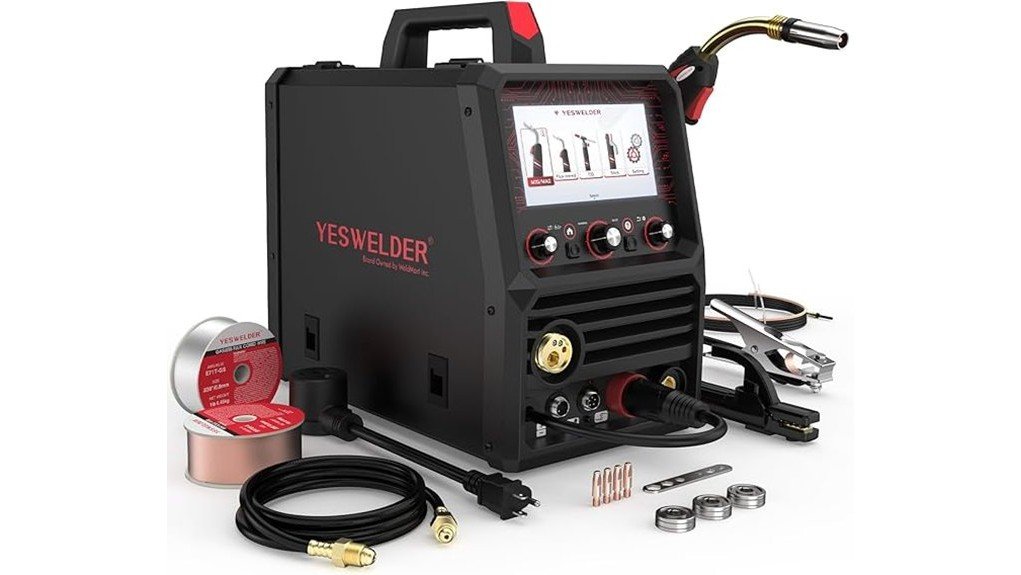
| Included Equipment | 24KD MIG gun, work clamp, electrode holder, drive rollers, 240V-to-120V adapter, four contact tips, gas hose, feeding liner, ER70S-6 wire, E71T-GS wire, and operator manual |
| Protection Features | Short-circuit, overheat, overcurrent, overvoltage, undervoltage, VRD, low-voltage alert, and fan-on-demand control |
What Is the YESWELDER Firstess DP200?
The YESWELDER Firstess DP200 is a compact multi-process inverter welder built around MIG and flux-cored welding. It adds pulse MIG, Dual Pulse MIG, DC Lift TIG, and stick modes, giving you more process choices than a basic wire-feed unit.
The machine is designed for users who want help choosing initial settings but do not want to be locked into automatic controls. Its IntuiWeld interface can match parameters to the selected material, wire, gas, and thickness, while manual menus let you fine-tune the arc and save repeat setups.
Who Should Buy It?
Best For
- Garage and small-shop welders who can use both 120V and 240V power.
- Users who want pulse MIG and spool-gun support for aluminum projects.
- Beginners who value guided settings and experienced users who want manual arc controls.
Skip If
- You need AC TIG for aluminum or high-frequency TIG starts.
- You want the lowest-cost machine for occasional flux-core repairs.
- You need an industrial production welder with a higher continuous-output duty cycle.
Before You Buy: The DP200 can MIG weld aluminum with the correct wire, 100% argon, and a compatible spool gun, but it cannot AC TIG weld aluminum. The spool gun, TIG torch, and TIG foot pedal are optional accessories, so confirm the package contents for the seller you choose.
Feature-by-Feature Review
120V and 240V Power
Dual-voltage input is one of the DP200’s most practical advantages. On 120V, the machine is easier to use in a home garage and provides up to 120A in MIG mode according to the current specification table. On 240V, MIG output reaches 200A, and YESWELDER recommends material thicknesses up to 3/8 inch when the process and preparation are appropriate.
The tradeoff is that a standard 120V circuit does not unlock the machine’s full output. For thicker work or longer welding periods, you will get more useful capacity from a correctly installed 240V circuit.
Pulse and Dual Pulse MIG
Pulse MIG controls current in repeating high and low stages, which can reduce average heat input compared with a continuously high setting. Dual Pulse adds a second rhythm to the pulse cycle, helping you manage bead appearance and heat on thin material and aluminum.
This is the feature that separates the DP200 from many entry-level multiprocess welders. It can give you more control over distortion and spatter, but it still requires correct wire, shielding gas, torch setup, travel speed, and practice. Dual Pulse does not turn poor joint preparation into a sound weld.
MIG, Flux-Cored, DC Lift TIG, and Stick Modes
Standard MIG is the main process for clean shop work on steel, stainless steel, and aluminum. Flux-cored mode is useful when wind makes shielding gas difficult to protect, while stick mode adds flexibility for repair work and common electrodes such as E6010, E6011, E6013, and E7018.
DC Lift TIG works on steel and stainless steel when you add the optional WP-17V torch and use 100% argon. It is a useful add-on process for occasional controlled welds, but it lacks AC output for TIG welding aluminum and does not offer a non-contact high-frequency start.
7-Inch Display and IntuiWeld Controls
The 7-inch LCD gives you more room to view process choices, recommended settings, warnings, and adjustment values than a small numeric panel. Adjustable brightness and light or dark themes can make the interface easier to read in different shop lighting.
The control system is helpful when several variables must match, including gas, wire alloy, wire diameter, and material thickness. A large display does add menu navigation, so users who prefer two basic dials may find the interface more detailed than necessary.
Automatic Matching, Manual Control, and Memory
Automatic parameter matching gives you a starting point for wire feed speed, current, and voltage based on your selected setup. You can then switch to manual control and adjust items such as inductance, voltage trim, wire feed speed, burn-back, and crater behavior.
Memory is especially useful when you repeat the same jobs. The DP200 stores up to 50 MIG/MAG programs and up to 20 programs for flux-cored, TIG, and stick modes, reducing the need to rebuild settings after changing processes.
Aluminum Capability and Spool-Gun Support
The DP200 supports ER4043 and ER5356 aluminum wire and can use 100% argon for aluminum MIG. YESWELDER identifies the optional LBT150 as the compatible spool gun, which feeds soft aluminum wire close to the torch and helps reduce feeding problems through a long liner.
Plan for the added cost of the spool gun and gas if aluminum is your main reason for buying the machine. You should also verify the recommended polarity, drive roll, liner, wire diameter, and pulse program before starting.
Package Contents and Portability
At 17.7 × 9.4 × 8.1 inches and 28.2 lb, the DP200 is portable enough to move around a garage or load for field work. The standard package includes the 24KD MIG gun, work clamp, electrode holder, voltage adapter, drive rollers, contact tips, gas hose, feeding liner, sample solid and flux-cored wires, and the operator manual.
The included equipment covers basic MIG, flux-cored, and stick setup, but shielding gas and personal protective equipment are still separate purchases. Optional TIG and spool-gun hardware are also separate.
How It Performs in Real Use
For Home Garage Repairs
On 120V, the DP200 suits brackets, carts, light fabrication, automotive sheet work, and routine repairs within the circuit and thickness limits. Automatic matching can help you reach a usable starting point quickly, but testing on scrap remains important before welding the final part.
For 240V Shop Fabrication
A 240V supply unlocks the 200A MIG range and makes the machine a better fit for thicker joints and repeated fabrication. The stated 60% duty cycle at 130A in MIG/TIG mode is useful for a compact machine, but high-output work still requires planned cooling pauses.
For Aluminum Projects
Pulse and Dual Pulse modes, aluminum wire support, and spool-gun compatibility make the DP200 more capable than a basic DC MIG welder for aluminum. Results will depend heavily on clean material, correct 100% argon flow, suitable wire, and a properly configured spool gun.
For Outdoor and Field Repairs
Flux-cored and stick modes give you alternatives when shielding gas is hard to protect outdoors. The 28.2 lb chassis is manageable, but you still need a suitable power source, dry working conditions, cable management, and protection from rain and conductive surfaces.
Setup Tips Before First Use
- Match the receptacle, plug, adapter, and circuit to the selected 120V or 240V input. Do not rely on an undersized extension cord.
- Install the correct drive roll, contact tip, liner, wire type, and polarity for solid wire, flux-cored wire, stainless, or aluminum.
- Select the shielding gas before using automatic parameter matching. Common choices include 100% CO2, mixed gas, or 100% argon, depending on the process and wire.
- Run a test bead on clean scrap of the same material and thickness, then adjust voltage trim, wire feed speed, and inductance as needed.
- Save a memory channel only after the setup produces a stable arc and acceptable bead profile.
Pro Tip: Label saved programs with the material, wire alloy, wire diameter, gas, thickness, and position. A complete label is more useful than saving a voltage and wire-speed pair without the setup details.
Compatibility and Safety
Use the DP200 only on a properly grounded circuit that matches the manual, plug, and adapter. Keep the work area dry, secure the work clamp to clean metal, inspect cables and torch parts, and allow clear airflow around the fan openings.
Wear an approved welding helmet, gloves, flame-resistant clothing, and suitable eye protection for grinding and wire handling. Provide ventilation for fumes, remove flammable materials, and never weld a tank, drum, fuel system, pressurized vessel, or unknown coated metal without the correct professional procedure.
The machine includes protections for conditions such as overheating, overcurrent, overvoltage, undervoltage, and short circuits, but those systems do not replace safe setup. Follow the current operator manual and the requirements for your workspace.
Pros and Cons
Pros
- 120V/240V input supports both garage and higher-output shop use.
- Pulse and Dual Pulse MIG add useful heat and bead control.
- Automatic matching and detailed manual adjustments suit different skill levels.
- Large 7-inch display makes settings and warnings easier to read.
- Memory channels reduce setup time for recurring material and wire combinations.
Cons
- No AC TIG or high-frequency TIG start for aluminum TIG work.
- Spool gun, TIG torch, foot pedal, shielding gas, and safety gear are not included.
- The menu-rich interface may be excessive for buyers who only need simple flux-core repairs.
Is It Worth the Price?
The DP200 sits above basic entry-level MIG and flux-core machines because you are paying for dual-voltage output, pulse functions, a large display, manual cycle controls, spool-gun compatibility, memory, and a broader accessory package. It offers the strongest value when you will use those features across several materials and repeat projects.
It is less compelling if you weld only thin steel a few times per year or need a dedicated TIG platform. In those cases, a simpler 120V MIG welder or a purpose-built AC/DC TIG welder may be a better use of your budget.
How It Compares to Alternatives
The YESWELDER MIG-205DS PRO is worth comparing if you want a simpler dual-voltage multiprocess machine and do not need the DP200’s large interface, Dual Pulse controls, or extensive memory. The Forney Easy Weld 140 MP-i is a more compact 120V multiprocess option for buyers who value household-power convenience over 200A-class 240V output.
The Hobart Handler 140 is a straightforward 120V MIG and flux-cored alternative with conventional controls and a long-established service network, but it does not match the DP200’s process range or pulse features. The DP200 makes the most sense when flexible MIG control, aluminum support, and dual-voltage operation matter more than minimal setup complexity.
Frequently Asked Questions
Does the YESWELDER DP200 run on both 120V and 240V?
Yes. It supports 120V and 240V input at 50/60 Hz. Use the correct receptacle, adapter, circuit capacity, and plug configuration listed in the operator manual.
How thick can the DP200 weld?
YESWELDER recommends up to 1/8 inch at 120V and 3/8 inch at 240V. Actual capability depends on the process, joint design, material, preparation, position, and number of passes.
Can the DP200 TIG weld aluminum?
No. Its TIG process is DC Lift TIG, which is intended for steel and stainless steel. Aluminum is handled through MIG or pulse MIG with the correct aluminum wire, 100% argon, and a compatible spool-gun setup.
Is a spool gun included with the DP200?
No. The DP200 supports the optional YESWELDER LBT150 spool gun, but it is not part of the standard package. Confirm the seller’s bundle before ordering because package configurations can change.
What comes with the YESWELDER DP200?
The listed standard package includes the welder, 24KD MIG gun, work clamp, electrode holder, drive rollers, voltage adapter, four contact tips, gas hose, feeding liner, sample solid and flux-cored wires, and an operator manual. Shielding gas and personal protective equipment are separate.
Is the DP200 suitable for beginners?
It can be beginner-friendly because the interface recommends starting parameters after you select the material, gas, wire, and thickness. New users still need instruction on polarity, joint preparation, gas flow, torch angle, travel speed, electrical safety, and PPE.
How many settings can the DP200 save?
It supports up to 50 memory channels for MIG/MAG and up to 20 for flux-cored, TIG, and stick. Saved programs are most useful when you record the complete material, wire, gas, and thickness setup.
Can you use the DP200 outdoors?
Flux-cored and stick modes are practical when wind makes shielding gas unreliable. Keep the welder dry, protect it from rain and conductive surfaces, and use a power source and extension setup that meet the manual’s requirements.
The Bottom Line
The YESWELDER Firstess DP200 is a strong choice for garage welders and small shops that want 120V/240V flexibility, pulse MIG, aluminum spool-gun support, a large display, and saved programs. Skip it if you need AC TIG aluminum capability, high-frequency TIG, or a simple low-cost flux-core machine with very few controls.
Its main strength is the combination of guided setup and detailed MIG adjustment in a portable 28.2 lb package. Its main limitation is that several advanced use cases require optional accessories, and TIG remains a secondary DC Lift TIG function.
Ready to Buy?
Check the latest price, seller package, and product details before you decide.