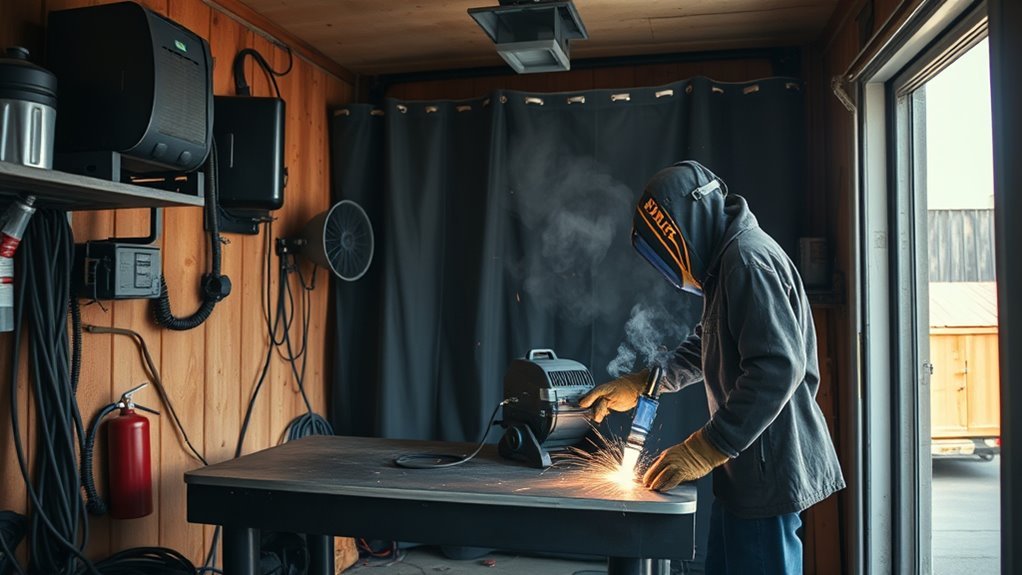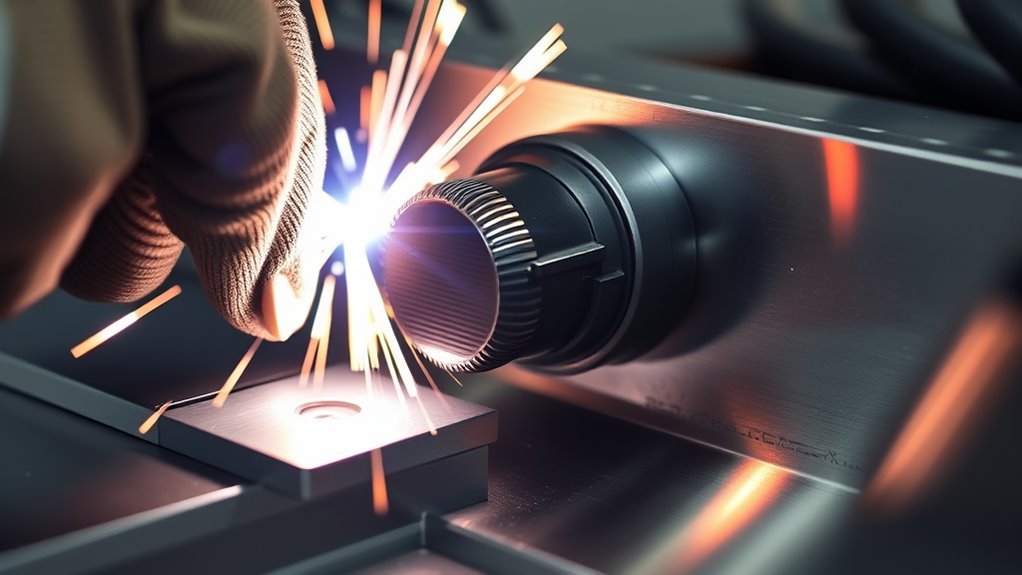
Wrong wire feed speed can ruin thin sheet metal quickly. Too little wire can produce a weak, narrow bead or let the wire burn back toward the contact tip. Too much wire can make the arc stub into the work, increase spatter, and add enough heat to burn through the panel. The safest approach is to begin with your welder’s chart, test on matching scrap, and change one control at a time.
Quick Answer
Use the settings chart inside your MIG welder as the first reference. For standard 20-gauge steel with 0.023-inch solid wire, a formula-based backup estimate is about 125 IPM. For 18-gauge steel, it is about 170 IPM. Test on matching scrap and balance wire speed with voltage, travel speed, stick-out, and joint fit-up.
Key Takeaways
- Follow your welder’s door chart, manual, or automatic setup system before using a generic setting.
- Measure the metal instead of guessing its gauge. Standard 20-gauge carbon steel is about 0.036 inch thick, while 18 gauge is about 0.048 inch.
- With constant-voltage MIG welding, wire feed speed mainly changes welding current and deposition rate. Voltage mainly changes arc length and bead profile.
- Use matching scrap, clean metal, a short stick-out, and small setting changes.
- Control heat on thin panels with good fit-up, short welds, and time for the joint to cool.
At a Glance
| Time Required | About 10-20 minutes for setup and test welds |
| Difficulty | Beginner to intermediate |
| Tools Needed | MIG welder, matching scrap, calipers or sheet gauge, clamps, wire, shielding gas, hand tools, and welding PPE |
| Cost | No special purchase if your welder is already equipped; only normal wire, gas, and scrap consumption |
What’s in This Article
- Before You Begin
- Why Wire Feed Speed Matters
- Calculated Starting Settings by Metal Thickness
- How to Set Wire Feed Speed Step by Step
- Fine-Tuning Wire Speed Using the Weld Bead
- Materials, Joints, and Welding Positions
- Troubleshooting Wire-Speed Problems
- Heat-Control Tips for Thin Sheet Metal
- Recording Your Settings
- Frequently Asked Questions
- Sources
- Conclusion
Before You Begin
Gather your welder, MIG gun, clean sheet metal, matching scrap pieces, shielding gas, welding wire, clamps, calipers or a sheet-metal gauge, and complete safety gear. Your test pieces should match the real workpiece in material, thickness, coating, joint type, and gap as closely as possible.
Warning: Welding can cause electric shock, fire, burns, eye damage, noise exposure, and hazardous fumes. Remove combustible materials, secure gas cylinders upright, use suitable eye and skin protection, and provide ventilation or local fume extraction. Do not weld an unknown coating, closed container, fuel tank, or confined-space component without the required hazard assessment, cleaning, testing, ventilation, and trained supervision.
Paint, plating, galvanizing, oil, adhesive, seam sealer, rust, and cleaning residues can contaminate the weld or create hazardous fumes. OSHA provides specific ventilation and protection requirements for welding and cutting, including work involving zinc-bearing, lead-bearing, cadmium-bearing, and other coated materials. Review the applicable OSHA welding requirements before working on coated metal.
Confirm the Process and Polarity
This guide focuses mainly on short-circuit MIG welding of mild-steel sheet with solid wire and shielding gas. Short-circuit transfer is commonly used on sheet metal because it can operate at lower heat input than spray transfer.
Follow the electrode manufacturer and welder manual for polarity. Common gas-shielded solid-steel MIG wire normally uses direct-current electrode positive, often written as DCEP. Self-shielded flux-cored wire may require the opposite polarity, so never assume that the solid-wire setup also applies to flux core.
Measure the Metal Instead of Guessing
Gauge numbers differ by material, so a gauge number alone can be misleading. Measure the workpiece with calipers after removing coatings from the measurement point, or use a gauge tool made for the material.
- Standard 20-gauge carbon steel: About 0.036 inch or 0.91 mm
- Standard 18-gauge carbon steel: About 0.048 inch or 1.21 mm
- Standard 16-gauge carbon steel: About 0.060 inch or 1.52 mm
- Standard 14-gauge carbon steel: About 0.075 inch or 1.90 mm
Note: Aluminum, stainless steel, galvanized steel, and standard carbon steel do not always use the same gauge-to-thickness conversion. Use the measured thickness whenever possible.
Why Wire Feed Speed Matters
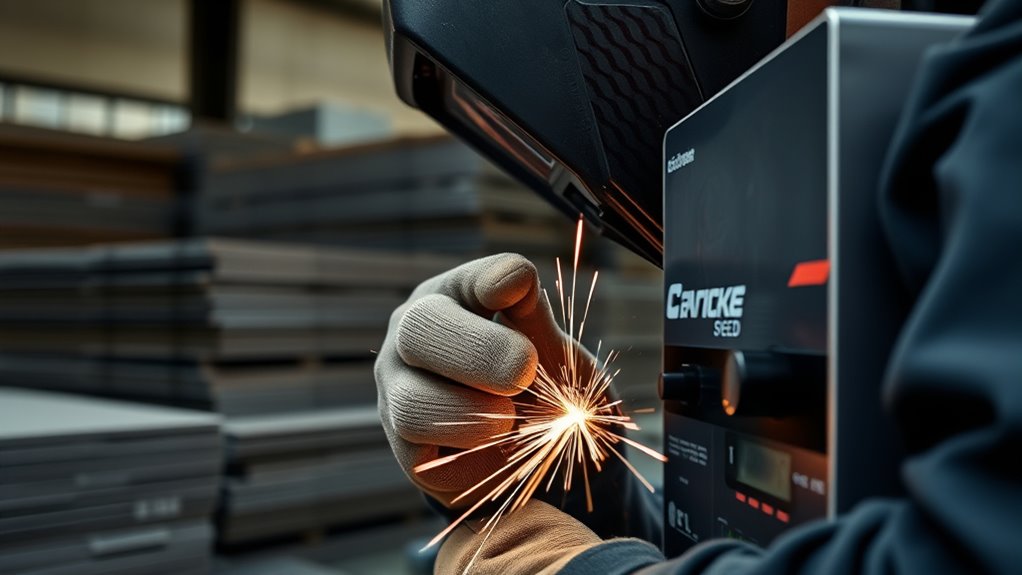
Wire feed speed controls how quickly the machine delivers electrode wire to the arc. On a constant-voltage MIG welder, increasing wire speed generally raises welding current and deposits more filler metal. This affects penetration, bead size, heat input, and the chance of burning through thin material.
Voltage performs a different job. It mainly affects arc length, bead width, bead height, and how smoothly the wire burns off. Wire speed and voltage must remain balanced. A wire speed that works at one voltage may stub into the work or burn back at another voltage.
Wire feed speed is not an isolated control. A good sheet-metal setting balances wire speed, voltage, travel speed, stick-out, shielding gas, joint fit-up, and welding sequence.
If you do not have a machine chart, Miller Electric gives a rough starting method: estimate about 1 amp for each 0.001 inch of steel thickness, select a suitable wire diameter, and multiply the estimated amperage by the wire-size factor. The published factors are 3.5 IPM per amp for 0.023-inch wire, 2 IPM per amp for 0.030-inch wire, 1.6 IPM per amp for 0.035-inch wire, and 1 IPM per amp for 0.045-inch wire. Review Miller’s MIG parameter-setting guidance for the full method.
The formula is only a backup estimate. Your welder’s door chart, manual, digital setup guide, or automatic setting system should be your first reference.
Clean, tight-fitting joints are easier to tune than dirty panels with wide gaps. Proper joint preparation improves arc stability and reduces the heat needed to obtain fusion.
Calculated Starting Settings by Metal Thickness
The following values are formula-based estimates for mild steel, not universal prescriptions. They assume a suitable constant-voltage MIG welder, solid steel wire, correct polarity, short-circuit transfer, clean metal, and a properly functioning wire-feed system.
| Steel Thickness | Suggested Solid Wire | Formula Estimate | Practical Use |
|---|---|---|---|
| 20 ga, about 0.036 in or 0.91 mm | 0.023 in | About 125 IPM | Thin automotive and light-fabrication sheet; use short welds and tight fit-up |
| 18 ga, about 0.048 in or 1.21 mm | 0.023 in | About 170 IPM | General sheet-metal work; test for burn-through and distortion |
| 16 ga, about 0.060 in or 1.52 mm | 0.023 or 0.030 in | About 210 IPM with 0.023 in or 120 IPM with 0.030 in | Choose the wire size supported by the machine and its drive components |
| 14 ga, about 0.075 in or 1.90 mm | 0.030 in | About 150 IPM | Near the heavier end of common sheet-metal work |
| 1/8 in, about 3.18 mm | 0.030 in | About 250 IPM | Heavier fabrication; verify the machine’s output and duty cycle |
| 3/16 in, about 4.76 mm | 0.035 or 0.045 in | About 300 IPM with 0.035 in or 190 IPM with 0.045 in | Plate rather than typical thin sheet; machine capacity becomes critical |
| 1/4 in, about 6.35 mm | 0.045 in | About 250 IPM | Requires a capable machine, suitable joint preparation, and possibly multiple passes |
Do not treat the calculated speed as a final setting. Set voltage from the machine chart for the selected material, wire, and gas. Then run test welds and tune the controls together.
The 3/16-inch and 1/4-inch rows are included as heavier reference points, but they are outside the thin-sheet focus of this guide. Review machine capacity before attempting them. This guide to selecting a welder for 1/4-inch steel explains why available output matters.
Note: A wire-speed dial marked from 1 to 10 or 0 to 100 may not display inches per minute. Use the conversion information in the welder manual rather than assuming the dial number equals IPM.
Products Worth Considering
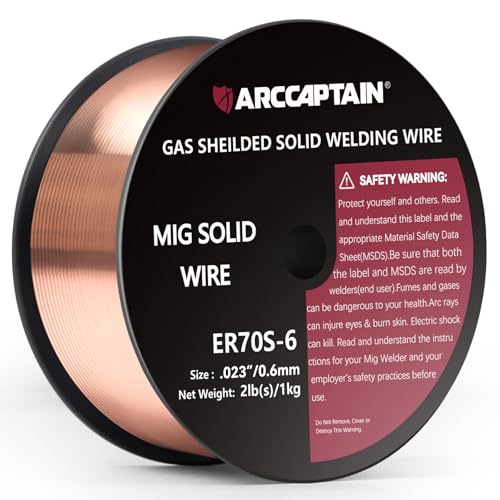
High-quality: ARCCAPTAIN's ER70S-6 mig welding wire .023" meets industry standards(Net Weight: 2lbs), ensuring consistent performance, superior strength. With its smooth feeding and stable welding parameters, you can achieve optimal penetration, high deposition rates, and exceptional overall welding performance.

High-quality:Tooliom's .023" ER70S-6 MIG Welding Wire (10lb spool) meets all industry standards for consistent strength and performance. Enjoy smooth feeding, stable arcs, optimal penetration, and high deposition rates—everything you need for exceptional welds

ER70S-6 MIG WIRE: It's the most common wire of the copper-coated mild steel GMAW (MIG) wires for single or multiple pass welding.
How to Set Wire Feed Speed Step by Step
- Identify the material: Confirm that the workpiece is mild steel and check for paint, zinc, lead, sealers, or unknown coatings.
- Measure the thickness: Use calipers or the correct material gauge instead of relying on appearance.
- Select the wire: Use 0.023-inch solid wire for easier low-current control on very thin steel when your machine supports it. Use larger wire only when the thickness and machine output justify it.
- Install matching feed components: Fit the correct drive-roll groove, liner, and contact tip for the wire diameter.
- Confirm polarity: Set the leads according to the wire label and machine manual. Common gas-shielded solid steel wire normally uses DCEP.
- Set shielding-gas flow: A common starting range for mild-steel MIG is about 20-25 CFH. Follow the machine and regulator instructions, and shield the weld from drafts without enclosing yourself in welding fumes.
- Use the machine chart: Set the recommended voltage and wire speed for the measured thickness, wire diameter, gas, and input power.
- Calculate a backup value if needed: Use the thickness and wire-size formula only when no chart or qualified procedure is available.
- Clamp matching scrap: Reproduce the same joint, gap, position, and backing conditions as the real part.
- Set stick-out: Keep the distance from the contact tip to the wire end around 1/4 to 3/8 inch for typical short-circuit sheet-metal work, unless the manufacturer specifies otherwise.
- Run a short test weld: Maintain a consistent work angle, travel angle, stick-out, and travel speed.
- Inspect both sides: Check bead shape, tie-in, discoloration, distortion, spatter, and signs of penetration or burn-through.
- Change one control: Adjust wire speed or voltage in a small step, repeat the test, and record the result.
Miller’s automotive MIG guidance recommends a short, consistent wire stick-out for better control. Excessive stick-out increases electrical resistance and can reduce current at the work.
Pro Tip: Mark a row of test coupons and change only one setting between welds. Write the wire speed and voltage beside each bead so you can compare the results instead of relying on memory.
Products Worth Considering

Lincoln ED030584 .035", NR-211, LB Spool, Inner Shield Flux-Core Welding Wire

Welding Easy and Quick: AWS E71T-GS 030” Flux Core welding wire (The actual Net Weight of Wire is 2LB), no need for shielding gas, install it then you can welding all positions, single and multi pass welding. Great for T-joints, butt welds & lap welds.

ER70S-6 PERFORMANCE: This .023 MIG welding wire supports precise arc control and low spatter for single-pass and multi-pass welding.
Fine-Tuning Wire Speed Using Weld Bead Appearance
A good short-circuit MIG bead should show consistent width, smooth tie-in at both toes, controlled reinforcement, and no visible porosity or undercut. The arc should remain stable without the wire repeatedly pushing the gun away or burning back into the contact tip.
Bead appearance is diagnostic, but it does not prove weld strength. For a practice coupon, inspect the back, cut or bend the sample when practical, and check whether the joint fused rather than merely receiving metal on its surface. Safety-critical work may require a qualified welding procedure and formal inspection.
Observing Bead Profile
- Narrow, tall, or rope-like bead: Possible low current, low voltage, excessive travel speed, long stick-out, or poor work angle.
- Wide, flat, turbulent bead: Possible excessive voltage, excessive heat, or travel that is too slow.
- Wire pushing into the work: Wire speed may be too high for the selected voltage, or voltage may be too low.
- Wire burning back toward the tip: Wire speed may be too low, voltage may be too high, or the feed path may be restricted.
- Heavy spatter: Check the balance between voltage and wire speed, polarity, work clamp, stick-out, surface cleanliness, and shielding gas.
Do not automatically increase wire speed whenever a bead looks narrow. First confirm that your travel speed, voltage, stick-out, work angle, and ground connection are consistent.
Analyzing Penetration and Fusion
Look for smooth tie-in where the weld meets the base metal. A bead that sits on top of the joint with sharp, unfused edges may have insufficient current, insufficient voltage, excessive travel speed, poor work angle, or contamination.
On thin sheet, the opposite problem is burn-through. A wide joint gap, slow travel, repeated welding in one area, excessive wire speed, excessive voltage, or poor fit-up can overheat the edge before the joint fills.
When possible, test a noncritical sample destructively. A shiny surface and pleasant arc sound cannot confirm internal fusion by themselves.
Monitoring Arc Sound
A smooth, consistent crackle often accompanies a balanced short-circuit arc. Use sound as one clue, not the only test.
- Repeated hard stubbing: Reduce wire speed slightly or increase voltage within the machine’s recommended range.
- Irregular popping and burnback: Increase wire speed slightly, reduce excessive voltage, and inspect the contact tip and liner.
- Hissing with a long arc: Voltage may be high for the wire speed, or stick-out may be inconsistent.
- Changing sound during one weld: Check hand position, stick-out, grounding, gas coverage, and wire feeding.
Proper stick-out length also matters with flux-cored wire, but flux-core stick-out and polarity requirements may differ from solid-wire MIG settings.
Adjusting for Different Materials, Joints, and Positions

Do not transfer mild-steel settings directly to stainless steel, aluminum, or flux-cored wire. Each combination may require different wire, shielding gas, polarity, drive rolls, gun components, transfer mode, and technique.
Material and Joint Considerations
- Mild steel: Solid ER70S-series wire with a suitable argon-carbon-dioxide blend is common for clean indoor sheet-metal work.
- Stainless steel: Match the filler wire and shielding gas to the base-metal grade and service requirement. Stainless fumes can contain chromium and nickel, so use appropriate exposure controls.
- Aluminum: Aluminum MIG normally needs dedicated drive components, suitable wire, pure argon, and a spool gun or push-pull system for reliable feeding. Thin aluminum can be difficult with basic short-circuit equipment.
- Self-shielded flux core: Follow the wire label for polarity and stick-out. Generic solid-wire MIG settings do not apply.
- Galvanized steel: Remove coatings only through an approved procedure and use suitable ventilation or local exhaust. Welding galvanized metal can generate zinc oxide fumes. Review information about zinc fumes before beginning.
Do not use a stick-welding amperage chart to select MIG wire speed. Stick welding and constant-voltage wire welding control current differently.
Welding Position Adjustments
Flat and horizontal positions are usually easiest because gravity helps contain the weld pool. Vertical and overhead welding require tighter puddle control, shorter weld segments, and parameters selected for the wire, joint, and machine.
There is no dependable rule that says vertical welding always needs more or less wire speed. A parameter change must be evaluated with voltage, travel direction, travel speed, work angle, and puddle size.
For corner, lap, and fillet joints, aim the gun so the arc reaches both pieces. Increasing wire speed cannot correct a poor work angle. If one sheet is thicker, direct slightly more heat toward the thicker member while watching the thin edge for burn-through.
Fit-Up and Gap Control
A wide or uneven gap makes sheet metal much harder to weld. The arc melts the edges before enough filler bridges the opening. Trim and clamp the joint so the gap remains small and consistent.
Copper backing can support the puddle and absorb heat on some noncritical repair work, but keep the backing clean and use it only where it is suitable for the joint and service. Do not allow clamps, backing bars, or magnets to create an unsafe current path.
Troubleshooting Common Wire-Speed Issues
Use the symptom as a starting clue, then check the entire setup. Wire speed is only one possible cause.
| Symptom | Likely Causes | What to Check |
|---|---|---|
| Wire stubs into the work | Wire speed too high, voltage too low, or stick-out too short | Reduce wire speed slightly or raise voltage within the approved range; restore consistent stick-out |
| Wire burns back to the tip | Wire speed too low, voltage too high, worn tip, liner restriction, excessive drive-roll slip, or long arc | Correct the setting balance and inspect the entire feed path |
| Excessive spatter | Poor voltage-speed balance, wrong polarity, dirty metal, poor ground, excessive stick-out, or unstable gas coverage | Verify polarity and chart settings; clean the joint and work-clamp point |
| Tall, narrow bead | Low current, low voltage, fast travel, long stick-out, or poor gun angle | Correct technique first, then increase wire speed or voltage one step at a time |
| Wide bead or undercut | Excessive voltage, slow travel, incorrect angle, or excessive heat | Reduce voltage within the recommended range and restore travel speed and angle |
| Burn-through | Excessive heat input, wide gap, slow travel, repeated welding in one area, or settings too high | Improve fit-up, use shorter welds, allow cooling, and reduce heat without losing fusion |
| Porosity or pinholes | No gas, low or excessive flow, drafts, leaks, blocked nozzle, contamination, or long stick-out | Check gas supply, connections, nozzle, flow while welding, and surface cleanliness |
| Erratic feeding or bird-nesting | Wrong drive roll, excess roll pressure, damaged liner, kinked cable, wrong tip, or tangled spool | Correct the mechanical feed problem before changing welding parameters |
| Poor fusion | Low current, low voltage, excessive travel speed, poor angle, contamination, or poor access to the root | Clean the joint, correct technique, and compare the settings with the machine chart |
The correct wire feed speed must be paired with suitable voltage and technique. Check for lack of penetration before accepting a weld based only on its surface appearance.
Heat-Control Tips for Consistent Sheet-Metal Welds
- Use short welds: Tack, stitch, or skip-weld where the joint design allows instead of running one long bead on a thin panel.
- Move around the joint: Alternate locations so heat does not build in one area.
- Allow cooling time: Let the panel cool naturally between welds. Do not quench a critical joint unless the approved procedure permits it.
- Keep the gap consistent: Poor fit-up is one of the fastest ways to create burn-through.
- Maintain stick-out: Changes in contact-tip-to-work distance change current and arc behavior even when the machine controls remain untouched.
- Keep the gun cable straight: Tight loops and sharp bends can disrupt wire feeding.
- Place the work clamp on clean metal: A weak current path creates an unstable arc and misleading symptoms.
- Protect the shielding gas: Block drafts at the work without trapping fumes around your breathing zone.
- Practice on the real joint type: A flat bead on a plate does not duplicate a butt joint, lap joint, plug weld, or vertical seam.
Best Practices for Recording and Referencing Settings
Recording your settings makes future setup faster and helps you identify whether a problem came from the machine or a change in the work.
- Record the welder: Include the machine model, input voltage, and selected process.
- Record the material: Note the alloy, measured thickness, coating, and joint type.
- Record consumables: Include wire classification, diameter, shielding-gas blend, flow rate, contact tip, and polarity.
- Record parameters: Write down voltage, displayed wire speed, inductance or arc-control setting, and any automatic program used.
- Record technique: Note position, travel direction, stick-out, travel speed, and whether you used tacks, stitches, or a continuous bead.
- Record the result: Describe bead shape, spatter, backside appearance, distortion, and destructive-test results when available.
Keep these notes as personal setup references, not as a replacement for an approved welding procedure specification. Regulated or safety-critical work may require qualified procedures, documented inspection, and a qualified welder.
Frequently Asked Questions
What voltage and wire speed should I set my MIG welder to?
Use the chart inside the welder, its manual, or its automatic setup system. Select the row for your measured thickness, wire diameter, shielding gas, and input power. Generic values are only starting estimates because voltage and wire speed vary among machines and welding conditions.
What happens if MIG wire feed speed is too high?
The wire may stub into the work, push the gun back, create heavy spatter, widen the bead, or add enough current and heat to burn through thin metal. Excessive wire speed can also produce poor penetration when the voltage and arc length are not balanced with it.
What happens if MIG wire feed speed is too low?
The weld may have low current, poor tie-in, and a narrow or convex profile. The wire may also burn back toward the contact tip, especially if voltage is high or the wire-feed path is restricted.
How do you calculate MIG wire feed speed?
As a rough backup for steel, estimate about 1 amp for every 0.001 inch of thickness. Multiply the estimated amps by approximately 3.5 for 0.023-inch wire, 2 for 0.030-inch wire, 1.6 for 0.035-inch wire, or 1 for 0.045-inch wire. Use the machine chart instead whenever it is available.
Should you use 0.023-inch or 0.030-inch wire for sheet metal?
A 0.023-inch solid wire is often easier to control at the low current needed for very thin sheet steel. A 0.030-inch wire covers a wider range of general fabrication. Use only a diameter supported by the welder, liner, drive rolls, contact tip, and manufacturer chart.
Does wire feed speed control amperage on a MIG welder?
On a typical constant-voltage MIG machine, increasing wire feed speed generally increases welding current because the machine supplies more current to melt the faster-fed wire. Voltage mainly controls arc length and strongly affects bead width and profile.
What gas flow should you use for MIG welding sheet metal?
For indoor mild-steel MIG welding, about 20-25 CFH is a common starting range. Follow the welder, regulator, and gas supplier instructions. Increase flow only when conditions require it because excessive flow can create turbulence and pull air into the shielding envelope.
Safety Disclaimer: This article provides general educational guidance and does not replace professional welding training, a hazard assessment, your equipment manual, an approved welding procedure, or workplace safety requirements. Structural, pressure-containing, lifting, vehicle-safety, and code-regulated welds may require qualified procedures, inspection, and a qualified welder.
Sources
- Miller Electric: MIG Welding – Setting the Correct Parameters – amperage estimates, wire-size ranges, wire-speed multipliers, voltage adjustment, and bead diagnostics
- Miller Electric: Understanding the Basics of MIG Welding for Mild Steel – metal preparation, shielding gas, and basic setup
- Miller Electric: MIG Basics for Automotive Welding Repair – thin-metal technique and recommended wire stick-out
- Lincoln Electric: GMAW Versus Self-Shielded Flux-Cored Welding – process, wire-size, shielding, and polarity differences
- OSHA 29 CFR 1910.252 – welding fire prevention, eye protection, ventilation, confined spaces, and coated-metal requirements
- NIOSH: Welding Fumes and Fume Extraction Guns – welding-fume hazards and engineering controls
Conclusion
Good MIG welding on sheet metal begins with an accurate thickness measurement and the settings recommended for your specific welder, wire, gas, and joint. Use formula-derived wire speeds only as backup estimates.
Test on matching scrap, maintain a short and consistent stick-out, and change one variable at a time. When the bead changes, consider voltage, travel speed, fit-up, gas coverage, grounding, and wire feeding before blaming wire speed alone.
Careful setup and heat control will produce more repeatable welds while reducing spatter, distortion, poor fusion, and burn-through.