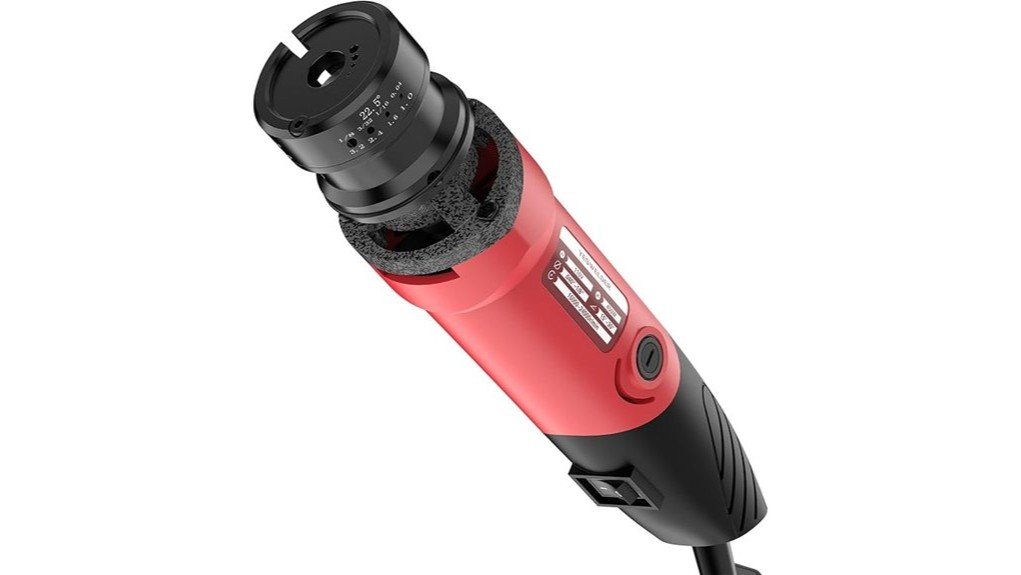
A contaminated or uneven tungsten point can make TIG setup less predictable, especially when you need repeatable arc starts. The YESWELDER MJQ01 Tungsten Electrode Sharpener Grinder gives you a dedicated, corded sharpening tool with fixed size and angle ports instead of relying on freehand bench-grinder technique. It supports four common electrode diameters, three preset angles, six speed levels, and a cut-off slot for damaged tips. The tradeoff is limited compatibility: you must use one of the listed sizes and angles, and the acrylic cover reduces loose dust but does not replace ventilation or personal protective equipment.
At a Glance: Quick Verdict
Editorial Rating: 8.6/10
Best For: TIG welders who regularly sharpen .040-inch through 1/8-inch electrodes and want repeatable preset angles.
Bottom Line: The MJQ01 combines useful size ports, three fixed angles, six-speed control, a cut-off slot, and contained grinding in one compact tool. It is less flexible than a fully adjustable professional sharpener and still requires careful dust control.
Key Takeaways
- The MJQ01 accepts .040-inch, 1/16-inch, 3/32-inch, and 1/8-inch tungsten electrodes.
- Preset grinding angles are 15, 22.5, and 30 degrees.
- The corded 110V grinder provides six speed levels from 15,000 to 24,000 rpm.
- A cut-off slot helps remove badly damaged tips before sharpening.
- The acrylic dust cover contains much of the grinding debris, but you still need safe ventilation, eye protection, and careful cleanup.
Key Specifications
| Specification | Detail |
|---|---|
| Brand | YESWELDER |
| Model | MJQ01 |
| Product Type | Corded tungsten electrode sharpener grinder |
| Input | 110V AC |
| Rated Power | 450W in the official MJQ01 manual |
| Speed Range | Six levels, 15,000 to 24,000 rpm |
| Electrode Sizes | .040 in, 1/16 in, 3/32 in, and 1/8 in (1.0, 1.6, 2.4, and 3.2 mm) |
| Preset Angles | 15°, 22.5°, and 30° |
| Grinding Wheel | Double-sided diamond wheel, 34 × 5 × 2.3 mm |
| Tip Removal | Integrated cut-off slot |
| Body Material | CNC-machined aluminum alloy grinding head |
| Dust Control | Removable acrylic dust cover |
| Weight | About 2.22 lb (1.008 kg) |
| Included Items | Electric grinder, storage box, hex screwdriver, acrylic dust cover, and two spare carbon brushes |
| Warranty | One year, according to the current Amazon product information |
Before You Buy: Confirm that your tungsten diameter and preferred point angle match the four sizes and three angles built into the MJQ01. The official manual lists 450W, while the current Amazon specification area lists 550W, so check the listing and manual supplied with your unit if power rating is important to your shop setup.
What Is the YESWELDER MJQ01?
The YESWELDER MJQ01 is a dedicated handheld grinder for preparing TIG tungsten electrodes. Instead of holding an electrode against an open bench grinder and estimating the taper, you insert it through a marked size-and-angle port in the grinding head. That fixed layout helps you reproduce the same basic geometry when you sharpen several electrodes.
The tool is powered by a 110V corded motor and offers six speed levels. Its head includes a double-sided diamond wheel, a flat grinding area, and a cut-off slot for removing damaged material before you form a new point. The package also includes a storage case, an acrylic dust cover, a hex screwdriver, and two spare carbon brushes.
This review is based on the current Amazon listing, YESWELDER product information, and the official MJQ01 operator’s manual. It does not claim hands-on laboratory testing.
Who Should Buy It?
Best For
- TIG welders who sharpen common .040-inch through 1/8-inch electrodes every week.
- Home shops and training spaces that want repeatable preset angles without a large bench setup.
- Welders who want one tool for cutting off a damaged tip, sharpening the taper, and lightly flattening the point.
Skip If
- You need electrode sizes or angles outside the fixed options.
- You want cordless portability or a fully enclosed industrial extraction system.
- You sharpen tungsten so rarely that your existing dedicated wheel already meets your needs.
Feature-by-Feature Review
Four Sizes and Three Preset Angles
The MJQ01 accepts .040-inch, 1/16-inch, 3/32-inch, and 1/8-inch electrodes. Metric equivalents are 1.0, 1.6, 2.4, and 3.2 mm. Those diameters cover many common TIG setups, but the head is not universal. An electrode that is oversized, bent, balled, or heavily contaminated may not enter the correct port until you remove the damaged end.
You can select a 15, 22.5, or 30-degree grinding port. Fixed ports reduce guesswork and make it easier to repeat the same angle, but they do not give you the continuous adjustment found on higher-priced specialty sharpeners.
Six-Speed Control
The motor provides six marked levels from 15,000 to 24,000 rpm. The manual recommends levels 3 to 4 for .040-inch and 1/16-inch electrodes, then levels 5 to 6 for 3/32-inch and 1/8-inch electrodes. These are starting points, not a reason to press harder. Light, controlled contact helps limit heat and unnecessary tungsten removal.
Cut-Off Slot and Flat Grinding Area
The cut-off slot is useful when the electrode end has a large contaminated ball, a damaged point, or a shape that will not fit through the sharpening port. You can remove the bad section first, then move to the correct port to form a new taper. The flat grinding area also lets you place a small flat on the tip when your welding procedure calls for one.
This feature saves you from reaching for a second grinder, but you still need to follow the manual and keep your fingers away from the grinding area. Do not force a bent electrode through a port.
Double-Sided Diamond Wheel
The included wheel measures 34 × 5 × 2.3 mm and can be used on both faces. When one side becomes smooth and loses effective abrasive, you can reverse it before buying a replacement. That design improves consumable value and keeps the grinder compact.
The wheel is a wear item. Sharpening speed, pressure, contamination, and electrode diameter all affect service life, so there is no reliable replacement interval for every shop.
Build Quality and Dust Control
The grinding head uses CNC-machined aluminum alloy, while the removable acrylic cover surrounds the working area. The cover helps collect tungsten powder instead of leaving the wheel fully exposed. It is a useful cleanliness feature, especially in a small shop, but it should not be treated as complete dust extraction.
The grinder weighs about 2.22 pounds, so it is light enough to move between a welding table and storage case. Because it is a 110V corded model, you also need a stable indoor power source and enough cable clearance to keep the cord away from hot metal, sparks, and sharp edges.
How It Performs in Real Use
Routine Re-Sharpening Between Welds
For normal tip wear, you can select the matching diameter and angle port, set the recommended speed range, and restore the taper without setting up a bench grinder. This is where the MJQ01 offers its clearest benefit: it makes a repetitive maintenance task quicker and more consistent.
Recovering a Contaminated or Damaged Tip
When a tungsten has dipped into the puddle or developed a damaged end, the cut-off slot gives you a way to remove the affected section before sharpening. This is more practical than trying to grind a large contaminated ball through a small angle port. You should inspect the remaining electrode for cracks or severe bending before reuse.
Thin-Material and Low-Amperage Work
Thin sheet and detailed joints can expose inconsistent electrode preparation because you have less room for wandering starts or poor control. The preset ports help you return to the same angle after contamination. The grinder cannot choose the correct angle for your process, so your welder manual and procedure still control the final tip geometry.
Shared Shops and Training Areas
Clearly marked size and angle ports can help several users follow one repeatable preparation method. The storage box also keeps the grinder, dust cover, tool, and spare brushes together. A shared shop still needs rules for cleanup, wheel inspection, tungsten type, and safe dust handling.
How to Use It Correctly
- Inspect the grinder first. Confirm that the diamond wheel, grinding head, dust cover, plug, and cord are secure and undamaged.
- Install the acrylic dust cover. Rotate it to align the correct size and angle port.
- Remove major damage when needed. Use the cut-off slot only as directed in the manual when the tip cannot enter the correct port.
- Select the diameter and angle. Match the port to the electrode, then use your welding procedure to choose 15, 22.5, or 30 degrees.
- Start with the manual’s speed guidance. Use levels 3 to 4 for .040-inch and 1/16-inch electrodes, or levels 5 to 6 for 3/32-inch and 1/8-inch electrodes.
- Use light pressure. Let the diamond wheel cut instead of forcing the tungsten into the abrasive.
- Disconnect power before cleanup. Allow the tool to stop, unplug it, and clean debris according to the manual.
Pro Tip: Regrind a worn or lightly contaminated point before it becomes badly eroded. You will usually remove less tungsten and spend less time rebuilding the taper.
Safety, Cleaning, and Maintenance
Use the dust cover whenever you grind, keep your hands out of the grinding area, and disconnect power before cleaning or maintenance. Eye protection, suitable shop ventilation, and a clean work area remain necessary because the cover contains debris but does not capture every airborne particle. Keep flammable materials away from sparks and follow the safety data sheet for the electrode type you are grinding.
Take extra care with thoriated tungsten. Grinding can create dust that requires specific handling and disposal precautions, so follow the electrode manufacturer’s safety data sheet, workplace rules, and local requirements. A compact cover is not a substitute for an approved exposure-control plan.
After use, remove accumulated debris and wipe the tool with a soft dry cloth. The manual says not to use the grinder in corrosive gas or smoky environments and not to clean it with solvent, alcohol, or a wet cloth. Check the carbon brushes regularly, inspect the power cord, and reverse or replace the diamond wheel when its working surface becomes smooth.
You can review the official YESWELDER MJQ01 operator’s manual before setup and maintenance.
Pros and Cons
Pros
- Supports four common tungsten diameters in both inch and metric sizes.
- Three fixed angles improve repeatability compared with freehand grinding.
- Six-speed control provides size-specific starting settings.
- Cut-off slot, flat grinding area, and double-sided wheel reduce the need for separate tools.
- Storage case, dust cover, hex screwdriver, and spare carbon brushes are included.
Cons
- Fixed ports do not support every electrode diameter or taper angle.
- The acrylic cover contains debris but is not a full dust-extraction system.
- Amazon and the official manual currently show conflicting power ratings.
Is It Worth the Price?
The MJQ01 sits above improvised bench-grinder methods because you are paying for preset ports, contained grinding, speed control, a cut-off slot, and a complete storage kit. It offers the strongest value when you sharpen tungsten often enough to benefit from repeatable setup and faster tip recovery.
It is less compelling when you only sharpen an electrode a few times per year or need a broader range of angles and diameters. In that case, a properly dedicated bench wheel or a more adjustable professional sharpener may fit your workflow better. Check the current package details and replacement-wheel availability before buying.
How It Compares to Alternatives
A dedicated bench grinder with a tungsten-only wheel can cost less if you already own the grinder, but freehand results depend more on technique and the setup takes more space. Rotary-tool sharpening attachments are compact and inexpensive, although many lack an integrated motor, storage case, or cut-off slot.
Higher-end sharpeners such as adjustable professional tungsten grinders can offer more angle control, stronger extraction options, or broader diameter support. The YESWELDER MJQ01 makes the most sense when you want a self-contained 110V tool with common preset sizes and angles without moving into the premium industrial tier.
Frequently Asked Questions
What tungsten sizes fit the YESWELDER MJQ01?
It supports .040-inch, 1/16-inch, 3/32-inch, and 1/8-inch electrodes. Metric equivalents are 1.0, 1.6, 2.4, and 3.2 mm. Other sizes are not confirmed for this grinding head.
Which grinding angles are available?
The head provides fixed 15, 22.5, and 30-degree ports. Choose the angle required by your TIG procedure or welder guidance rather than assuming one angle is correct for every material and amperage.
What speed should you use?
The manual recommends levels 3 to 4 for .040-inch and 1/16-inch electrodes. It recommends levels 5 to 6 for 3/32-inch and 1/8-inch electrodes. Use light pressure and stop if you notice abnormal noise, odor, smoke, or vibration.
Can it remove a badly contaminated tip?
Yes, the head includes a cut-off slot for removing a damaged section before sharpening. Inspect the remaining electrode and do not force a bent or oversized end through a sharpening port.
Does the dust cover make grinding dust-free?
No. The acrylic cover helps contain grinding debris, but it is not a sealed vacuum extraction system. Use suitable ventilation, eye protection, cleanup procedures, and any additional controls required for your electrode type.
When should the diamond wheel be replaced?
Reverse the wheel when the first face becomes smooth and no longer cuts effectively. Replace it after both faces are worn or if the wheel is damaged. Disconnect power before inspection or replacement.
Is the YESWELDER MJQ01 beginner-friendly?
The marked size and angle ports remove some of the guesswork found in freehand grinding. Beginners still need to read the manual, choose the correct tip geometry, use appropriate protective equipment, and learn safe electrode handling.
What warranty comes with the grinder?
The current Amazon product information lists a one-year manufacturer warranty. Confirm the terms, seller, registration requirements, and coverage at the time of purchase because warranty details can change.
The Bottom Line
The YESWELDER MJQ01 is a strong choice for TIG welders who want repeatable sharpening across four common tungsten sizes, three preset angles, and six speed levels. Its cut-off slot, double-sided wheel, dust cover, and storage kit make it more complete than a basic rotary-tool attachment. Skip it when you need unrestricted angle adjustment, uncommon electrode sizes, cordless use, or industrial dust extraction.
Ready to Buy?
Check the latest price, power specification, warranty terms, and package contents before you decide.