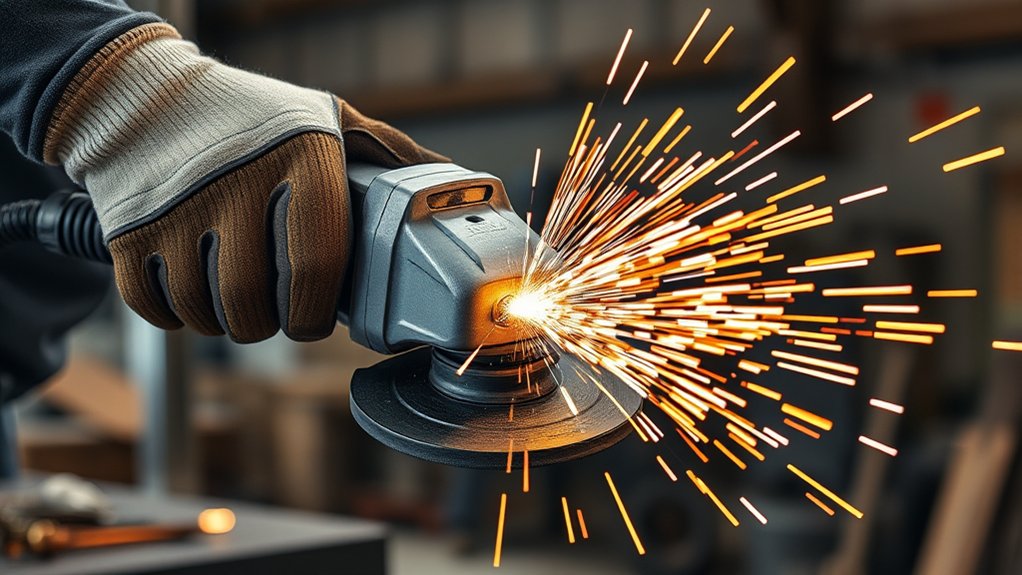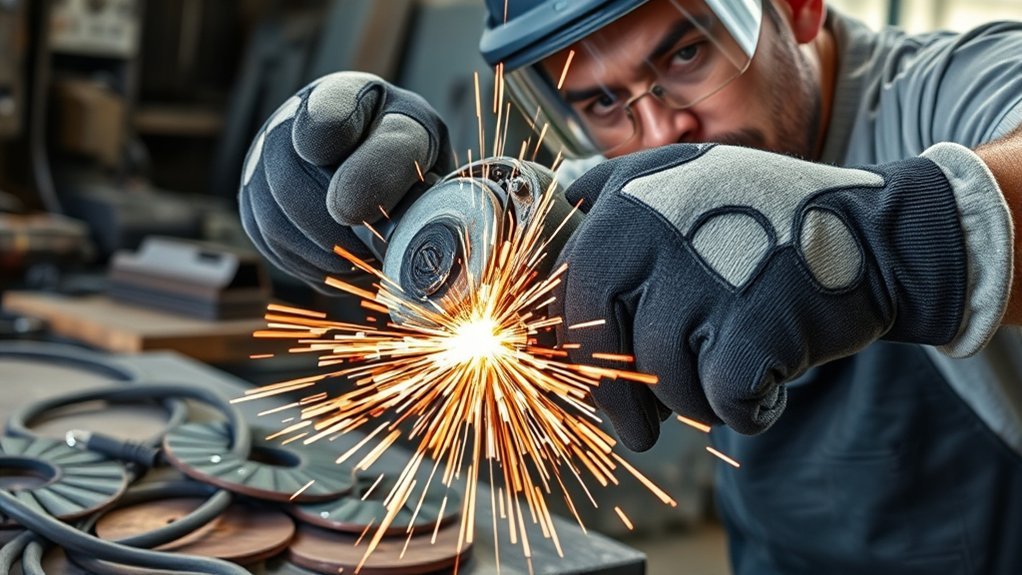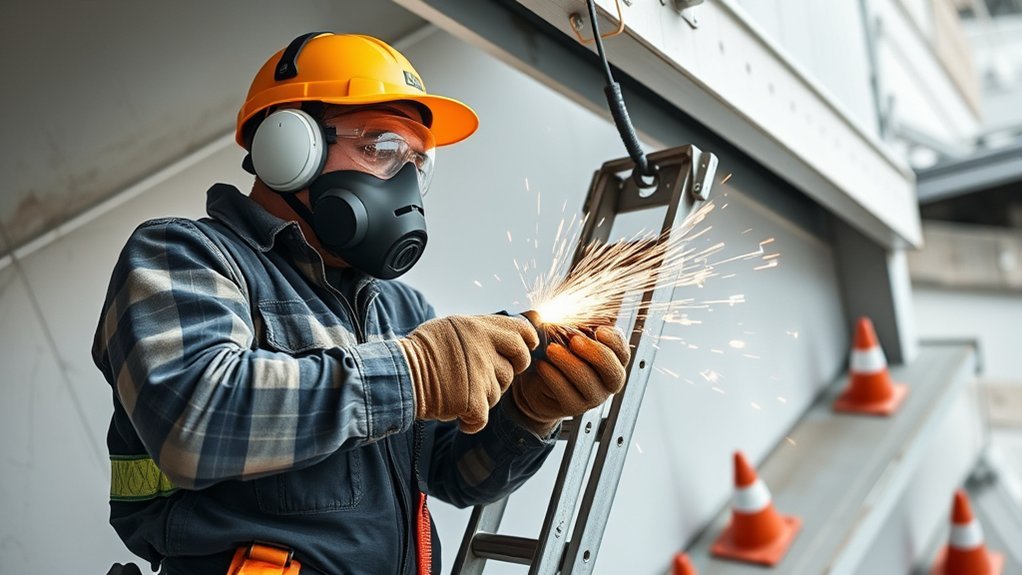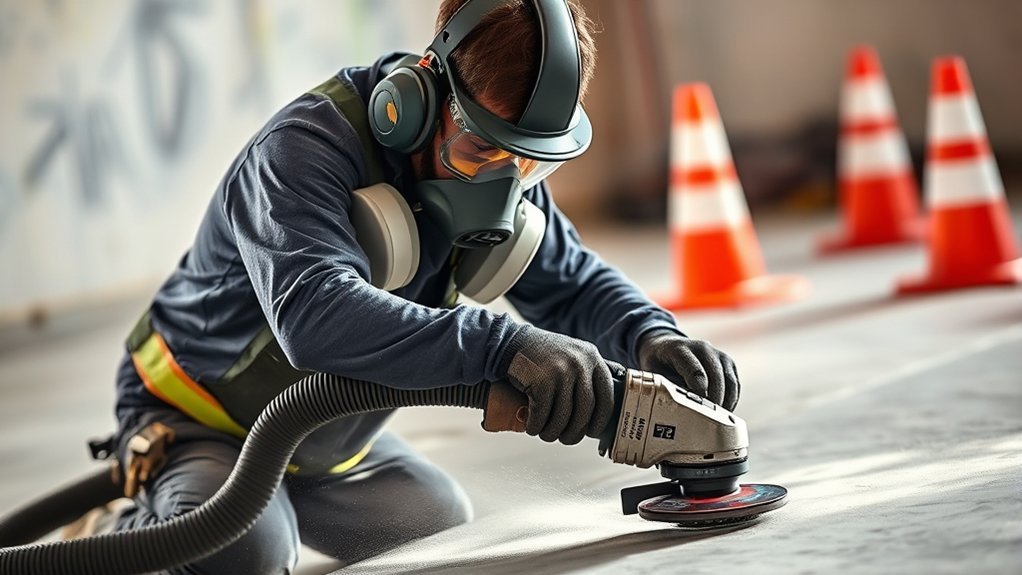
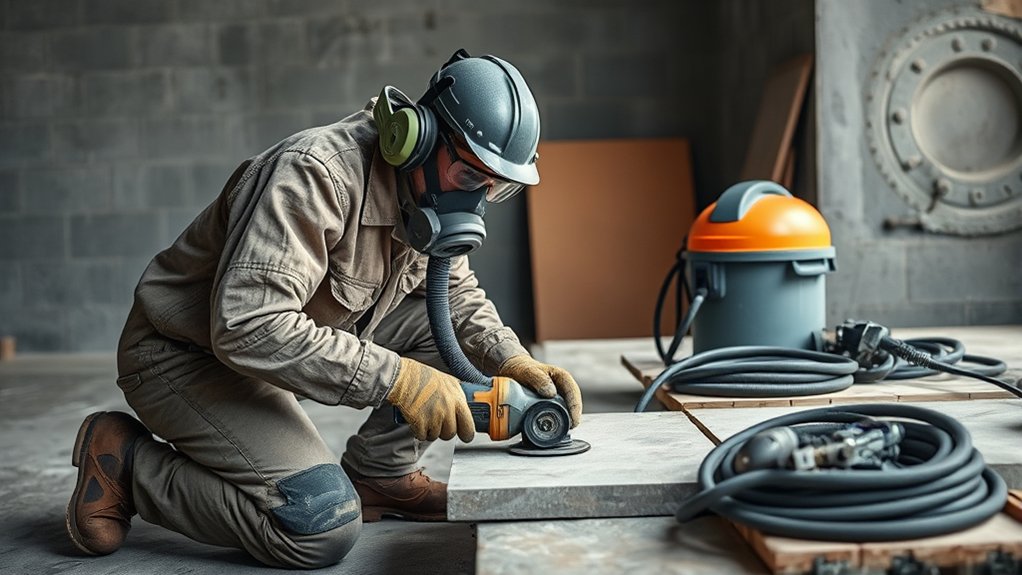
For handheld concrete grinding with an angle grinder, wear impact-rated safety glasses or sealed goggles, hearing protection, snug work gloves, fitted clothing, and protective footwear. Add a face shield over the eye protection when chips or wheel fragments may strike your face. Control respirable crystalline silica at the tool with a compliant shroud and dust collector or a manufacturer-approved wet method. Under OSHA Table 1, the respirator requirement depends on the task, location, and total grinding time during the shift.
Last updated: July 23, 2026. OSHA Table 1, respirator APFs, fit-testing rules, cleanup guidance, and schema were rechecked.
Quick Answer
For general handheld concrete grinding, OSHA Table 1 specifies no respirator for outdoor work when the listed wet or dust-collection controls are fully used. Indoor or enclosed grinding with a compliant shroud and dust collector requires no respirator up to four hours per shift and an APF 10 respirator over four hours. Mortar removal requires APF 10 up to four hours and APF 25 over four hours. PPE still includes impact-rated eye protection, hearing protection, snug gloves, fitted clothing, and protective footwear.
Scope: The OSHA Table 1 summary below applies to handheld grinders used in construction. Walk-behind floor grinders are listed as a separate task with different control details, so do not use the handheld-grinder row for those machines.
Key Takeaways
- Use engineering controls first. A respirator is backup protection, not a substitute for a working shroud, dust collector, or approved wet system.
- For OSHA-covered construction work, respirator requirements depend on the grinding task, indoor or outdoor location, and hours of use.
- Wear primary eye protection under a face shield; a face shield alone does not fully protect the eyes.
- Tight-fitting respirators require medical evaluation, fit testing, and a seal check each time they are put on when workplace use is required.
- Inspect the wheel, guard, side handle, dust-control system, power source, and PPE before every grinding session.
At a Glance
| Time Required | Varies by site; do not begin until the hazard review, dust controls, PPE fit, and equipment checks are complete |
| Difficulty | Moderate; workers need grinder, silica-control, and respirator training when applicable |
| Tools Needed | Guarded grinder, correct concrete-grinding wheel, side handle, shroud and dust collector or approved wet system, and task-specific PPE |
| Cost | Varies by equipment and respirator class; required workplace PPE is generally supplied under the employer’s applicable OSHA obligations |
Understanding OSHA Guidelines for Concrete Grinding Safety
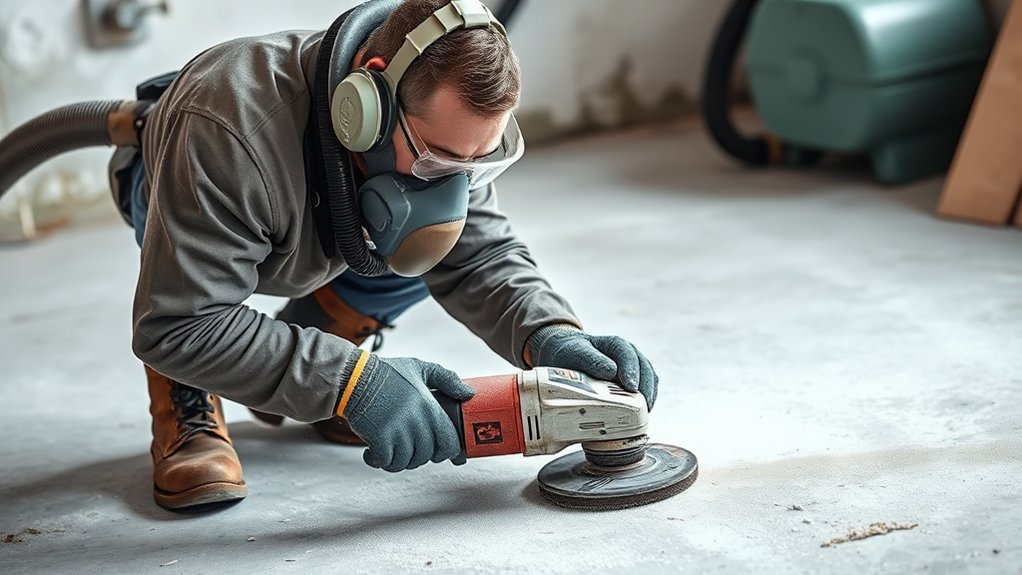
For construction work, the main silica rule is 29 CFR 1926.1153. It allows an employer to follow the specified controls in Table 1 or use exposure data to show that other controls keep exposure within the rule. The permissible exposure limit is 50 micrograms per cubic meter of air as an eight-hour time-weighted average, and the action level is 25 micrograms per cubic meter.
PPE is only one part of the control plan. Employers must first use feasible engineering and work-practice controls, such as a grinder shroud connected to a suitable dust collector or an integrated water-delivery system where Table 1 allows it. NIOSH found that local exhaust ventilation attached to a concrete grinder can sharply reduce dust exposure when the shroud, hose, filter, and vacuum are working correctly.
OSHA’s construction PPE rule also requires equipment to be safe for the work and selected so it properly fits each affected employee. Loose gloves, slipping eyewear, oversized clothing, and a poorly sealing respirator can all create new hazards.
Warning: Never dry-grind concrete without an effective dust-control plan. Respirable crystalline silica can cause silicosis, lung cancer, chronic obstructive pulmonary disease, and kidney disease. A visible dust cloud also signals that the control system needs attention.
What PPE for Concrete Grinding Is Essential?
The final PPE selection should come from a job-specific hazard assessment. The following equipment covers the common hazards of handheld concrete grinding:
- Primary eye protection: Impact-rated safety glasses with side protection or dust-sealing goggles. Sealed goggles are often the better choice when fine dust can enter around ordinary glasses.
- Face protection: A clear impact-rated face shield worn over safety glasses or goggles when chips, wheel fragments, or heavy debris may strike the face.
- Respiratory protection: A NIOSH-approved respirator with the assigned protection factor required by OSHA Table 1 or the employer’s exposure assessment. Respirator type cannot be chosen by filter name alone.
- Hearing protection: Earplugs, earmuffs, or both, selected from the measured noise level and the amount of attenuation needed.
- Hand protection: Snug abrasion- and cut-resistant work gloves that preserve control of the switch and side handle. Avoid loose cuffs or oversized fingers.
- Foot protection: Protective-toe, slip-resistant footwear when the hazard assessment identifies falling, rolling, puncture, or slippery-surface hazards.
- Clothing and head protection: Fitted long sleeves and long pants help limit skin contact with abrasive dust. Add a hard hat, high-visibility clothing, or knee protection when site conditions require them.
Gloves do not make it safe to touch a moving wheel, and a face shield does not replace primary eye protection. PPE must work as a system without blocking your view, interfering with the respirator seal, or reducing your grip on the grinder.
Control Silica Dust Before Relying on a Respirator
For handheld angle grinders used on concrete for purposes other than mortar removal, OSHA Table 1 separates outdoor work from indoor or enclosed work. Mortar removal, also called tuckpointing, has its own row and requires more respiratory protection. The table below summarizes the federal construction rule; an OSHA-approved state plan may impose additional requirements.
| Task | Required Table 1 control | Up to 4 hours/shift | More than 4 hours/shift |
|---|---|---|---|
| General concrete grinding outdoors | Integrated water delivery that continuously feeds the surface, or a commercially available shroud and dust-collection system operated as specified | No respirator specified | No respirator specified |
| General concrete grinding indoors or in an enclosed area | Commercial shroud and dust collector; provide exhaust as needed to prevent visible dust buildup | No respirator specified | APF 10 respirator |
| Mortar removal or tuckpointing | Commercial shroud and dust collector operated as specified | APF 10 respirator | APF 25 respirator |
For the shroud-and-dust-collector options above, Table 1 requires at least 25 cubic feet per minute of airflow per inch of wheel diameter, a filter with 99% or greater efficiency, and either a cyclonic pre-separator or a filter-cleaning mechanism. A household or general-purpose shop vacuum does not qualify merely because it can connect to the shroud. The complete system must meet the Table 1 specifications and be operated and maintained according to the manufacturers’ instructions.
Do not confuse the grinder’s tool-connected dust-collector specification with the cleanup rule. OSHA’s housekeeping provision names HEPA-filtered vacuuming, wet sweeping, or another method that minimizes exposure as alternatives to dry sweeping or dry brushing when feasible.
If the employer does not fully and properly use Table 1 controls, it must assess exposure and use controls and respiratory protection that keep exposure within the silica standard. A respirator never excuses a missing shroud, clogged filter, leaking hose, or poor work practice.
Products Worth Considering
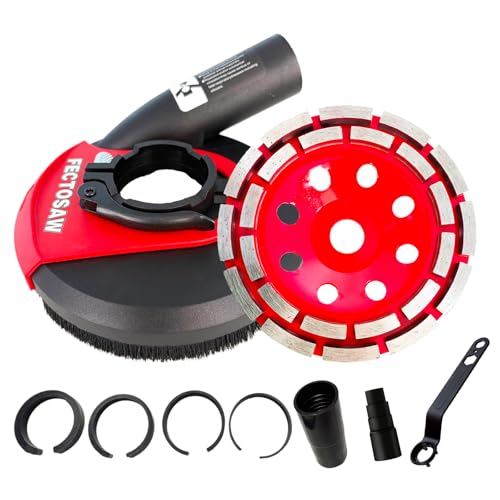
Complete Grinding & Dust Control Kit Includes a dust shroud and diamond grinding cup wheel, providing efficient surface grinding and dust collection in one ready-to-use set.
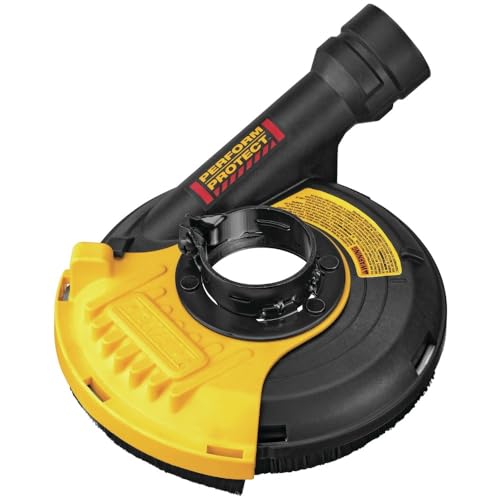
Designed to contain grinding dust
How Does the Four-Hour Rule Work Across a Shift?
The four-hour threshold is based on the combined time spent on all Table 1 tasks during the shift, not only one uninterrupted grinding period. When the total duration of all Table 1 tasks exceeds four hours, use the respirator requirement shown in the “more than four hours” column for each task performed. When the combined duration is four hours or less, use the “up to four hours” column. The employer should account for the full shift before work starts instead of switching protection only after the fourth hour has passed.
The safest question is not “Which mask should I wear?” but “How will I stop silica dust at the grinding surface, and what protection is still required after that control is working?”
Choosing the Right Respiratory Protection Against Silica Dust
A respirator must match the required assigned protection factor, contaminant, work conditions, and user. Under OSHA’s respiratory protection rule, a filtering facepiece such as an N95 and an elastomeric half-mask air-purifying respirator generally fall in the APF 10 category when used in a complete respiratory protection program. A full-facepiece air-purifying respirator has a higher APF when all program and fit-testing requirements are met. PAPRs vary by facepiece design and cannot be labeled simply as “high protection.”
Filter efficiency and respirator protection are related but different. N95 and P100 describe particulate filter performance. They do not, by themselves, determine the respirator’s APF or prove that the facepiece fits the user.
| Respirator type | Typical OSHA APF | Key point |
|---|---|---|
| Filtering facepiece or elastomeric half-mask air-purifying respirator | 10 | Tight-fitting; requires the correct filter, medical evaluation, fit test, training, and seal checks when use is required at work |
| Full-facepiece air-purifying respirator | 50 | Tight-fitting; higher protection depends on a complete program and required quantitative fit testing |
| Loose-fitting PAPR | 25 | Does not rely on a face seal and may accommodate facial hair, but the exact unit still must be approved and selected for the hazard |
Products Worth Considering

ODOR REDUCTION for use with certain non-harmful sprays/vapors from stains, varnishes, coatings and sealants

[Combination] The combination of respirator mask and dust goggles forms a comprehensive eye‑face protective system.Glasses effectively prevent dust from entering eyes,while spare cotton pads ensure the continuous protection of the mask.In addition,the body of this respirator mask with filters is made of high-quality silicone material,which is soft and breathable,and will not feel uncomfortable even during prolonged wear.It is an ideal reusable respirator mask with filters for sanding,painting.

PROTECTION : The AirGearPro G-500 Respirator mask and Safety Goggles are CE certified to ensure your protection during painting, woodworking, construction, sanding, renovation, demolition etc.
What Does APF Mean for Concrete Grinding?
The assigned protection factor describes the workplace protection expected from a respirator class when it is correctly selected, fitted, used, and maintained within a complete respiratory protection program. APF 10 means the respirator is expected to reduce the concentration inside the facepiece to one-tenth of the concentration outside it. APF 25 and APF 50 represent greater expected reduction. APF is not a guarantee for a poorly fitting respirator, and it does not replace the maximum-use-concentration calculation or the need to control dust at the source.
Fit Testing, Medical Evaluation, and Seal Checks
When respirator use is required in a workplace, the employer must establish a written respiratory protection program. The worker must receive a medical evaluation before required use, pass a fit test for the same make, model, style, and size of tight-fitting respirator, and complete a user seal check every time the respirator is put on. A seal check is not a substitute for a fit test.
Facial hair that crosses the sealing surface makes a tight-fitting respirator unsuitable. A loose-fitting hood or helmet PAPR may be an option because it does not depend on a tight face seal. A tight-fitting PAPR still has seal and fit-testing requirements.
Note: OSHA requirements apply to covered workplaces, not ordinary homeowner activity. The silica health hazard still exists during DIY work, so use effective dust capture or an approved wet system, keep others out of the area, and select a NIOSH-approved respirator conservatively rather than relying on a loose “dust mask.”
Why Eye and Face Protection Is Essential
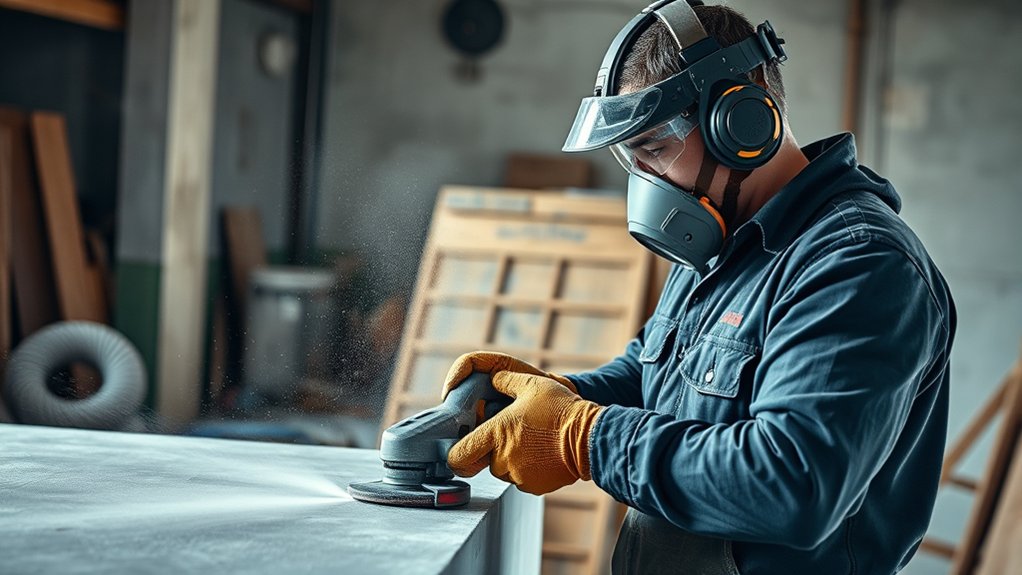
Concrete chips, abrasive grit, and wheel fragments can move fast enough to cause serious eye or face injury. OSHA requires suitable eye or face protection for flying-particle hazards and side protection when flying objects are present. Choose equipment marked for impact protection and make sure it fits without interfering with the respirator.
Importance of Eye Protection
Use safety glasses with side protection for lower-dust impact work, or goggles that fit close to the face when airborne dust can enter around ordinary glasses. Prescription eyeglasses are not safety glasses unless they are designed and marked as protective eyewear.
- Inspect lenses, frames, straps, and side protection before use.
- Replace eyewear with cracks, deep scratches, loose parts, or poor visibility.
- Use anti-fog methods approved by the eyewear maker; do not remove protection because lenses fog.
Face Shield Benefits
A face shield adds coverage for the cheeks, forehead, and neck area. Wear it over safety glasses or goggles when the grinder can throw large chips or when a wheel failure could send fragments toward the operator. A shield alone is not primary eye protection.
Keep the shield clear and securely adjusted. Replace a cracked or badly scratched visor before work continues.
Preventing Eye Injuries
- Position the grinder guard between your body and the wheel.
- Keep bystanders outside the debris and dust area or give them equivalent protection.
- Stop work if the shield, goggles, respirator, or lighting blocks a clear view of the grinding path.
The Importance of Hearing and Hand Protection
Concrete grinders can produce hazardous noise, especially indoors where sound reflects from walls and floors. Select hearing protection from a noise assessment instead of choosing the highest printed noise reduction rating without considering fit, compatibility, and communication needs. OSHA’s construction noise rules require protection when exposure exceeds the limits in its noise table.
Earplugs must be inserted correctly, and earmuff cushions must seal around the ear. Eyewear temples, respirator straps, hats, and hair can create gaps under earmuffs. Where one protector cannot provide enough attenuation, a safety professional may specify dual protection.
Use snug work gloves that resist abrasion and cuts while allowing full control of the trigger, paddle switch, and side handle. Gloves can reduce minor skin injuries, but they do not eliminate vibration exposure or make contact with a wheel safe. Stop if your hands become numb, painful, unusually cold, or weak.
Protective Footwear, Clothing, and Other Site PPE
Safety-toe footwear is appropriate when tools, slabs, or debris could fall or roll onto the foot. Choose slip-resistant soles for dusty or wet floors and puncture-resistant features when sharp debris is present. “Steel toe” is not the only compliant design; the correct footwear depends on the hazard assessment.
Wear fitted clothing and secure long hair, jewelry, drawstrings, and loose sleeves. Long pants and sleeves help keep abrasive dust and slurry off the skin. A hard hat is needed when overhead or falling-object hazards exist, and knee pads can help during floor-edge work that requires kneeling.
Avoid These Common Mistakes With PPE
Most PPE failures come from incorrect selection, poor fit, or using PPE to compensate for a failed engineering control. Check the following problems before the wheel starts.
Common PPE Misunderstandings
- “An N95 is always enough.” The required APF depends on the task and exposure. An N95 is an APF 10 filtering facepiece in a compliant program, not a universal answer.
- “A face shield replaces goggles.” Use the shield over primary eye protection.
- “No visible dust means no silica exposure.” Respirable particles can be too small to see. Visible dust is a warning, but its absence does not prove safe exposure.
- “A P100 filter automatically gives more APF.” P100 improves filter efficiency, but a half-mask respirator remains in its assigned protection class unless the respirator class changes.
- “A beard is fine with any PAPR.” Only loose-fitting PAPR hoods or helmets avoid a face-seal requirement; tight-fitting PAPRs still require a clear sealing surface.
Inadequate Gear Selection
Match every item to the actual hazard and to the other PPE. Goggles that break a respirator seal, earmuffs held open by thick eyewear, or gloves that prevent safe switch operation are poor choices even when each item looks protective by itself.
Do not use damaged, improvised, or unmarked eye protection. Do not modify respirators, drill holes in a face shield, remove the grinder guard, or fit a wheel that exceeds the grinder’s size or speed rating.
Neglecting Fit Testing
A tight-fitting respirator must seal on the individual wearer. Workplace fit testing is required before first use, whenever a different facepiece is used, at least annually, and when physical changes could affect fit. Perform the manufacturer’s seal check each time you put it on.
- Use the exact make, model, style, and size that passed the fit test.
- Keep facial hair, clothing, straps, and eyewear out of the sealing area.
- Leave the work area immediately if you notice facepiece leakage, increased breathing resistance, dizziness, breathing difficulty, or a damaged respirator.
Pre-Use PPE and Grinder Safety Checklist
Complete this check before connecting power or installing the battery:
- Identify the task. Confirm whether the work is general concrete grinding, mortar removal, or another silica-generating task.
- Select the dust control. Fit the correct shroud and dust collector, or use an integrated wet system only when the grinder and accessories are designed for wet use.
- Inspect the wheel. Verify the wheel is intended for concrete, undamaged, correctly mounted, and rated at or above the grinder’s no-load speed.
- Check the guard and side handle. Secure both and position the guard between the wheel and your body.
- Test dust collection. Check hose connections, airflow, bag or drum capacity, filter condition, and the filter-cleaning system.
- Put on PPE. Check fit and compatibility from footwear to eye, face, hearing, hand, and respiratory protection.
- Control the area. Remove trip hazards, protect nearby workers, arrange ventilation, and keep cords or hoses out of the grinding path.
- Run a brief test. Start the grinder in a safe position and stop if you notice unusual vibration, noise, wheel wobble, dust leakage, or damaged PPE.
Pro Tip: Keep spare eye protection, hearing protectors, approved filters, vacuum bags, and shroud parts on site. A clogged filter or scratched lens should stop the job, not tempt anyone to grind without protection.
Best Practices for Maintaining Your PPE and Equipment
Inspect PPE before each use. Replace cracked lenses, stretched straps, torn gloves, damaged earmuff cushions, worn footwear, clogged disposable respirators, and defective respirator parts. Follow the manufacturer’s instructions for service life, cleaning, storage, and replacement.
Clean reusable respirators only with approved methods. Remove filters or cartridges as directed, wash reusable components, rinse thoroughly, air-dry, reassemble, and function-check the unit. Store clean respirators in a sealed container or cabinet that protects them from dust, sunlight, moisture, chemicals, and deformation.
Maintain the grinder and dust controls as carefully as the PPE. A worn shroud brush, split hose, full vacuum bag, loaded filter, or weak seal can let dust escape. Stop and correct the problem when visible dust leaks from the shroud.
Safe Cleanup After Concrete Grinding
Do not create a second exposure while cleaning. OSHA generally prohibits dry sweeping or dry brushing when those methods can add to silica exposure and feasible alternatives exist. Use a HEPA-filtered vacuum, wet sweeping, or another method that minimizes airborne dust.
Do not use compressed air to blow concrete dust from clothing or surfaces unless it is used with a ventilation system that captures the dust cloud or no feasible alternative exists. Handle vacuum bags, filters, and slurry so dust is not released again. Wash exposed skin and change dusty clothing before entering a vehicle or clean area.
How to Foster a Safety Culture on the Job Site
A strong safety culture treats silica control and PPE as part of production, not as optional add-ons. Workers should know the task-specific control method, required respirator, inspection steps, and stop-work conditions before grinding begins.
- Use a written exposure control plan: Identify silica tasks, controls, housekeeping methods, and access restrictions.
- Assign a competent person: Have a qualified person make regular inspections and correct foreseeable silica hazards.
- Hold short pre-task talks: Review dust capture, wheel condition, PPE compatibility, nearby workers, and cleanup.
- Encourage peer checks: A coworker can spot a loose respirator strap, raised face shield, disconnected hose, or missing guard.
- Track recurring failures: Repeated filter clogging, dust leakage, or damaged PPE calls for a better system, not repeated workarounds.
For employees required by the silica standard to wear a respirator 30 or more days per year, the employer must make medical surveillance available at no cost. Training must also cover the health hazards, exposure-producing tasks, controls, respirators, competent person, and medical-surveillance program.
Frequently Asked Questions
What PPE is needed for grinding concrete?
Use impact-rated safety glasses or sealed goggles, a face shield over primary eye protection when debris is severe, hearing protection, snug work gloves, fitted clothing, and protective footwear. Add head, knee, or high-visibility protection when site hazards require it. Respiratory protection must match OSHA Table 1 or the exposure assessment.
What PPE is required for silica?
Silica protection begins with engineering controls, not PPE alone. Use the required shroud and dust collector or approved wet method. When a respirator is required, select a NIOSH-approved model with the necessary APF and follow the workplace respiratory protection program, including medical evaluation, fit testing, training, and seal checks for tight-fitting models.
What PPE is required for an angle grinder?
At minimum, use impact-rated eye protection, hearing protection, suitable gloves, fitted clothing, and protective footwear selected for the hazard. Add a face shield for severe flying-particle hazards and task-specific respiratory protection for concrete, masonry, coatings, or other hazardous dusts. Keep the correct guard and side handle installed.
What are OSHA’s requirements for silica during concrete grinding?
For construction, employers may fully implement the control methods and respirator requirements in OSHA Table 1 or use exposure data and alternative controls. The silica PEL is 50 micrograms per cubic meter as an eight-hour TWA. The rule also covers housekeeping, a written exposure control plan, a competent person, training, and medical surveillance in specified cases.
Can you grind concrete without a respirator?
Sometimes, under OSHA Table 1, no respirator is specified when the correct engineering controls are fully and properly used. For example, general outdoor concrete grinding with an approved wet system or compliant shroud and dust collector lists no respirator for either duration column. Indoor work over four hours and mortar removal have different requirements. Never interpret “no respirator specified” as permission to grind without dust control.
Is an N95 enough for concrete dust?
An N95 filtering facepiece can provide APF 10 protection in a complete workplace respiratory program, but it is not automatically enough for every concrete task. Mortar removal lasting more than four hours requires APF 25 under Table 1, and other conditions may require exposure assessment or stronger protection.
Can I wear a respirator with a beard?
Not when facial hair crosses the sealing surface of a tight-fitting respirator. A loose-fitting PAPR hood or helmet may be suitable because it does not depend on a face seal. A tight-fitting PAPR still requires an unobstructed seal and fit testing.
How is the four-hour limit calculated under OSHA Table 1?
Add the time spent on all Table 1 tasks during the shift. If the combined duration is more than four hours, apply the respirator requirement in the more-than-four-hours column to each Table 1 task performed. If the combined duration is four hours or less, use the shorter-duration column.
Does any HEPA shop vacuum meet OSHA Table 1 for grinding?
No. For a handheld grinder shroud, Table 1 specifies at least 25 cfm of airflow per inch of wheel diameter, a filter with 99% or greater efficiency, and a cyclonic pre-separator or filter-cleaning mechanism. The grinder, shroud, hose, and dust collector must be operated and maintained as a complete system according to the manufacturers’ instructions.
Safety Disclaimer: This article provides general safety information and does not replace a site-specific hazard assessment, professional training, product instructions, applicable federal or state rules, or an employer’s written safety programs. Stop work and consult a qualified safety professional when the dust-control method, respirator selection, wheel setup, or exposure level is uncertain.
Conclusion
Safe concrete grinding starts by controlling silica at the tool, then adding PPE that fits the worker and the task. Use the correct shroud, dust collector, wet method, wheel, guard, and side handle before relying on a respirator. Protect the eyes, face, hearing, hands, feet, and nearby workers, and stop when dust escapes or any part of the system fails.
Sources
- OSHA 29 CFR 1926.1153: Respirable Crystalline Silica — Table 1 controls, exposure limits, housekeeping, plans, training, and medical surveillance
- NIOSH: Control of Hazardous Dust When Grinding Concrete — grinder shrouds and local exhaust ventilation
- OSHA 29 CFR 1910.134: Respiratory Protection — respirator programs, APFs, medical evaluation, fit testing, and use
- NIOSH: Respirator Fit Testing — face-seal testing and facial-hair considerations
- OSHA 29 CFR 1926.102: Eye and Face Protection — flying-particle and side-protection requirements
- OSHA: Hearing Loss in Construction — construction noise exposure and hearing conservation