A burning smell from an angle grinder is a stop-work warning, not something to grind through. The odor may come from a loaded disc, blocked cooling vents, an undersized extension cord, worn carbon brushes, failing bearings, damaged wiring, or a hot cordless battery. Disconnect the tool, let it cool, and identify the cause before using it again.
Quick Answer
If your angle grinder smells like burning, release the trigger, wait for the wheel to stop, unplug the cord or remove the battery, and move the tool away from combustible material. Do not restart it until you have checked the wheel, guard, vents, cord or battery, and other visible parts for heat, damage, or blockage.
Key Takeaways
- Stop immediately if the smell is strong, returns under light load, or comes with smoke, abnormal sparks, power loss, vibration, or repeated shutdowns.
- Common causes include blocked vents, excessive pressure, a binding or incorrect wheel, worn brushes or bearings, and an undersized extension cord.
- Limit do-it-yourself checks to external parts and maintenance specifically allowed by the model’s manual.
- Do not open a battery pack, bypass a switch, repair burnt wiring, or keep resetting a tripped breaker.
- Use only wheels and replacement parts that match the grinder’s model, size, mounting system, and maximum speed.
At a Glance
| Time Required | Cooling time varies by tool and fault; add enough time for a careful external inspection. Professional diagnosis may take longer. |
| Difficulty | Beginner for external inspection and cleaning; advanced electrical or motor work should go to a qualified repair technician. |
| Tools Needed | Model manual, flashlight, clean cloth, soft brush or vacuum, eye protection, and dry compressed air only when the manual permits it. |
| Cost | External inspection may cost nothing. Brushes, cords, bearings, batteries, motor parts, and shop labor vary by model. |
What’s in This Article
- Why Your Angle Grinder Smells Like Burning
- What the Burning Smell May Mean
- How to Recognize When Your Grinder Is Overheating
- Signs of Overheating
- Mistakes That Make Overheating Worse
- Immediate Steps to Take When You Smell Burning
- Check the Power Source First
- Inspect Internal Components Safely
- Allow the Tool to Cool
- How to Inspect Your Angle Grinder for Signs of Damage
- How to Handle Electrical Problems Safely
- Cleaning and Maintenance Tips to Prevent Overheating
- Replacing Worn or Damaged Parts Safely
- Safe Restart Test After the Cause Is Fixed
- When to Seek Professional Repair for Your Grinder
- How to Keep Your Grinder Healthy Long-Term
- Real User Experiences With Angle Grinder Overheating
- Frequently Asked Questions
- Conclusion
- Sources
Why Your Angle Grinder Smells Like Burning
A burning odor means something is getting hotter than it should or hot debris is collecting where it should not. The cause may be mechanical, electrical, or related to the wheel and work technique. Continuing to run the grinder can turn a small problem into a damaged armature, failed switch, ruined battery, broken wheel, shock hazard, or fire.
Blocked airflow is a common cause. The motor fan pulls air through the housing, so metal powder, concrete dust, and other debris can collect around the vents and internal parts. A current DeWalt angle grinder manual warns that excessive powdered-metal buildup inside the housing can create electrical hazards.
Heavy pressure can also overload the motor and wheel. A grinder should cut or grind at the rate it was designed for. Forcing it, twisting a cut-off wheel, using the side of a cut-off disc, or letting the wheel bind increases load, heat, kickback risk, and wheel damage.
For a corded grinder, the power supply matters too. An extension cord with conductors that are too small for the tool’s amperage and cord length can cause voltage drop, power loss, and overheating. Follow the cord-size chart in your grinder manual rather than choosing by appearance alone.
What the Burning Smell May Mean
The odor alone cannot prove which part has failed, but its timing and the grinder’s behavior can narrow the search:
- Smell appears only under hard load: The wheel may be dull, glazed, pinched, incorrect for the material, or pushed too hard.
- Smell comes from the rear vents: Airflow may be blocked, carbon brushes may be worn, the commutator may be damaged, or the motor may be overloaded.
- Sharp hot-plastic smell near the cord, plug, or switch: Stop using the grinder. Melting insulation, a loose connection, or switch damage needs professional attention.
- Rough noise with heat at the gear head: A bearing or gearbox problem may be adding friction.
- Odor follows concrete or metal grinding: Dust may be packed around the vents or inside the housing. Conductive metal dust is especially concerning.
- Odor comes from a cordless battery: Remove the battery only if it can be done without touching a hot, swollen, leaking, smoking, or burning pack. Keep people away and follow the manufacturer’s emergency guidance.
Warning: A cordless battery that is swollen, leaking, hissing, smoking, extremely hot, or giving off a strong chemical odor is not a normal grinder-overheating problem. Do not open, puncture, charge, or reuse it. Move away, call emergency services if there is smoke or fire, and contact the tool manufacturer for handling and disposal instructions.
How to Recognize When Your Grinder Is Overheating
Angle grinders normally become warm during use, especially around the gear case. There is no universal “safe to touch” temperature that applies to every model. Treat a sudden change from the grinder’s normal behavior as the more useful warning.
Stop when heat rises quickly, the odor becomes stronger, speed falls under a normal load, the tool shuts down repeatedly, or the sound changes. Smoke, melted plastic, abnormal arcing, or a tripped breaker means the grinder should stay out of service until it is inspected.
Signs of Overheating
- A strong or worsening burning smell
- Smoke from the motor vents, switch, plug, cord, battery, or gear head
- A sudden drop in speed or cutting performance
- Repeated electronic thermal shutdown on a cordless or protected model
- Unusual whining, growling, scraping, or rattling
- Excessive vibration with a wheel that is correctly mounted
- Heavy or uneven sparks visible through the brush vents on a brushed motor
- A hot, discolored, softened, or melted cord, plug, switch, or battery case
- A breaker or GFCI that trips again after the tool is removed from the work
Warning: Do not keep cycling the switch to “see if it clears up.” Repeated starts can add heat, damage a wheel that is binding, and worsen an electrical fault.
Mistakes That Make Overheating Worse
You can prevent many overheating problems by avoiding a few common mistakes:
- Forcing the tool: Let the wheel do the work. Excessive pressure does not guarantee a faster cut.
- Using the wrong accessory: A wheel must match the task, grinder diameter, arbor or mounting system, guard type, and speed. The wheel’s rated speed must be at least as high as the grinder’s maximum speed.
- Grinding with a cut-off wheel: Thin cut-off wheels are designed for radial cutting, not side loading.
- Running with clogged vents: Cooling openings must stay clear.
- Using a long, light-duty cord: Choose the wire gauge from the manual’s amperage-and-length chart.
- Ignoring binding or vibration: Stop and correct the cause instead of pushing harder.
- Working near combustibles: Angle-grinder sparks can ignite flammable material and combustible dust.
OSHA’s angle grinder safety guidance calls for the correct wheel, a wheel speed rating above the grinder speed, an adjusted guard, pre-use wheel inspection, two-handed control, suitable personal protective equipment, and a work area clear of flammable material.
Immediate Steps to Take When You Smell Burning
- Release the trigger. Keep control of the grinder until the wheel stops completely.
- Disconnect energy. Unplug a corded grinder or remove a detachable battery when it is safe to do so.
- Move away from combustibles. Set the tool on a noncombustible surface away from paper, sawdust, fuel, solvents, rags, and combustible dust.
- Do not touch the wheel or gear case immediately. They may be hot enough to burn skin.
- Watch for smoke or a worsening battery condition. Leave the area and call emergency services if a fire starts or a battery begins venting or burning.
- Let the tool cool fully. Do not rush the diagnosis.
- Inspect only after power is disconnected. Start with the wheel, guard, vents, cord or battery, plug, switch area, and housing.
Check the Power Source First
For a corded grinder, inspect the full cord and plug under good light. Look for cuts, crushed sections, exposed conductors, melted insulation, bent or loose prongs, discoloration, and heat marks. Do not tape over damaged insulation as a permanent repair.
Check the receptacle and extension-cord ends for looseness, discoloration, buzzing, or heat. Do not keep resetting a breaker or GFCI that trips when the grinder is connected. If the outlet itself appears damaged or hot, stop using it and call a qualified electrician.
If an extension cord is needed, use an outdoor-rated cord outdoors and select the American Wire Gauge size from the grinder manual. The Bosch GWS8-45 manual, for example, explains that an adequately sized cord helps prevent excessive voltage drop, loss of power, and overheating. The correct gauge depends on both amperage and cord length.
For a cordless grinder, inspect the battery rails, terminals, latch, and case. Do not use a cracked, modified, swollen, leaking, overheated, or impact-damaged pack. Manufacturer instructions warn that damaged batteries can behave unpredictably and may cause fire or explosion.
Inspect Internal Components Safely
Internal electrical inspection is not a general homeowner step. Opening the housing can expose live-energy components, disturb insulated wiring, defeat seals, or create a dangerous reassembly error. It may also affect the warranty.
A qualified repair technician can inspect carbon brushes, brush holders, the commutator, armature, stator, switch, wiring, bearings, and gearbox. Burnt windings, melted insulation, damaged terminals, heavy commutator scoring, and failed electronic controls require proper testing and model-specific parts.
Bosch warns that unauthorized preventive maintenance can misplace internal wires and components, creating a serious hazard. DeWalt likewise directs power-tool service to qualified repair personnel using identical replacement parts.
Note: A multimeter is useful only when the user understands electrical isolation, the tool’s wiring diagram, and the correct test procedure. Do not probe a connected grinder or bypass a switch, thermal protector, brake, or other safety device.
Allow the Tool to Cool
Cooling time depends on the grinder, workload, air temperature, and failed part, so a fixed 15- or 30-minute rule is not reliable. Wait until the wheel, gear case, motor housing, cord or battery, and surrounding air have returned to a normal temperature and the odor is no longer increasing.
Cooling does not repair the cause. If the smell returns during light no-load operation or normal work, stop again and remove the grinder from service.
How to Inspect Your Angle Grinder for Signs of Damage
Use this external inspection before deciding whether cleaning or a part replacement is appropriate:
- Read the model label and manual. Confirm the exact model number, wheel size, maximum speed, arbor or mounting system, guard requirements, brush type if applicable, and owner-serviceable parts.
- Inspect the wheel. Do not use it if it is cracked, chipped, warped, contaminated, badly worn, or missing the markings needed to confirm its type and speed rating.
- Check the mounting parts. The flange, lock nut, spindle, and mounting surfaces should be clean, undamaged, and correct for the wheel.
- Inspect the guard and side handle. The guard must be the correct type, firmly attached, and positioned between the operator and wheel. The side handle should be secure.
- Turn the spindle by hand only with power disconnected. It should move without obvious binding, scraping, or excessive play. Do not force it.
- Check the vents. Look for packed dust, metal powder, fibers, or debris.
- Inspect the housing and controls. Look for cracks, loose fasteners, melted areas, discoloration, or a switch that sticks.
- Inspect the power source. Check the cord, plug, extension cord, battery, terminals, and charger as applicable.
OSHA’s portable power-tool fact sheet says tools should be examined for damage before use, damaged tools should not be used, and accessories should follow the manufacturer’s instructions.
Products Worth Considering

Included: (1) DeWalt N441218 Angle Grinder Guard Replacement for Angle Grinder DCG414B

Genuine, OEM DeWalt Replacement Part

How to Handle Electrical Problems Safely
Safe owner-level electrical work is limited. You can disconnect the grinder, inspect the cord, plug, battery, terminals, switch exterior, and housing, then compare the condition with the manual. A detachable cord or externally accessible brush may be replaceable by the owner only when the manufacturer provides a specific procedure.
Do not splice a flexible power cord inside the strain relief, install a switch that merely “looks similar,” fit generic brushes without confirming the part number, or repair melted insulation with tape. The conductor size, insulation rating, terminals, routing, strain relief, brush grade, and safety features must match the model.
Stop and use a qualified repair technician when you find burnt wiring, melted insulation, severe brush arcing, a damaged commutator, a failed electronic control, repeated breaker trips, or a switch that will not control the tool reliably.
Warning: Never open or attempt to repair a lithium-ion battery pack. Battery service should be performed only by the manufacturer or an authorized provider.
Cleaning and Maintenance Tips to Prevent Overheating
Regular cleaning helps the grinder’s cooling system work as designed, but the method must match the manual and the dust involved.
- Unplug the grinder or remove the detachable battery.
- Wear eye protection. Add suitable respiratory protection when the dust presents an inhalation hazard.
- Use a vacuum or soft brush to remove loose dust from the exterior and vent openings.
- Use dry compressed air only if the manufacturer permits it. Keep the air controlled, wear eye protection, and direct dust away from people.
- Do not insert wire, picks, screws, or other pointed objects through the vents.
- Do not wash the grinder or use gasoline, aggressive solvents, or cleaners that can damage plastic and insulation.
- Clean the flange, lock nut, guard, and spindle area before fitting a wheel.
The Bosch manual states that ventilation openings and switch levers must remain clean and free of foreign matter. It also advises disconnecting the tool before cleaning and wearing safety goggles when dry compressed air is used.
Gearbox lubrication is model-specific. Do not add general-purpose grease because the gear lubricant, quantity, service interval, and disassembly method vary. Follow the exact manual or have an authorized service center perform the work.
Pro Tip: After concrete, masonry, or heavy metal grinding, clean the exterior vents before the dust hardens or packs into the intake. Pair the grinder with the manufacturer-approved dust shroud and extraction system when the task and model support one.
Replacing Worn or Damaged Parts Safely
Disconnect the plug or remove the detachable battery before changing any accessory or owner-serviceable part. Record the full model and type number from the nameplate before ordering anything.
Replace a damaged wheel, guard, flange, lock nut, side handle, cord, switch, bearing, brush, or battery only with a part approved for that model and application. “Fits the spindle” is not enough. The part must also match the wheel type, diameter, thickness, speed, guard, electrical rating, and mounting design.
Carbon brushes are not universal. Some brushed grinders provide external brush caps and a manual replacement procedure; others require disassembly or use service-minder brushes that shut the tool down. Brushless grinders do not have carbon brushes. Follow the model manual and replace brushes as a matched set when instructed.
Bearings that are noisy, rough, loose, or causing abnormal heat should be replaced promptly by a qualified service provider. Continued operation can damage the armature, stator, gears, spindle, or wheel mounting.
Products Worth Considering

[7PCS 5/8"-11 Angle Grinder Nut Wrench Replacement Kit] 1 piece angle grinder wrench and 6 angle grinder nuts (3 inner flange nuts, 3 outer flange nuts) for lock nut removal, wheel/disc replacement.Compatible with most arbor grinders and lock nuts, Perfect for home DIY, workshop projects, and professional grinder parts replacement
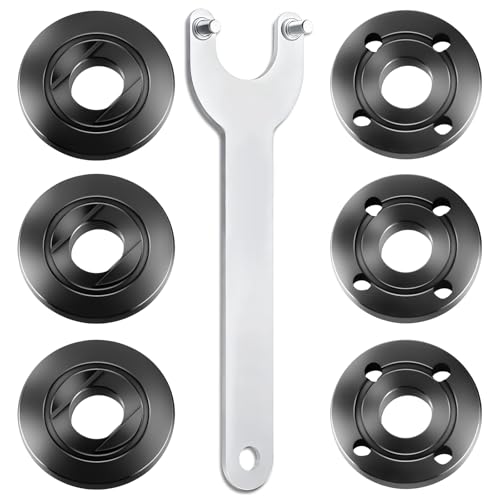
WHAT YOU GET: Includes 1 extended angle grinder wrench and 6 thickened-design flange nuts (3 inner nuts + 3 outer nuts), always have spare nuts to avoid downtime.

【INCLUDE】Our angle grinder wrench kit include 1 angle grinder wrench, 3 inner angle grinder flange nuts, 3 outer angle grinder flange nuts. We have also provided you with a storage bag for easy carrying and storage.
Safe Restart Test After the Cause Is Fixed
Do not perform a test run if you found burnt wiring, melted plastic, a damaged battery, a faulty switch, a cracked housing, or an unresolved power problem. Send the grinder for service instead.
After cleaning or replacing an approved external accessory:
- Confirm that the wheel and guard match the manual and are mounted correctly.
- Make sure the switch is off before reconnecting power.
- Clear the area and keep bystanders away.
- Hold the grinder with both hands and stand out of the wheel’s plane.
- Run the grinder at no load for the period stated in the manual. Many manufacturer instructions call for a one-minute no-load test after installing an accessory.
- Stop immediately if you notice vibration, wobble, rubbing, smoke, abnormal arcing, heat, noise, or a returning odor.
When to Seek Professional Repair for Your Grinder
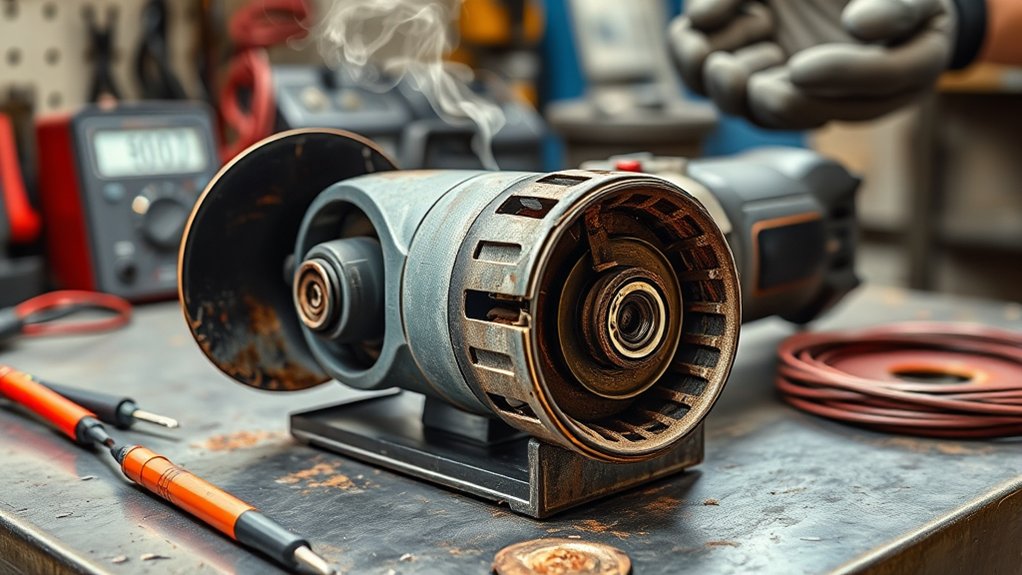
Choose professional repair when the problem goes beyond a dirty vent or clearly damaged accessory. Stop using the grinder for any of these conditions:
- Smoke or a strong electrical smell: Especially from the rear vents, switch, cord, battery, or charger.
- Burnt or melted parts: Wiring, insulation, plug blades, terminals, switch housing, or battery case.
- Repeated power failure: The grinder cuts out, will not start, trips a breaker or GFCI, or restarts unpredictably.
- Abnormal brush arcing: Heavy, uneven, or worsening sparks around the brush area.
- Rough bearings or gears: Growling, scraping, excessive spindle play, or gear-head heat.
- Motor damage: Burnt windings, a scored commutator, weak speed, or overheating under no load.
- Battery damage: Swelling, cracking, leakage, impact damage, overheating, smoke, or hissing.
- Uncertain repair: You cannot confirm the correct part, wiring route, torque, or safety test from the manual.
A technician can test insulation, continuity, current draw, switch operation, brush contact, armature and stator condition, bearings, gears, and electronic controls. The technician can also determine whether the repair will restore the tool safely.
Replacement may make more sense when the housing is cracked, several major assemblies are damaged, the correct parts are unavailable, or the repair cost approaches the price of a suitable new grinder. Compare the written estimate, warranty status, age, duty cycle, and safety features rather than price alone.
How to Keep Your Grinder Healthy Long-Term
A simple routine reduces heat, vibration, and sudden failure. Base the schedule on the model manual, operating hours, workload, and dust exposure rather than a universal monthly interval.
Regular Cleaning Practices
- Inspect the wheel, guard, handle, cord or battery, and vents before each use.
- Remove exterior dust after each dusty job.
- Keep the air intakes and exhaust openings clear.
- Clean the spindle, flange, nut, and guard when changing accessories.
- Stop when the grinder’s sound, heat, vibration, smell, or speed changes.
Proper Storage Techniques
Store the grinder unplugged or without its detachable battery in a clean, dry, temperate location. Protect it from rain, high humidity, impact, direct heat, and metal debris that can enter the vents.
Store abrasive wheels as their manufacturer directs, away from moisture, freezing conditions, contamination, and physical damage. Do not leave a wheel where it can be struck, bent, or loaded by other tools.
Keep battery terminals away from loose metal objects. Store and charge batteries only within the temperature limits in the battery and charger manuals.
Scheduled Maintenance Checks
- Before each use: Inspect the grinder, wheel, guard, handle, cord or battery, and work area.
- After dusty work: Clean the exterior and vents using the approved method.
- At the manual’s brush interval: Inspect or replace carbon brushes on brushed models. Some models require authorized service.
- When noise or heat changes: Have bearings and gears checked instead of waiting for a calendar date.
- At any safety shutdown: Read the model-specific indicator or manual before restarting.
Pro Tip: Keep a small service note with the model number, wheel type, brush or bearing service date, and symptoms you noticed. Specific notes help a repair technician diagnose an intermittent overheating problem.
Real User Experiences With Angle Grinder Overheating
Owner reports can reveal patterns, but they do not identify a failed part by themselves. Three patterns appear often in real-world troubleshooting:
- The smell starts during a difficult cut: Binding, excessive pressure, an incorrect wheel, or a weak extension cord may be loading the motor.
- The smell improves after vent cleaning: Airflow restriction may have contributed, but the grinder still needs attention if the odor, heat, or power loss returns.
- An older grinder smells, sparks heavily, and loses speed: Brushes, the commutator, bearings, or windings may be worn and should be professionally inspected.
Do not copy a repair merely because it worked for another owner. Grinders that look similar can use different switches, brush grades, wiring, electronics, guards, wheels, and batteries. The model manual and approved parts list are the correct reference.
Frequently Asked Questions
What are signs my grinder needs repair?
Your grinder needs inspection or repair if it smells burnt, smokes, loses speed, vibrates with a correctly mounted wheel, makes a new rough sound, trips power, shows heavy brush arcing, or has a damaged cord, switch, housing, battery, spindle, guard, or mounting part.
What causes an angle grinder to overheat?
Common causes include blocked vents, excessive pressure, a pinched or incorrect wheel, a dull or glazed accessory, an undersized extension cord, worn brushes, damaged bearings, motor faults, and long operation beyond the tool’s duty capability. A damaged cordless battery can also overheat independently of the motor.
Can sparks from an angle grinder start a fire?
Yes. Grinding sparks and hot particles can ignite flammable liquids, gases, dust, paper, wood shavings, oily rags, and other combustible material. Clear the work area and do not use a grinder in an explosive atmosphere or where combustible dust has accumulated.
How can you tell if an angle grinder disc is bad?
Do not use a disc that is cracked, chipped, warped, contaminated, badly worn, out of balance, or missing the markings needed to verify its type and maximum speed. Also reject a disc that does not match the grinder’s diameter, mounting system, guard, and intended operation.
Should you use an angle grinder after it smells like burning?
No. Stop, disconnect power, let it cool, and find the cause first. Restart only after the problem is corrected, the wheel and guard are verified, and the tool passes the manufacturer’s no-load check without odor, smoke, vibration, abnormal noise, or heat.
Can an extension cord make a grinder smell burnt?
Yes. A cord that is too long or has conductors too small for the grinder’s amperage can cause voltage drop, loss of power, and overheating. Use the wire-gauge chart in the model manual, keep the cord only as long as needed, and replace damaged plugs or cords.
Is a slight burning smell normal on a new angle grinder?
Do not assume a burning smell is normal. A brief new-tool odor may have a harmless source, but smell alone cannot rule out a loaded wheel, blocked vent, wiring problem, or battery fault. Stop if the odor is strong, persistent, worsening, or paired with smoke, abnormal sparks, heat, vibration, or power loss.
Why does my cordless grinder smell burnt?
The motor may be overloaded or dusty, but the battery, terminals, or electronic controls may also be overheating. Remove a detachable battery only when it is safe. Do not reuse a pack that is swollen, leaking, cracked, smoking, hissing, unusually hot, or strongly odorous.
Conclusion
A burning smell from an angle grinder means you should stop, disconnect power, and inspect the tool before the next cut. Begin with the wheel, guard, vents, cord or battery, plug, and visible housing. Correct overload, airflow, accessory, and extension-cord problems only with model-approved methods. Smoke, melted insulation, battery damage, repeated power trips, heavy arcing, rough bearings, or a returning odor calls for professional repair.
Sources
- OSHA: Angle Grinder Safety — wheel selection, speed rating, guarding, fire hazards, inspection, two-handed use, and PPE.
- OSHA: Safe Use of Portable and Hand-Held Power Tools — pre-use inspection, manufacturer-approved accessories, guarding, no-load startup, and disconnecting power before service.
- DeWalt DCG407/DCG408 Instruction Manual — air-vent cleaning, combustible hazards, wheel ratings, damaged batteries, and qualified service.
- Bosch GWS8-45 Operating Instructions — brush and bearing service, compressed-air cleaning, ventilation openings, solvents, and extension-cord sizing.
- Milwaukee 6130-33 Product Information — airflow and debris-control design used to reduce motor heat and protect internal components.