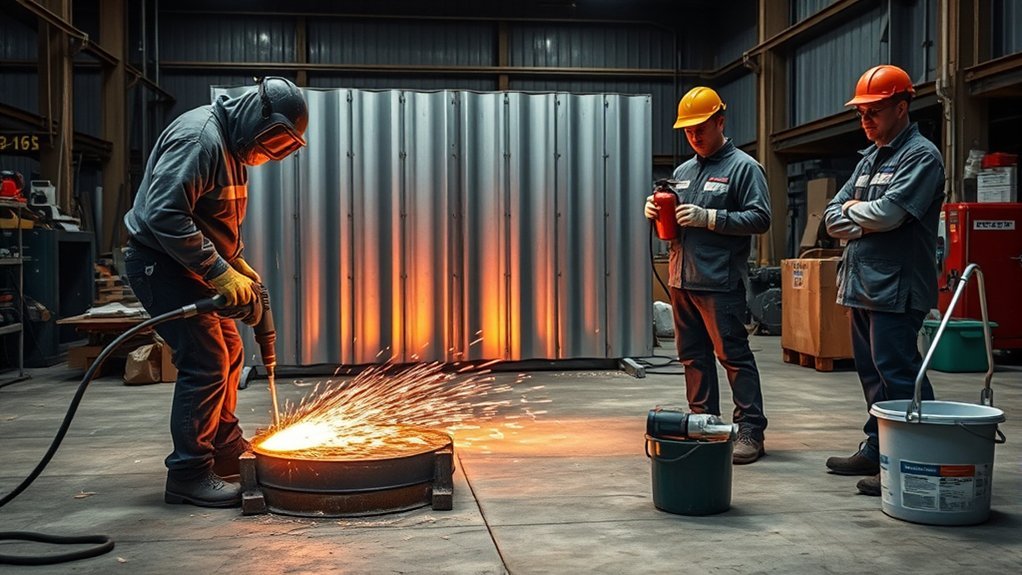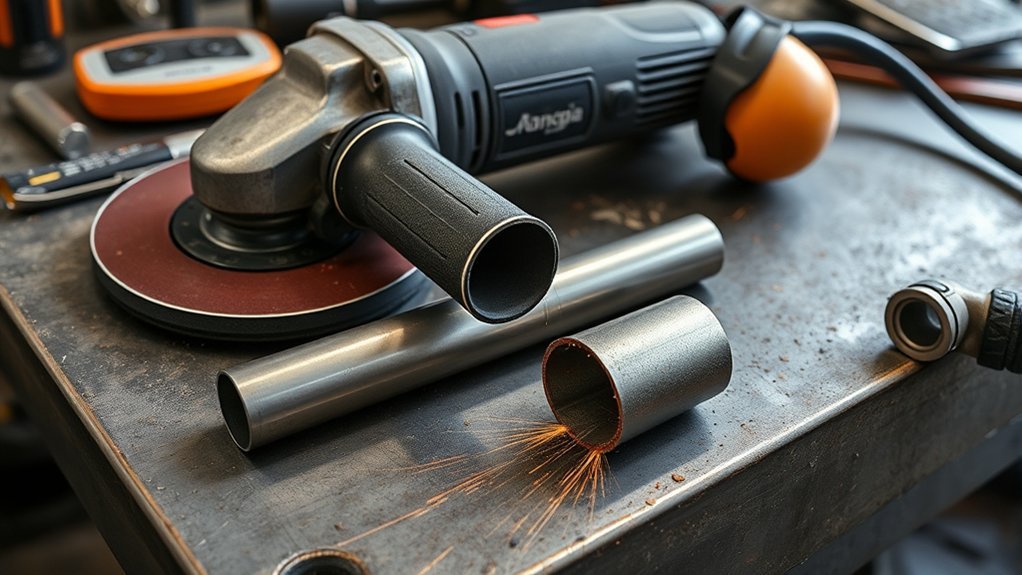
An angle grinder and a compact cut-off tool can both slice metal, but they are not interchangeable. The better choice depends on the cut, the material, the room around the work, and whether you also need to grind or finish the surface. This guide compares the tools, wheels, guards, and safety steps that matter before you pull the trigger.
Quick Answer
Choose a compact cut-off tool for narrow cuts, tight access, and thin stock. Choose an angle grinder when you also need to grind, deburr, sand, wire-brush, or polish, or when a larger wheel provides more reach. Neither tool is automatically safer: the correct wheel, guard, support, and technique matter most.
Key Takeaways
- A compact cut-off tool is usually easier to guide through sheet metal, small bolts, brackets, and tight spaces.
- An angle grinder is the better all-purpose choice for cutting plus grinding, deburring, rust removal, sanding, and polishing.
- Wheel diameter, arbor, type, material rating, and maximum RPM must all match the tool and its manual.
- Use a cutting guard for cut-off wheels when the manufacturer requires it; never grind on the face of a thin cut-off wheel.
- Secure the work, keep the kerf from closing, control dust and sparks, and wear both impact-rated eye protection and a face shield.
At a Glance
| Best for tight, narrow cuts | Compact cut-off tool |
| Best for one-tool versatility | Angle grinder |
| Typical small handheld size | Cut-off tools often use 3-inch wheels; small angle grinders commonly use 4-1/2- or 5-inch wheels. Check the exact model. |
| Main limitation | A cut-off tool is specialized; an angle grinder is bulkier and can be harder to place in confined areas. |
| Most important safety check | Match the wheel and guard to the tool, material, arbor, diameter, and rated speed. |
What’s in This Article
- What Angle Grinders and Cut-Off Tools Are
- Key Differences Between an Angle Grinder and Cut-Off Tool
- When to Use an Angle Grinder
- When to Use a Cut-Off Tool
- Wheel and Guard Compatibility
- Safety Checklist
- Cost and Value Comparison
- Which Tool Should You Choose?
- Frequently Asked Questions
- Conclusion
- Sources
What Angle Grinders and Cut-Off Tools Are
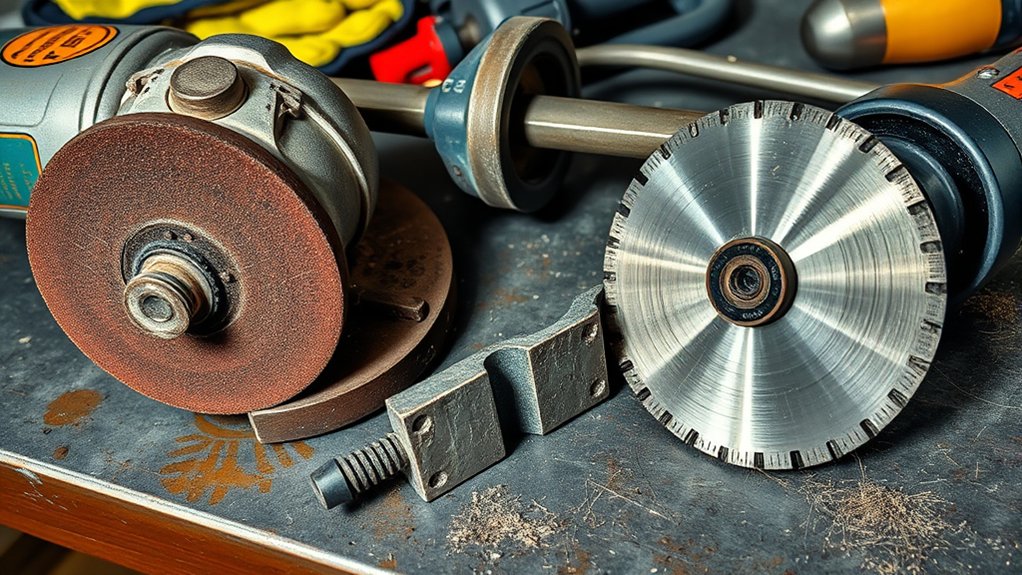
This comparison covers handheld compact cut-off tools, often built around a 3-inch wheel, and small angle grinders, commonly built around a 4-1/2- or 5-inch wheel. It does not cover a stationary abrasive chop saw or a large gas-powered cut-off machine.
An angle grinder has a geared head that places the spindle at a right angle to the motor. With the manufacturer-approved accessory and guard, it can cut, grind, deburr, sand, wire-brush, and polish. Small models are widely used for metal fabrication, repair work, masonry, tile, and surface preparation.
A compact cut-off tool is designed mainly for edge cutting. Current 3-inch models often include a shoe or dust shroud, a small guard, and forward/reverse wheel rotation. That layout can improve access and lets you direct sparks or debris away from yourself when the manual permits it. For example, Milwaukee describes its 3-inch model as optimized for one-handed use and compatible with approved metal, tile, and carbide abrasive wheels.
Note: “Cut-off tool” is a broad name. Always check the wheel diameter, arbor, guard, power source, and approved materials for the exact model rather than relying on the category name.
Key Differences Between an Angle Grinder and Cut-Off Tool
The main differences are tool purpose, wheel size, access, cutting depth, and accessory range. A compact cut-off tool usually favors control in confined spaces. An angle grinder usually favors capacity and versatility.
Precision, Kerf, and Cut Quality
A compact cut-off tool often feels easier to guide on thin sheet, small brackets, and short trim cuts because the wheel and tool body are smaller. A shoe or depth guide can also help hold a consistent cutting position.
However, the tool name does not guarantee a cleaner cut. Cut quality also depends on wheel thickness, wheel condition, material support, feed pressure, and whether the cut closes on the wheel. Angle grinders can use thin cut-off wheels too, so a steady operator can make a clean cut with either tool.
- Choose the cut-off tool when access and a narrow kerf matter most.
- Choose the angle grinder when the material is thicker or the larger wheel provides useful reach.
- Finish the edge with a separate grinding or flap disc on an angle grinder; do not use the side of a thin cut-off wheel.
Power, Capacity, and Depth of Cut
A larger wheel generally reaches deeper into pipe, bar, and thick stock. That often gives an angle grinder an advantage on heavier cutting jobs. A compact 3-inch cut-off tool has a shallower maximum depth, but it can reach places where a grinder head or side handle will not fit.
Do not compare tools by RPM alone. A 3-inch cut-off tool may spin near 20,000 RPM while a 4-1/2-inch angle grinder may run near 11,000 RPM. Wheel diameter changes rim speed, and the wheel must still be approved for the tool’s maximum no-load speed.
Versatility and Accessories
An angle grinder wins when one motor needs to perform several jobs. Depending on the manual, guard, and accessory system, it may accept grinding wheels, cut-off wheels, flap discs, sanding attachments, wire brushes, and polishing pads.
A compact cut-off tool is more specialized. It may cut metal, tile, masonry, plastic, drywall, or fiber cement with the correct approved wheel, but it is not a substitute for a grinder. Do not use it for side grinding unless the manufacturer expressly approves that operation and accessory.
Handling and Control
Some compact cut-off tools are designed for one-handed operation, but you still need a firm grip and a stable workpiece. Follow the exact manual, use the shoe when supplied, and keep your free hand out of the wheel path.
Use an angle grinder with both hands and the auxiliary handle unless the manufacturer gives different instructions for that exact setup. The larger exposed plane of the wheel, higher torque reaction, and wider range of accessories demand careful body position and control.
The best cutting tool is the one that fits the space and material while accepting the exact wheel and guard required for the job.
When to Use an Angle Grinder
Choose an angle grinder when you need more than a single cut. It is usually the better shop tool for thick metal, weld cleanup, rust removal, beveling, masonry surface work, and projects that need both cutting and finishing.
| Task | Why an Angle Grinder Fits |
|---|---|
| Cutting thick metal, rebar, or pipe | A larger approved wheel can provide more reach and capacity. |
| Grinding welds or beveling edges | A grinding wheel or flap disc removes and shapes material after the cut. |
| Removing rust, paint, or scale | Approved wire brushes and abrasive discs expand the tool’s use. |
| Grinding concrete or masonry | A suitable diamond cup wheel and dust shroud can remove material efficiently. |
| Sanding or polishing surfaces | The correct backing pad and speed-compatible accessory support finishing work. |
Use the wheel only for its intended operation. A cut-off wheel cuts on its edge. A grinding wheel removes material with an approved grinding surface. Switching from cutting to grinding may also require a different guard, flange, or accessory setup.
When to Use a Cut-Off Tool
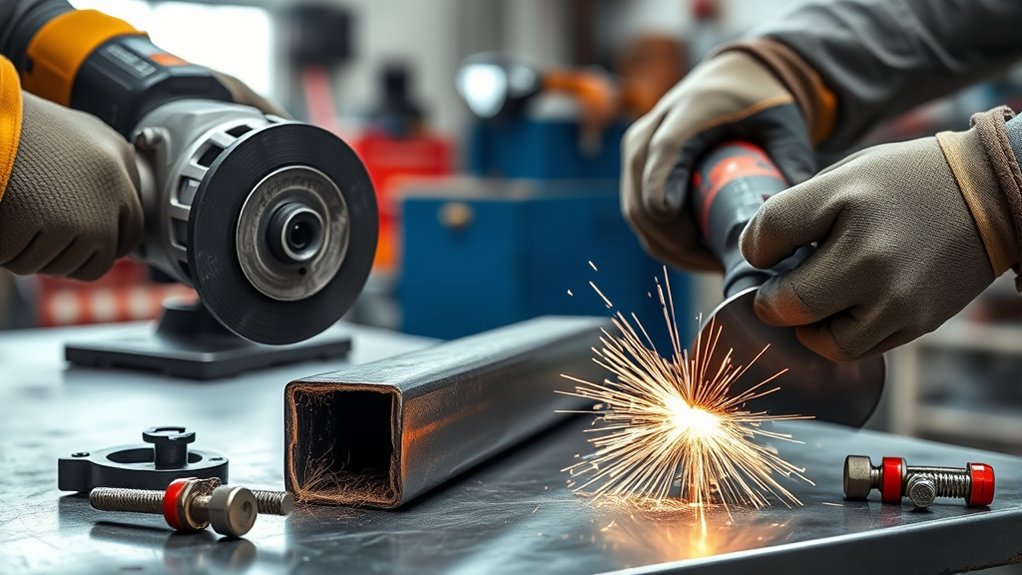
Choose a compact cut-off tool when the job is mainly a controlled cut and space is limited. Its small wheel and narrow body can help around brackets, body panels, small pipe, bolts, threaded rod, tile, and light fabrication.
Tight Access and Small Parts
A cut-off tool can fit where a grinder’s gearcase, guard, or side handle gets in the way. This is useful for short cuts near corners and for trimming small components that are securely held.
- Sheet metal and body panels: The narrow wheel can reduce material loss.
- Bolts, screws, and brackets: The compact body can improve access.
- Tile or masonry notches: Use only the approved diamond wheel and required dust controls.
- Plastic or fiber cement: Confirm that both the tool and wheel are rated for the material.
Cut Direction and Spark Control
Some cordless cut-off tools offer forward and reverse wheel rotation. Select the direction specified by the manual so the tool moves predictably and throws sparks or debris away from your body, nearby people, hoses, batteries, glass, and combustible material.
Rotation direction does not remove kickback risk. Keep the wheel straight in the kerf, support the material so the cut does not pinch closed, and stop the wheel before backing out or changing direction.
Automotive Cutting Cautions
Before cutting on a vehicle, inspect both sides of the work area. Locate fuel and brake lines, wiring harnesses, air-conditioning lines, airbag components, the fuel tank, and interior trim that could ignite. Use the vehicle’s service information before disconnecting or moving any system.
Warning: Never cut, drill, grind, or probe an electric or hybrid vehicle’s high-voltage battery enclosure, orange high-voltage cables, or marked high-voltage components. Isolate the vehicle only by the manufacturer-approved service procedure or send the job to a qualified technician.
Wheel and Guard Compatibility
The wheel is not safe just because it physically fits. Before installation, confirm every item below against the tool manual and wheel label:
- Wheel diameter: Never install a wheel larger than the tool permits.
- Arbor and flange: The wheel must seat correctly without forcing, makeshift bushings, or improvised adapters.
- Maximum RPM: The wheel’s rated speed must equal or exceed the tool’s maximum no-load speed.
- Wheel type: Use a cut-off wheel, grinding wheel, diamond blade, carbide abrasive wheel, flap disc, or brush only for its approved task.
- Material rating: Match the wheel to steel, stainless steel, aluminum, masonry, tile, plastic, or other material as stated by the manufacturer.
- Guard and flange: Use the guard and mounting parts specified for that wheel type.
- Rotation arrow: Match directional diamond wheels to the selected rotation direction.
OSHA’s portable-grinder rules require guards to be positioned between the operator and the wheel so fragments are deflected away if a wheel breaks. Current angle-grinder systems may use a more enclosed Type A cutting guard for cut-off wheels and a Type B grinding guard for grinding wheels. Follow the tool manual; guard names and approved combinations vary by manufacturer.
Warning: Never apply side pressure to a thin cut-off wheel or use its face for grinding. Manufacturer instructions warn that this can crack and break the wheel.
Safety Checklist
Both tools can throw wheel fragments, sparks, chips, and dust at high speed. Use this checklist before every cut.
Before the Cut
- Disconnect power. Unplug the tool or remove the battery before changing wheels, guards, flanges, or depth settings.
- Read the manual and wheel label. Confirm the tool, wheel, guard, arbor, material, and RPM are compatible.
- Inspect the wheel. Do not use a cracked, chipped, dropped, wet, contaminated, or out-of-date bonded abrasive wheel.
- Check the guard. Secure it in the position that places the barrier between you and the wheel.
- Secure the workpiece. Use a vise or clamps. Support both sides so the offcut cannot trap the wheel or fall unexpectedly.
- Clear the area. Move fuel, solvents, paper, sawdust, oily rags, batteries, and other combustible items away from the spark path. Keep an appropriate fire extinguisher nearby.
- Wear PPE. Use impact-rated eye protection with side protection plus a face shield, hearing protection, suitable gloves, sturdy footwear, and close-fitting nonflammable clothing. Tie back long hair and remove loose jewelry.
During the Cut
- Stand out of the wheel’s plane and keep bystanders away from it.
- Let the wheel reach full speed before contact.
- Use light, steady feed pressure; forcing the tool can slow the wheel, increase heat, and reduce control.
- Keep a cut-off wheel straight. Do not twist, pry, or steer sharply while it is inside the kerf.
- Use both hands on an angle grinder and the auxiliary handle supplied with it.
- Route sparks and debris away from your body, the cord or battery, hoses, glass, and flammable material.
- If the wheel binds, release the trigger and hold the tool still until the wheel stops. Correct the support or alignment before restarting.
After the Cut
- Let the wheel stop completely before removing it from the work or setting the tool down.
- Remember that the cut edge and workpiece may remain hot and sharp.
- Disconnect power before inspecting the wheel or clearing debris.
- Clean dust with a method suited to the hazard; do not blow silica-containing dust from clothing or surfaces with compressed air.
Pro Tip: Mark the cut, make a shallow starter pass when the material and wheel allow it, and position supports so the kerf opens rather than pinches. Better support often improves accuracy more than switching tools.
Dust and Coated Materials
Grinding or cutting concrete, mortar, stone, and some tile can release respirable crystalline silica. OSHA’s construction silica standard lists engineering controls for handheld grinders and saw-type cutting tasks, including approved water delivery or shrouded dust collection systems where applicable. Follow the tool, wheel, and dust-control instructions; a casual shop vacuum may not meet the required control standard.
Paint, plating, sealers, and residues can also create hazardous dust or fumes. Identify the coating before cutting, use suitable ventilation and exposure controls, and do not cut containers or parts that may hold fuel, solvent, refrigerant, or pressure.
Cost and Value Comparison
There is no reliable rule that one category always costs less. Price changes with brand, power source, wheel size, safety features, battery capacity, charger, guard package, and included accessories.
- Angle grinder value: Usually better when you need several operations from one tool.
- Cut-off tool value: Usually better when tight access and repeated small cuts are the main need.
- Battery-platform value: A bare tool may be economical if you already own compatible batteries and a charger.
- Operating cost: Include approved wheels, replacement guards or flanges, dust extraction, PPE, and clamps.
- Downtime cost: A brake, no-lock-on switch, kickback control, or easier guard adjustment may be worth more than the lowest purchase price.
Choose by job fit and safety system first. A cheaper tool is poor value if it cannot accept the correct guard or wheel for the work you actually perform.
Products Worth Considering

【Including】27-Pack Angle Grinder Cutting and Grinding Wheel Set consist of 3 kinds of wheel discs: 20pcs cutting wheels in 3/64” thick; 3pcs grinding wheels in 1/4” thick; 4pcs Zirconia flap discs; Great cutting and grinding wheel set for Metal and Stainless Steel.
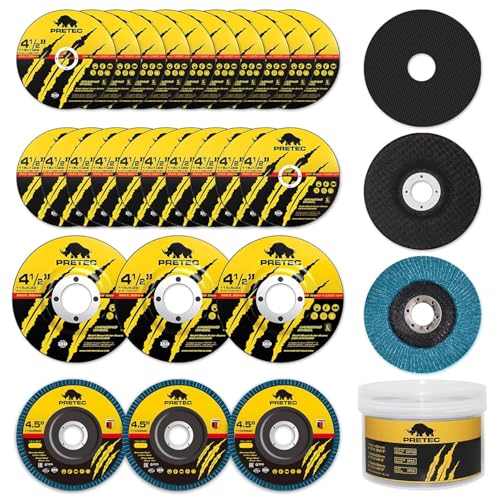
26pcs Angle Grinder Disc 4-1/2 inch & 3 Different Types : ✅ The 26 packs angle grinder wheels 4-1/2 inch including 20 Packs 4.5"x1/4"x7/8" Cut off Wheels, 3 Packs 4.5"x7/8" 60 Grit Flap Discs, 3 Packs 4.5"x1/25"x7/8" Grinding Wheels, with each type of disk collectively wrapped with those of its kind. This kit has everything you need to prep steel.

Which Tool Should You Choose?
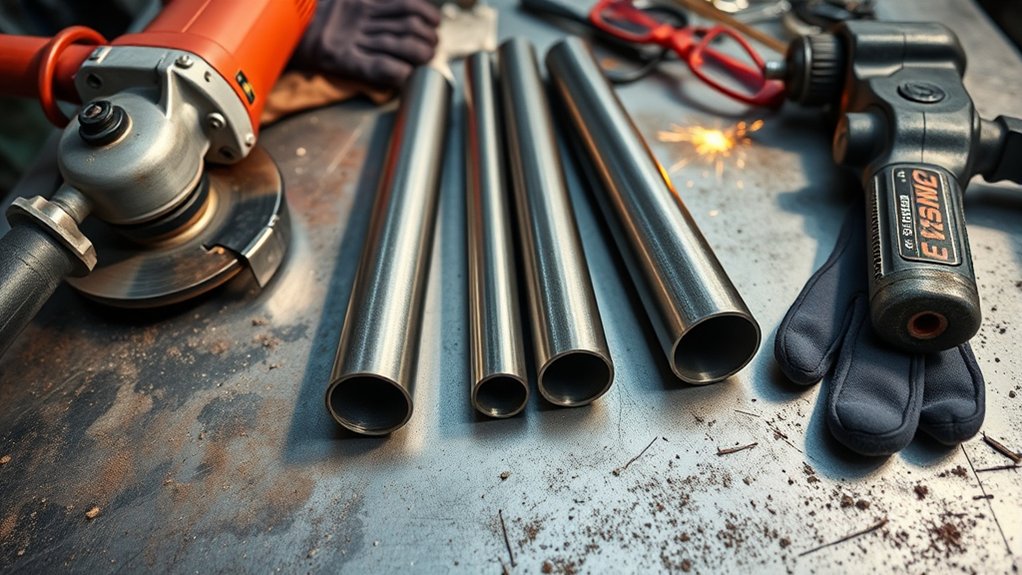
Use the job list below as a starting point, then confirm the exact tool and wheel manual.
| Job | Better First Choice | Reason |
|---|---|---|
| Trim thin sheet metal or a small bracket | Cut-off tool | Compact access and a narrow cutting path. |
| Cut rebar, thick pipe, or heavy stock | Angle grinder | A larger wheel usually offers more reach. |
| Cut and then smooth a weld | Angle grinder | Change to the correct grinding or flap disc for finishing. |
| Make a small tile notch | Cut-off tool | Small wheel and shoe can improve control, with the approved diamond blade. |
| Remove rust, scale, or paint | Angle grinder | Accepts approved brushes and surface-conditioning accessories. |
| Work inside a crowded assembly | Cut-off tool | Narrower body can fit around nearby parts. |
| Build a general repair kit with one tool | Angle grinder | Handles the widest range of approved accessories and tasks. |
Choose another tool when it controls the work better. A metal-cutting bandsaw or chop saw is often better for repeated square cuts; a reciprocating saw may be safer where abrasive sparks are unacceptable; and an oscillating tool may suit flush cuts in delicate, confined areas.
Products Worth Considering

Super Power : Equipped with a 4 Amps motor along with a 500 W maximum power output, the unique power output of this 4-1/2 angle grinder can produce a no-load speed of 11000 RPM, giving it fast cutting and grinding capacity

[High-Performance Cutting] Designed for cutting metal & stainless steel, these cut off wheels 4 1/2 inch work efficiently with any angle grinder wheel, supporting speeds up to 13,300 RPM.

【POWERFUL 16.8V CORDLESS ANGLE GRINDER】Experience absolute freedom for garage projects. Powered by a reliable 16.8V system, this TEENO battery powered grinder delivers consistent power for auto repairs. The smart dual-battery kit lets you swap the two 2000mAh packs instantly. It’s the perfect cordless grinder for quick metalwork when pulling out bulky power tools isn't practical.
Frequently Asked Questions
Can a grinder cut open a safe?
An angle grinder may cut some safe materials, but doing so can cause fire, toxic smoke, wheel breakage, and damage to the contents. Only work on a safe you legally own. For a locked or damaged safe, use the manufacturer or a licensed locksmith rather than attempting an uncontrolled cut.
What are the disadvantages of an angle grinder?
An angle grinder is louder, bulkier, and less convenient in tight spaces than a compact cut-off tool. It can produce strong torque reaction, sparks, dust, and aggressive material removal. Safe use also depends on the correct wheel, guard, auxiliary handle, support, and two-handed control.
Can you use an angle grinder with a cut-off wheel?
Yes, when the grinder manufacturer approves cutting and the wheel matches the tool’s diameter, arbor, maximum RPM, flange, material, and required cutting guard. Keep the wheel straight and use only its edge. Never grind with the face of a thin cut-off wheel.
What is the best power tool to cut locks?
For a lock you own or are authorized to remove, the safest choice depends on the lock, location, nearby property, and fire risk. A locksmith can often remove it with less damage. Do not cut a lock without clear ownership or permission.
Is a cut-off tool safer than an angle grinder?
Not automatically. A compact cut-off tool may be easier to place and control for small cuts, while an angle grinder may provide better capacity and two-handed leverage. Either tool can kick back or break a wheel if the setup, guard, support, or technique is wrong.
Can a cut-off tool replace an angle grinder?
It can replace an angle grinder for some small cutting jobs, but it cannot replace grinding, beveling, rust removal, sanding, wire-brushing, or polishing functions unless the manufacturer specifically approves those accessories and operations.
Can both tools use the same cutting wheels?
Usually not. Even when two wheels look similar, diameter, arbor, thickness, maximum RPM, flange design, rotation direction, and guard requirements may differ. Use only wheels listed or approved for the exact tool and application.
Which tool makes the straightest cut?
A compact cut-off tool with a stable shoe often helps on short, narrow cuts, but support and technique matter more than the label. Mark the line, clamp the work, prevent the kerf from closing, and use a guide when the tool manufacturer allows it.
Conclusion
Pick a compact cut-off tool for narrow cuts, small parts, and tight access. Pick an angle grinder when you need greater reach or want one tool for cutting, grinding, deburring, sanding, and polishing.
Whichever tool you choose, match the wheel and guard to the manual, secure the workpiece, control the spark and dust path, and keep the wheel straight. Correct setup and support matter more than raw RPM or tool size.
Sources
- OSHA 29 CFR 1910.243, Guarding of Portable Powered Tools — portable grinder guard placement and wheel-fragment protection.
- OSHA 29 CFR 1910.133, Eye and Face Protection — protection from flying particles and side-impact hazards.
- OSHA 29 CFR 1926.1153, Respirable Crystalline Silica — dust controls for cutting and grinding silica-containing materials.
- Milwaukee M12 FUEL 3-Inch Cut-Off Tool Operator’s Manual — wheel installation, guard adjustment, cutting technique, and kickback precautions.
- Milwaukee 4-1/2- and 5-Inch Angle Grinder Operator’s Manual — two-handed operation, wheel speed compatibility, and cut-off wheel limitations.
- U.S. Department of Energy Alternative Fuels Data Center: EV Maintenance and Safety — identification and isolation of high-voltage vehicle systems.