Disclosure: As an Amazon Associate, we earn from qualifying purchases. If you click a link on this page and make a purchase, we may receive a small commission at no extra cost to you.
ARCCAPTAIN TIG200P AC/DC Welder Review
Aluminum TIG welding becomes difficult when your machine lacks AC cleaning control, pulse adjustment, or enough output for thicker work. The ARCCAPTAIN TIG200P AC/DC combines aluminum-capable AC TIG, DC TIG, pulse TIG, stick welding, and timed spot TIG control in a portable 26.5 lb unit. Its broad adjustment range gives you more control than a basic entry-level welder, but the standard package does not include a foot pedal and full 200A TIG output requires 220V power. This review explains the verified specifications, practical limitations, setup requirements, and buyer types that get the most value from it.
Quick Verdict
Rating: 8.2/10
Best For: DIY fabricators, hobby welders, and light shop users who need AC/DC TIG, pulse adjustment, and portable aluminum welding capability.
Bottom Line: The TIG200P gives you useful AC waveform settings, dual-voltage operation, and a wide selection of TIG controls in a manageable 26.5 lb package. Its main tradeoffs are a 25% duty cycle at maximum output, no foot pedal in the standard package, and lower output when connected to 110V.
| Specification | Detail |
|---|---|
| Brand | ARCCAPTAIN |
| Model | TIG200P AC/DC, also shown as TIG200PACDC |
| Product Type | Dual-voltage AC/DC inverter TIG and stick welder |
| Input Voltage | AC 110V ±15% or AC 220V ±15% |
| TIG Output | 10 to 120A on 110V; 10 to 200A on 220V |
| Stick Output | 10 to 110A on 110V; 10 to 160A on 220V |
| Welding Modes | AC TIG, DC TIG, AC pulse TIG, DC pulse TIG, square and triangular AC waveforms, Stick/MMA, and spot TIG control |
| Listed Material Range | 0.5 to 5 mm aluminum; 0.5 to 10 mm for other listed weldable metals |
| AC Output Frequency | 20 to 250 Hz |
| AC Balance | 20% to 60% |
| Pulse Frequency | 0.5 to 200 Hz in DC; 0.5 to 25 Hz in AC |
| Pulse Duty Factor | 5% to 95% |
| Gas Timing | Pre-flow: 0 to 5 seconds; post-flow: 0 to 15 seconds |
| Slope Adjustment | Upslope and downslope: 0 to 15 seconds |
| Arc Start | High-frequency arc start |
| Torch Controls | 2T, 4T, and spot TIG modes |
| Foot Pedal | Supported, but sold separately with the standard package |
| Maximum-Output Duty Cycle | TIG 200A at 25%; Stick/MMA 160A at 25% |
| Cooling | Air-cooled |
| Weight | 12 kg / 26.5 lb |
| Protection Class | IP21S |
| Insulation Class | Class B |
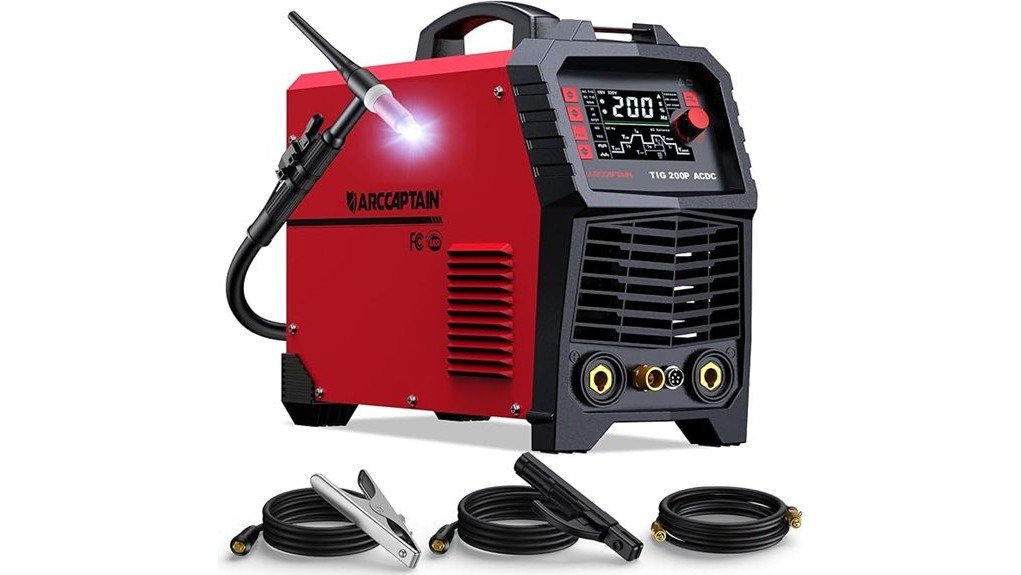
| Included Accessories | 13 ft WP-26 TIG torch, 10 ft ground clamp, 10 ft electrode holder, voltage adapter, argon hose, brush and hammer, tungsten electrode, gas regulator, and manual |
| Regulator Connection Note | Replacement regulators should be compatible with CGA-580, 0.965 inch × 14 TPI |
| Warranty / Service Note | ARCCAPTAIN lists five years for core components with exclusions; Amazon currently states three years of quality service. Confirm the applicable terms before purchase. |
What Is the ARCCAPTAIN TIG200P AC/DC?
The ARCCAPTAIN TIG200P AC/DC is a portable inverter welder designed for aluminum, mild steel, stainless steel, carbon steel, copper, and other suitable weldable metals. It combines AC TIG for aluminum and magnesium alloys with DC TIG for ferrous metals and copper.
The machine also includes pulse TIG, adjustable square and triangular AC waveforms, Stick/MMA welding, and a timed spot TIG function. This combination is aimed at users who need more control than a basic DC-only TIG machine but do not need a large industrial power source.
The standard package includes the main leads, a WP-26-style TIG torch, an argon regulator and hose, one tungsten electrode, and basic cleaning tools. Shielding gas, filler rod, complete personal protective equipment, extra consumables, and the optional foot pedal must still be purchased or supplied separately.
Who Should Buy It?
Best For
- DIY fabricators who need AC TIG for aluminum and DC TIG for steel or stainless projects
- Hobby and light shop users who want pulse, AC balance, AC frequency, slope, and gas-timing adjustments
- Garage welders who value dual-voltage operation and a 26.5 lb body that can be moved between work areas
Skip If
- You need long, repeated welds at the full 200A output without frequent cooling periods
- You want a complete TIG package with a foot pedal, shielding gas, filler rod, helmet, and gloves included
- You need a premium production machine backed by a local industrial welding-equipment dealer
Before You Buy: The advertised 200A TIG output is available on 220V. Output is limited to 120A TIG and 110A Stick/MMA on 110V, and the standard package does not include a foot pedal. Check your electrical circuit, plug arrangement, and package option before ordering.
Feature-by-Feature Review
AC/DC TIG and Stick Welding Modes
AC TIG is the feature that separates this machine from less expensive DC-only TIG welders. Alternating current provides the cleaning action needed to break through the oxide layer on aluminum, while DC TIG is suited to mild steel, stainless steel, carbon steel, and copper.
The machine also reaches 160A in Stick/MMA mode on 220V. Stick welding gives you a practical backup process for outdoor repair, thicker steel, or material that is not clean enough for detailed TIG work. It does not replace a high-output production stick welder, but it expands the range of repairs you can complete with one power source.
ARCCAPTAIN and Amazon describe the machine as a 7-in-1 welder, although the exact count depends on whether individual AC waveform combinations are counted as separate processes. The useful point is that you can select AC TIG, DC TIG, pulse variations, Stick/MMA, and timed spot TIG control from the same panel.
Pulse, Square, and Triangular Waveform Control
Pulse TIG alternates between peak and background current. This gives you more control over average heat input, puddle timing, and travel rhythm when welding thin sheet or heat-sensitive parts. The machine provides a broad 0.5 to 200 Hz pulse range in DC and a narrower 0.5 to 25 Hz range in AC.
Square-wave AC switches polarity quickly and supports a focused, stable arc with effective oxide cleaning. The 20 to 250 Hz AC frequency range lets you adjust how concentrated the arc feels. Higher frequency generally creates a narrower, more focused arc, while lower settings produce a wider arc pattern.
The triangular waveform is intended to reduce average heat input and bring the weld current back down quickly. It can be useful on thin aluminum where excess heat raises the risk of distortion or edge burn-through. These settings still require practice, clean material, correct gas coverage, and a suitable tungsten setup.
AC Balance and Heat Management
The 20% to 60% AC balance range changes the relationship between electrode-negative penetration and electrode-positive cleaning action. More cleaning can help with contaminated or heavily oxidized aluminum, but excessive cleaning also adds heat to the tungsten and can reduce penetration.
You should not treat one AC balance value as correct for every project. The right setting depends on alloy, surface preparation, joint shape, tungsten size, amperage, and material thickness. Starting near the middle of the available range and adjusting on scrap is safer than making a large change on the finished part.
Digital Panel and Torch Controls
The large display shows the selected welding parameters and makes the machine easier to configure than a panel filled with unmarked or multi-purpose knobs. Available adjustments include pre-flow, initial current, upslope, peak current, background current, pulse duty, downslope, crater current, post-flow, AC frequency, AC balance, and pulse frequency.
You can select 2T, 4T, or spot TIG torch control. In 2T mode, you normally hold the torch switch while welding. The 4T sequence reduces the need to hold the switch throughout a longer pass. Spot TIG control is useful for repeatable timed tacks, but it is not the same process as a two-sided resistance spot welder used for automotive sheet-metal panels.
Remote amperage control is supported, but the standard machine package does not include the pedal. Torch-switch control is workable for practice and many bench projects, although a compatible pedal gives you better real-time amperage control as the part heats up.
Dual-Voltage Output
Dual-voltage operation makes the TIG200P easier to use in a home garage, but 110V and 220V performance are not equal. On 110V, TIG output is limited to 120A and Stick/MMA output is limited to 110A. That can be enough for thinner material, practice pieces, and lower-amperage repair work.
Connecting the machine to 220V opens the full 10 to 200A TIG range and the 10 to 160A Stick/MMA range. Buyers planning aluminum fabrication near the upper end of the listed thickness range should treat 220V as a practical requirement rather than an optional convenience.
Portability and Included Accessories
At 12 kg, or 26.5 lb, the welder is light enough to move around a garage or carry to an occasional repair project. It is still only one part of a mobile TIG setup because you must also transport the shielding-gas cylinder, filler material, PPE, leads, and consumables.
The standard accessory list is useful for getting the machine assembled. It includes a 13 ft WP-26 TIG torch, 10 ft ground clamp, 10 ft electrode holder, voltage adapter, argon hose, gas regulator, brush and hammer, tungsten electrode, and manual.
No protective carrying case is listed with the standard package. A welding cart or ventilated protective storage setup can help prevent damage to the display, connectors, torch, and leads when the machine is not in use.
Pro Tip: Keep a written settings log for each alloy and thickness you weld. Record amperage, AC frequency, AC balance, pulse settings, gas flow, tungsten type, and filler rod so you can return to a successful starting point later.
Safety, Duty Cycle, and Warranty
ARCCAPTAIN lists VRD, over-current, over-voltage, overload, and over-temperature protection. These protections can help the machine respond to certain electrical or thermal problems, but they do not replace correct grounding, dry work conditions, proper ventilation, suitable PPE, or a correctly sized electrical circuit.
The published maximum-output duty cycle is 25% at 200A TIG and 25% at 160A Stick/MMA. This indicates that full-output welding requires substantial cooling time. Actual thermal performance can also change with ambient temperature, airflow, input voltage, extension-cord use, and how frequently you restart the arc.
The IP21S enclosure rating provides limited protection against solid objects and vertically falling water drops under defined test conditions. It does not make the machine weatherproof. Keep it dry, maintain clear airflow around the vents, and do not use it in rain or standing water.
Warranty wording should be checked before purchase. ARCCAPTAIN currently describes a five-year warranty for core components and excludes wear parts and structural components, while the Amazon listing states three years of quality service. Save your receipt, register the machine when required, and confirm which policy applies to the seller and package you select.
How It Performs in Real Use
For Aluminum Fabrication
The combination of AC TIG, 20 to 250 Hz AC frequency, 20% to 60% AC balance, and AC pulse control gives you the adjustments needed for aluminum sheet, brackets, small frames, and hobby fabrication. The listing states an aluminum range of 0.5 to 5 mm, but achievable results depend on joint design, alloy, preparation, torch technique, power input, and available amperage.
For work near the upper end of that range, use 220V and expect the 25% full-output duty cycle to limit continuous welding. Thin aluminum benefits from the pulse and triangular-wave options, but those controls cannot compensate for poor cleaning or weak gas coverage.
For Stainless and Mild Steel
DC TIG provides controlled, clean welding for stainless and mild steel when the joint is properly prepared. The low 10A starting point is helpful for smaller parts, although very delicate sheet still requires good torch control and careful heat management.
Stick/MMA mode adds flexibility for gates, brackets, equipment repairs, and other steel work where appearance is less important than speed or penetration. The full 160A stick output requires 220V.
For Thin Sheet and Heat-Sensitive Parts
DC pulse up to 200 Hz, AC pulse up to 25 Hz, adjustable background current, and a 5% to 95% pulse duty factor give you several ways to reduce average heat input. These controls can help limit distortion and make puddle timing more repeatable.
The number of settings may also slow down inexperienced users. Change one variable at a time and test the result on scrap from the same material before welding the finished part.
For Garage and Mobile Repair
The 26.5 lb machine is easier to move than a large transformer-based TIG welder. Dual-voltage input also gives you more flexibility when traveling between a home garage and a workshop with 220V service.
Portability is limited by the rest of the TIG system. The argon cylinder must remain secured upright during use and transport, and the torch, leads, regulator, filler rods, consumables, and PPE need separate storage.
Setup Tips Before First Use
- Confirm the power source. Use a correctly grounded circuit that meets the machine and local electrical requirements. Do not assume every household outlet or extension cord can support maximum input.
- Inspect the package. Check the torch, ground lead, electrode holder, regulator, hose, adapter, connectors, and machine housing for shipping damage before powering the unit.
- Secure the gas cylinder. Keep the argon cylinder upright and restrained. Use the correct regulator connection and inspect the hose and fittings for leaks.
- Prepare the metal. Remove oil, paint, moisture, and oxidation. Use a dedicated stainless-steel brush for aluminum so you do not transfer carbon-steel contamination.
- Choose suitable consumables. Match the tungsten diameter, tungsten type, filler rod, cup, and gas flow to the material and amperage. Follow the machine manual and consumable manufacturer guidance.
- Start with simple settings. Establish a stable non-pulse weld before adding pulse, changing AC frequency, or making large AC balance adjustments.
- Protect yourself and the work area. Wear a suitable welding helmet, gloves, flame-resistant clothing, and eye protection. Remove flammable materials and provide appropriate ventilation.
- Respect thermal limits. Stop if the thermal warning activates, airflow becomes blocked, or the machine behaves abnormally. Allow the cooling system to complete its cycle as directed by the manual.
Pros and Cons
Pros
- AC and DC TIG support covers aluminum, steel, stainless steel, carbon steel, and copper
- Adjustable pulse, AC frequency, AC balance, slope, crater, and gas-timing controls
- Full 10 to 200A TIG range on 220V
- Dual-voltage input supports both garage practice and higher-output shop use
- 26.5 lb body and a useful standard accessory package improve portability and setup value
Cons
- The standard package supports a foot pedal but does not include one
- Maximum TIG and Stick output carries a 25% published duty cycle
- Warranty and service wording differs between the manufacturer and Amazon listings
- New TIG users may find the large number of waveform and timing adjustments difficult at first
Is It Worth the Price?
The ARCCAPTAIN TIG200P AC/DC sits in the value-focused part of the aluminum TIG market. It is worth considering when you need AC TIG, pulse control, dual-voltage input, and a broad digital adjustment range without moving directly to a premium industrial machine.
You get the most value when you will use several of its capabilities. A shop that regularly switches between aluminum TIG, stainless TIG, mild-steel TIG, and occasional stick repair can make better use of the machine than someone who only needs basic stick welding.
Budget for the complete setup rather than the power source alone. Shielding gas, filler rod, PPE, extra tungsten, replacement consumables, a welding cart or case, and an optional foot pedal can add to the total cost.
How It Compares to Alternatives
The Weldpro TIG200ACDC is worth comparing if an included foot pedal is a priority. The LOTOS TIG200ACDC also combines 200A AC/DC TIG, dual-voltage input, a regulator, and a foot pedal in its listed package.
The PrimeWeld TIG225X offers more rated amperage and includes a foot pedal, regulator, TIG torch, gas hose, and starter consumables. The ARCCAPTAIN makes the most sense when you prefer its compact 26.5 lb design, 250 Hz AC frequency ceiling, digital control layout, and lower-cost standard package, and you are comfortable adding a pedal separately.
Frequently Asked Questions
Can the ARCCAPTAIN TIG200P weld aluminum?
Yes. It includes AC TIG modes designed for aluminum and magnesium alloys. The listing states an aluminum thickness range of 0.5 to 5 mm, although actual capacity depends on power input, alloy, joint preparation, technique, and duty-cycle limits.
Can it produce 200 amps on a 110V outlet?
No. The published TIG range on 110V is 10 to 120A, while the full 10 to 200A range is available on 220V. Stick output is limited to 110A on 110V and reaches 160A on 220V.
Does the standard package include a foot pedal?
No. The welder supports remote foot-pedal amperage control, but the standard machine package lists the pedal as a separate purchase. Some manufacturer bundle options may include one, so check the exact package contents before ordering.
What shielding gas should you use?
Use 100% argon for normal TIG welding with this machine. Confirm the regulator connection, set gas flow for the torch and working conditions, and inspect all fittings for leaks before striking an arc.
What does the 25% duty cycle mean for buyers?
It means the machine is not designed for uninterrupted welding at its maximum rated output. High-amperage work requires cooling periods, and actual run time can change with ambient temperature, airflow, input power, and operating conditions.
What comes in the standard box?
The listed package includes the welder, 13 ft WP-26 TIG torch, 10 ft ground clamp, 10 ft electrode holder, voltage adapter, argon hose, brush and hammer, tungsten electrode, gas regulator, and manual. Shielding gas, filler rod, full PPE, and the foot pedal are not listed with the standard machine package.
Is the spot TIG function the same as resistance spot welding?
No. The machine’s spot TIG mode provides timed TIG output for controlled tacks or repeated short welds. It does not replace a two-sided resistance spot welder used to clamp and fuse overlapping automotive sheet metal.
Is the ARCCAPTAIN TIG200P suitable for beginners?
It can suit a motivated beginner who wants to learn AC/DC TIG and is willing to practice on scrap. The digital display helps you see each setting, but AC balance, pulse duty, waveform selection, slope timing, and crater control create a steeper learning curve than a basic stick or fixed-setting TIG machine.
The Bottom Line
The ARCCAPTAIN TIG200P AC/DC earns an 8.2/10 for its aluminum-capable AC TIG modes, broad pulse and waveform controls, dual-voltage input, and portable 26.5 lb design. It is a strong fit for DIY fabricators, hobby welders, and light shops, but production users should look elsewhere if they need a higher full-output duty cycle, dealer-level support, or a foot pedal included as standard.
Ready to Buy?
Check the latest package contents, warranty terms, price, and product details before you decide.