
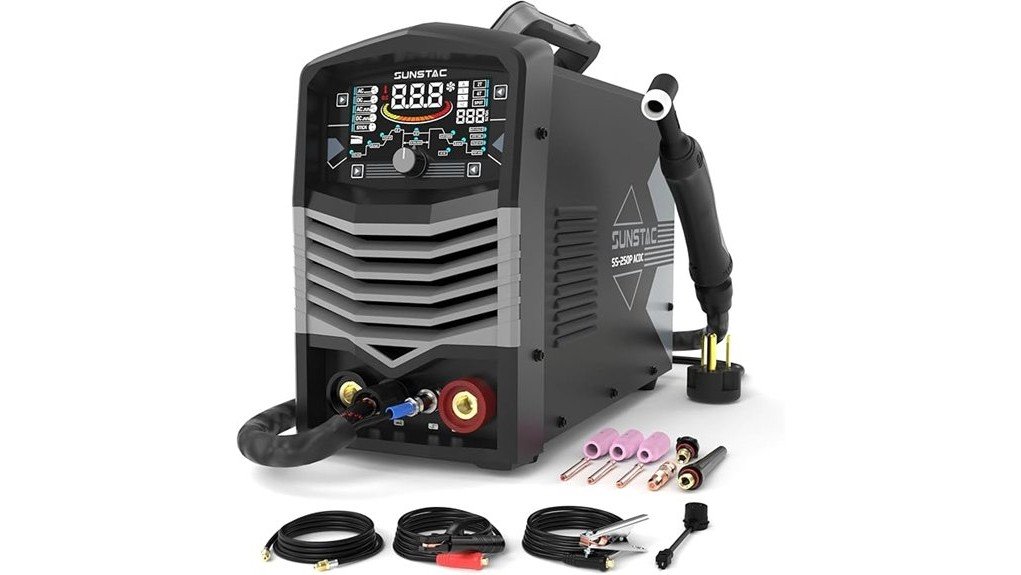
Disclosure: As an Amazon Associate, we earn from qualifying purchases. If you click a link on this page and make a purchase, we may receive a small commission at no extra cost to you.
Aluminum TIG welding often forces you to choose between a basic DC machine that cannot weld aluminum and a more flexible AC/DC unit that costs more. The Sunstac 250A AC/DC Aluminum TIG Welder with Pulse, model SS-250P/ACDC, aims to cover that gap with 110V/220V input, AC and DC TIG, pulse, spot, and stick modes in one 29.9-pound package. This review explains where those controls can help, what the current product listing confirms, and which limits matter before you order. Its main tradeoffs are the separately sold foot pedal and the seller’s warning that AC-mode current readings can vary with AC Balance.
Quick Verdict
Rating: 8/10, recommended with caveats
Best For: DIY welders and small fabrication shops that need AC TIG for aluminum and DC TIG for steel from one dual-voltage machine.
Bottom Line: The SS-250P/ACDC offers a broad set of TIG controls, a clear LCD, and useful 110V/220V flexibility. You should budget for a compatible foot pedal and treat the AC amperage display as a reference rather than a calibrated measurement.
| Specification | Detail |
|---|---|
| Brand | Sunstac |
| Model | SS-250P/ACDC |
| Product type | AC/DC TIG welder with pulse, spot, and stick modes |
| Input voltage | 110V/220V dual voltage |
| Claimed maximum output | Up to 250A |
| Processes | High-frequency AC TIG, high-frequency DC TIG, pulsed AC, pulsed DC, AC spot, DC spot, and stick |
| Listed metals | Aluminum, aluminum alloy, alloy steel, stainless steel, carbon steel, copper, and iron |
| Claimed aluminum capacity | Up to 5/32 in (4 mm) on 110V and up to 6 mm, roughly 1/4 in, on 220V |
| Display | LCD digital screen |
| Trigger controls | 2T, 4T, and spot modes |
| Parameter memory | Yes, according to the listing |
| Foot pedal support | Supported, but pedal is not included |
| Item weight | 29.9 pounds |
| Package dimensions | 19 x 18.8 x 12.4 inches |
| Color and material | Black metal housing |
| Package quantity | One unit |
| ASIN | B0CNQQBZNW |
| Important limitation | The seller states that AC-mode current measurement can be inaccurate and vary with AC Balance. |
Key Takeaways
- The SS-250P/ACDC combines AC TIG for aluminum, DC TIG for common steels, pulse and spot controls, and stick welding in one machine.
- Dual-voltage input lets you use 110V where needed, but the listing assigns the higher claimed aluminum thickness to 220V operation.
- The LCD, 2T/4T controls, and parameter memory can make repeated setup easier once you have tested a working recipe.
- The foot pedal is not included, so confirm pedal connector compatibility and total cost before ordering.
- The AC amperage display is not presented as lab-accurate. You still need test coupons, sound technique, and visual inspection to set the machine correctly.
What Is the Sunstac SS-250P/ACDC?
The Sunstac SS-250P/ACDC is a dual-voltage inverter built around AC/DC TIG. AC output supports aluminum oxide cleaning, while DC TIG suits carbon steel and stainless steel. It also adds pulsed AC, pulsed DC, spot modes, and stick welding.
Its appeal is range rather than simplicity. The 29.9-pound machine gives you many controls, but you still need correct preparation, shielding gas, tungsten, filler, and practice.
Who Should Buy It?
Best For
- Garage welders who need AC TIG for aluminum and DC TIG for steel from one machine.
- Small shops that repeat similar jobs and can benefit from saved parameters, 4T operation, pulse, or spot control.
- Buyers who have 110V access now and expect to use 220V for higher-output work later.
Skip If
- You need a foot pedal, torch, regulator, or full accessory package guaranteed in the box without checking the seller’s package list.
- Your work requires calibrated AC amperage records or strict production documentation.
- You want a basic plug-and-weld machine with very few settings and minimal TIG learning time.
Before You Buy: The current listing says the foot pedal is not included and warns that AC-mode current measurement can be inaccurate. Confirm the package contents, compatible pedal connection, input plug, circuit requirements, and seller terms before you pay.
Welding Capabilities and Material Compatibility
AC TIG for Aluminum
AC TIG is the main reason to choose this model over a DC-only machine. Sunstac claims aluminum capacity up to 4 mm on 110V and 6 mm on 220V. Treat those as listing limits because joint design, alloy, preparation, consumables, and technique affect usable thickness.
AC Balance changes penetration and oxide cleaning. It can also affect the displayed current on this machine, so start with the manual and tune on clean test material.
DC TIG for Steel and Stainless
For carbon steel, stainless steel, and alloy steel, DC TIG gives you fine puddle control. Pulsed DC can help pace filler addition and manage heat on thinner parts, but poor fit-up or slow travel can still cause distortion.
Stick Mode for General Repairs
Stick mode is useful for repairs where TIG and shielding gas are less convenient. Because the listing lacks a complete electrode chart and duty-cycle table, match electrode type and diameter to the manual and available input power.
Dual-Voltage Power and Output
The 110V/220V input helps when you move between a home garage and a higher-voltage shop. The listing reserves its larger aluminum thickness claim for 220V, which matters if plate work is a priority.
Confirm the plug, circuit, breaker, grounding, and extension-cord limits before use. Ask a qualified electrician to evaluate the circuit when needed.
LCD, 2T/4T, Spot, and Saved Parameters
The LCD makes selected settings easier to read than a dial-only panel, while parameter memory helps you return to a tested setup.
In 2T mode, you hold the trigger during the weld. In 4T mode, the sequence can latch for longer beads. Spot mode provides controlled bursts for tacks or repeated short welds.
Pulse Control and AC Display Accuracy
Pulse TIG cycles between higher and lower current, which can help control a small puddle on thin or heat-sensitive joints. Spot TIG provides short, repeatable welds or reinforcement points.
The listing warns that AC current measurement may be inaccurate and vary with AC Balance. Do not treat the displayed value as a calibrated record. Test on matching scrap and judge penetration, cleaning action, and bead quality.
How It Performs in Real Use
For Garage Aluminum Projects
It suits brackets, repairs, and light aluminum fabrication. Use 220V for the listing’s higher claimed capacity and 110V for thinner work where 220V is unavailable.
For Thin Stainless or Carbon Steel
DC pulse adds heat-management options for thin steel and stainless. It will not correct contamination, poor gas coverage, excessive arc length, or slow travel.
For Repeated Small-Shop Fabrication
Saved parameters, 4T mode, spot control, and the LCD can shorten setup for repeated joints. Verify each recipe on a test coupon before production.
For Mobile or Shared-Workspace Repairs
At 29.9 pounds, the power source is movable by one person. The full TIG setup is less portable because you also need gas, a secured cylinder, leads, consumables, and PPE.
Setup Tips Before First Use
- Check every box item: The technical details list only a TIG welder as the included component. Compare the delivery with the current package list promptly.
- Confirm input power: Verify the plug, adapter, circuit, breaker, and grounding before connecting the machine. Do not use an undersized extension cord.
- Prepare aluminum correctly: Remove oil and oxide with suitable methods and dedicated tools.
- Practice on matching scrap: Use the same alloy, thickness, joint type, filler, and position when dialing in AC Balance, pulse, and amperage.
- Verify pedal compatibility: The pedal is sold separately. Confirm the correct connector and control range with the seller before buying an accessory.
- Record proven settings: Note the material, thickness, tungsten, filler, gas flow, and panel settings for each accepted test coupon.
Pro Tip: Build a small settings log for each material and joint. Because the listing warns about AC display variation, your notes should include bead appearance, cleaning width, penetration, and travel speed, not just the displayed amperage.
Compatibility and Safety
TIG welding exposes you to UV radiation, hot metal, electricity, shielding gas, and fumes. Wear a rated helmet, safety glasses, gloves, flame-resistant clothing, and suitable footwear. Remove combustibles, secure cylinders, inspect equipment, and provide suitable ventilation.
Never weld a closed container or an unknown coated or contaminated part without a safe procedure. Review OSHA’s welding hazards and solutions and the American Welding Society’s safety resources. The listing also displays a California Proposition 65 warning.
Pros and Cons
Pros
- AC TIG supports aluminum work that a DC-only TIG machine cannot handle in the same way.
- 110V/220V input gives you more flexibility across garages and small shops.
- Pulsed AC, pulsed DC, spot, 2T, and 4T modes provide useful heat and trigger control.
- The LCD and parameter memory make tested settings easier to repeat.
- Stick mode adds a second process for basic repairs and general electrode work.
Cons
- The foot pedal is not included, which raises the complete setup cost if you want live amperage control.
- The seller warns that AC current readings can be inaccurate and vary with AC Balance.
- The listing does not provide a full verified package inventory, duty-cycle table, or detailed warranty terms in the main specifications.
Is It Worth the Price?
The SS-250P/ACDC offers the most value when you will use AC aluminum capability, DC TIG, pulse controls, and stick mode. It is less compelling if you only need occasional DC steel work.
Account for the extra pedal, shielding gas, consumables, package contents, return terms, and warranty details. Seller offers can change, so compare the complete setup cost rather than the machine alone.
How It Compares to Alternatives
The Sunstac advertises up to 250A plus AC/DC pulse and spot modes. Compare it with the YESWELDER TIG-200P ACDC and TOOLIOM 200A AC/DC if brand familiarity matters, or a Weldpro 200A package if an included pedal matters more than headline output.
Compare the full kit, support, warranty, control layout, and verified duty cycle. The Sunstac fits buyers who value its mode set and accept buying a pedal separately.
Customer Feedback and Support Options
This review uses the product listing and buyer-facing specifications, not an independent bench test. Customer comments can help identify patterns around arc starts, accessories, packaging, and support.
The listing links to Amazon’s voluntary 30-day return policy for many purchases and a separate warranty-information route. Read the current seller terms and test the machine promptly after delivery.
Frequently Asked Questions
Does the Sunstac SS-250P/ACDC run on 110V and 220V?
Yes. The listing identifies it as a 110V/220V dual-voltage machine. The listed aluminum capacity is lower on 110V, so 220V is the better choice when you need the machine’s higher claimed output range.
Can it TIG weld aluminum?
Yes. AC TIG is included for aluminum and aluminum alloy. Sunstac claims up to 4 mm on 110V and 6 mm on 220V, but actual results depend on alloy, joint design, preparation, consumables, settings, and technique.
Is a foot pedal included?
No. The listing says foot-pedal control is supported but the pedal is not included. Confirm the required connector and compatibility with the seller before buying a separate pedal.
What metals can it weld?
The listing names aluminum, aluminum alloy, alloy steel, stainless steel, carbon steel, copper, and iron. You still need the correct process, polarity, filler, shielding gas, tungsten, and preparation for each material.
Is it suitable for a beginner?
The LCD, saved parameters, and 2T/4T controls can make settings easier to see and repeat. TIG still requires coordination, clean material, correct gas coverage, and practice, so a beginner should expect to spend time on test coupons.
Is the AC amperage display accurate?
The seller specifically warns that current measurement in AC mode can be inaccurate and that AC Balance can cause variations. Use the display as a setup reference and validate the procedure on matching scrap.
What accessories come in the box?
The technical details identify the included component only as a TIG welder, while the foot pedal is clearly excluded. Review the current seller’s package photos and written contents list so you know whether a torch, work clamp, regulator, adapters, and consumables are included.
What safety checks should you complete before welding?
Confirm the input circuit, grounding, leads, torch parts, gas connections, cylinder restraint, ventilation, and PPE. Remove nearby combustibles, identify coatings or contamination, and follow the machine manual plus applicable OSHA and AWS guidance.
The Bottom Line
The Sunstac SS-250P/ACDC is a practical choice for a garage or small shop that wants AC TIG for aluminum, DC TIG for steel, pulse and spot control, and dual-voltage flexibility in one machine. Skip it if you need a pedal included or calibrated AC current reporting, but keep it on your list if its broad mode set matters more than those limits.
Ready to Buy?
Check the latest seller, package contents, price, and product details before you decide.
Related Reviews
- TIG Welder S7 200 Amp Review
- YESWELDER 205A TIG Welder Review
- YESWELDER TIG Welding Foot Pedal Review


