Feeding solder while holding a hot tool and keeping a small joint steady can make basic repairs harder than they need to be. The PNECK DQ-33 Automatic Soldering Gun Kit combines a trigger-fed solder system, 100W/120W power switching, and a ceramic heater in one corded tool. It is a practical option for hobby electronics, wire repairs, craft work, and beginner practice, but it is not a substitute for a temperature-controlled soldering station when precision matters. This review explains the verified features, useful limitations, safety points, and buyer fit so you can decide whether the kit matches your work.
Quick Verdict
Editorial Rating: 8/10, recommended with caveats
Best For: Beginners, hobbyists, small electronics repairs, wire work, and light DIY soldering.
Bottom Line: The automatic feeder and two power levels make this kit convenient for quick, small jobs. Its main tradeoff is limited temperature control compared with a digital station, so it is less suitable for delicate or professional bench work.
Key Specifications
| Specification | Detail |
|---|---|
| Brand | PNECK |
| Model | DQ-33 |
| ASIN | B0DJQXM75P |
| Product Type | Corded automatic-feed soldering gun kit |
| Power Settings | 100W and 120W |
| Heating Element | Ceramic heater |
| Maximum Temperature | Up to 896°F / 480°C, manufacturer listing claim |
| Claimed Heat-Up Time | About 30 seconds |
| Solder Feed | Trigger-operated automatic feed with adjustable feed speed |
| Handle Material | Plastic |
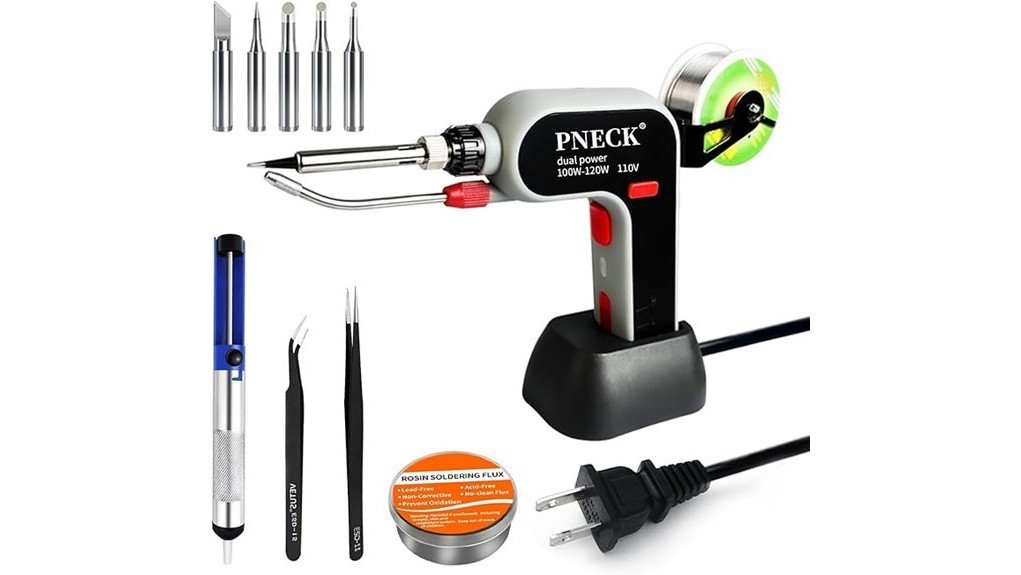
| Kit Contents | Soldering gun, 5 tips, desoldering pump, no-clean rosin flux paste, 2 tweezers, and base |
| Best Use | Electronics repair, wire soldering, hobby projects, jewelry work, and DIY practice |
| Warranty Note | Manufacturer warranty length is not clearly stated on the listing; check current terms before purchase |
What Is the PNECK DQ-33 Automatic Soldering Gun Kit?
The PNECK DQ-33 is a corded soldering gun built around a one-handed solder-feed mechanism. Instead of holding a separate length of solder wire in your free hand, you load the wire into the feeder and use the tool’s control to advance it toward the heated tip. This layout can free your other hand to support a wire, terminal, board, or small workpiece.
The listing describes two selectable power levels, a ceramic heating element, and a top temperature of 896°F / 480°C. PNECK packages the tool as an 11-in-1 kit with five tips, a desoldering pump, flux paste, two tweezers, and a base. Those accessories make it more complete than a bare soldering iron, although the package does not replace precision temperature control, a fume extractor, or other safety equipment.
This assessment is based on the published product listing and practical buyer-use analysis. The claimed heat-up time and maximum temperature were not independently measured in a lab.
Who Should Buy It?
Best For
- Beginners who want a self-contained kit for learning basic joints and wire repairs
- Hobbyists who value one-handed solder feeding in tight work areas
- DIY users who need a quick-heating tool for occasional electronics, craft, or household projects
Skip If
- You need exact digital temperature control for sensitive circuit boards or repeatable professional work
- You want a cordless tool for field repairs away from an outlet
- You need clearly documented manufacturer warranty coverage before buying
Before You Buy: The two wattage settings are not the same as precise temperature adjustment. For heat-sensitive components, fine-pitch boards, or repeated bench work, a temperature-controlled station is the safer and more predictable choice.
Design and Build Quality
The gun-style body is shaped for one-handed use, with a plastic handle and a screwdriver-style tip profile listed in the product details. The trigger-feed layout is the main design advantage because it reduces the number of separate items you must control at the joint. A supplied base gives you a place to support the hot tool between steps, but you should still place it on a stable, heat-resistant surface.
This format is convenient for short repair sessions, but it is bulkier around the hand than a slim pencil iron. That can matter when you work inside crowded enclosures or need a very shallow approach angle. The feeder also adds a moving part that must be loaded and kept clear, so it may take a few practice joints before the solder flow feels natural.
Power and Heating Performance
The DQ-33 switches between 100W and 120W. The lower setting is the better starting point for small wires and common hobby joints because it reduces unnecessary heat input. The higher setting can help when a larger connector or heavier wire draws heat away from the tip, but extra wattage also raises the risk of overheating insulation, pads, or nearby plastic.
PNECK states that the ceramic heater warms in about 30 seconds and reaches up to 896°F / 480°C. That top temperature is enough for many common soldering tasks, yet the listing does not show a digital display or a degree-by-degree control range. In practice, you manage heat mainly through the selected power level, tip choice, contact time, and work technique.
Pro Tip: Start at 100W with a clean, tinned tip. Move to 120W only when the joint is large enough to pull heat away faster than the lower setting can supply it.
Automatic Solder Feed and Controls
The automatic feeder is the feature that separates this kit from a basic manual iron. The listing states that the feed speed is adjustable, which can help you avoid pushing too much solder into a small joint. With practice, you can hold the work steady in one hand while the gun heats and feeds solder from the other.
The system does not remove the need for good joint preparation. Dirty surfaces, an oxidized tip, poor mechanical contact, or excess solder can still produce a weak connection. The feeder also works best when the solder wire is loaded correctly and moves without binding, so follow the supplied instructions rather than forcing the mechanism.
Included Accessories and Kit Value
The verified package is described as an 11-in-1 set. It includes one automatic soldering gun, five soldering tips, one desoldering pump, one container of no-clean rosin flux paste, two tweezers, and one base. The five tips give you options for different joint sizes, while the pump helps remove molten solder during corrections or component replacement.
The accessory selection is useful for a first kit because it covers basic soldering, positioning, flux application, and desoldering. Even so, you may still need solder wire, eye protection, a heat-resistant work mat, tip-cleaning material, and ventilation equipment depending on what is included by the current seller and how you plan to work.
How It Performs in Real Use
For Electronics and Circuit Board Repairs
The one-handed feeder can help when you need your free hand to hold a wire or stabilize a board. Use the smallest suitable tip and limit contact time on delicate pads. For fine-pitch components, temperature-sensitive parts, or expensive boards, a regulated station offers better control than this two-power design.
For Wire and Terminal Work
The 100W/120W output is better suited to ordinary hobby wiring and small terminals than to heavy cable or large metal masses. The higher setting may recover heat faster on a larger joint, but you should stop if insulation begins to soften or the workpiece needs prolonged heating.
For Craft and Jewelry Projects
The included tip choices and tweezers can support small decorative joins and craft repairs. Material compatibility still matters because not every metal accepts the same solder or flux. Test on scrap material first and confirm that the chosen solder and flux are suitable for the metal and finish.
For Beginner Practice and Quick Repairs
The kit is convenient for learning because the feeder, stand, tips, flux, and desoldering pump are packaged together. Beginners should practice on scrap wire or low-value boards before attempting an important repair. The trigger system simplifies solder delivery, but good results still depend on cleaning, tinning, joint heating, and steady timing.
Setup and Usage Tips
- Read the supplied instructions first. Confirm how the solder wire loads, which control changes feed speed, and how the two power settings are selected.
- Choose the right tip. Use a tip that contacts enough of the joint to transfer heat without touching nearby components.
- Secure the work. Hold boards and wires with a vise, helping hands, or another stable support so the joint cannot move while cooling.
- Clean and tin the tip. A thin solder coating improves heat transfer and helps protect the tip from oxidation.
- Heat the joint, not only the solder. Apply solder where it can flow onto the heated surfaces instead of melting a blob directly on the tip.
- Use only enough solder to wet the joint. Excess solder can bridge nearby contacts and hide a poor connection.
- Return the gun to its base. Keep the hot tip away from cords, plastic, paper, and the edge of the workbench.
Safety and Maintenance
Soldering creates burn, eye, smoke, and chemical-exposure risks. Work in a well-ventilated area, keep your face out of the rising fumes, wear eye protection, and wash your hands after handling solder or flux. The Amazon listing carries a California Proposition 65 warning concerning lead and lead compounds, so review the current warning and the materials you plan to use before starting.
Unplug the tool and let it cool fully before changing tips, clearing the feeder, or storing the kit. Keep the tip tinned during use, clean it with a suitable brass-wool or damp-sponge cleaner, and avoid scraping away protective plating. Replace a tip when it becomes badly pitted, will not accept solder, or transfers heat unevenly.
Do not use the gun on live circuits. Disconnect power, discharge stored energy where applicable, and confirm the equipment is safe to service. When a repair involves mains voltage, high-current batteries, or equipment you do not understand, use a qualified technician.
Pros and Cons
Pros
- Automatic solder feeder supports one-handed work
- 100W and 120W settings provide two simple heat-output choices
- Ceramic heater is claimed to warm in about 30 seconds
- Five tips, flux, tweezers, a pump, and a base create a useful starter package
- Suitable for several light-duty tasks, including electronics, wire, craft, and DIY repairs
Cons
- No clearly verified digital temperature display or degree-by-degree control
- Gun body and feeder can feel less precise than a slim pencil iron in tight spaces
- Manufacturer warranty duration and replacement-part support are not clearly stated
Is It Worth the Price?
The PNECK DQ-33 is worth considering as a budget-friendly or entry-level kit when your priority is quick setup and one-handed solder feeding. The included tips, flux, tweezers, desoldering pump, and base reduce the number of separate accessories a beginner must buy before practicing.
You get the most value if your projects involve occasional wire repairs, hobby boards, crafts, or small household jobs. It is not the best value for a professional bench where repeatable temperatures, calibration, broad tip support, and documented replacement parts matter more than a compact all-in-one package.
How It Compares to Alternatives
A basic manual soldering iron is usually simpler, slimmer, and easier to position in crowded electronics, but it requires you to feed solder with your other hand. A digital soldering station takes more desk space and usually costs more, yet it is the better choice for precise temperature control and frequent circuit-board work.
A cordless soldering iron is easier to carry for field repairs, although runtime and sustained heat can be more limited. The PNECK DQ-33 makes the most sense when you have outlet access and want the convenience of a trigger-fed, accessory-rich kit rather than maximum precision or portability.
Frequently Asked Questions
What brand and model is this automatic soldering gun?
The current Amazon product details identify it as the PNECK DQ-33, ASIN B0DJQXM75P. Check the listing before purchase because seller packaging and included items can change.
Does it have adjustable temperature control?
It has 100W and 120W power settings, but the listing does not clearly show a digital temperature display or degree-by-degree adjustment. Choose a regulated soldering station when exact temperature control is essential.
How hot does the PNECK DQ-33 get?
PNECK lists an upper temperature of 896°F / 480°C. Actual tip temperature can vary with the selected power, tip condition, joint size, contact time, and working environment.
How fast does the ceramic heater warm up?
The product listing claims a heat-up time of about 30 seconds. Treat that as a manufacturer claim because warm-up performance was not independently measured for this review.
What comes in the 11-in-1 kit?
The listing names one automatic soldering gun, five soldering tips, one desoldering pump, one no-clean rosin flux paste, two tweezers, and one base. Confirm the package list shown by the current seller before ordering.
Is it suitable for circuit-board repairs?
It can handle basic hobby board repairs when you use the correct tip and short contact times. For fine-pitch parts, heat-sensitive components, or valuable boards, a temperature-controlled station provides better protection and repeatability.
Does the automatic feeder make soldering easier?
It can make small jobs easier by letting one hand control both the tool and solder feed. You still need to prepare the joint, secure the work, use the correct amount of solder, and practice the feed speed.
What safety steps should you follow?
Use eye protection and ventilation, keep the hot tip on a stable base, and never work on a powered circuit. Unplug the gun and let it cool before changing tips, clearing the feeder, or storing it.
The Bottom Line
The PNECK DQ-33 is a solid fit for beginners and hobby users who want fast warm-up, one-handed solder feeding, and a broad starter accessory set. Skip it for delicate professional electronics or any job that depends on exact temperature control, because its main strength is convenience rather than bench-station precision.
Ready to Buy?
Check the latest price, package contents, warranty terms, and product details before you decide.