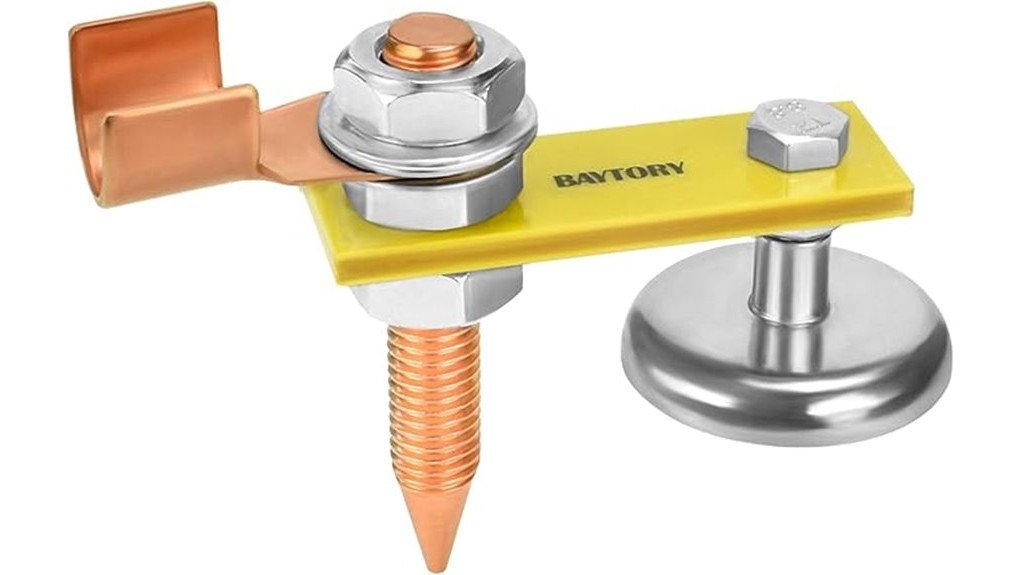
The BAYTORY Magnetic Welding Clamp is a magnetic ground clamp: a magnet head with a copper tail that holds your work lead against steel without a spring jaw. It works best on clean, flat or curved mild steel, and it will not hold on aluminum or non-magnetic stainless. Before you buy, check the current amperage rating on the listing, because a magnet can only carry as much current as its contact patch allows.
Quick Verdict
Best for: Welders who move their ground often on clean mild steel, plate, tube, and pipe.
Watch out: It will not grip aluminum or non-magnetic stainless, and the current rating needs to be checked on the listing.
Key Specifications
| Specification | Detail |
|---|---|
| Brand | BAYTORY |
| Product type | Magnetic welding clamp (ground clamp) |
| ASIN | B089VS4HX2 |
| Listed size | About 4 inches in diameter, per the listing (unverified) |
| Listed weight | About 1.5 pounds, per the listing (unverified) |
| Construction | Magnet head with copper tail, per the listing |
| Current rating | Not confirmed here; check the listing |
| Warranty | Not confirmed here; check the listing |
| Works on | Clean ferrous metal such as mild steel |
What Is the BAYTORY Magnetic Welding Clamp?
It is a ground (work) clamp alternative for welders who are tired of fighting a spring clamp on pipe, tube, or crowded fixtures. The magnet pulls the head onto the steel, and the copper tail connects to your ground cable. The listing describes it as suited to both flat and curved metal surfaces.
It does not replace every ground clamp. A magnet grips only where there is clean ferrous metal, so it suits fabrication tables, plate, tube, and structural steel better than aluminum or austenitic stainless parts.
Who It Is For and Who Should Skip It
A good fit if you:
- Move the ground often between workpieces or fixture positions.
- Weld round stock, pipe, or tube where a jaw clamp sits poorly.
- Mostly work on mild steel at modest amperage in a home or small shop.
Skip it if you:
- Weld mainly aluminum or 300-series stainless, which magnets do not grip.
- Run high amperage for long periods and need a rated bite-style clamp.
- Need a confirmed outdoor rating, warranty period, or certified current rating. Check the listing and the product manual for these.
How to Use a Magnetic Ground Clamp
- Grind or wire-brush the spot where the magnet will sit down to bare, clean steel. Paint, rust, mill scale, and oil all raise resistance.
- Place the magnet as close to the weld area as you can while keeping it away from sparks and spatter.
- Connect the copper tail to your ground cable and confirm the connection is tight and not loose or corroded.
- Tug the clamp to confirm it is held firmly, then strike a short test arc.
- Watch for a hot clamp or cable. If it warms quickly, stop, clean the contact, or switch to a higher-rated clamp.
Tips for a Reliable Ground and Common Problems
- Contact quality matters more than magnet strength. A weak or inconsistent ground shows up as an erratic arc, poor starts, or a hot clamp.
- Keep the magnet cool. Heat reduces magnet strength, so avoid placing it on a freshly welded or hot area.
- Watch for arc blow. The magnet and the ground current can pull the arc sideways on some jobs. If the arc wanders, move the clamp to the opposite end of the joint.
- Do not rely on it for load. It is a ground connection, not a clamp for holding parts in alignment.
Pros and Cons
Pros
- Fast to place and reposition on steel.
- Works on flat and curved surfaces, per the listing.
- Compact and portable.
Cons
- Useless on non-magnetic metals.
- Contact drops on dirty, painted, rusty, or coated surfaces.
- Current rating, weather resistance, and warranty are not confirmed here, so check the listing.
Is It Worth the Price?
It is worth considering if you reposition your ground often or work with curved magnetic steel. Its value is speed and convenience, not replacing every ground clamp. Compare it against the current listing, your welder amperage, and the metals you weld most. If you also weld aluminum or stainless, keep a standard clamp in the kit.
Alternatives to Consider
For other magnetic options, see our 200A magnetic welding ground clamp review, welding magnetic grounding clamp review, and Arc-Zone magnetic welding ground clamp review. For a mechanical option, a copper-jaw or T-style clamp such as the one in our T-style welding ground clamp review bites directly into the work. Our guide to types of welding clamps explains where each type fits.
Frequently Asked Questions
Can I use the BAYTORY magnetic clamp on aluminum or stainless steel?
Not on aluminum, and not on non-magnetic 300-series stainless. A magnet only holds on ferrous metal, so use a standard jaw-style clamp for those materials.
What is the amperage rating?
This page cannot confirm a current rating. Check the Amazon listing and any manual that comes with the clamp before using it near its limit, and stop if the clamp or cable gets hot.
Does a magnetic ground clamp work on curved surfaces like pipe?
The listing describes it as suitable for flat and curved surfaces. Contact area is smaller on a curve, so clean the spot well and confirm the clamp is firmly seated.
Can a magnetic ground clamp cause arc blow?
It can contribute, because the ground location and magnetic fields affect where the arc is pulled. If the arc wanders, move the clamp to the opposite end of the joint or try a different ground position.
Is it safe to use outdoors?
A weather rating is not confirmed here. Keep it dry when possible, wipe off moisture and debris before use, and follow the manual.
Final Verdict
The BAYTORY Magnetic Welding Clamp is a simple accessory for quick grounding on clean mild steel. Its strengths are speed and use on curved surfaces; its limits are the need for clean ferrous metal and an unconfirmed current rating. If those fit your work, it is a handy addition to the toolkit.