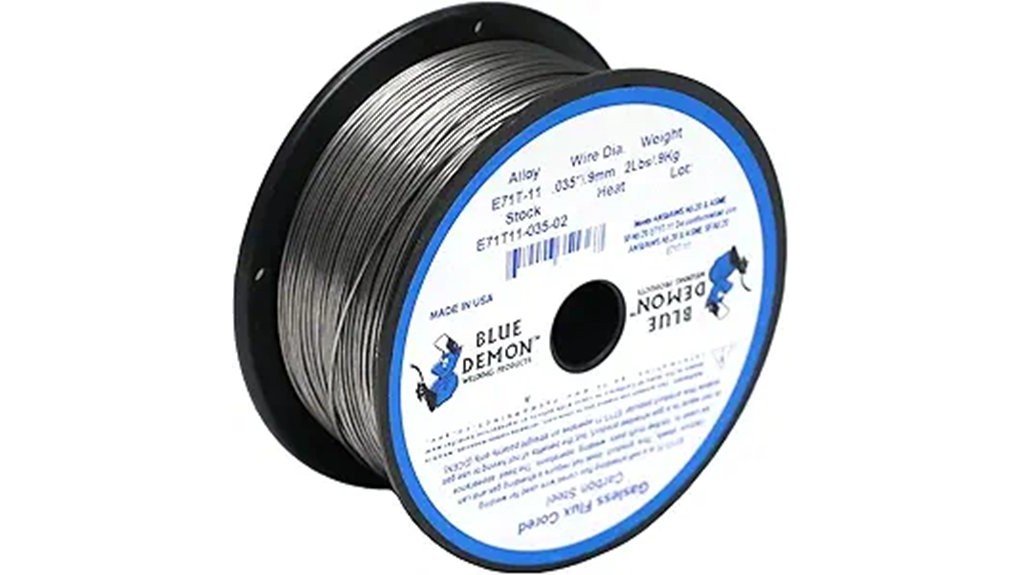
Flux-core wire can simplify outdoor repairs, but the wrong diameter, polarity, or spool size can leave you with a product your welder cannot use. The Blue Demon E71T-11 reviewed here is a 0.035-inch self-shielded wire on a 2 lb spool, made for carbon-steel welding without an external gas cylinder. Its main strengths are portability, DCEN operation, and limited multi-pass capability. Its main tradeoffs are slag cleanup, welding fumes, and less control on very thin or appearance-critical work.
Quick Verdict
Editorial Rating: 8.5/10, recommended with compatibility and cleanup caveats
Best For: Outdoor repairs, mobile maintenance, garage fabrication, and welders using compact flux-core machines
Bottom Line: Blue Demon E71T-11 gives you a gasless setup and supports limited multi-pass carbon-steel welding. You still need a machine that accepts 0.035-inch wire, DCEN polarity, and a 2 lb spool, and you must remove slag between passes.
Key Takeaways
- This listing is for 0.035-inch Blue Demon E71T-11 wire on a 2 lb spool.
- It is a self-shielded FCAW-S consumable, so you do not need an external shielding-gas cylinder.
- The wire runs on DCEN, direct current electrode negative, not the DCEP setup commonly used with gas-shielded solid MIG wire.
- Blue Demon lists it for carbon steel and limited multi-pass work in flat, horizontal, vertical-up, and overhead positions.
- You should expect slag, smoke, and post-weld cleanup even when the machine settings are correct.
- Very thin automotive sheet, stainless steel, aluminum, and code-critical structural work need a different process, consumable, or approved welding procedure.
At a Glance
| Specification | Detail |
|---|---|
| Brand | Blue Demon |
| Product | E71T-11 self-shielded flux-core welding wire |
| Manufacturer Part Number | E71T11-035-02 |
| ASIN | B00G5GIIMU |
| AWS Classification | E71T-11 under AWS A5.20 |
| Wire Diameter | 0.035 inch, approximately 0.9 mm |
| Spool Weight | 2 lb |
| Welding Process | Self-shielded flux-cored arc welding, FCAW-S |
| Shielding Gas | Not required |
| Polarity | DCEN, electrode negative |
| Base Metal | Carbon steel |
| Welding Positions | Flat, horizontal, vertical-up, and overhead |
| Pass Capability | Single-pass and limited multi-pass work |
| Typical Applications | Butt, lap, and fillet welds; assembly, maintenance, machine parts, tanks, and prefabrication |
| Listed Material Range | Typical applications from 16-gauge steel through 1/2 inch, subject to machine capacity and the welding procedure |
What Is the Blue Demon E71T-11?
Blue Demon E71T-11 is a tubular carbon-steel electrode with flux inside the wire. The flux produces the shielding needed around the weld pool, so you can weld without connecting a bottle, regulator, or gas hose.
This design makes the wire useful for field repairs and outdoor jobs where wind could disturb an externally supplied shielding gas. The reviewed variant uses 0.035-inch wire and a compact 2 lb spool, which is a common format for smaller consumer and light-duty welding machines.
E71T-11 differs from basic E71T-GS wire because it is classified for limited multi-pass use. That does not mean every machine, joint, or metal thickness is suitable. Your welder output, joint preparation, duty cycle, and approved procedure still control what you can safely weld.
Who Should Buy It?
Best For
- Welders whose machines accept 0.035-inch wire, DCEN polarity, and a 2 lb spool
- Outdoor gate, bracket, equipment, farm, and general carbon-steel repair work
- Mobile users who want to avoid transporting a shielding-gas cylinder
Skip If
- Your machine cannot reverse polarity to DCEN or cannot feed 0.035-inch tubular wire
- You need a nearly slag-free cosmetic finish on thin sheet metal
- You are welding aluminum, stainless steel, or a load-bearing structure without an approved procedure
Before You Buy: Confirm four details in your welder manual: 0.035-inch wire support, 2 lb spool fit, the required contact-tip size, and the ability to run DCEN. A machine marketed as a MIG welder does not automatically support every self-shielded flux-core wire.
Feature-by-Feature Review
Self-Shielded, Gasless Operation
The main buying benefit is reduced equipment. You do not need a shielding-gas bottle, flowmeter, regulator, or gas hose. That makes the setup easier to transport to a fence, trailer, machine, or piece of equipment that cannot be moved into the shop.
Gasless does not mean fume-free or weatherproof. Strong wind can still disturb the arc and spread fumes, while rain and wet work areas create electrical and weld-quality hazards. Work only in dry conditions and follow your welder’s safety instructions.
0.035-Inch Wire and 2 lb Spool
The 0.035-inch diameter is a practical size for general repair and fabrication, but it usually needs more heat than a smaller 0.030-inch wire. That can help on moderate steel thicknesses while making very thin sheet easier to burn through.
The 2 lb spool is convenient for compact welders and occasional repair work. It is easier to store and carry than a large industrial spool, though frequent users may go through it quickly and should compare the cost per pound with larger compatible packages.
DCEN Polarity and Machine Compatibility
Blue Demon specifies DCEN, which places the welding gun or electrode on the negative terminal and the work lead on the positive terminal. Running the wrong polarity can lead to excess spatter, poor penetration, an unstable arc, and difficult slag behavior.
Check the diagram inside your welder or the owner’s manual before loading the spool. Also confirm the drive-roll groove, contact tip, and wire-feed path are suitable for 0.035-inch flux-core wire.
Welding Positions and Limited Multi-Pass Use
The listing supports flat, horizontal, vertical-up, and overhead welding. Vertical-up is useful when you need to build a joint instead of letting the molten pool run downward, but it normally requires more practice and careful travel speed.
E71T-11 can be used for limited multi-pass work. Remove slag completely between passes, inspect the bead, and follow an appropriate welding procedure. Trapped slag can weaken the weld and may not be visible after the next bead covers it.
Arc Behavior, Spatter, and Slag
Blue Demon describes this wire as less sensitive to light rust and mill scale than some gas-shielded processes, with relatively low spatter and slag that is easier to remove. Those benefits depend heavily on polarity, voltage, wire-feed speed, stickout, travel angle, and surface condition.
You will still get better results on clean steel. Remove oil, grease, paint, heavy rust, moisture, and loose scale before welding. Flux-core wire is more tolerant of imperfect field conditions, but it cannot correct poor joint preparation.
How It Performs in Real Use
For Outdoor Repairs
This is where the wire makes the most sense. You can carry the welder and spool to a gate, bracket, mower deck, equipment frame, or other carbon-steel part without hauling gas equipment. You still need a stable power source, a dry work area, and enough ventilation to keep the fume plume away from your breathing zone.
For Garage and Maintenance Work
The 2 lb spool is manageable for occasional maintenance jobs and takes up little storage space. It can handle butt, lap, and fillet welds when your machine has enough output and the joint is prepared correctly.
The tradeoff is cleanup. You must chip or brush away slag and remove spatter before painting, coating, inspecting, or adding another pass.
For Automotive Sheet and Brackets
The wire can suit brackets, mounts, and some steel repair pieces, but 0.035-inch flux-core wire is not the easiest choice for thin cosmetic body panels. Many body panels are thinner than the listing’s stated 16-gauge lower application point, so burn-through and distortion can become difficult to control.
For appearance-sensitive thin sheet, a smaller wire or gas-shielded solid MIG setup may provide finer heat control and less cleanup. Structural vehicle repairs should follow the vehicle manufacturer’s repair procedures and be completed by a qualified person.
For Fabrication and Multi-Pass Work
The listing identifies assembly, machine parts, tanks, prefabrication, and steel up to 1/2 inch as typical applications. Treat that range as product context rather than a promise that a small welder can join 1/2-inch steel in every joint design.
Machine amperage, duty cycle, joint preparation, preheat requirements, pass sequence, and applicable welding codes all matter. Load-bearing or safety-critical work needs an approved welding procedure and appropriate inspection.
Setup Tips Before First Use
- Confirm spool fit: Check that your machine accepts a 2 lb spool and that the hub hardware holds it securely.
- Verify wire diameter: Use a 0.035-inch contact tip and the drive-roll setup specified by your welder manufacturer.
- Set DCEN polarity: Connect the gun or electrode lead to negative and the work lead to positive when your machine uses removable polarity leads.
- Reduce excess drive tension: Use enough pressure to feed the wire without slipping, but do not crush or deform the tubular electrode.
- Start with the machine chart: Use the welder’s recommended voltage and wire-feed settings for 0.035-inch self-shielded wire and the actual metal thickness.
- Test on scrap: Make practice welds using the same material, thickness, joint, and position as the final job.
- Clean between passes: Remove all slag before adding another bead.
- Store the spool dry: Keep unused wire away from humidity, condensation, chemicals, and grinding dust.
Pro Tip: When troubleshooting spatter or a harsh arc, check polarity before changing several machine settings. Incorrect polarity can make a usable voltage and wire-speed combination behave poorly.
Compatibility and Welding Safety
Blue Demon lists this E71T-11 wire for carbon steel. Do not use it as a substitute for aluminum or stainless-steel filler wire. Match the electrode classification to the base metal, joint requirements, and welding procedure.
Flux-core welding creates visible smoke and metal fumes. Use suitable eye, face, hand, body, hearing, and respiratory protection based on the hazard assessment. General airflow may not be enough, especially indoors or near other workers. Local fume extraction may be needed.
Galvanized steel requires extra caution because heating its zinc coating can produce zinc-oxide fumes. Do not assume that an electrode’s ability to deposit weld metal makes the job safe. Review the coating, safety data, ventilation plan, and applicable work procedure before welding.
OSHA advises welders to avoid breathing welding fumes, use adequate ventilation, keep fumes away from the breathing zone, clean hazardous coatings when permitted, and avoid welding in confined spaces without proper controls. See the OSHA welding-fume fact sheet for additional guidance.
What Buyers Should Expect
- Main benefit: A portable carbon-steel welding setup without an external shielding-gas system.
- Setup sensitivity: Correct DCEN polarity and a suitable 0.035-inch feed system are essential.
- Cleanup: Slag and some spatter remain part of the process, even when the arc is tuned well.
- Learning curve: Flat welds are easier for beginners than vertical-up or overhead work.
Pros and Cons
Pros
- Self-shielded design removes the need for a gas bottle, regulator, and hose
- Compact 2 lb spool fits many smaller home and repair welders
- Supports flat, horizontal, vertical-up, and overhead positions
- E71T-11 classification permits limited multi-pass welding
- Suitable for outdoor and mobile carbon-steel repair work
Cons
- Requires DCEN and may not work with machines that have fixed polarity
- Produces slag and fumes, so ventilation and cleanup are required
- The 0.035-inch size is less forgiving on very thin, cosmetic sheet metal
Is It Worth the Price?
The Blue Demon E71T-11 is worth considering when you value a compact gasless setup more than a near-spatter-free finish. You get a recognized E71T-11 classification, a common 0.035-inch diameter, limited multi-pass capability, and a 2 lb package that suits occasional repair work.
The value is less convincing if your welder needs a different spool format, cannot run DCEN, or is mainly used for thin automotive panels. Frequent welders should also compare larger compatible spools because a 2 lb package may have a higher cost per pound.
How It Compares to Alternatives
Forney E71T-GS is worth comparing when your work is mainly thin mild steel and single-pass welding. E71T-GS is simpler for basic repairs, while Blue Demon E71T-11 makes more sense when you specifically need limited multi-pass capability.
Lincoln Electric Innershield NR-211-MP is another established E71T-11 option for light-gauge and thin-plate work. Hobart Fabshield 21B is also classified as E71T-11 and comes in several package sizes. Compare diameter, spool fit, polarity, approved thickness, and local availability rather than choosing by brand name alone.
Frequently Asked Questions
Can Blue Demon E71T-11 be used in a MIG welder?
Yes, but only when the machine supports self-shielded flux-core wire, a 0.035-inch diameter, a 2 lb spool, and DCEN polarity. Check the manual rather than relying only on the word MIG on the machine.
What polarity does this wire require?
Blue Demon specifies DCEN, or direct current electrode negative. The welding gun connects to negative and the work lead connects to positive on machines with changeable polarity leads.
What voltage and wire-feed speed should you use?
There is no single correct setting for every machine or joint. Start with your welder’s chart for 0.035-inch self-shielded wire, then fine-tune on scrap that matches the final material thickness and welding position.
Can it be used for multi-pass welding?
Yes, E71T-11 supports limited multi-pass work. Remove all slag between passes and follow a suitable welding procedure for the joint, material thickness, and service conditions.
Can you weld galvanized steel with it?
The current Blue Demon listing identifies carbon steel as the base material. Galvanized steel adds a zinc coating that can produce hazardous zinc-oxide fumes, so confirm the welding procedure, coating-removal rules, ventilation, and filler-metal compatibility before proceeding.
Is 0.035-inch wire suitable for automotive body panels?
It may work on some heavier repair pieces, but it is not the easiest choice for very thin cosmetic panels. A smaller wire or gas-shielded solid-wire setup can offer finer heat control and less slag cleanup.
Why is the wire feeding poorly?
Check the contact-tip size, drive-roll groove, spool tension, liner condition, and drive pressure. Excess tension can deform tubular wire, while too little tension allows slipping.
How should you store an opened spool?
Store it in a dry, enclosed location away from condensation, chemicals, and grinding debris. Protect the loose wire end so it cannot unwind or become contaminated before the next use.
The Bottom Line
The Blue Demon E71T-11 0.035-inch, 2 lb spool is a strong fit for welders who need portable, gasless carbon-steel repair capability and a wire that supports limited multi-pass work. Skip it when your machine cannot run DCEN, your work is mainly very thin cosmetic sheet, or the job requires a different alloy or approved structural procedure.
Its best feature is the simple self-shielded setup. Its main limitation is the combination of slag, fumes, and machine-specific compatibility checks that come with flux-core welding.
Ready to Buy?
Confirm the wire diameter, spool size, and polarity on the current product page before you decide.