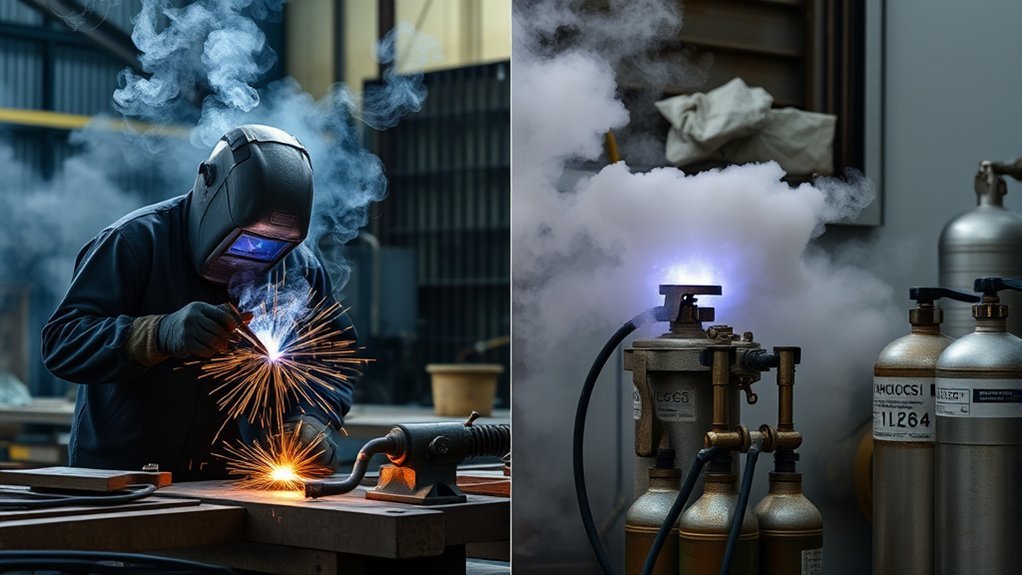
Choosing between self-shielded flux-cored wire and gas-shielded flux-cored wire starts with the work location. Self-shielded wire is usually the practical choice for outdoor repairs, fieldwork, and portable setups. Gas-shielded wire is usually better in a protected shop when you want a stable arc, consistent bead shape, and production-friendly results.
Quick Answer
Use self-shielded flux-cored wire (FCAW-S) outdoors, around changing airflow, or when portability matters. Use gas-shielded flux-cored wire (FCAW-G) in a protected work area when the specified shielding gas, smoother arc behavior, repeatable bead profile, and higher-production welding matter more than mobility.
Key Takeaways
- FCAW-S needs no external shielding gas, so it is easier to move and use outdoors.
- FCAW-G needs the exact gas listed by the wire manufacturer, commonly 100% CO2 or an approved argon/CO2 blend.
- Both processes create slag, so clean the bead before inspection or another pass.
- Polarity is wire-specific; many hobby FCAW-S wires use DCEN, while many FCAW-G wires use DCEP, but the spool label controls.
- Neither process is automatically safe or code-ready; use the wire data sheet, machine chart, ventilation, PPE, and any required welding procedure.
Understanding Flux-Cored Welding
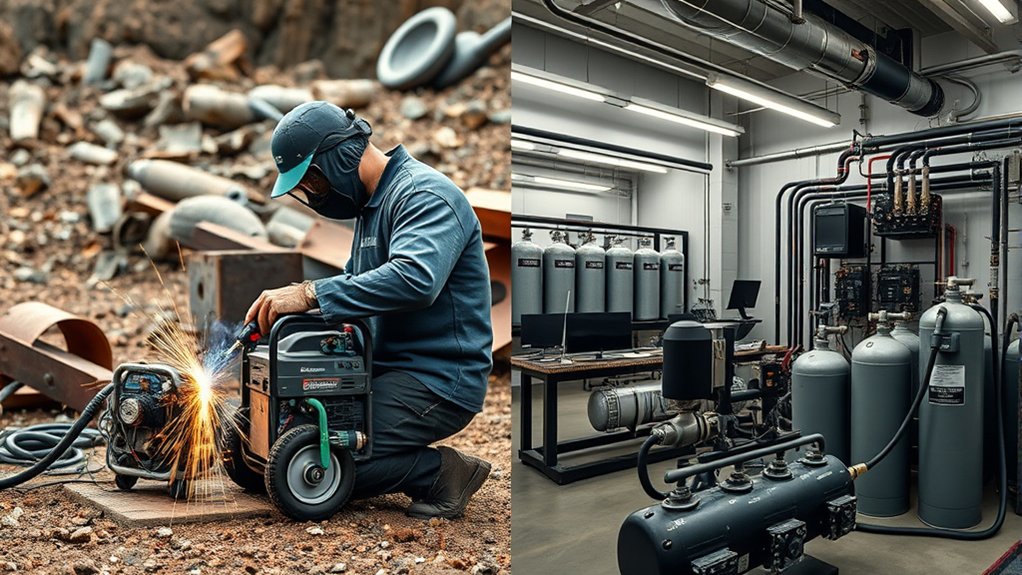
Flux-cored arc welding (FCAW) uses a continuously fed tubular electrode filled with fluxing and alloying ingredients. As the wire melts, those ingredients help protect and shape the weld. The two main process families are self-shielded flux-cored welding (FCAW-S) and gas-shielded flux-cored welding (FCAW-G).
Both can produce sound welds when the electrode matches the base metal, joint design, welding position, machine output, and required mechanical properties. The key difference is shielding. FCAW-S develops its shielding system from ingredients inside the wire. FCAW-G uses flux inside the wire plus an external shielding gas. MillerWelds explains the two FCAW forms and notes that both leave slag that must be removed.
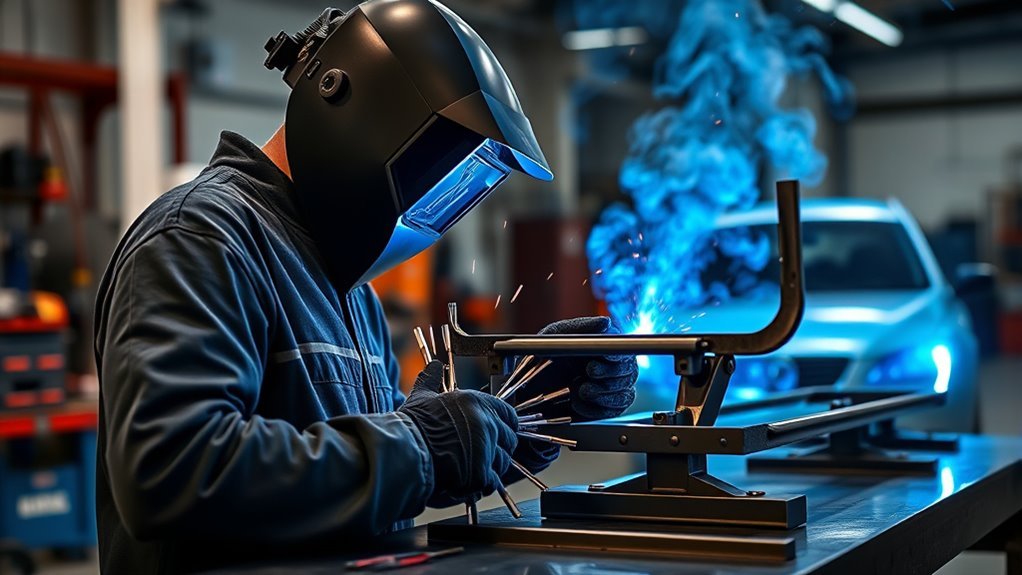
Warning: FCAW produces intense light, sparks, hot slag, hot metal, electrical hazards, and welding fume. Wear a properly selected welding helmet, safety glasses, gloves, hearing protection as needed, and flame-resistant clothing. Remove fire hazards, provide suitable ventilation or local exhaust, and never weld in a confined space without the required evaluation, ventilation, and entry procedures.
Self-Shielded Flux-Cored Wire (FCAW-S)
Self-shielded flux-cored wire does not need a separate shielding-gas cylinder. Ingredients inside the wire produce the shielding system and slag as the arc burns. This makes FCAW-S useful for farm repairs, construction sites, trailers, gates, outdoor structural work, and other jobs where carrying a cylinder, regulator, and hose would be inconvenient.
FCAW-S is often the better choice when wind or changing airflow is present because there is no external gas stream to blow away. It is also practical when you need quick setup, less equipment, and a wire suited to the steel thickness and welding position. Its field-friendly nature can make it accessible for repair work, but it still requires correct polarity, steady technique, clean metal, proper contact-tip-to-work distance, and complete slag removal between passes.
Advantages of Self-Shielded Wire
- No gas cylinder required: You do not need a bottle, regulator, gas hose, or gas refill.
- Better suited to outdoor work: It avoids the external shielding-gas stream that drafts can disrupt.
- Good portability: A compact wire feeder or engine-driven setup is easier to move to field repairs.
- Useful on thicker steel: Many FCAW-S electrodes are designed for repair, structural, or high-deposition work, provided the machine and procedure match the job.
- Some tolerance for surface contamination: Certain wires can handle light mill scale or minor contamination better than solid MIG wire, although cleaning remains the correct first step.
Limits of Self-Shielded Wire
- Visible fume and smoke: FCAW can be a high-fume process, and exposure depends on the wire, base metal, coatings, settings, ventilation, and welder position.
- Slag cleanup: Chip and brush the bead before inspection and before depositing another pass.
- Less cosmetic finish: Many FCAW-S beads look rougher than a well-tuned gas-shielded process or solid-wire MIG weld.
- Spatter sensitivity: Wrong voltage, wire-feed speed, polarity, stickout, or travel angle can increase spatter and make the arc unstable.
- Wire-specific polarity and limits: Many common FCAW-S wires use DCEN, but position, thickness, and single-pass or multi-pass limits vary by electrode.
Pro Tip: For outdoor repairs, clean the joint, block strong gusts when practical, and keep contact-tip-to-work distance within the electrode maker’s range. Do not shorten or lengthen stickout by guesswork; FCAW wires can be sensitive to this setting.
Gas-Shielded Flux-Cored Wire (FCAW-G)
Gas-shielded flux-cored wire uses flux ingredients inside the electrode plus an external shielding gas. Depending on the classification and product, the approved gas may be 100% CO2, a specified argon/CO2 blend, or either one. FCAW-G is common in fabrication shops, production welding, structural steel, shipbuilding, heavy equipment, and out-of-position work performed in a protected area.
Many FCAW-G products are designed for stable arc performance, a controlled bead profile, high deposition rates, and all-position welding. Those benefits are not universal, however. Arc behavior, spatter, slag release, mechanical properties, and permitted positions depend on the exact wire, gas, diameter, parameters, and procedure. If appearance, repeatability, or production speed matters, compare the manufacturer data sheets rather than choosing by process name alone.
Advantages of Gas-Shielded Wire
- Controlled bead profile: Many products are designed for smooth, uniform beads in protected shop conditions.
- Potentially lower spatter: The correct wire, gas, voltage, and wire-feed speed can reduce cleanup.
- Out-of-position options: Fast-freezing slag systems are available for vertical and overhead welding.
- High productivity: FCAW-G can deliver high deposition rates with a suitable power source and qualified procedure.
- Repeatable shop results: Controlled airflow, gas delivery, joint preparation, and machine settings make production consistency easier.
Limits of Gas-Shielded Wire
- Needs gas equipment: You need the correct cylinder, regulator or flowmeter, hose, gun parts, and gas supply.
- Sensitive to drafts: Moving air can disturb gas coverage and contribute to porosity.
- Less portable: The added gas equipment makes field work more difficult.
- More setup variables: Gas composition, flow, leaks, nozzle condition, contact-tip-to-work distance, and airflow all affect results.
- Wire-specific polarity: Many FCAW-G electrodes use DCEP, but the product data sheet and welding procedure control.
- Slag remains: Gas shielding does not turn FCAW-G into solid-wire MIG; the bead still has slag that must be removed.
If you are welding very thin sheet metal, especially auto body panels, do not assume either FCAW type is the best choice. Solid MIG wire with shielding gas or TIG often gives better heat control and less post-weld cleanup. A flux-cored electrode may work on thinner steel only when its diameter, classification, machine range, joint fit-up, and manufacturer settings fit the material.
Self-Shielded vs Gas-Shielded Flux-Cored Wire: Key Differences
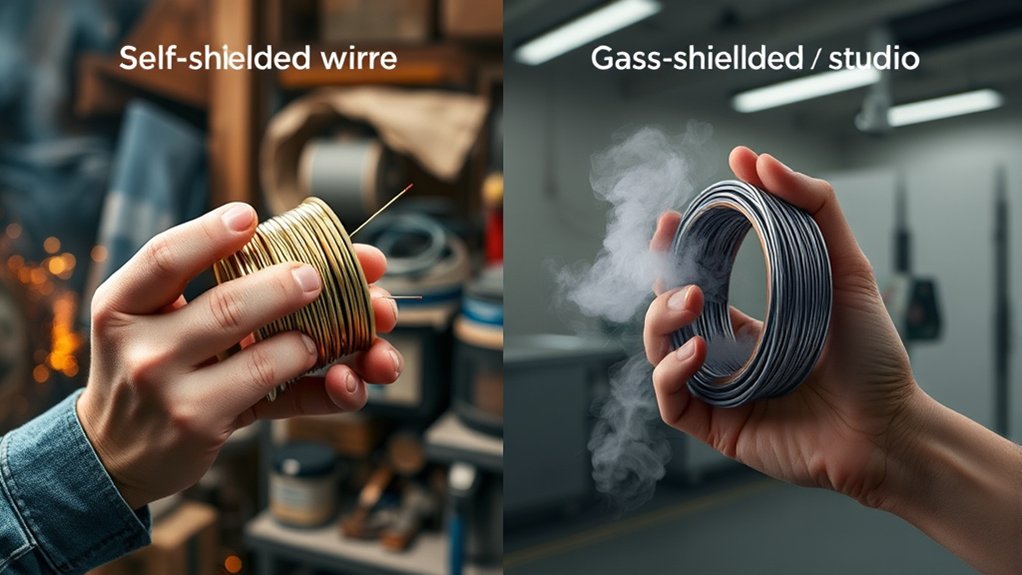
Match the process to the environment first, then check the wire classification, base metal, thickness, position, appearance target, productivity goal, and available equipment. FCAW-S usually wins on mobility and outdoor use. FCAW-G usually wins where gas coverage and welding variables can be controlled.
| Factor | Self-Shielded FCAW-S | Gas-Shielded FCAW-G |
|---|---|---|
| Shielding | Shielding system comes from ingredients inside the wire. | Flux ingredients plus the specified external shielding gas. |
| Best environment | Outdoor repairs, fieldwork, remote jobs, and changing airflow. | Indoor shops, protected bays, and controlled production areas. |
| Equipment | Welder, suitable gun and drive system, wire, PPE, ventilation, and slag-cleaning tools. | The same core equipment plus the correct gas cylinder, regulator or flowmeter, and hose. |
| Weld appearance | Often functional rather than cosmetic; appearance varies by wire and technique. | Many wires are designed for a smooth, uniform profile in controlled conditions. |
| Wind sensitivity | More tolerant because it does not rely on external gas coverage. | Drafts can disrupt shielding and cause porosity; use a protected work area. |
| Polarity | Often DCEN for common hobby wires, but verify every spool. | Often DCEP, but verify the wire data sheet and procedure. |
| Slag and cleanup | Slag removal is required; smoke and spatter vary by wire and settings. | Slag removal is still required; some products offer low-spatter operation. |
| Best fit | Repairs, construction, farm work, and portable outdoor welding. | Fabrication shops, structural production, shipbuilding, and repeatable heavy welding. |
Products Worth Considering

Effortless and Efficient Welding: Hassle-free experience with our AWS E71T-GS 0.030" Flux Core welding wire (Net Weight: 10lbs). No shielding gas needed, install and weld in any position. Perfect for strong T-joints, butt welds, and lap welds.

E71T-GS GASLESS FLUX CORE WIRE: This AWS E71T-GS self-shielded flux-cored wire delivers smooth, stable welding without external shielding gas. It offers excellent arc stability, consistent feedability and reliable performance, allowing users to produce clean welds with minimal setup work. Its advanced flux formulation enables welding over light rust and mill scale for improved everyday practicality.

E71T-GS FLUX CORE WIRE: This self-shielding, AWS E71T-GS flux-cored wire excels due to its advanced core design, delivering exceptional arc stabilization and high feedability for effortless welding. The core also incorporates powerful deoxidizing agents, ensuring clean, reliable welds even when welding through light rust or mill scale.
How to Read the Wire Label and Data Sheet
The process name alone does not tell you enough. Read the full AWS classification, manufacturer product name, polarity, approved shielding gas, diameter, position rating, thickness range, and single-pass or multi-pass limits before loading the spool.
- Self-shielded example: Lincoln Electric Innershield NR-211-MP is an E71T-11 wire listed for DCEN operation. This is an example, not a rule for every FCAW-S product.
- Gas-shielded example: Lincoln Electric UltraCore 71A75 Dual is classified for DCEP operation with either 100% CO2 or a specified argon/CO2 blend.
- C and M gas designators: In common FCAW-G classifications, a C designator identifies classification with CO2, while an M designator identifies classification with a mixed shielding gas. Some wires carry both classifications. Hobart Brothers explains these wire families and designators.
- Usability designator: Dash numbers such as T-1, T-8, T-9, or T-11 relate to usability and performance requirements. Do not guess shielding method or job suitability from one character without checking the current product data sheet.
The spool label and manufacturer data sheet outrank general rules about gas, polarity, position, stickout, and material thickness.
Note: “Dual shield” is a common trade term for gas-shielded flux-cored welding. It does not mean every FCAW-G wire can use two different gases. Use only the gas composition listed for that product.
How to Pick the Right Flux-Cored Wire
Start with the job, not the spool. The base metal type, material thickness, joint design, welding position, machine output, service requirements, and work location all affect the correct wire choice.
Products Worth Considering

Welding Easy and Quick: AWS E71T-GS 030” Flux Core welding wire (The actual Net Weight of Wire is 2LB), no need for shielding gas, install it then you can welding all positions, single and multi pass welding. Great for T-joints, butt welds & lap welds.

E71T-GS FLUX CORE WIRE: This self-shielding, AWS E71T-GS flux-cored wire excels due to its advanced core design, delivering exceptional arc stabilization and high feedability for effortless welding. The core also incorporates powerful deoxidizing agents, ensuring clean, reliable welds even when welding through light rust or mill scale.

E71T-GS FLUX CORE WIRE: This self-shielding, AWS E71T-GS flux-cored wire excels due to its advanced core design, delivering exceptional arc stabilization and high feedability for effortless welding. The core also incorporates powerful deoxidizing agents, ensuring clean, reliable welds even when welding through light rust or mill scale.
Choose Self-Shielded Wire If
- You are welding outdoors or away from the shop.
- You do not want to transport a shielding-gas cylinder.
- The work area has light wind or changing airflow.
- The wire data sheet covers the steel thickness and welding position.
- You need a durable repair more than a cosmetic bead.
- You are welding farm equipment, gates, trailers, brackets, construction steel, or field repairs within the approved procedure.
Choose Gas-Shielded Wire If
- You are welding indoors or in a protected bay.
- You want a wire designed for a controlled bead profile or lower-spatter operation.
- You can maintain the specified gas composition and flow without drafts.
- You are doing production work or repeatable fabrication.
- You need a wire classification that meets a specified mechanical-property or code requirement.
- You have a suitable power source, feeder, gun, gas system, and ventilation setup.
Match Wire to Thickness and Position
Do not use one wire for every job. A wire and parameter range suited to 1/4-inch plate may be too hot for thin sheet. A small-diameter wire or low-output machine may not provide the fusion required on heavy steel. Check whether the electrode is approved for flat, horizontal, vertical, overhead, single-pass, or multi-pass welding.
Wire diameter matters too. A common .035-inch flux core welding wire can serve many hobby and repair jobs, but diameter alone does not establish safe thickness capacity. Use the voltage and wire-feed chart on the machine only as a starting point, then confirm the electrode manufacturer’s operating range and test on matching scrap.
Use a Qualified Procedure for Critical Welds
General comparison advice is not a welding procedure specification. Structural members, lifting points, pressure-containing parts, roll cages, suspension mounts, trailer couplers, vehicle frames, and other safety-critical components may require an approved joint design, qualified welder, specified preheat, controlled interpass temperature, inspection, and code-compliant consumables.
Warning: Do not select wire or settings for a safety-critical weld from an internet chart alone. Follow the applicable drawing, engineer’s requirements, welding procedure specification, consumable data sheet, and inspection rules.
Setup Checks Before You Weld
Many FCAW problems come from setup rather than from the process itself. Before welding, check each item below:
- Polarity: Confirm DCEN or DCEP on the spool label or data sheet. Do not guess.
- Drive rolls: Use the roll type and tension recommended for the tubular wire. Knurled rolls are common, but the machine and wire instructions control.
- Contact tip and liner: Match the contact tip, liner, and gun capacity to the wire diameter and amperage.
- Stickout or CTWD: Keep contact-tip-to-work distance within the electrode maker’s range.
- Gas composition: For FCAW-G, use only the gas approved for that classification and product.
- Gas flow: Set flow while gas is moving, check for leaks, and protect the arc from drafts. Too little flow can leave the puddle unprotected, while excessive flow can create turbulence and pull air into the shielding stream.
- Nozzle condition: Remove spatter so gas can leave the nozzle evenly.
- Wire condition: Keep wire clean and dry, and replace rusty, damaged, or contaminated electrode.
- Metal preparation: Remove paint, oil, solvent residue, heavy rust, moisture, plating, and unknown coatings before welding.
- Technique: A drag or pull technique is common for slag-producing FCAW, but follow the wire maker’s instructions for the joint and position.
- Test weld: Run a bead on scrap of the same alloy, thickness, joint type, and position before welding the final part.
Note: Flux-cored wire can be more tolerant of rusty or dirty metals than solid wire, but tolerance is not permission to weld over grime. Clean steel improves arc stability, fusion, inspection, and fume control.
Common Problems and Troubleshooting
If a flux-cored weld looks rough, do not switch wire immediately. Check polarity, voltage, wire-feed speed, contact-tip-to-work distance, gas coverage, work angle, travel speed, grounding, wire condition, and metal preparation first.
| Problem | Likely Cause | Fix |
|---|---|---|
| Porosity | Drafts, gas leaks, wrong gas or flow, moisture, dirty metal, contaminated wire, or incorrect CTWD. | Block drafts, find leaks, use the specified gas and flow, clean and dry the joint, and reset CTWD. |
| Excessive spatter | Wrong polarity, voltage or wire-feed mismatch, poor work angle, unstable feeding, or incorrect stickout. | Confirm polarity, tune voltage and wire speed together, correct feeding and angle, and review spatter solutions. |
| Slag inclusions | Slag trapped between passes, poor bead placement, wrong travel angle, low heat, or an oversized weave. | Remove all slag between passes, keep the puddle visible, use the correct angle, and stay within the procedure range. |
| Lack of fusion | Low heat input, fast travel, poor joint access, dirty metal, or incorrect joint preparation. | Use approved parameters, correct travel speed and work angle, clean the joint, and prepare the joint as specified. |
| Burn-through | Too much heat for the material, slow travel, poor fit-up, or wire that is too large for the job. | Reduce heat within the approved range, improve fit-up, move faster, use a suitable smaller wire, or choose solid MIG or TIG for very thin sheet. |
| Erratic wire feeding | Wrong drive roll, excess tension, worn tip or liner, damaged wire, or a tight gun-cable bend. | Install the correct feeding parts, reset tension, replace worn consumables, remove damaged wire, and straighten the gun cable. |
Safety and Fume Control
FCAW can generate substantial visible smoke, metal fume, and process gases. The hazard changes with the electrode, base metal, coatings, gas, amperage, work location, and ventilation. OSHA’s welding-fume fact sheet lists metals and gases that may be present and describes possible short- and long-term health effects.
Use local exhaust when practical, keep your head out of the plume, and position the work so fumes move away from your breathing zone. Welding outdoors does not guarantee adequate ventilation. If engineering controls and work practices do not keep exposure within applicable limits, a proper respiratory-protection program may be required. OSHA lists welding requirements for general industry, construction, and maritime work on its welding standards page.
- Wear a welding helmet with a lens shade suitable for the arc current, plus safety glasses with side protection.
- Wear flame-resistant clothing, welding gloves, closed leather footwear, and hearing protection when needed.
- Remove paint, solvent residue, oil, moisture, plating, and unknown coatings before welding.
- Keep a suitable fire extinguisher nearby and check the area for smoldering material after welding.
- Do not weld on sealed containers, tanks, drums, or parts that held flammable or toxic materials unless they have been handled under an approved procedure.
- Use suitable ventilation or source capture, especially on stainless steel, galvanized steel, painted metal, or other coated and alloyed materials.
- Protect nearby people from arc radiation and sparks with screens and controlled access.
Frequently Asked Questions
What is the difference between self-shielded and gas-shielded flux-cored wire?
Self-shielded flux-cored wire develops its shielding system from ingredients inside the electrode, so it does not need a gas cylinder. Gas-shielded flux-cored wire uses flux plus an external gas specified by the manufacturer. FCAW-S suits portable outdoor work, while FCAW-G suits protected, controlled welding.
Does self-shielded flux core need gas?
No. A self-shielded FCAW electrode does not need external shielding gas. Do not add gas unless the manufacturer specifically approves that setup for the exact product. Correct polarity, clean metal, proper settings, and slag removal are still required.
What is self-shielded flux core used for?
Self-shielded flux core is commonly used for outdoor welding, field repair, construction, farm equipment, trailers, gates, brackets, and structural work covered by the electrode data sheet and welding procedure. It is useful when portability and wind tolerance matter more than cosmetic finish.
Where is self-shielded FCAW most commonly used?
Self-shielded FCAW is common in outdoor repair, structural fieldwork, heavy fabrication, farm maintenance, and construction where a gas cylinder is inconvenient or airflow would make an externally shielded process unreliable.
Is gas-shielded flux core better than self-shielded flux core?
Neither is better for every job. FCAW-G is often better for controlled shop production, specified mechanical properties, and wires designed for smooth arc performance. FCAW-S is often better for portability and outdoor work. The correct choice comes from the environment, wire classification, procedure, and required result.
Does gas-shielded flux core still make slag?
Yes. FCAW-G still uses a flux-cored electrode and leaves slag on the weld. Remove it before inspection and between passes. External gas improves shielding but does not turn the process into solid-wire MIG welding.
What polarity should flux-cored wire use?
Use the polarity printed on the spool or product data sheet. Many common self-shielded hobby wires use DCEN, and many gas-shielded wires use DCEP, but exceptions exist. Wrong polarity can cause an unstable arc, spatter, poor bead shape, and lack of fusion.
What gas should you use with gas-shielded flux core?
Use only the gas listed for the exact electrode classification. Depending on the wire, that may be 100% CO2, a specified argon/CO2 blend, or either one. Changing gas can change arc behavior, penetration, bead shape, chemistry, and whether the wire meets its classification.
Can you use flux-cored wire on thin sheet metal?
Some flux-cored wires can weld thinner steel when the diameter, machine range, joint fit-up, and settings match the material. Very thin sheet is often easier with solid MIG wire and shielding gas or TIG because those processes can offer better heat control and less slag cleanup.
Conclusion
Choose self-shielded flux-cored wire when you need portability, outdoor capability, and no gas cylinder. Choose gas-shielded flux-cored wire when you can protect the arc from drafts and need a product designed for repeatable shop or production welding. In both cases, let the wire data sheet, machine capacity, joint requirements, ventilation plan, and applicable welding procedure make the final decision.
Sources
- MillerWelds: Flux-Cored Welding—The Basics for Mild Steel — supports FCAW-S and FCAW-G definitions, outdoor use, slag, cleaning, drive rolls, stickout, and drag technique.
- Lincoln Electric: Innershield NR-211-MP — provides a self-shielded E71T-11 product example and DCEN polarity data.
- Lincoln Electric: UltraCore 71A75 Dual — provides a gas-shielded product example, DCEP polarity, and approved CO2 or argon/CO2 gas options.
- Hobart Brothers: Weldability of Gas- and Self-Shielded Flux-Cored Wires — supports current AWS classification context, common usability designators, shielding gases, polarity, applications, and data-sheet checks.
- OSHA: Controlling Hazardous Fume and Gases During Welding — supports fume composition, health effects, ventilation, positioning, and respiratory-protection guidance.
- OSHA: Welding, Cutting, and Brazing Standards — identifies applicable OSHA standards for general industry, construction, and maritime work.