Flux-core welding may or may not require shielding gas. The answer depends on the wire, not simply on the machine. Self-shielded flux-cored wire creates its own protective gas and slag, while gas-shielded flux-cored wire must be used with the gas specified by its manufacturer.
Before changing polarity, connecting a cylinder, or choosing settings, read the spool label and the wire data sheet. That simple check prevents poor arc performance, excess spatter, porosity, and weak fusion. For additional setting guidance, see this flux core welding reference, then confirm every value against your machine and consumable instructions.
Quick Answer
Self-shielded flux-cored wire does not need an external gas cylinder. Gas-shielded flux-cored wire does. Check whether the spool is marked FCAW-S or FCAW-G, then use the polarity, shielding gas, wire-feed speed, voltage, and stickout listed by the wire manufacturer.
Key Takeaways
- FCAW-S is self-shielded: The flux inside the tubular wire provides the shielding system, so no external gas is required.
- FCAW-G is gas-shielded: It requires the exact CO2 or argon/CO2 gas permitted by the wire data sheet.
- Polarity is product-specific: Self-shielded wire is often DCEN, while gas-shielded wire is commonly DCEP, but the spool instructions control.
- Settings are not universal: Wire diameter, electrode classification, joint, position, machine, and base-metal thickness all affect the correct range.
- Flux does not make coatings safe: Remove paint, plating, oil, and galvanizing near the weld where feasible, and control welding fumes.
At a Glance
| Time Required | About 15–30 minutes for setup, inspection, and a scrap test |
| Difficulty | Beginner to intermediate; safety-critical work requires qualified personnel |
| Tools Needed | Compatible wire-feed welder, correct wire and drive rolls, contact tips, work clamp, PPE, chipping hammer, wire brush, and scrap steel |
| Cost | FCAW-S avoids cylinder and refill costs; FCAW-G adds a cylinder, regulator, gas hose, and shielding gas |
What Is Flux-Core Welding and How Does It Work?
Flux-cored arc welding, or FCAW, uses a continuously fed tubular electrode. The wire has a metal outer sheath and fluxing ingredients inside. The electric arc melts the wire and base metal to form the weld.
As the wire burns, its internal ingredients help protect and clean the molten weld pool. They also form a layer of slag over the cooling weld. That slag must be removed before inspection and before another pass is placed over the weld.
Flux-core welding shares a wire feeder and gun with MIG welding, but it is a separate welding process. MIG, formally called gas metal arc welding or GMAW, uses solid or metal-cored wire with external shielding gas. FCAW uses a flux-filled electrode and may be either self-shielded or gas-shielded.
Miller Electric’s FCAW overview explains that both forms use a flux-filled wire, but only one can operate without an external gas supply.
The Two Main Types of Flux-Core Wire
Self-shielded flux-cored arc welding, or FCAW-S, does not use external shielding gas. Heat from the arc activates ingredients inside the wire, producing the shielding system and protective slag. This makes FCAW-S portable and more tolerant of outdoor airflow than gas-shielded processes.
Gas-shielded flux-cored arc welding, or FCAW-G, uses both the flux-filled wire and an external gas. Depending on the electrode, the permitted gas may be 100% carbon dioxide, an argon/carbon-dioxide mixture, or another blend listed by the manufacturer.
| Feature | Self-Shielded FCAW-S | Gas-Shielded FCAW-G |
|---|---|---|
| External gas | Not required | Required |
| Typical work area | Field repairs and outdoor fabrication | Shops, covered work areas, and production fabrication |
| Portability | High because there is no cylinder or gas hose | Lower because a cylinder, regulator, and hose are needed |
| Wind tolerance | Better than externally shielded processes, within the wire maker’s limits | Shielding can be disrupted by drafts and wind |
| Polarity | Often DCEN, but verify the wire label | Commonly DCEP, but verify the wire label |
| Slag | Yes | Yes |
| Common advantages | Portable and useful where a gas cylinder is impractical | Smooth operation and high productivity with compatible equipment |
Note: Do not connect shielding gas to a self-shielded wire unless the consumable manufacturer specifically approves that use. Extra gas can change the weld-metal chemistry and arc behavior instead of improving the weld.
Does Flux-Core Welding Require Gas?
No gas is needed when the wire is self-shielded. Gas is mandatory when the wire is gas-shielded. The machine may be capable of running both types, but the electrode determines which setup is correct.
The spool label—not the appearance of the welder—tells you whether flux-core welding requires gas.
Look for the following information on the spool, package, or technical data sheet:
- Process: FCAW-S means self-shielded; FCAW-G means gas-shielded.
- AWS classification: This identifies the electrode’s strength and usability requirements.
- Required polarity: The instructions may specify DCEN or DCEP.
- Shielding gas: A gas-shielded product lists the approved gas or gases.
- Wire diameter: Match it to the drive roll, contact tip, machine output, and recommended material range.
- Welding positions: Not every wire is approved for flat, horizontal, vertical, and overhead work.
- Pass limitations: Some wires are limited to single-pass work or a stated maximum plate thickness.
The current AWS A5.20/A5.20M:2025 specification covers carbon-steel FCAW electrodes used either with or without shielding gas. It also includes classification requirements related to mechanical properties, usability, gas ranges, toughness, and optional hydrogen designators.
What Gas Does Gas-Shielded Flux Core Use?
Common choices include 100% CO2 and argon/CO2 mixtures, but they are not interchangeable for every wire. The permitted gas is part of the electrode’s tested operating conditions.
Using the wrong gas can change arc stability, penetration, spatter, bead shape, weld-metal chemistry, and mechanical properties. Set the flow rate according to the wire and equipment instructions, then protect the work area from drafts without blocking safe fume extraction.
Pros and Cons of Flux-Core Welding Without Gas
Self-shielded flux core is useful when portability and outdoor performance matter more than minimum cleanup. It can be an excellent choice for repair and fabrication, but it is not automatically the best process for every metal or thickness.
Advantages of Self-Shielded Flux Core
- No external shielding-gas cylinder, regulator, or gas hose is required.
- The equipment is easier to move around farms, construction sites, and large workpieces.
- The shielding system is more tolerant of outdoor airflow than MIG or FCAW-G.
- Many electrodes provide strong penetration and useful deposition rates on suitable steel thicknesses.
- Some products tolerate light mill scale or minor surface contamination better than solid-wire MIG.
- Continuous wire feeding avoids frequent electrode changes.
Disadvantages of Self-Shielded Flux Core
- The process creates slag that must be removed between passes.
- It generally produces more smoke and spatter than well-tuned solid-wire MIG.
- Thin sheet can be harder to weld without burn-through or distortion.
- Flux-cored wire normally costs more per pound than basic solid steel wire.
- The wire can be crushed by excessive drive-roll pressure.
- Incorrect stickout, polarity, voltage, or travel speed can quickly reduce weld quality.
| Aspect | Self-Shielded Flux Core | Solid-Wire MIG |
|---|---|---|
| Shielding | Produced by the flux system inside the wire | Provided by an external gas cylinder |
| Outdoor use | More tolerant of airflow | Shielding is easily disturbed by wind |
| Surface preparation | May tolerate light mill scale better, but clean metal is still preferred | Works best on clean, bright metal |
| Thin sheet | More difficult with many machines and wires | Often easier to control |
| Cleanup | Slag and spatter removal required | No slag; usually less cleanup |
| Portability | High | Reduced by the gas cylinder and hose |
| Best choice | Outdoor steel repair and portable fabrication | Clean indoor work, thin sheet, and appearance-sensitive welds |
When Should You Use Flux-Core Welding?
Choose the process according to the wire, environment, material, joint, required weld quality, and applicable procedure. Self-shielded flux core is most useful when an external gas supply would be difficult to protect or transport.
Good Uses for Self-Shielded Flux Core
- Outdoor repairs on carbon-steel equipment.
- Farm gates, brackets, frames, and noncritical implements.
- Construction-site fabrication performed under an approved procedure.
- Heavy-equipment repair where the base material and repair procedure are known.
- Portable work far from a shop gas supply.
- Steel projects thick enough for the machine and selected wire.
Jobs That Need More Caution or Another Process
- Very thin automotive sheet that is likely to warp or burn through.
- Aluminum, copper, cast iron, or unknown alloys.
- Stainless steel unless the exact wire, shielding gas, ventilation, and procedure are suitable.
- Painted, plated, galvanized, or chemically contaminated metal that has not been evaluated and prepared.
- Load-bearing trailers, suspension parts, roll cages, lifting devices, pressure vessels, fuel systems, bridges, or seismic structures without qualified engineering and welding controls.
Warning: Flux does not make galvanized, painted, plated, or solvent-contaminated metal safe to weld. Identify the coating, review its safety information, remove hazardous coatings from the heat-affected area where feasible, and use effective ventilation or local exhaust. Welding outdoors does not guarantee safe fume exposure. Never weld in a confined space without the required ventilation, atmospheric controls, training, and authorization.
OSHA’s welding-fume guidance recommends keeping the welder’s head out of the plume, cleaning potentially hazardous coatings, using suitable general or local exhaust ventilation, and applying respiratory protection when other controls do not reduce exposure adequately.
Best Applications for Gasless Flux Core in Everyday Welding
For everyday work, gasless flux core is especially practical for carbon-steel repairs where portability matters. Examples include gate hinges, equipment guards, workbench frames, mower-deck repairs, brackets, and farm implements after the material and load have been evaluated.
Clean the joint even when the wire is described as tolerant of mill scale. Remove oil, moisture, loose rust, paint, and plating near the weld. Better preparation improves arc stability and makes defects easier to detect.
Flux Core vs MIG Welding: Which Is Better for Your Project?
Flux-core and MIG welding both use continuously fed wire, but the shielding method and operating behavior differ. Neither process is automatically stronger. Weld strength depends on the filler-metal classification, base metal, joint design, settings, technique, and inspection.
| Feature | Flux-Core Welding | MIG Welding |
|---|---|---|
| Wire type | Tubular flux-filled electrode | Usually solid wire |
| Gas needed | No for FCAW-S; yes for FCAW-G | Yes |
| Slag | Yes | No |
| Outdoor performance | FCAW-S is more tolerant of airflow | Best where gas shielding can be protected |
| Thin sheet | May be difficult with high heat input | Often easier with a suitable small-diameter wire and machine |
| Thicker steel | Often productive with the correct wire and machine | Capability depends on machine output, transfer mode, wire, and joint |
| Appearance | More slag and cleanup | Usually smoother with less cleanup |
| Technique | A drag technique is normally used | Push or drag may be used depending on the application |
Choose self-shielded flux core for portable outdoor steel work. Choose gas-shielded flux core for productive shop fabrication when the wire, gas, and equipment match. Choose solid-wire MIG for clean indoor work, thin sheet, and projects where minimal slag and a smooth appearance are priorities.
Products Worth Considering

E71T-GS FLUX CORE WIRE: This self-shielding, AWS E71T-GS flux-cored wire excels due to its advanced core design, delivering exceptional arc stabilization and high feedability for effortless welding. The core also incorporates powerful deoxidizing agents, ensuring clean, reliable welds even when welding through light rust or mill scale.

E71T-GS FLUX CORE WIRE: This self-shielding, AWS E71T-GS flux-cored wire excels due to its advanced core design, delivering exceptional arc stabilization and high feedability for effortless welding. The core also incorporates powerful deoxidizing agents, ensuring clean, reliable welds even when welding through light rust or mill scale.

Welding Easy and Quick: AWS E71T-GS 030” Flux Core welding wire (The actual Net Weight of Wire is 2LB), no need for shielding gas, install it then you can welding all positions, single and multi pass welding. Great for T-joints, butt welds & lap welds.
How to Set Up a Welder for Flux-Core Welding
Many constant-voltage wire-feed welders can run flux-cored wire, but not every machine supports every wire diameter, polarity, or gas-shielded process. Read both the machine manual and the electrode data sheet before loading the spool.
1. Identify the Exact Wire
Confirm the classification, diameter, shielding method, polarity, welding positions, and permitted material range. Do not rely only on the words “flux core” or “gasless” printed on the front of the machine.
2. Disconnect Power Before Opening the Feeder
Turn the machine off and follow its manual before installing the spool, changing drive rolls, moving polarity leads, or servicing the gun.
3. Install the Correct Drive Roll and Contact Tip
Use a drive roll designed for the wire type and diameter. A V-knurled roll is common for flux-cored wire because it grips the tubular electrode without requiring extreme pressure. Match the contact tip to the wire diameter.
Apply only enough drive-roll pressure to feed the wire without slipping. Excessive pressure can deform the electrode and cause feeding problems.
4. Set the Required Polarity
Self-shielded wire is often electrode-negative, or DCEN. Gas-shielded wire is commonly electrode-positive, or DCEP. These are useful starting expectations, not universal rules. Connect the gun and work leads exactly as the consumable and machine instructions specify.
5. Connect Gas Only for FCAW-G
For gas-shielded wire, secure the cylinder upright, install the correct regulator, inspect the hose and fittings, and use the specified gas. Check for leaks by the method approved for the equipment. Do not use an open flame.
For self-shielded wire, leave the external gas supply off unless the manufacturer specifically approves a gas-assisted procedure.
6. Prepare the Work and Work-Lead Connection
Remove loose rust, scale, oil, moisture, paint, and plating from the weld area. Attach the work clamp to clean metal as close to the weld as practical. Confirm that the joint fit-up and bevel match the planned weld.
7. Set Voltage and Wire-Feed Speed
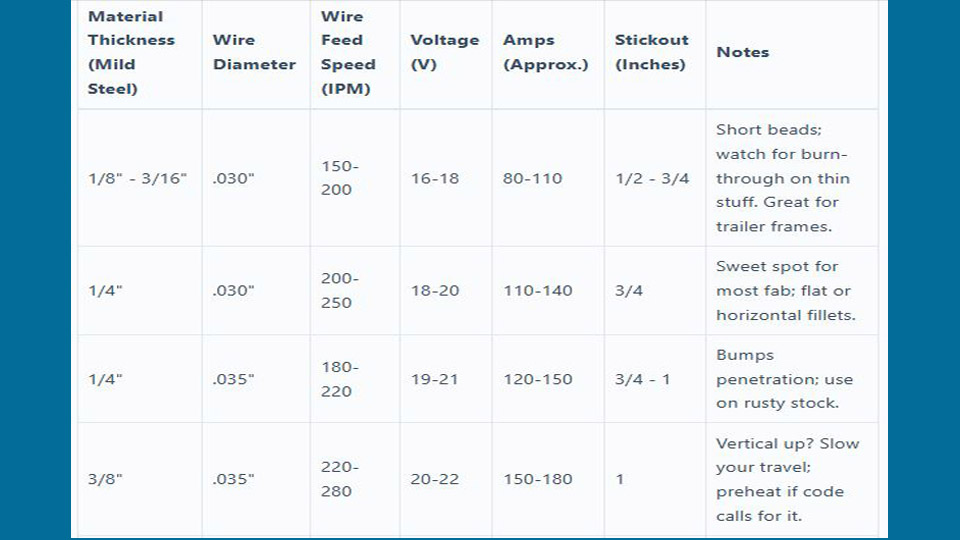
Start with the chart inside the machine or the consumable data sheet. Select the row that matches the wire diameter, material thickness, joint, and position.
On many constant-voltage wire feeders, wire-feed speed strongly affects welding current, while voltage affects arc length and bead profile. Change one control at a time and remain within the manufacturer’s approved range.
For example, the Lincoln NR-211-MP E71T-11 data sheet lists different voltage, current, wire-speed, and contact-tip-to-work-distance ranges for each diameter. Those values apply to that product and should not be copied to another electrode without verification.
8. Make and Inspect a Scrap Test
- Use scrap that matches the project’s material and thickness.
- Wear a welding helmet, safety glasses, flame-resistant clothing, gloves, and suitable footwear.
- Hold the gun at the contact-tip-to-work distance listed for the wire.
- Use a slight drag angle unless the data sheet states otherwise.
- Make a short bead while listening for a steady arc.
- Allow the work to reach a safe handling condition, then remove slag while wearing eye protection.
- Inspect the bead for porosity, undercut, overlap, cracks, trapped slag, and poor fusion.
- Adjust one variable at a time and repeat the test.
Pro Tip: Photograph the spool label and save the technical data sheet before discarding the package. You will still have the polarity, gas, position, stickout, and setting information when the spool is mounted inside the machine.
Machine Settings for Gasless Flux Core
There is no single correct voltage or wire speed for “gasless flux core.” Even wires with the same diameter can use different ranges because their classifications and formulations differ.
Use these signs to make small corrections within the approved range:
- Wire stubbing into the work: The wire-feed speed may be too high for the voltage, or the travel angle and stickout may be wrong.
- Long, harsh arc: Voltage may be excessive, stickout may be too long, or the work connection may be poor.
- Tall, narrow bead with poor toe fusion: Travel may be too fast, voltage may be low, or the joint may need more preparation.
- Wide bead or undercut: Voltage, travel speed, angle, or heat input may be excessive.
- Heavy spatter: Check polarity, stickout, voltage, wire speed, work connection, and wire feeding.
Choosing the Right Flux-Core Wire
Select wire by base metal, strength requirement, joint, position, thickness, service temperature, shielding method, and applicable code. Brand alone is not enough.
| Selection Question | What to Check |
|---|---|
| What metal is being welded? | Use a consumable classified for the exact carbon steel, low-alloy steel, or stainless alloy. |
| Does it need gas? | Confirm FCAW-S or FCAW-G and read the shielding-gas requirement. |
| What positions are required? | Verify flat, horizontal, vertical, and overhead approval on the product data sheet. |
| Single-pass or multipass? | Do not exceed the wire’s pass or plate-thickness limitations. |
| Is the joint load-bearing? | Use an approved welding procedure, specified consumable, qualified welder, and required inspection. |
| Is low-temperature toughness required? | Check the exact impact-toughness designator and test temperature. |
| Does the machine have enough output? | Match wire diameter and operating range to the machine’s rated output and duty cycle. |
E71T-11 is a common self-shielded classification for general carbon-steel fabrication, but every E71T-11 product has its own diameter, thickness, and operating limits. E71T-8 products are also self-shielded and are widely used in structural applications, but code or seismic approval is product- and procedure-specific.
Gas-shielded classifications may include designators identifying the gas used for classification testing. Follow the product’s complete classification and data sheet rather than assuming every gas-shielded wire works with both CO2 and an argon blend.
Products Worth Considering

E71T-11 FLUX CORE WIRE: Known for its smooth arc action and minimal spatter, it operates efficiently without the need for external shielding gas, making it ideal for outdoor use or drafty environments where gas-shielded processes might struggle. This electrode offers excellent slag removal and good weld penetration.

GASLESS: E71T-11 does not require a shielding gas. The flux core inside the wire acts in place of the shielding gas. This makes the wire very versatile and perfect for mobile jobs, outdoor jobs, and people who do not have access to shielding gas.

High Quality & Reliable Welds: VEVOR 0.03" 2 lbs E71T-11 flux core MIG welding wire provides stable arc action with low spatter for smooth, clean weld beads. It is suitable for thin-gauge carbon steel plates and supports multi-pass welding
Store Flux-Core Wire Correctly
Keep wire clean, dry, and protected from condensation, dirt, oil, and physical damage. Follow the manufacturer’s storage and reconditioning instructions. Replace wire that is rusty, crushed, contaminated, or feeding poorly rather than trying to weld through the problem.
Common Flux-Core Welding Problems and Fixes
| Problem | Likely Causes | What to Check |
|---|---|---|
| Excessive spatter | Wrong polarity, poor work connection, excessive stickout, mismatched voltage and wire speed, or unstable feeding | Verify polarity first, clean and reposition the clamp, check the data-sheet stickout, and inspect the drive system |
| Porosity | Moisture, oil, coatings, excessive arc length, poor gas coverage on FCAW-G, drafts, or damaged wire | Clean and dry the joint, verify gas type and flow, shield the arc from drafts, and inspect the wire |
| Worm tracks | Gas escaping through solidifying slag, excessive voltage, unsuitable technique, or contaminated material | Use the manufacturer’s settings, correct the angle and travel speed, and clean the joint |
| Slag inclusions | Failure to clean between passes, poor bead placement, low heat input, or an incorrect angle | Remove all slag, improve access to the joint root and toes, and correct the settings |
| Lack of fusion | Travel speed too high, heat input too low, poor joint preparation, incorrect angle, or excessive stickout | Improve preparation and fit-up, slow travel as needed, shorten stickout within the approved range, and retest |
| Undercut | Excessive voltage, travel speed, weaving, or incorrect gun angle | Reduce the offending variable within the approved range and pause long enough for the toes to fill |
| Wire feeding problems | Wrong roll or tip, excessive roll tension, kinked liner, rusty wire, or spool-brake problems | Match the feeding parts to the wire, reduce pressure, straighten or replace the liner, and inspect the spool |
| Arc starts and stops | Poor clamp contact, worn tip, slipping wire, thermal overload, or damaged cable | Clean the connection, replace worn parts, check duty cycle, and inspect the gun and work leads |
Do not aim a general-purpose fan directly across a gas-shielded arc. It may remove the shielding gas. Position local exhaust close enough to capture the plume while keeping the airflow from passing through the arc or into the welder’s face.
Flux-Core Welding for Structural and Safety-Critical Work
Flux-cored welding is widely used in structural steel, heavy equipment, shipbuilding, and other demanding work. That does not mean any flux-core wire or hobby machine is approved for a load-bearing job.
The current AWS D1.1/D1.1M:2025 structural steel code addresses procedure qualification, welder qualification, fabrication, inspection, and acceptance criteria. Compliance depends on the complete welding system, including:
- Base-metal type and thickness.
- Joint design and welding position.
- Electrode classification, manufacturer, diameter, and shielding gas.
- Preheat and interpass-temperature requirements.
- Qualified welding procedure specifications.
- Welder performance qualifications.
- Required inspection and acceptance standards.
Note: Do not use a practice bead or a wire’s tensile-strength classification as proof that a trailer, roll cage, lifting point, pressure-retaining part, bridge component, or seismic connection is safe. Those jobs require the applicable design, procedure, qualification, and inspection controls.
Real-World Applications for Flux Core in the USA
Self-shielded flux core is common in portable carbon-steel repair because crews can work without moving a gas cylinder and protecting an external shielding plume. Typical uses include field fabrication, farm-equipment repair, construction work, and maintenance on large steel assemblies.
Gas-shielded flux core is common in covered fabrication environments where high productivity, repeatable operating conditions, and code-controlled procedures matter. It is used for structural fabrication, heavy equipment, shipbuilding, and other production work with suitable ventilation and fume controls.
For home projects, flux core works well on items such as workbench frames, garden structures, brackets, and noncritical equipment repairs. Evaluate the metal, coating, thickness, load, and failure consequences before striking an arc.
Conclusion: Your Flux-Core Welding Game Plan
Flux-core welding does not always require gas. Self-shielded FCAW-S wire operates without an external cylinder, while gas-shielded FCAW-G wire needs the gas stated by its manufacturer.
Start every job by reading the spool label. Confirm polarity, wire diameter, gas, drive rolls, contact tip, welding position, material range, and settings. Clean the joint, control fumes, make a scrap test, and remove slag between passes.
Use self-shielded wire when portability and outdoor tolerance matter. Use gas-shielded wire when the procedure calls for it and the shielding can be protected. For structural or safety-critical work, follow an approved procedure and the applicable qualification and inspection requirements rather than relying on general shop advice.
Frequently Asked Questions
Can beginners use flux-core welding without gas?
Yes. A compatible wire-feed welder and self-shielded wire provide a relatively simple portable setup. Beginners should still read the machine and wire instructions, wear complete PPE, control fumes, practice on clean scrap, and avoid safety-critical projects until properly trained and qualified.
What is the difference between flux-core and stick welding?
Both processes use flux to help protect the weld. Flux-core welding continuously feeds a tubular wire through a gun, while stick welding uses individual coated electrodes. Flux core can provide high productivity on longer seams. Stick equipment is often simple and practical for short repairs or hard-to-reach locations.
Is flux-core welding strong enough for structural steel?
Yes, suitable FCAW electrodes are widely used for structural steel. Strength and code compliance depend on the specified wire, base metal, joint, welding procedure, welder qualification, workmanship, and inspection. A hobby setup or a 70-ksi wire label does not by itself make a structural weld acceptable.
How do I reduce spatter with gasless flux core?
Verify polarity first. Then check the work connection, stickout, voltage, wire-feed speed, contact tip, drive-roll pressure, gun angle, and travel speed. Use the wire maker’s recommended range and change only one variable at a time.
Can I use flux-core wire in a regular MIG welder?
Many wire-feed MIG machines can run flux-cored wire, but the machine must support the wire diameter, output range, duty cycle, drive-roll type, contact tip, and required polarity. Gas-shielded FCAW also requires a compatible gas system. Check the owner’s manual before changing the setup.
Can I use shielding gas with gasless flux-core wire?
Not unless the wire manufacturer specifically approves it. Self-shielded wire is formulated to create its own shielding system. Adding gas may change arc behavior, weld chemistry, and mechanical properties rather than improve the weld.
How can I tell whether my flux-core wire needs gas?
Read the spool label, package, and technical data sheet. Look for FCAW-S or “self-shielded” for wire that needs no external gas. FCAW-G or a listed shielding-gas requirement means a gas cylinder is required. Also verify polarity and approved gas type.
Sources
- Lincoln Electric: Self-Shielded vs Gas-Shielded Flux-Cored Electrodes — shielding methods, polarity tendencies, slag, and operating differences.
- Miller Electric: Flux-Cored Welding Basics for Mild Steel — FCAW process fundamentals, setup, and outdoor-use considerations.
- Lincoln Electric NR-211-MP Data Sheet — E71T-11 polarity, diameter limits, operating ranges, and mechanical properties.
- OSHA: Controlling Hazardous Fume and Gases During Welding — coating removal, ventilation, respiratory protection, and confined-space precautions.
- AWS A5.20/A5.20M:2025 — current classification requirements for carbon-steel flux-cored electrodes.
- AWS D1.1/D1.1M:2025 Structural Welding Code—Steel — structural welding procedures, qualifications, fabrication, inspection, and acceptance requirements.