How does flux core welding work? A hollow wire filled with flux is fed through a welding gun, an electric arc melts the wire and the base metal together, and the flux inside the wire shields and shapes the weld as it burns. Some wires make their own shielding gas and need no cylinder. Others pair the flux with an external gas.
This guide explains what happens at the arc, what the flux actually does, how self-shielded and gas-shielded wire differ, which settings matter, and how to make a first weld safely on mild steel.
Quick Answer
Flux core welding (FCAW) feeds a tubular, flux-filled wire into an electric arc. The arc melts the wire and the joint into one puddle. The flux releases shielding gases, helps clean the molten metal, and forms a slag crust over the cooling bead. You chip that slag off afterward.

Image by welderslab
What Is Flux Core Welding?
Flux-cored arc welding is a wire-fed arc process. The electrode is a thin metal tube filled with flux, and sometimes alloying powders. It runs on the same kind of equipment as MIG welding: a constant-voltage power source, a wire feeder, and a gun.
It is semi-automatic. The machine feeds the wire, and you control the gun position, angle, and travel speed. The main differences from MIG are the wire (tubular instead of solid), the shielding (the wire can supply it), and the slag left on the weld.
How Does Flux Core Welding Work?
Every flux core weld follows the same sequence:
- The wire feeds. Drive rolls push the wire from the spool through the liner to the contact tip, which passes welding current into it.
- The arc starts. When the wire touches the work, the circuit closes and an arc forms between the wire tip and the metal.
- The metal melts. The arc melts the end of the wire and a small area of the base metal, and droplets of filler transfer into the puddle.
- The flux reacts. The core ingredients burn and decompose in the heat. Depending on the wire, they release shielding gases, deoxidizers, and arc stabilizers, and they form slag.
- Slag covers the bead. The slag floats on the puddle, protects the cooling metal, and helps shape the bead.
- You remove the slag. Once the weld is safe to handle, chip and brush the slag off. Do this between passes too, or it can end up trapped in the weld.
On a constant-voltage machine, wire-feed speed mostly sets the welding current, while voltage mainly sets arc length and bead shape. That is why a flux core welder often has a wire-speed knob and a voltage setting but no amperage dial.
What the Flux Does
- Shields the puddle. In self-shielded wire, the flux produces the gases that keep air away from the molten metal.
- Cleans and protects. Deoxidizing ingredients help deal with oxygen and light surface oxides so the weld stays sound.
- Stabilizes the arc. Arc-stabilizing ingredients help the arc run smoothly.
- Forms slag. The slag supports the puddle, which helps in vertical and overhead welding, and slows cooling.
- Can add alloys. Some wires carry alloying elements in the core to reach the strength or properties the wire is classified for.
Flux is not a cure for dirty metal. Oil, moisture, paint, heavy rust, and coatings still cause porosity and weak fusion, so clean the joint first.
Self-Shielded vs Gas-Shielded Flux Core
There are two forms of the process, and they work slightly differently at the arc.
| Feature | Self-shielded (FCAW-S) | Gas-shielded (FCAW-G) |
|---|---|---|
| Shielding source | Flux inside the wire | Flux inside the wire plus external gas |
| Gas cylinder | Not needed | Required, using the gas on the wire data sheet |
| Wind | More tolerant, but not wind-proof | Drafts can blow the gas away |
| Typical polarity | Often DCEN, but check the wire label | Commonly DCEP, but check the wire label |
| Best for | Outdoor and portable steel repair | Shop work and higher productivity |
Both leave slag. For a deeper comparison, see self-shielded vs gas-shielded flux core, or read whether flux core welding requires gas for your wire.
Products Worth Considering

Welding Easy and Quick: AWS E71T-GS 030” Flux Core welding wire (The actual Net Weight of Wire is 2LB), no need for shielding gas, install it then you can welding all positions, single and multi pass welding. Great for T-joints, butt welds & lap welds.

E71T-GS FLUX CORE WIRE: This self-shielding, AWS E71T-GS flux-cored wire excels due to its advanced core design, delivering exceptional arc stabilization and high feedability for effortless welding. The core also incorporates powerful deoxidizing agents, ensuring clean, reliable welds even when welding through light rust or mill scale.

Portable Welding Solution: Our 1lb flux core welding wire is a compact, gasless solution perfect for portable machines, designed to provide seamless performance for small-scale DIY repair projects
What Controls the Weld
| Setting | What it changes | Starting point |
|---|---|---|
| Wire-feed speed | Welding current and deposition rate | Machine chart or wire data sheet |
| Voltage | Arc length and bead width | Machine chart or wire data sheet |
| Stickout | Current and arc stability | Miller suggests about 3/4 inch for flux core; follow the wire maker |
| Polarity | Arc stability and spatter | Whatever the wire label says |
| Travel angle | Slag control and penetration | Drag the gun, about 5 to 15 degrees |
| Travel speed | Bead size and fusion | Steady pace that keeps the puddle tied into both toes |
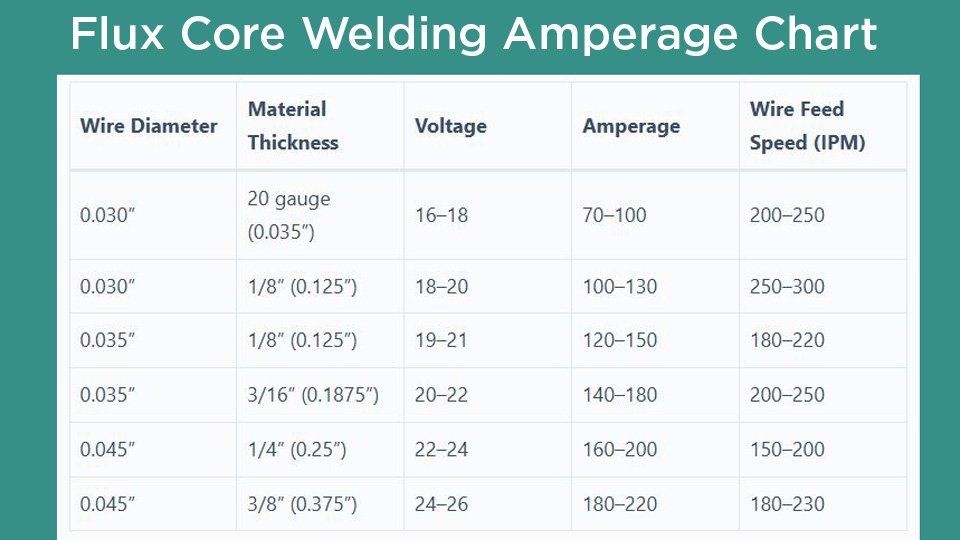
Use a drag (pull) technique so the slag stays behind the arc. Exact numbers depend on the wire diameter, classification, and machine, so see the flux core welding amperage chart for how wire speed, voltage, and thickness relate.
Products Worth Considering

Welding Easy and Quick: AWS E71T-GS 035” Flux Core welding wire(The actual Net Weight of Wire is 2LB), no need for shielding gas, install it then you can welding all positions, single and multi pass welding. Great for T-joints, butt welds & lap welds.

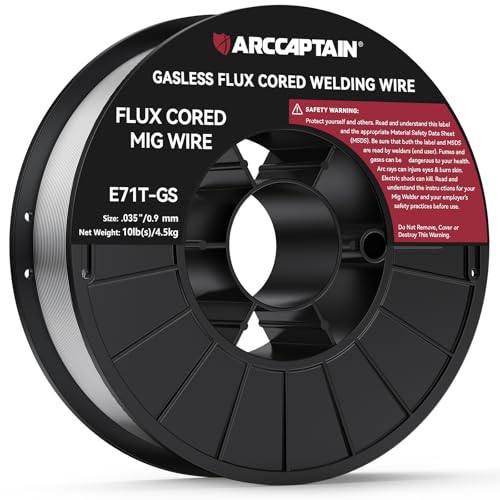
Effortless and Efficient Welding: Hassle-free experience with our AWS E71T-GS 0.035" Flux Core welding wire (Net Weight: 10lbs). No shielding gas needed, install and weld in any position. Perfect for strong T-joints, butt welds, and lap welds.
What You Need to Get Started
- A wire-feed welder that can run flux-cored wire at the polarity the wire requires
- Flux-cored wire in a diameter your machine supports, commonly .030 or .035 inch on small machines
- Knurled or flux-core drive rolls and a contact tip that match the wire diameter
- A work clamp, grinder or wire brush, chipping hammer, and clamps
- A shielding gas setup only if the wire is gas-shielded
- Helmet, safety glasses, welding gloves, flame-resistant clothing, and leather footwear
Basic Steps for a First Flux Core Weld
Practice on clean mild-steel scrap, not on a part that carries a load.
- Read the wire label for polarity, diameter, and whether it needs gas.
- Turn the machine off and set the polarity leads as the label and manual show.
- Fit the drive roll and contact tip to the wire, and set only enough roll pressure to feed without slipping.
- Grind or brush the joint to clean metal, and attach the work clamp to bare steel close to the weld.
- Set voltage and wire speed from the machine chart or wire data sheet.
- Hold the gun at a slight drag angle with a steady stickout, and run a short test bead.
- Adjust one setting at a time until the arc is steady and the bead ties into both sides.
- Let the weld cool, chip the slag, wire-brush the bead, and inspect it for cracks, pinholes, and undercut.
Pros and Limits of Flux Core Welding
| Strengths | Limits |
|---|---|
| Self-shielded wire needs no gas cylinder | Slag must be removed after every pass |
| Handles light breezes better than gas MIG | More smoke and spatter than solid-wire MIG |
| Good deposition on medium and thick steel | Hard to control on thin sheet metal |
| Some wires tolerate light mill scale | Wire often costs more per pound than solid wire |
Common Problems and Fixes
| Problem | Likely cause | Fix |
|---|---|---|
| Heavy spatter | Wrong polarity, voltage too high, uneven stickout | Check the wire label first, then return to the chart settings |
| Porosity (pinholes) | Dirty or wet metal, damp wire, wind on gas-shielded wire | Clean the joint, store wire dry, block drafts |
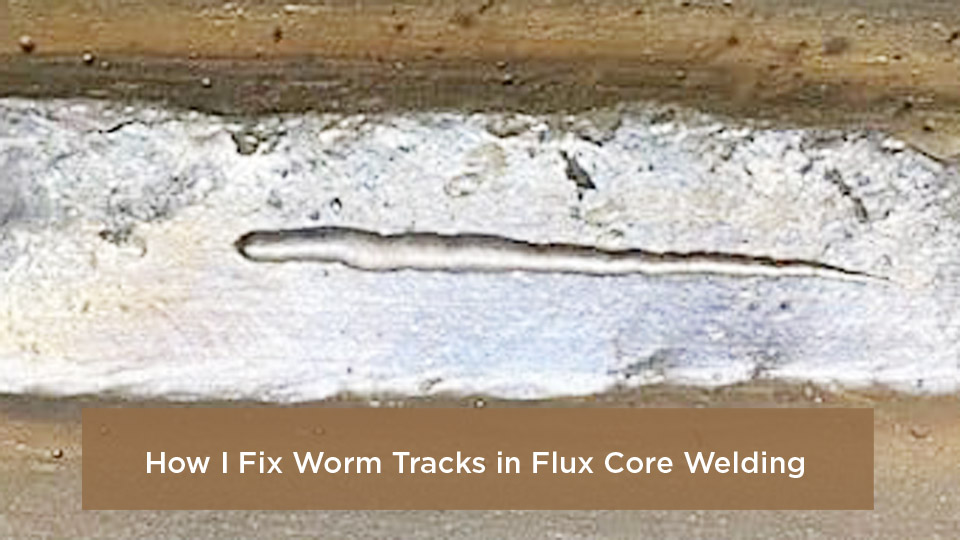
| Trapped slag | Slag left between passes, pushing the gun | Clean every pass and drag the gun |
| Wire stubs or bird-nests | Wrong drive roll, too much roll pressure, worn tip | Match the feed parts to the wire and reduce pressure |
| Burn-through | Too much heat for thin metal | Lower the settings, use short welds, or switch process |
Safety Basics
- Flux core makes more fume than many other processes. Keep your head out of the plume and use local exhaust or good ventilation. OSHA covers this in its welding fume fact sheet.
- Do not weld over unknown paint, plating, galvanizing, or on closed containers.
- Wear a welding helmet with the right shade, safety glasses, dry gloves, and flame-resistant clothing.
- Keep combustibles away and an extinguisher close, and let hot slag cool before handling it.
- Do not use a beginner setup on trailers, vehicle suspension, lifting points, or other safety-critical parts.
Related reading: flux core welding amperage chart, flux core welding tips for beginners, flux-cored welding wire types and uses and what flux core welding is used for.
Frequently Asked Questions
Does flux core welding need gas?
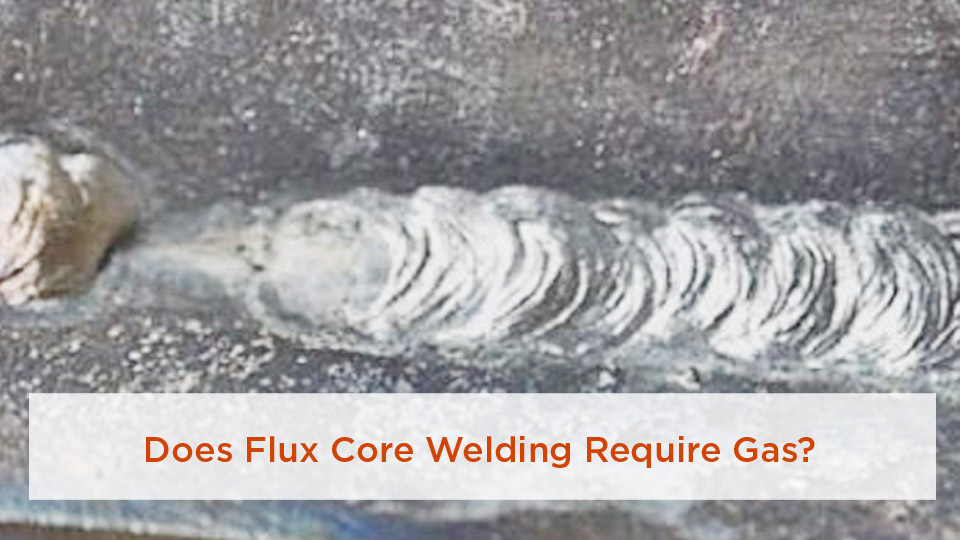
Not always. Self-shielded flux-cored wire makes its own shielding and needs no gas cylinder. Gas-shielded flux-cored wire needs the external gas listed on the wire data sheet. Check the spool label.
Is flux core welding strong?
It can be. Strength depends on the wire classification, base metal, joint, settings, and technique, not on the process name. Critical welds need an approved procedure, qualified welder, and inspection.
Why does flux core make so much smoke and spatter?
The flux burns in the arc, which creates fume, and the process is spatter-prone when polarity, voltage, or stickout is off. Verify polarity first, then return to the chart settings and keep stickout steady.
Can I flux core weld thin metal?
Only with care. Flux core runs hot for thin sheet and burns through easily. Use the smallest approved wire, low settings, tight fit-up, and short welds, or choose gas MIG for thin panels.
Do I push or pull with flux core?
Pull (drag) the gun so the slag stays behind the arc. A travel angle of about 5 to 15 degrees is a common starting point, and the wire maker can specify otherwise.
Is flux core welding good for beginners?
It is a common first process because the wire feeds continuously and self-shielded wire needs no gas. Beginners still need to learn polarity, settings, slag removal, ventilation, and safe practice on scrap.
Sources
- Miller: Flux-Cored Welding Basics for Mild Steel – process basics, stickout, drag technique, and travel angle
- OSHA: Controlling Hazardous Fume and Gases During Welding – ventilation, coatings, and respiratory protection