When you compare MIG and flux-cored welding for auto body work, the right choice depends on the metal, panel location, repair procedure, and required finish. For ordinary mild-steel cosmetic patches, MIG welding with solid wire and shielding gas is usually easier to control and finish. Flux core is better reserved for thicker, nonstructural steel and outdoor work where shielding gas cannot be protected from moving air.
Quick Answer
MIG with solid wire and shielding gas is usually better for thin auto body panels because it gives you cleaner welds, finer low-heat control, and no slag to remove. Use self-shielded flux core mainly for thicker, nonstructural mild steel or outdoor repairs, and always follow the vehicle maker’s repair procedure.
Key Takeaways
- Choose gas-shielded MIG for most thin cosmetic panels. It gives you better low-end control and less finishing work.
- Do not choose a process before checking the vehicle repair information. Modern steels may require GMA welding, MIG brazing, resistance spot welding, rivets, adhesives, or part replacement.
- Reserve flux core for appropriate nonstructural work. It is useful outdoors and on thicker mild steel, but it creates slag and usually puts more heat into thin sheet.
- Test before touching the vehicle. Tune and inspect welds on coupons made from the same type and thickness of metal.
- Protect the entire vehicle. Remove nearby combustibles, follow battery and high-voltage procedures, control fumes, and inspect hidden areas for fire.
At a Glance
| Best Overall Choice | Gas-shielded MIG with solid wire for most ordinary mild-steel body-panel patches |
| Best Flux-Core Use | Thicker, nonstructural mild steel and outdoor work where gas shielding cannot be protected |
| Light-Gauge MIG Starting Point | Often .023- or .024-inch solid wire with an argon-rich steel shielding gas, subject to the machine, wire, and repair instructions |
| Main Thin-Panel Risks | Burn-through, distortion, weak fusion, excessive grinding, and hidden fire |
| Tools Needed | Correct welder and wire, shielding gas when required, PPE, ventilation, clean ground clamp, clamps, grinder, wire brush, matching test coupons, and fire-protection equipment |
| Skill Level | Beginner to intermediate for nonstructural cosmetic patches; trained collision-repair technician for structural, restraint, or high-voltage areas |
What Is MIG Welding and How Does It Work?
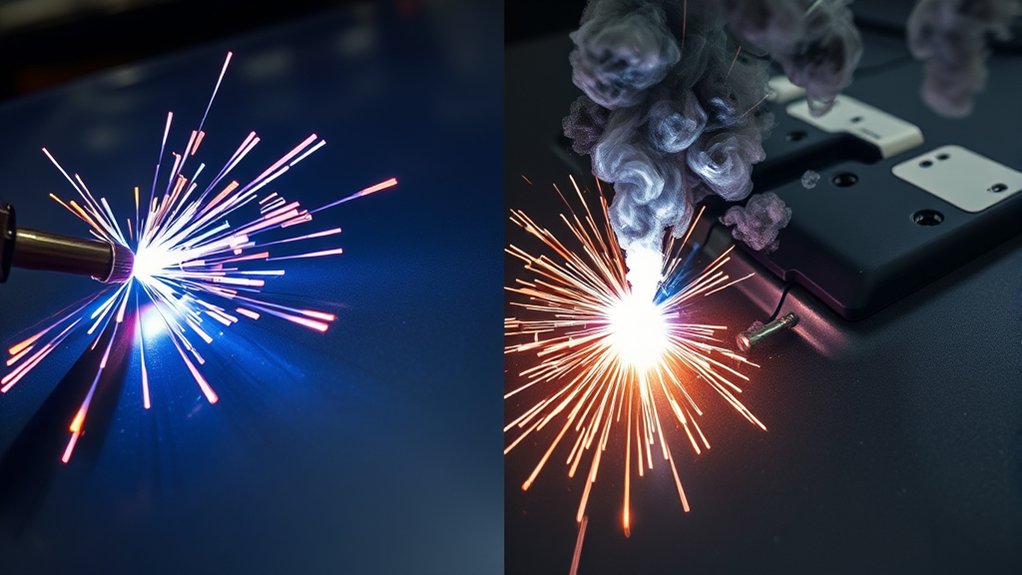
MIG is the familiar shop name for gas metal arc welding, or GMAW. The machine continuously feeds a wire electrode through the gun. An arc melts the wire and base metal while shielding gas protects the molten weld pool from the surrounding air.
On carbon steel, a shielding mix containing carbon dioxide is technically a metal active gas, or MAG, process. However, North American welders commonly use “MIG” as the practical name for gas-shielded wire welding on automotive steel.
MIG works well for body repairs because it gives you steady wire feeding and controllable short tacks. That matters on door skins, quarter panels, floor sections, rocker outer panels, and patch panels where excess heat can stretch or distort the sheet. Always confirm that the part is repairable and that GMA welding is an approved attachment method before treating it as ordinary sheet metal.
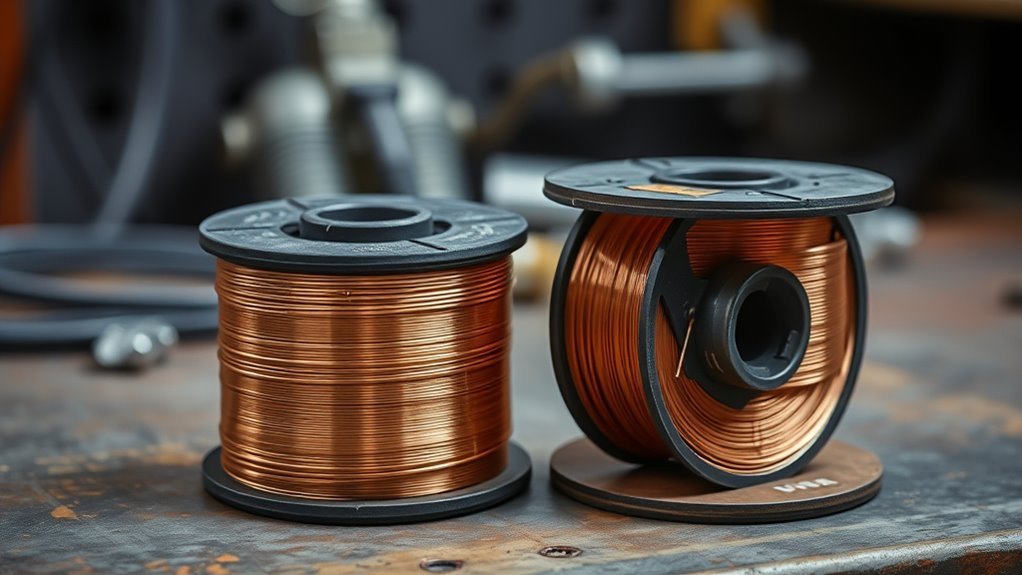
For permitted mild-steel sheet repairs, a common setup uses solid wire and an argon-rich shielding mix. Miller’s current sheet-metal welding guidance recommends .023- or .024-inch wire for most light-gauge work and notes that .030-inch wire may be suitable at 18 gauge and thicker. Your welder chart, filler-wire instructions, test results, and vehicle repair procedure control the final choice.
MIG leaves no flux slag, so you can see the weld surface before grinding, priming, sealing, and painting. You still need close fit-up, clean metal, sound ground contact, and correctly balanced wire speed and voltage.
Pro Tip: Make several welds on coupons cut from the removed panel or made from metal of the same type and thickness. Inspect the bead and back side before welding the vehicle. For collision-repair attachment welds, follow the OEM or training procedure for destructive testing.
Key Features and Benefits of Flux-Core Welding
Flux-cored arc welding also feeds wire continuously, but the electrode is tubular and contains flux ingredients. Those ingredients help shield the weld and form a slag layer over the bead.
There are two main categories:
- Self-shielded flux-cored wire: Generates its own shielding and does not use an external gas cylinder.
- Gas-shielded flux-cored wire: Uses both flux ingredients and externally supplied shielding gas.
When hobby welders say “gasless MIG,” they usually mean self-shielded flux-core welding. The phrase is convenient, but the process is FCAW rather than MIG because it does not use the same external gas-shielded solid-wire setup.
Self-shielded wire is portable and more tolerant of outdoor air movement than gas-shielded MIG. Flux-cored wires can also provide strong sidewall fusion and high deposition rates in suitable applications. Those production advantages matter more on thicker fabrication than on the brief, spaced tacks used for a body-panel seam. See this guide to common flux-core applications for broader examples.
The consistent tradeoffs are slag, fume, and extra cleaning. Spatter also can be greater, but the amount depends on the wire, polarity, voltage, wire speed, stickout, and technique. On thin sheet, the larger available flux-cored wire and higher heat input can make burn-through and distortion harder to avoid.
Portability and Ease of Use
Self-shielded flux core is useful when you must work away from a protected indoor welding bay. You do not have to move a gas cylinder, regulator, and hose, and light outdoor air movement does not remove a separate shielding-gas envelope.
- No external gas cylinder with self-shielded wire.
- Better outdoor practicality than gas-shielded MIG when wind cannot be blocked.
- Useful fusion characteristics on suitable thicker mild-steel work.
- Slag removal required before inspection, another pass, primer, or coating.
- Greater thin-sheet difficulty because the process can put more heat into the panel.
Flux core is not a shortcut around preparation. Remove paint, rust, oil, undercoating, adhesive, seam sealer, and other contaminants from the joint as required by the repair procedure.
Cost-Effectiveness for Repairs
A self-shielded setup may have a lower initial cost because it does not need a gas cylinder, regulator, or refill. However, flux-cored wire can cost more than solid wire, and slag removal, brushing, grinding, and refinishing add labor.
Flux core may be economical for a hidden, nonstructural bracket or a thicker mild-steel repair where appearance is secondary. MIG usually saves finishing time on an exterior patch because you can inspect and dress the bead without first removing slag.
MIG vs. Flux Core: Which Is Best for Thin Metal?
For ordinary thin automotive mild steel, gas-shielded MIG is usually the better choice. Small solid wire, stable low settings, and an argon-rich shielding gas can reduce spatter and make short tacks easier to control. Miller also advises against flux-cored wire for thin sheet where the additional heat raises the chance of burn-through.
Flux core can join some thin materials when the wire and machine are rated for them, but it gives you less margin for error. It also leaves slag that must be removed before you can fully inspect the surface or apply coatings. Additional grinding can introduce more heat and distortion.
| Factor | MIG With Solid Wire | Self-Shielded Flux Core |
|---|---|---|
| Thin cosmetic panels | Usually the better process when GMA welding is permitted | Possible with some equipment, but less forgiving |
| Weld finishing | No slag and generally easier to inspect and dress | Slag must be removed completely |
| Outdoor work | Requires effective protection from moving air | More practical when a gas shield cannot be protected |
| Thicker mild steel | Works within the machine’s output and approved procedure | Useful for appropriate nonstructural fabrication and repair |
| Structural collision repair | Use only where the vehicle maker specifies GMA welding | Do not use unless the vehicle-specific procedure explicitly permits it |
| Paint preparation | Cleaner starting surface with no flux slag | Requires thorough slag and residue removal |
Note: MIG will still blow holes through thin steel if the setting is too hot, the gap is too wide, the metal is thin from corrosion, or you hold the trigger too long. Process choice cannot correct poor fit-up or damaged base metal.
Products Worth Considering

ER308L WIRE: A low-carbon stainless steel wire engineered to minimize intergranular carbide precipitation. This enhances corrosion resistance without the need for stabilizers, making it ideal for critical applications.

High-quality: ARCCAPTAIN's ER70S-6 mig welding wire .030" meets industry standards(Net Weight: 10lbs), ensuring consistent performance, superior strength. With its smooth feeding and stable welding parameters, you can achieve optimal penetration, high deposition rates, and exceptional overall welding performance.

E71T-GS GASLESS FLUX CORE WIRE: This AWS E71T-GS self-shielded flux-cored wire delivers smooth, stable welding without external shielding gas. It offers excellent arc stability, consistent feedability and reliable performance, allowing users to produce clean welds with minimal setup work. Its advanced flux formulation enables welding over light rust and mill scale for improved everyday practicality.
Check the Repair Type and OEM Procedure First
Before choosing MIG or flux core, decide whether you are making a simple cosmetic rust patch or repairing part of the vehicle’s crash structure. The difference is more important than the name on the welder.
Modern vehicle bodies may combine mild steel, high-strength steel, ultra-high-strength steel, aluminum, galvanized coatings, structural adhesive, rivets, and factory spot welds. The approved repair can call for GMA plug welds, butt welds, squeeze-type resistance spot welding, MIG brazing, rivet bonding, adhesive bonding, or replacement at a specific factory seam.
I-CAR’s welding and MIG-brazing resources repeatedly direct technicians to follow the vehicle maker’s repair information, select approved equipment, restore corrosion protection, protect high-voltage vehicles, and test weld quality.
Warning: Do not treat frame rails, pillars, rocker reinforcements, roof rails, crush zones, suspension mounts, seat mounts, seat-belt anchors, airbag-related structures, or high-voltage battery enclosures as ordinary patch metal. These repairs require vehicle-specific procedures, suitable equipment, and collision-repair training.
Cosmetic and Nonstructural Repairs
A skilled DIYer may be able to handle a small patch in ordinary mild steel when the area is confirmed as nonstructural and the repair does not affect restraints, suspension, crash management, or a high-voltage system. Examples may include a nonstructural exterior rust patch or a removable mild-steel bracket.
Even then, inspect the back side, identify nearby wiring and flammable material, and confirm that the remaining metal is thick enough to weld. Rust that extends into reinforcements or seams often requires more than a surface patch.
Structural and Collision Repairs
Floor pans and rockers are not automatically nonstructural. Their function varies by vehicle and location. A rocker outer cover may be different from the reinforcement behind it, and a flat floor section may connect to rails, seat mounts, or battery structures.
When the repair affects crash performance, use the current body-repair manual for the exact year, make, model, and part. If the procedure is unavailable or the required equipment is beyond your setup, refer the job to a qualified collision-repair facility.
Pros and Cons of MIG Welding for Auto Body Projects
MIG is popular for permitted body-panel work because the small wire and clean process suit short, spaced tacks. When you move around the joint and allow cooling time, you reduce concentrated heat buildup.
MIG Welding Advantages
- No flux slag: You can inspect the bead before grinding or coating.
- Cleaner finishing: The weld is easier to prepare for primer, seam sealer, and paint.
- Useful low-end control: Small solid wire and a stable machine make brief tacks easier on thin mild steel.
- Accessible setup guidance: Many machines provide starting settings for metal thickness, wire size, and gas.
- Process flexibility: Some machines provide multiple welding processes, though each process still needs the correct consumables and setup.
MIG Welding Challenges
- Gas equipment required: You need a cylinder, regulator or flowmeter, hose, and secure cylinder storage.
- Sensitive to moving air: Wind or a strong fan can disturb the shielding-gas envelope.
- Preparation still matters: Remove contaminants and coatings as directed by the repair procedure.
- Machine quality matters: A welder with rough wire feeding or poor control at its lowest settings can be frustrating on thin panels.
- Not automatically OEM-approved: Some joints require another attachment process even when MIG could physically join the metal.
For a cosmetic butt seam, treat MIG as a series of short tacks rather than one continuous bead. Tack one area, move to a distant part of the seam, and continue rotating around the panel. Do not chase one tack directly after another while the surrounding metal remains hot.
Advantages and Challenges of Flux-Cored Welding in Automotive Repair

Flux core is practical when portability and outdoor operation matter more than a smooth cosmetic finish. It can work well on suitable thicker mild-steel brackets, tabs, and nonstructural pieces when the wire, machine, polarity, and technique match the material.
Flux core is a useful portable fabrication process, but it is not the default attachment method for modern collision-structural repairs.
Where Flux Core Makes Sense
- Outdoor mild-steel work where you cannot maintain gas shielding.
- Suitable thicker nonstructural brackets, tabs, and support pieces.
- Repairs where slag removal and a rougher initial finish are acceptable.
- Locations where safely moving and securing a gas cylinder is impractical.
Where Flux Core Is Risky
- Door skins, roof skins, quarter panels, and other broad cosmetic surfaces.
- Thin, rust-weakened metal or patches with poor fit-up.
- Repairs requiring minimal grinding and clean paint preparation.
- Structural or high-strength-steel joints without explicit OEM approval.
- Coated and galvanized panels without correct coating removal, ventilation, and corrosion-restoration procedures.
Correct wire speed, voltage, polarity, stickout, and travel technique can reduce defects, but they cannot make the wrong wire suitable for the repair. Review these flux-core welding tips, then verify every setting against the wire label and machine manual.
Key Factors for Selecting MIG or Flux-Core Welding for Auto Body Work
Base the choice on the repair requirements rather than the machine already in your garage. A removable bracket, cosmetic quarter-panel patch, rocker reinforcement, and suspension mount do not have the same material or attachment requirements.
| Factor | Choose MIG When… | Choose Flux Core When… |
|---|---|---|
| Repair procedure | The vehicle maker permits GMA welding at that joint. | The work is confirmed nonstructural or the procedure specifically permits FCAW. |
| Material thickness | You are joining thin ordinary mild steel and need low-end control. | The mild steel is thicker and not part of a restricted structure. |
| Appearance | The weld must be dressed for a smooth exterior finish. | Slag removal and a rougher initial bead are acceptable. |
| Location | You can work indoors or shield the weld from moving air. | You must work outdoors and cannot protect external gas coverage. |
| Cleanup time | You want to minimize slag removal and aggressive grinding. | You can remove all slag before inspection and coating. |
| Experience | You are learning controlled tack welding on thin sheet. | You have practiced the exact wire and metal thickness and confirmed the repair is suitable. |
When the repair information permits either process, MIG is normally the practical choice for thin visible panels. Understanding common heat-control and weld-quality problems will help with either setup.
Safety Checks Before Welding Auto Body Metal
Warning: Auto body welding can ignite carpet, foam, insulation, undercoating, adhesives, seam sealer, fuel vapors, wiring, and materials hidden behind the panel. Wear suitable welding PPE, provide effective ventilation, keep fire-extinguishing equipment ready, and inspect every side of the repair before and after hot work.
OSHA’s general hot-work requirements call for combustible hazards to be moved or protected and for a trained fire watch when more than a minor fire could develop. When a fire watch is required, OSHA specifies that it continue for at least 30 minutes after welding or cutting to detect smoldering fires.
- Read the vehicle procedure: Check battery, retained-power, restraint, module, and welding precautions for the exact vehicle.
- Disconnect systems correctly: A simple 12-volt battery disconnection may not be sufficient, and some vehicles require a waiting period or memory procedure.
- Treat hybrids and EVs separately: Follow the manufacturer’s high-voltage disable procedure. Do not rely on removing the 12-volt cable or an orange service plug unless the procedure says that completes the required isolation.
- Remove nearby combustibles: Pull back carpet, foam, insulation, sound deadener, trim, seam sealer, adhesives, and wiring around both sides of the weld zone.
- Inspect fuel-system proximity: Do not weld near a fuel tank, line, vapor component, or contaminated cavity until the approved procedure makes the area safe.
- Clean the joint correctly: Remove paint, corrosion, oil, undercoating, and coatings only as directed for the attachment method.
- Control fumes at the source: Use local exhaust where practical and keep your breathing zone out of the plume.
- Select respiratory protection for the hazard: The correct protection depends on the base metal, coating, filler, flux, ventilation, and applicable workplace program.
- Place the ground clamp nearby: Attach it to clean bare metal as close to the weld as the repair procedure permits so current does not travel unnecessarily through the vehicle.
- Shield nearby parts: Protect glass, trim, modules, hoses, harnesses, and painted surfaces from sparks and grinding debris.
- Inspect hidden areas afterward: Look, smell, and feel for abnormal heat or smoke without touching hot metal. Continue the required fire watch.
NIOSH notes that welding-fume exposure varies with the wire, flux, rods, and base metal. Coatings can add further hazards, so ventilation and respiratory decisions must be based on the materials actually being heated.
How to Set Up Your Welder for MIG or Flux-Core Auto Repair
Start with the vehicle repair procedure, filler-wire instructions, and machine chart. Then tune the setup on matching coupons. There is no safe universal voltage or wire-speed number for every car panel.
Products Worth Considering
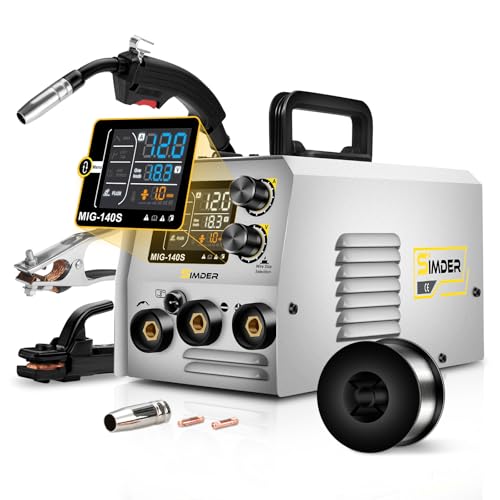
THREE-PROCESS WELDING STATION BUILT FOR FIRST-TIME USERS - Flux Core MIG, Lift TIG and Stick in one machine, so you can find the process that fits your projects without buying three separate welders. Runs on a standard 110V household outlet or 220V for heavier work - no electrician, no special wiring. Welds carbon steel, low-alloy steel, stainless steel, titanium, copper and cast iron

Package Includes: 10ft mig gun + 1pcs nozzle +1pcs diffuser + 6 tips (.023", .030", .035" - two of each size). This mig gun uses the same consumables as the Tweco Mini/#1. 21-50 nozzle, 35-50 diffuser, 11-series contact tip.

【LOW SPATTER & EASY CLEANUP】Minimal Spatter, Flawless Beads: Experience exceptionally low spatter and minimal post-weld cleanup. This ER70S-6 solid wire allows you to achieve smooth, visually appealing beads with ease, saving both time and grinding effort on your metal fabrication.
MIG Setup for Auto Body Panels
- Confirm that GMA welding is permitted for the part and joint.
- For ordinary light-gauge mild steel, consider .023- or .024-inch solid wire as a starting choice when the machine supports it.
- Use a compatible filler classification, commonly ER70S-6 for permitted ordinary mild-steel work. Do not assume it is approved for high-strength steel.
- Use the shielding gas recommended for the wire, metal, and machine. A 75% argon and 25% carbon-dioxide mix is common for mild-steel short-circuit MIG.
- Set polarity according to the machine and wire instructions. Solid steel MIG wire normally uses DCEP, also called electrode positive.
- Install the correct drive-roll groove, liner, and contact tip for the wire diameter.
- Keep stickout short and consistent within the wire-maker’s recommendation.
- Connect the ground clamp to clean metal close to the work.
- Use brief tacks and cooling intervals rather than a continuous seam on broad thin panels.
Flux-Core Setup for Auto Repair
- Confirm that the repair is suitable for FCAW before loading flux-cored wire.
- Check whether the wire is self-shielded or gas-shielded.
- Set polarity from the wire label. Many self-shielded wires use DCEN, but some products require a different setup.
- Use the drive roll and contact tip specified for the tubular wire.
- Follow the wire maker’s travel-direction guidance. Many self-shielded wires are used with a drag technique.
- Expect slag and substantial fume, and provide appropriate ventilation.
- Remove slag before another pass, inspection, grinding, primer, or coating.
Test one change at a time. A tall convex bead can indicate insufficient heat, excessive wire feed, poor travel technique, or poor tie-in. Burn-through can result from excess heat, a wide gap, slow movement, corrosion-thinned metal, or excessive trigger time. Confirm the correction by cutting, bending, twisting, or otherwise testing coupons as required by the applicable repair standard.
Joint Fit-Up and Tack Sequence
Good fit-up reduces the amount of heat and filler metal needed to close a repair. Remove all weak, perforated metal and shape the replacement patch so the gap stays small and consistent without forcing the panel into tension.
Butt Seams, Lap Joints, and Plug Welds
- Butt seams: Common for cosmetic patching because they avoid a moisture-trapping overlap, but they demand accurate fit-up and careful heat control.
- Lap joints: Easier to fit in some nonstructural repairs, but the overlap must be protected against corrosion and must not conflict with the OEM procedure.
- Plug welds: Often used to replace factory spot welds only when the repair procedure permits them. Hole diameter, spacing, metal preparation, and weld testing are procedure-specific.
- Adhesive or rivet-bonded joints: Do not replace these with an improvised fusion weld. Follow the specified adhesive, rivet, clamping, curing, and corrosion-protection process.
Copper backing can help support a small gap during a permitted nonstructural cosmetic repair, but it should not be used to disguise poor fit-up or alter a structural joint. Do not leave copper or another backing material trapped inside the vehicle.
Controlling Panel Heat
- Place the first tacks far apart to lock panel alignment.
- Add new tacks between cool areas rather than extending a hot bead.
- Move to another part of the seam whenever one area becomes hot.
- Allow controlled cooling instead of quenching hot sheet metal with water unless a repair procedure specifically allows it.
- Stop and correct distortion early instead of burying it beneath more weld and grinding.
Tips for Beginners Using MIG or Flux Core
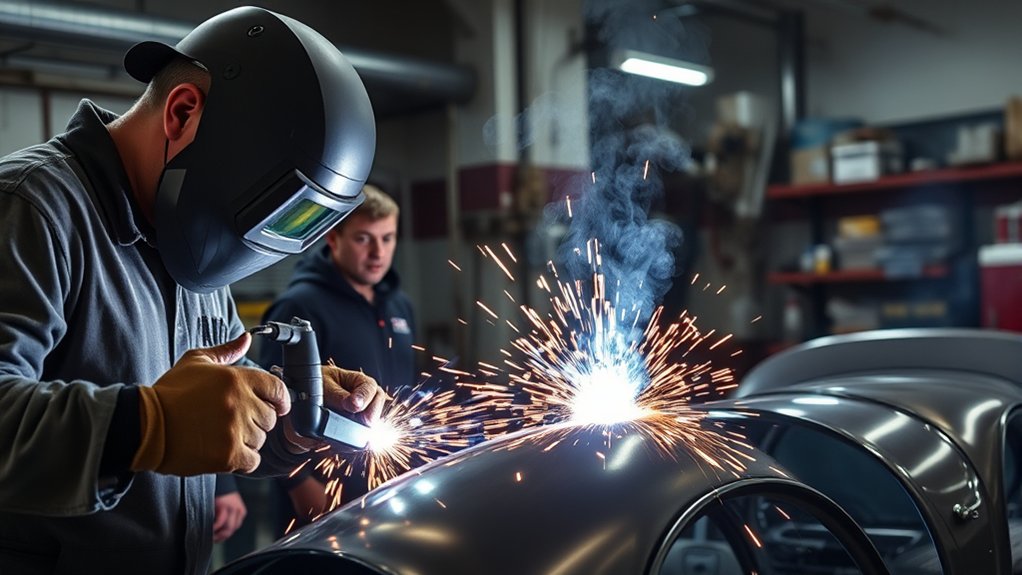
Build control on scrap before working on a vehicle. Practice starts, stops, plug welds, butt-seam tacks, and out-of-position welds using the same metal thickness and joint design as the repair.
Body-Panel Welding Technique
- Fit the patch closely: A wide gap needs more filler and heat.
- Use short tacks: Release the trigger before the panel overheats.
- Skip around the seam: Do not concentrate heat in one corner.
- Watch both sides: A neat front surface does not prove adequate fusion or safe conditions behind the panel.
- Use backing carefully: Copper can assist a permitted cosmetic joint but cannot make rust-thinned metal sound.
- Allow cooling time: Patience is safer than trying to finish the seam in one pass.
- Grind lightly: Keep the abrasive moving and stop before the surrounding sheet becomes hot or thin.
Surface preparation is part of weld quality. Clean the joint and coupon to the condition required by the repair procedure. Aluminum, stainless steel, high-strength steel, and coated vehicle parts need different filler metals, gases, preparation methods, and approved equipment. Do not apply mild-steel MIG or self-shielded flux-core settings to those materials.
Preparation and Finishing Steps After Welding
The repair is not complete when the arc stops. You must inspect the weld, control grinding heat, restore corrosion protection, and check the hidden side of the joint.
- Remove slag when using flux core. Chip and wire-brush until the bead and toes are fully visible.
- Inspect the weld. Look for pinholes, porosity, cracks, incomplete fusion, missed sections, and excessive undercut.
- Complete required weld testing. Use matching coupons and follow the OEM or training standard for visual and destructive tests.
- Dress the weld carefully. Use light pressure, keep the abrasive moving, and avoid thinning the base panel.
- Clean grinding residue. Remove loose abrasive particles, slag, and metal dust before applying refinishing products.
- Restore corrosion protection. Apply epoxy primer, seam sealer, cavity wax, underbody coating, or other products in the order specified for the repair.
- Protect the back side. Hidden bare steel can rust even when the visible repair looks finished.
- Complete the fire inspection. Check cavities, trim, insulation, and the opposite side throughout the required monitoring period.
Do not assume weld-through primer belongs under every joint. Its use depends on the welding method and vehicle-maker procedure. Applying the wrong product between the metals can reduce weld quality, while failing to restore the approved coating system can lead to corrosion.
Troubleshooting Common MIG and Flux-Core Welding Issues
Identify the symptom, inspect the setup, and change one variable at a time. Recheck the result on a coupon rather than experimenting on the vehicle.
| Problem | Likely Causes | What to Check |
|---|---|---|
| Burn-through | Excess heat, long trigger time, wide gap, slow movement, or rust-thinned metal | Use the next appropriate lower setting, shorten tacks, improve fit-up, and confirm that the remaining metal is sound |
| Panel distortion | Concentrated welding or grinding heat | Increase tack spacing, skip around, allow cooling, and reduce grinding pressure |
| Porosity | Contamination, lost gas coverage, wind, leaks, blocked nozzle, excessive stickout, or damp consumables | Clean the joint, block moving air, inspect the gas path, check flow, and use dry wire |
| Excessive spatter | Incorrect polarity, poor voltage and wire-speed balance, contamination, or unstable feeding | Verify polarity, tune on scrap, clean the metal, and inspect the tip, liner, and drive rolls |
| Tall or weak bead | Insufficient heat, excessive travel speed, poor ground, or lack of fusion | Clean the ground point, verify the settings, adjust travel, and test the bead rather than judging appearance alone |
| Slag inclusion | Flux-core slag trapped between tacks or passes | Remove slag completely before welding over the area and correct the gun angle |
| Erratic wire feeding | Wrong drive roll, excessive tension, damaged liner, worn tip, tangled spool, or poor gun-cable routing | Straighten the cable and inspect the spool, drive system, liner, and contact tip |
If the machine sputters or stops feeding, inspect the liner, contact tip, drive-roll tension, spool brake, ground clamp, polarity, and consumables. This MIG welder troubleshooting guide covers additional equipment faults.
Frequently Asked Questions
What type of welder is best for auto body work?
A gas-shielded MIG welder with stable low settings and small solid wire is usually the best general choice for permitted mild-steel body-panel repairs. Structural collision work may require specialized GMA welding, resistance spot welding, MIG brazing, rivet bonding, or another OEM-specified process.
Can I use a flux-core welder for auto body work?
You can use flux core for some thicker, nonstructural mild-steel repairs, especially outdoors. It is harder to control on thin exterior panels and leaves slag. Do not use it on structural vehicle parts unless the vehicle-specific repair procedure explicitly permits FCAW.
Is flux core as strong as MIG?
Either process can make a sound weld when the filler metal, joint, settings, and procedure are correct. Automotive suitability is not decided by maximum strength alone. Heat input, material type, attachment method, corrosion protection, and crash performance also matter.
Why is MIG preferred for thin sheet metal?
MIG can use small solid wire, stable low settings, and an argon-rich shielding gas to make brief, controlled tacks. It also leaves no flux slag, which simplifies inspection and finishing while reducing the need for aggressive grinding.
Do I need shielding gas for flux core?
It depends on the wire. Self-shielded flux-cored wire does not need external gas. Gas-shielded flux-cored wire does. Check the spool label because the required gas, polarity, contact-tip distance, and operating range vary by product.
What MIG wire size works best for auto body panels?
For permitted light-gauge mild-steel work, .023- or .024-inch solid wire is a common starting choice. Some welders use .030-inch wire on 18-gauge and thicker metal. Confirm the size against the machine rating, filler instructions, metal thickness, and vehicle repair procedure.
Can a 120-volt MIG welder handle auto body work?
Many 120-volt MIG welders can handle thin mild-steel panels, but low-end arc stability matters more than the advertised maximum amperage. Use the required dedicated circuit, correct extension-cord limits, small wire, and matching test coupons. A machine that cannot produce repeatable low settings is a poor choice for cosmetic sheet metal.
Can I weld galvanized auto body steel?
Only after checking the vehicle repair procedure. Zinc coating near the joint can affect weld quality and produce hazardous fume when heated. Remove only the coating required by the approved process, provide effective fume control, and restore the specified corrosion protection after welding.
Should I disconnect the car battery before welding?
Follow the service information for the exact vehicle. Many procedures require battery disconnection, system shutdown, a waiting period, removal or protection of nearby modules, and a close ground-clamp location. Hybrid and electric vehicles also require the manufacturer’s high-voltage disable and verification procedure.
Are floor-pan and rocker-panel repairs nonstructural?
Not necessarily. Floors can connect to rails, seat mounts, restraint anchors, or battery structures, while rockers often contain crash reinforcements. Identify the exact layer and check the body-repair manual before cutting or welding.
What safety gear do I need for MIG or flux-core auto body welding?
Use an appropriate welding helmet, safety glasses, welding gloves, flame-resistant clothing, leather footwear, grinding eye and hearing protection, and effective ventilation. Respiratory protection must match the metals, coatings, flux, and exposure conditions. Keep suitable fire-extinguishing equipment ready and monitor hidden areas after welding.
Conclusion
For most permitted repairs on ordinary thin automotive mild steel, gas-shielded MIG welding is the better choice. It gives you finer low-heat control, no flux slag, and a cleaner surface for inspection, grinding, primer, sealer, and paint.
Self-shielded flux core still has a useful role on suitable thicker, nonstructural mild-steel work and outdoor jobs where shielding gas cannot be protected. It should not be treated as a general replacement for OEM-specified collision-repair welding.
Start every repair by identifying the part, material, and approved attachment method. Protect the vehicle from electricity, fumes, heat, and fire; practice on matching coupons; inspect and test the welds; control panel heat; and restore every corrosion-protection layer after the joint cools.
Sources
- TWI: Metal Inert Gas Welding, Process and Applications — supports GMAW/MIG process terminology, continuous wire feeding, shielding gas, and transfer fundamentals.
- MillerWelds: Solid Wire Versus Flux-Cored Wire — supports differences in wire type, job location, shielding, thickness, slag, portability, and finishing.
- MillerWelds: Successfully Welding Sheet Metal With MIG and TIG — supports light-gauge wire size, shielding-gas, polarity, and thin-sheet recommendations.
- I-CAR: Welding and MIG Brazing Hotspot — supports OEM repair procedures, modern joining methods, vehicle protection, high-voltage precautions, corrosion protection, and weld testing.
- OSHA 1910.252: Welding, Cutting, and Brazing — supports hot-work fire prevention, combustible protection, fire-watch conditions, and post-work monitoring.
- CDC/NIOSH: Welding Fumes and Manganese — supports welding-fume exposure concerns and the effect of wire, flux, and base-metal selection.