You may see videos or product listings that claim you can weld aluminum with ordinary gasless flux-core wire, but that advice mixes together several different joining processes. Standard self-shielded flux-core wire is made for steel, not aluminum. To make a reliable aluminum fusion weld, you normally need solid aluminum MIG wire with shielding gas, an AC TIG setup, or another process specifically approved for the alloy and application.
Quick Answer
You cannot weld aluminum with the ordinary self-shielded flux-core wire used in gasless steel welders. For aluminum MIG welding, use solid ER4043, ER4943, or ER5356 wire, 100% argon shielding gas, DCEP polarity, and a spool gun or push-pull feeder approved for your machine.
Key Takeaways
- Steel flux-core wire, including products classified as E71T-11, must not be used to weld aluminum.
- ER4043 and ER5356 are aluminum MIG/TIG filler classifications, not ordinary self-shielded flux-core wires.
- A typical aluminum MIG setup uses solid wire, 100% argon, DCEP polarity, and a spool gun or push-pull feeder.
- Identify the base alloy before welding. Common alloys such as 2024 and 7075 are highly crack-sensitive and unsuitable for ordinary structural arc welding.
- Use the machine manufacturer’s aluminum chart instead of copying universal voltage and wire-speed settings.
At a Glance
| Time Required | About 30–60 minutes to identify the material, install the aluminum setup, clean the joint, and test settings on scrap |
| Difficulty | Intermediate; thin, cast, structural, and unknown alloys require more experience |
| Tools Needed | Compatible MIG welder, spool gun or push-pull feeder, solid aluminum wire, 100% argon, dedicated stainless brush, degreaser, clamps, PPE, and ventilation |
| Cost | Varies by machine compatibility, spool-gun requirements, gas-cylinder arrangements, and consumables; there is no reliable gasless-wire shortcut |
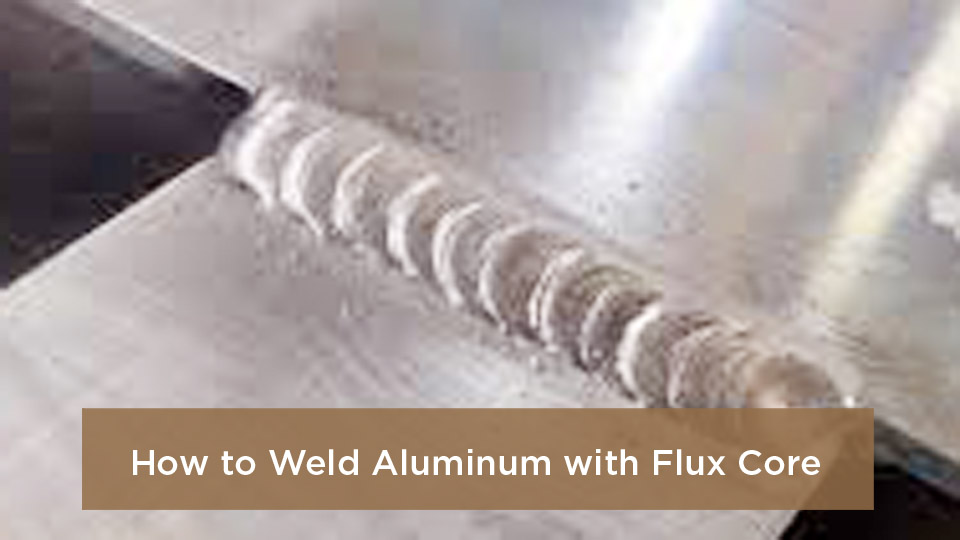
Image source credited in the original article: Reddit.
Can You Weld Aluminum with Flux Core Wire?
Look, straight up: not with the ordinary self-shielded flux-core wire sold for mild steel. That wire uses a steel sheath, steel-compatible alloying ingredients, and a flux system designed to create a steel weld deposit. Running it against aluminum can produce spatter, contamination, poor fusion, brittle intermetallic compounds, and a joint that only looks attached at the surface.
Major filler-metal manufacturers list common aluminum products such as ER4043 and ER5356 as aluminum MIG wire and TIG rod. By comparison, Lincoln Electric identifies Innershield NR-211-MP as an E71T-11 self-shielded flux-cored electrode for steel.
Warning: Do not load steel flux-core wire into a welder and attempt to join aluminum. A bead may stick to the surface without creating a sound fusion weld. Never use an unverified joint on a trailer, vehicle suspension, boat hull, pressure part, ladder, lifting device, or other load-bearing structure.
Why the “Aluminum Flux Core” Name Causes Confusion
The phrase can refer to products that are not flux-cored arc-welding wire:
| Label or Product | What It Actually Is | Can It Run as Gasless Aluminum FCAW? |
|---|---|---|
| E71T-11 or E71T-GS wire | Self-shielded carbon-steel flux-core wire | No |
| ER4043, ER4943, or ER5356 | Solid aluminum MIG wire or aluminum TIG rod | No; MIG use requires external shielding gas |
| Flux-coated aluminum stick electrode | An SMAW electrode with flux on the outside | No; this is stick welding, not wire-feed FCAW |
| Flux-bearing aluminum brazing rod | A lower-temperature brazing product | No; brazing does not melt the aluminum base metal into a fusion weld |
| Metal-cored or specialty research wire | A specialized industrial consumable used under a defined procedure | Not a substitute for an ordinary hobby flux-core setup |
Note: Check the AWS classification printed on the spool, package, technical data sheet, and safety data sheet. Do not rely on a marketplace title or an unlabeled spool.
What Equipment Do You Need Instead of Flux Core?
Your exact setup depends on the alloy, thickness, joint, and machine. For common shop work, the practical replacement for gasless flux core is a MIG machine that supports aluminum solid wire and external shielding gas.
| Equipment | Why It Matters | What to Verify |
|---|---|---|
| MIG power source | Provides constant-voltage output for solid aluminum wire | The manual must approve aluminum, DCEP, the chosen wire diameter, and the intended thickness |
| Spool gun or push-pull feeder | Keeps soft aluminum wire from buckling or bird-nesting in a long liner | Electrical connection, control plug, duty cycle, wire series, and machine compatibility |
| 100% argon | Shields the molten aluminum from the atmosphere | Correct regulator, leak-free hose, secure cylinder, and manufacturer-recommended flow |
| Solid aluminum wire | Supplies compatible filler metal | Base-alloy compatibility, wire diameter, service temperature, corrosion exposure, and anodizing requirements |
| Aluminum drive components | Reduce wire shaving and deformation | Correct U-groove rolls, liner, contact tip, and low drive-roll pressure where applicable |
| Dedicated cleaning tools | Prevent iron and hydrocarbon contamination | Stainless brush and abrasives used only on aluminum |
| PPE and ventilation | Control arc radiation, burns, fumes, gases, and fire hazards | Helmet shade, protective clothing, local exhaust, SDS requirements, and respiratory assessment |
A machine advertised as “MIG/flux core” may support aluminum, but a flux-core-only machine often does not. It may lack a gas solenoid, gas connection, DCEP configuration, enough output, or spool-gun controls. Read the owner’s manual before buying accessories.
Pro Tip: Confirm spool-gun compatibility by the exact welder model and serial range. A gun that physically fits may still have an incompatible trigger circuit, control connector, output limit, or wire-alloy restriction.
How to Prepare Aluminum for Welding
Aluminum preparation has two separate jobs: remove hydrocarbons first, then remove oxide and corrosion. Reversing that order can smear oil into the surface while you brush or sand.
- Identify the alloy. Look for mill markings, drawings, service records, or a reliable material test. Unknown scrap, castings, and repaired parts need extra caution.
- Remove paint, anodizing, sealant, and coatings from the weld zone. Research the coating before heating it because some coatings release highly toxic fumes.
- Degrease the joint. Use a cleaner approved for aluminum and welding preparation. Apply it with a clean, lint-free cloth and let it evaporate completely.
- Remove oxide. Brush with a stainless steel brush dedicated to aluminum. Use light pressure so you lift the oxide instead of smearing it into the base metal.
- Prepare the joint. Follow the applicable drawing or welding procedure for bevel angle, root face, gap, backing, and fit-up.
- Clean the filler wire path. Keep the spool covered, dry, and protected from dust, oil, grinding debris, and condensation.
- Clamp securely. Aluminum expands and conducts heat quickly, so thoughtful tack placement and heat sequencing help control distortion.
The aluminum base metal melts at roughly 1,200°F, while its oxide layer melts near 3,700°F. Removing contamination and heavy oxide before welding helps prevent poor fusion and an unstable puddle.
Alloys That Need Special Caution
Do not assume every piece of aluminum is readily weldable. Most 1xxx, 3xxx, 5xxx, and 6xxx alloys can be arc welded with a suitable procedure and filler. Many 2xxx and 7xxx alloys are much more crack-sensitive. Lincoln Electric specifically warns against treating common alloys such as 2024 and 7075 as ordinary structural weldable alloys.
Cast aluminum adds another problem: oil, coolant, corrosion, and gas can remain trapped in pores. A casting may need repeated cleaning, controlled preheating under an approved procedure, and professional inspection.
Step-by-Step Guide: How to MIG Weld Aluminum Instead
The following sequence replaces the original flux-core procedure. It is a general setup guide, not a substitute for your machine manual, filler-metal data sheet, qualified welding procedure, or engineering requirements.
Products Worth Considering

Replacement: This 150A spool gun is the replacement for the Spoolmate 150 gun (Please confirm the model of the welder and the compatibility of the welding gun before...
1. Confirm the Machine Can Weld Aluminum
Check the manual for approved input power, material thickness, wire diameter, spool-gun or push-pull compatibility, and duty cycle. Conventional aluminum MIG commonly uses spray transfer and requires enough output to establish a stable arc.
Miller’s general guidance treats approximately 14-gauge aluminum, about 0.074 inch, and thicker as the practical range for conventional aluminum MIG. Thinner material may require pulsed MIG, specialized equipment, or AC TIG for better heat control.
2. Install the Correct Wire-Feeding System
Install the approved spool gun or push-pull system. Match the contact tip, drive roll, liner, and guides to the selected wire. Keep drive-roll pressure only high enough to feed without slipping. Too much pressure can flatten or shave the wire.
3. Set the Correct Polarity
For ordinary solid aluminum MIG wire with shielding gas, use DCEP, meaning the gun or electrode is positive and the work lead is negative. Follow the machine and filler-metal instructions if they specify a different configuration for a specialized process.
4. Connect 100% Argon
Secure the cylinder upright, connect the regulator and hose, and leak-check the system. Common aluminum MIG guidance starts around 20–30 cubic feet per hour, but nozzle size, draft, gun design, and procedure can change the required flow.
Do not use the argon/CO2 C25 mixture commonly used for steel. Reactive gases can damage aluminum weld quality.
5. Load the Correct Solid Aluminum Wire
Load the wire without bending or contaminating it. ER4043 and ER5356 are common choices, but neither is automatically correct for every alloy. Match the filler to the base metal and service conditions.
6. Use the Manufacturer’s Starting Settings
Set wire diameter and material thickness on the machine’s aluminum program, door chart, or manual. Do not copy universal figures such as 22–26 volts or 200–300 IPM from another machine. Two welders can produce different arcs at the same displayed settings.
7. Test on Matching Scrap
Use scrap with the same alloy, thickness, joint orientation, surface preparation, and backing conditions. Adjust one variable at a time. Check penetration, bead contour, soot, porosity, distortion, and wire feeding before touching the actual part.
8. Tack the Joint
Use clean, well-spaced tacks to hold alignment. Keep gaps within the procedure because excessive gaps increase burn-through and distortion risk.
9. Push the Gun
Use a push travel angle, commonly around 10–15 degrees, so the argon reaches the leading edge of the puddle. Maintain the contact-tip-to-work distance specified for the gun. Avoid a drag angle, oversized weave, or long pauses.
10. Increase Travel Speed as the Part Heats
Aluminum absorbs heat quickly at the start, then the entire part becomes hotter. You may need to travel faster or use shorter weld segments as heat builds. For larger fillets, use multiple straight passes instead of one wide weave.
11. Let the Joint Cool Naturally
Do not quench the weld unless an approved procedure explicitly requires it. After cooling, remove soot with a dedicated stainless brush and inspect the weld. Aluminum MIG does not normally produce the removable slag associated with self-shielded steel flux-core wire.
12. Inspect Before Service
Reject visible cracking. Investigate grouped porosity, lack of fusion, excessive undercut, incomplete fill, burn-through, or severe distortion. Safety-critical work may require dye-penetrant testing, radiography, ultrasonic testing, destructive testing, or inspection under the governing code.
Best Aluminum MIG Wires: ER4043 vs. ER5356
Wire choice is your weld’s backbone, but the right choice depends on more than strength. Consider crack sensitivity, ductility, corrosion exposure, color after anodizing, service temperature, base-alloy chemistry, and the applicable code.
| Filler | Common Uses | Advantages | Important Limits |
|---|---|---|---|
| ER4043 | Many 6xxx alloys, castings, and general fabrication where the filler chart allows it | Good fluidity, smooth feeding, lower shrinkage, and good resistance to hot cracking in many 6xxx joints | Not the automatic choice for high-magnesium 5xxx alloys; anodized color and strength requirements may rule it out |
| ER4943 | Some applications that traditionally use 4043 | Good fluidity with improved strength potential in selected joints | Compatibility still depends on the base alloy and qualified procedure |
| ER5356 | Many 5xxx alloys, including common 5052 applications, and selected 6xxx joints | Higher as-welded strength in many applications, good ductility, and a closer anodized color match | Service-temperature and stress-corrosion limits must be checked; it is not correct for every casting or alloy |
| ER5183 or ER5556 | Selected higher-strength 5xxx marine and structural applications | Can better match stronger base alloys such as 5083 under the correct procedure | Not a universal upgrade; unnecessary or unsuitable in many ordinary joints |
Note: Do not select filler by matching the first digit of the base alloy. Use a recognized filler-selection chart, the project specification, or advice from the filler-metal manufacturer.
Products Worth Considering
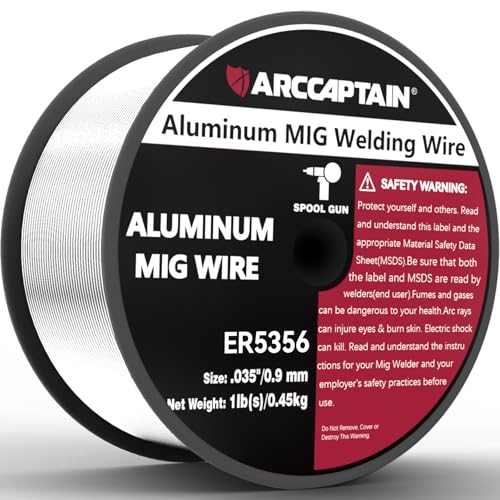
Smooth Welding Experience: With ARCCAPTAIN ER5356 Aluminum Welding Wire, expect smooth and stable arc characteristics, ensuring easy control and excellent weld bead appearance

Smooth Welding Experience: With ARCCAPTAIN ER4043 Aluminum Welding Wire, expect smooth and stable arc characteristics, ensuring easy control and excellent weld bead appearance.

ER4043 WELDING WIRE: A premium 5% silicon aluminum (AlSi5) filler metal designed for the MIG welding process. This composition delivers excellent fluidity and wetting characteristics, making it ideal for welding a wide range of aluminum alloys. It features a melting range of 1065°F to 1170°F, a density of 0.097 lbs/in³, and produces a consistent gray finish after anodizing.
Common Aluminum MIG Mistakes and How to Fix Them
| Problem | Likely Cause | Corrective Action |
|---|---|---|
| Wire will not fuse to the aluminum | Steel flux-core wire or incompatible filler | Stop immediately and verify the spool classification, base alloy, and filler compatibility |
| Wire burns back into the tip | Short stickout, low wire speed, poor feeding, wrong tip, or excessive heat at the gun | Use the correct tip, check feed tension, maintain the specified distance, and return to the machine chart |
| Bird-nesting | Long or restrictive feed path, excessive drive pressure, wrong roll, damaged liner, or soft wire | Use an approved spool gun or push-pull system and correct aluminum feed components |
| Heavy black soot | Poor gas coverage, wrong push angle, contamination, excessive stickout, or unsuitable settings | Check for leaks and drafts, clean correctly, use a push angle, and confirm gas flow |
| Porosity | Oil, moisture, hydrated oxide, gas leaks, drafts, contaminated wire, paint, or an unstable arc | Remove the defective weld, eliminate the source, clean again, and re-weld under verified shielding |
| Cold lap or lack of fusion | Low heat, fast travel, wrong work angle, large joint, or oxide contamination | Clean again, adjust settings on scrap, aim the arc at the joint root, and use multiple passes if required |
| Burn-through | Excessive heat, slow travel, large gap, or material too thin for the process | Increase travel speed, shorten weld segments, reduce the gap, use backing, or switch to AC TIG or pulsed MIG |
| Cracking after cooling | Wrong base alloy, wrong filler, excessive restraint, crater cracking, or a crack-sensitive alloy | Stop using the part, identify the alloy, remove the crack completely, and obtain a qualified repair procedure |
| Bead looks good but fails under load | Incomplete fusion, unsuitable alloy, unqualified joint design, or heat-affected-zone weakening | Do not judge strength by appearance; use inspection, testing, and engineering requirements |
Safety Tips for Welding Aluminum
Welding aluminum creates intense ultraviolet radiation, hot metal, reflected heat, fumes, and process gases. The exact fume composition depends on the base alloy, filler wire, coatings, cleaners, and nearby contamination.
- Use effective ventilation. Position local exhaust near the plume without pulling shielding gas away from the arc.
- Keep your head out of the plume. Outdoor work does not automatically provide adequate ventilation.
- Review the SDS. Check the wire, cleaner, coating, and base material before welding.
- Use the correct respirator program. Respiratory protection may be necessary when ventilation and work practices cannot control exposure. Cartridge selection must match the identified contaminants.
- Wear welding PPE. Use an appropriate helmet shade, safety glasses, flame-resistant clothing, leather gloves, and closed footwear.
- Protect the argon cylinder. Secure it upright and keep it away from heat, impact, and vehicle traffic.
- Control combustibles. Remove flammable materials, provide suitable fire-extinguishing equipment, and maintain a fire watch when required.
- Avoid chlorinated-cleaner vapors. Keep chlorinated degreasers and their vapors away from arc radiation and hot work.
- Do not use oxygen for ventilation. Oxygen enrichment increases fire risk.
OSHA 29 CFR 1910.252 requires mechanical ventilation under specified conditions, including restricted spaces, low ceilings, and areas where cross-ventilation is obstructed. OSHA also recommends local exhaust to draw fumes away from the breathing zone.
Warning: Never weld a fuel tank, gas cylinder, sealed tube, drum, pressure vessel, or container that has held a flammable or unknown substance unless it has been professionally cleaned, tested, vented, and prepared under an approved hot-work procedure. An apparently empty container can explode.
Alternatives to Flux Core for Welding Aluminum
| Method | Advantages | Limitations | Best Fit |
|---|---|---|---|
| MIG with solid aluminum wire | Fast, productive, and practical for many medium-thickness parts | Requires argon, compatible feeding equipment, and enough output for a stable aluminum arc | Frames, trailers, plate, production work, and general fabrication under a suitable procedure |
| AC TIG | Excellent puddle control, clean appearance, and better control on thin material | Slower and more skill-intensive | Thin sheet, visible joints, repairs, castings, and precision work |
| Pulsed MIG | Controls average heat while maintaining controlled droplet transfer | Requires a capable power source and correct program | Thinner material, out-of-position work, and production applications |
| Aluminum stick electrode | Portable and does not require a wire feeder | Difficult arc control, substantial cleanup, moisture-sensitive electrodes, and limited applications | Specialized field repairs performed under the electrode manufacturer’s procedure |
| Aluminum brazing | Lower heat and simple portable equipment | Not a fusion weld and normally provides lower joint performance than a properly designed weld | Non-structural fittings, hobby repairs, and assemblies specifically designed for brazing |
| Rivets or bolts | No weld heat or heat-affected-zone weakening | Requires appropriate fastener spacing, edge distance, corrosion isolation, and joint design | Panels, enclosures, brackets, and parts better suited to mechanical fastening |
If you must work outdoors, do not replace argon with steel flux-core wire. Build a wind screen or move the work into a sheltered, well-ventilated area where drafts cannot strip shielding gas from the puddle.
Welding Aluminum in Different Positions
Flat and horizontal positions are usually easiest because molten aluminum is fluid and conventional MIG spray transfer creates a hot puddle. Vertical and overhead work require better heat control, suitable equipment, and more operator skill.
Flat Position
Use a push angle and straight travel. Keep the gun moving as heat builds. For a large fillet, make multiple straight passes instead of one oversized weave.
Horizontal Position
Bias the work angle slightly toward the upper member while maintaining gas coverage at both toes. Watch for the puddle rolling onto the lower plate without fusing the upper edge.
Vertical Position
Pulsed MIG or a procedure developed specifically for vertical aluminum often gives better control than copying steel FCAW techniques. Keep beads narrow and follow the approved direction of progression.
Overhead Position
Overhead aluminum welding exposes the operator to falling molten metal and reflected arc energy. Use qualified settings, full protective clothing, short controlled passes, and a position-specific procedure. Beginners should establish sound flat-position welds before attempting overhead work.
Conclusion: Use the Right Aluminum Welding Process
Welding aluminum with ordinary gasless flux-core wire is not a practical shortcut. The reliable shop solution is usually solid aluminum MIG wire with 100% argon and an approved spool gun or push-pull feeder. AC TIG is often the better choice for thin material, visible work, castings, and repairs that need precise heat control.
Prep ruthlessly, identify the alloy, match the filler, follow the machine chart, and test on matching scrap. For a trailer, boat, vehicle, pressure part, lifting device, or other safety-critical project, use a qualified welding procedure and competent inspection rather than trusting bead appearance.
After welding and inspection, clean the surface and apply a primer or coating specifically approved for aluminum and the expected environment. Do not automatically apply a zinc-rich primer intended for steel.
Frequently Asked Questions
What polarity should I use to MIG weld aluminum?
Use DCEP for ordinary solid aluminum MIG wire with external shielding gas. That means the gun is connected to positive and the work lead to negative. Always confirm the polarity in the welder and wire manufacturer’s instructions.
Can a gasless MIG welder weld aluminum?
A flux-core-only gasless machine normally cannot weld aluminum. It may lack a gas valve, argon connection, DCEP arrangement, spool-gun support, or suitable output. A combination MIG/flux-core machine can weld aluminum only when its manufacturer approves the required aluminum accessories and setup.
Is ER4043 aluminum flux-core wire?
No. ER4043 is an aluminum filler classification commonly supplied as solid MIG wire or TIG rod. When used for MIG welding, it requires external shielding gas, normally 100% argon for common shop applications.
Can I use E71T-11 or NR-211-MP on aluminum?
No. E71T-11 products such as NR-211-MP are self-shielded carbon-steel flux-core wires. They do not deposit a compatible aluminum weld metal.
Is aluminum flux-core wire good for thin sheet?
Ordinary aluminum FCAW wire is not the solution for thin sheet. Conventional aluminum MIG is also difficult below roughly 14 gauge because spray transfer produces substantial heat. AC TIG or a suitable pulsed-MIG system usually provides better control.
How do I avoid porosity in aluminum welds?
Remove oil before brushing, use a dedicated stainless brush, keep the wire dry and clean, check the gas system for leaks, protect the arc from drafts, use a push angle, and maintain the specified contact-tip-to-work distance. Grind out unacceptable porosity before repairing the weld.
Should I choose ER4043 or ER5356?
ER4043 is common for many 6xxx alloys and castings because it flows well and reduces cracking in many joints. ER5356 is common for many 5xxx alloys and selected 6xxx applications where strength, ductility, or anodized color matters. Use a filler-selection chart for the exact base alloy and service conditions.
Can beginners MIG weld aluminum?
Yes, but beginners should start with clean, weldable alloy in the flat position, use a manufacturer-approved spool-gun setup, and practice on matching scrap. Structural, cast, very thin, unknown, or crack-sensitive alloys should be handled by an experienced aluminum welder.
Can I weld aluminum outdoors without shielding gas?
Do not substitute steel flux-core wire for argon. Use wind screens or move the work into a sheltered, ventilated area. If wind still disrupts the shielding gas, stop and wait for suitable conditions or choose another approved joining process.
Sources
- Miller: How to Successfully MIG Weld Aluminum — equipment, cleaning, gas, thickness, gun technique, and troubleshooting guidance
- Hobart Brothers: Aluminum MIG/TIG Filler Metals — classifications and uses for ER4043, ER5356, and other aluminum fillers
- Lincoln Electric: Innershield NR-211-MP — confirms that NR-211-MP is a self-shielded steel flux-core product
- Lincoln Electric: Common Design Mistakes in Aluminum — aluminum alloy weldability and warnings about crack-sensitive alloys
- OSHA 29 CFR 1910.252 — welding ventilation, fire prevention, cleaning-compound, and confined-space requirements
- OSHA: Controlling Hazardous Fume and Gases During Welding — welding-fume hazards, ventilation, exposure controls, and respiratory-protection guidance