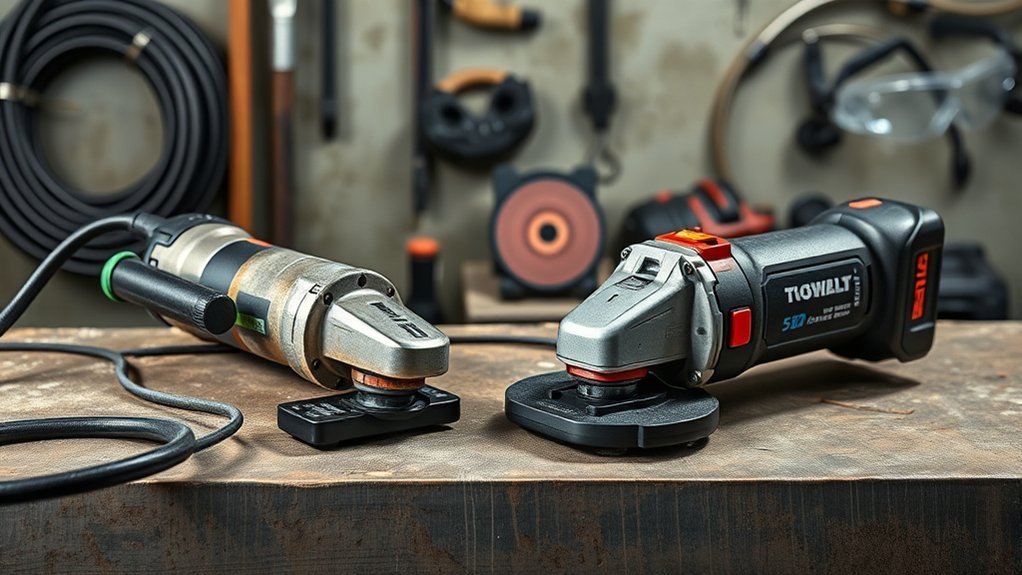
Choosing between a corded and cordless angle grinder comes down to more than raw power. You also need to consider how long you work, where you work, which wheels you use, and whether you already own compatible batteries. This guide compares performance, runtime, handling, safety, cost, and accessory compatibility so you can choose with confidence.
Quick Answer
Choose a corded angle grinder for long grinding sessions, repeated heavy cuts, or shop work near reliable power. Choose a cordless grinder for quick repairs, outdoor work, ladders, and areas where a cord limits movement. Modern cordless models can be very strong, but batteries still limit sustained runtime.
Key Takeaways
- Corded grinders are usually the better choice for long, continuous cutting and grinding near an outlet.
- Cordless grinders provide faster setup and better movement for short jobs, field repairs, and tight spaces.
- No-load RPM does not tell you how much torque or sustained power a grinder has.
- Cordless runtime depends on battery energy, material, wheel type, pressure, temperature, and duty cycle.
- Wheel diameter, guard type, mounting system, and rated speed must match the grinder.
- Safety and accessory compatibility should come before small differences in price or advertised power.
What’s in This Article
- Understanding the Basics of Angle Grinders
- Corded vs Cordless Angle Grinder: Quick Verdict
- Power and Performance: Corded vs. Cordless
- Cordless Grinder Runtime: What to Expect
- Weight and Design: How Do They Compare?
- Wheel Size and Accessory Compatibility
- When to Choose a Corded Grinder
- When to Choose a Cordless Angle Grinder
- Essential Safety Features in Angle Grinders
- Cost Comparison: Corded vs. Cordless
- How to Choose the Right Angle Grinder
- Maintenance Tips for Grinder Longevity
- Sources
- Frequently Asked Questions
- Conclusion
Understanding the Basics of Angle Grinders
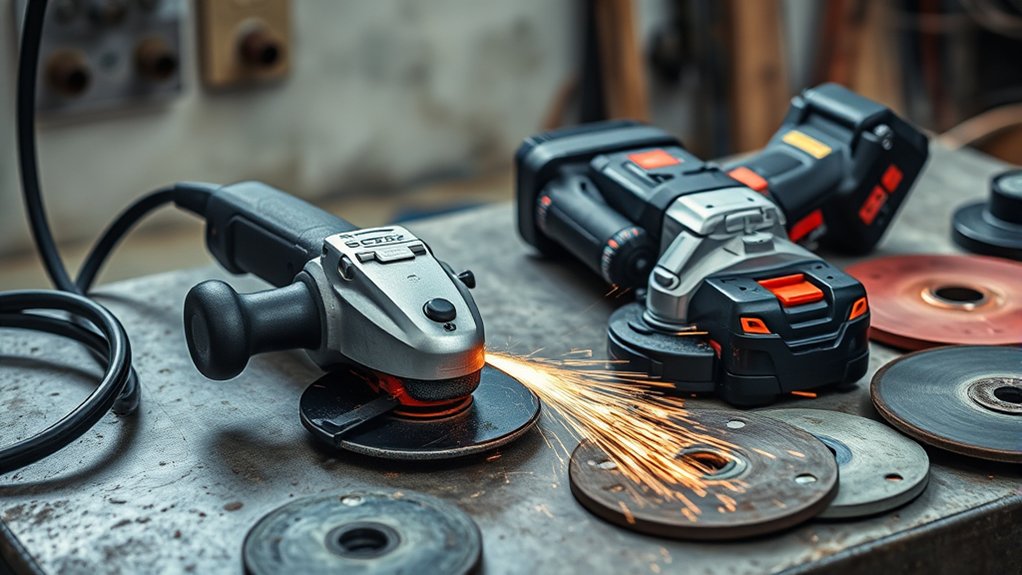
An angle grinder is a handheld power tool that can cut, grind, deburr, clean, sand, and polish when fitted with the correct accessory. Common jobs include cutting metal, smoothing welds, removing rust, preparing concrete, and cleaning surfaces with a wire wheel.
The tool turns a wheel or disc at high speed through a spindle mounted at a right angle to the motor. The job the grinder can perform safely depends on the wheel diameter, accessory type, guard, mounting system, rated speed, and manufacturer instructions.
Small 4½-inch and 5-inch grinders suit many home, fabrication, and repair jobs. Larger grinders can make deeper cuts and cover more surface, but they are heavier and require more control. Never fit a larger wheel than the grinder and guard are designed to accept.
Note: No-load RPM tells you how fast the spindle turns without cutting or grinding. It does not, by itself, show torque, material-removal speed, or how well the motor holds speed under load.
Corded vs Cordless Angle Grinder: Quick Verdict
A corded grinder is usually the practical winner for continuous work near a dependable power source. A cordless grinder is usually the better choice when mobility, fast setup, or access matters more than uninterrupted runtime.
| Feature | Corded Angle Grinder | Cordless Angle Grinder |
|---|---|---|
| Best use | Long grinding, repeated cuts, fabrication, and shop work | Quick cuts, field repairs, outdoor work, ladders, and tight spaces |
| Power supply | Outlet or properly sized generator | Compatible rechargeable battery |
| Sustained runtime | Not limited by a battery, although the tool still needs cooling and proper duty | Limited by battery energy, heat, workload, and available spare packs |
| Mobility | Limited by outlet location and cord management | Excellent movement with no trailing power cord |
| Operating weight | Often lighter within the same small-grinder class because there is no battery | Battery size changes weight and balance |
| Starting cost | Often lower when buying a complete setup from scratch | Can be economical if you already own compatible batteries and a charger |
| Main limitation | Cord reach, snagging, trip hazards, and power availability | Battery runtime, heat, pack cost, and charging downtime |
Power and Performance: Corded vs. Cordless
Power ratings are not always easy to compare. Corded grinders may list amperage, input watts, horsepower, or no-load RPM. Cordless manufacturers may advertise voltage, maximum watts out, a corded-amp equivalent, or performance compared with an earlier model.
A higher no-load RPM does not automatically mean faster cutting or stronger grinding. Wheel choice, torque under load, motor controls, and pressure all affect real performance.
Products Worth Considering

IMPORTANT NOTICE BEFORE PURCHASE ! ! ! Tool Only – Ideal for users who already own compatible batteries (Battery & Charger NOT Included). DIY POWER AT YOUR FINGERTIPS: Take...
What Corded Grinder Ratings Mean
A corded grinder draws power directly from an outlet. Small models are often labeled by amperage in the United States, while larger or international models may use watts or horsepower. For example, the DEWALT DWE402 specification lists an 11-amp motor and 11,000 no-load RPM.
Direct outlet power makes it easier for a suitable corded grinder to sustain demanding work without stopping for battery changes. That does not mean every corded model is stronger than every cordless model. Wheel size, motor design, gearing, and electronic controls still matter.
What Cordless Grinder Ratings Mean
Cordless grinders are commonly sold on 18V-class, 20V MAX, and higher-voltage battery platforms. Voltage identifies the battery system, but it does not give a complete measure of power or runtime.
Manufacturers also use different performance terms. The DEWALT DCG410B, for example, is listed at up to 1,590 maximum watts out and 9,000 no-load RPM. The Bosch GWS18V-8-2N is described as delivering performance comparable to an 8-amp corded tool and is rated at 11,000 no-load RPM. These ratings should not be treated as direct equivalents without manufacturer test details.
Performance Under Load
Heavy grinding creates a high, steady load. A corded grinder generally handles that duty with fewer interruptions when the outlet and extension cord can supply the required current.
A strong cordless grinder can cut and grind quickly, especially in short bursts. During demanding work, its electronics may reduce output or stop the tool to protect the battery and motor from overload or excess heat. A depleted, cold, hot, damaged, or undersized battery may also limit performance.
Cordless Grinder Runtime: What to Expect
There is no reliable universal “minutes per charge” number for cordless angle grinders. Cutting thin sheet metal takes far less energy than grinding a large weld or removing concrete. Even two grinders using batteries with similar labels can perform differently.
These factors have the greatest effect on runtime:
| Runtime Factor | How It Affects the Grinder | What to Check |
|---|---|---|
| Battery energy | A pack with more usable energy normally supports more work within the same tool platform. | Manufacturer watt-hour rating or compatible amp-hour choices |
| Material and task | Thick steel, concrete, and heavy weld grinding demand more energy than light trimming. | Expected cut depth, length, and grinding area |
| Wheel type | An inefficient, glazed, worn, or incorrect wheel increases load and heat. | Correct wheel for the material and operation |
| Applied pressure | Forcing the tool increases current draw, heat, binding risk, and wheel wear. | Let the accessory cut at its intended rate |
| Temperature | Very hot or cold packs may provide reduced performance or trigger protection. | Battery and charger temperature guidance |
| Duty cycle | Intermittent cuts allow more cooling than continuous grinding. | How much uninterrupted work the job requires |
A larger amp-hour battery within the same compatible platform usually provides more energy, but it also adds weight and may change the tool’s balance. Compare the complete battery specifications instead of assuming that a higher voltage label always means longer runtime.
Pro Tip: For a job you perform often, measure runtime by completed work rather than minutes. Count cuts, track the area ground, and note which battery and wheel you used. That gives you a more useful estimate for future projects.
For extended cordless work, use manufacturer-approved spare batteries and a compatible charger. Allow hot packs to cool as directed instead of forcing them back onto the tool or charger.
Weight and Design: How Do They Compare?
Weight alone does not show how comfortable a grinder will feel. Balance, grip diameter, handle position, switch design, vibration, wheel size, guard, and battery placement all affect control.
Weight Distribution Differences
A small corded grinder may feel lighter because it does not carry a battery pack. Its cord can still pull against the tool, catch on the workbench, or change your movement during a cut.
A cordless model carries its energy source on the tool. A compact pack may improve handling, while a high-capacity pack may increase runtime but make the grinder feel rear-heavy. Compare the operating weight with the battery, guard, side handle, and intended accessory installed.
Design Ergonomics and Comfort
Look for a grip you can hold securely with gloves, a side handle that fits your working position, and a switch you can release quickly. A paddle switch, electronic brake, vibration-control handle, and tool-free guard adjustment can improve daily use, but only when you understand how each feature operates.
Some grinders have lock-on switches for long work. These reduce finger strain but can allow the tool to keep running after you lose your grip. A no-lock-on paddle switch may be a better choice for beginners or unpredictable work positions.
Portability and Handling Ease
Cordless grinders are easier to carry between work areas and eliminate the need to drag a cord across ladders, scaffolding, vehicles, or outdoor sites. They are also faster to set up for a few quick cuts.
Corded grinders work well at a bench or fabrication station where the cord can be routed safely. For long sessions, their lack of battery changes can outweigh the loss of mobility.
Wheel Size and Accessory Compatibility
Power source should not be your only buying decision. The grinder must also accept the wheel size and accessory type needed for your work.
| Wheel Class | Typical Strength | Trade-Off |
|---|---|---|
| 4½-inch and 5-inch | Compact handling for common cutting, deburring, weld cleanup, and surface work | Less cutting depth and surface coverage than larger grinders |
| 6-inch | Greater reach and cutting depth while remaining more manageable than very large grinders | More weight and accessory cost |
| 7-inch and 9-inch | Deep cuts and high material-removal capacity for demanding work | Greater weight, reaction force, storage needs, and operator fatigue |
Before fitting any accessory, confirm all of the following:
- The wheel diameter is approved for the grinder and guard.
- The accessory’s maximum rated speed is at least as high as the grinder’s rated speed.
- The arbor, thread, flange, or mounting system matches the tool.
- The guard is approved for the accessory and operation.
- The wheel is intended for the material being cut, ground, sanded, or brushed.
- The accessory is undamaged, within its service life where applicable, and installed in the correct direction.
A grinding wheel, flap disc, wire wheel, diamond wheel, and abrasive cut-off wheel are not interchangeable simply because they fit the spindle. Each may require a different guard, flange, operating angle, or technique.
Products Worth Considering

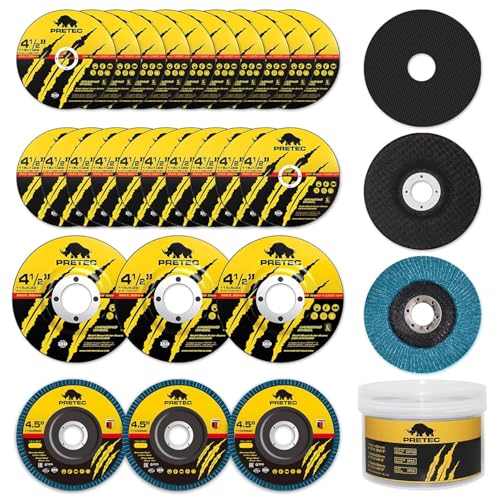
26pcs Angle Grinder Disc 4-1/2 inch & 3 Different Types : ✅ The 26 packs angle grinder wheels 4-1/2 inch including 20 Packs 4.5"x1/4"x7/8" Cut off Wheels, 3 Packs 4.5"x7/8" 60 Grit Flap Discs, 3 Packs 4.5"x1/25"x7/8" Grinding Wheels, with each type of disk collectively wrapped with those of its kind. This kit has everything you need to prep steel.

High performance aluminum oxide grain for long life and high material removal of the grinding wheel
When to Choose a Corded Grinder
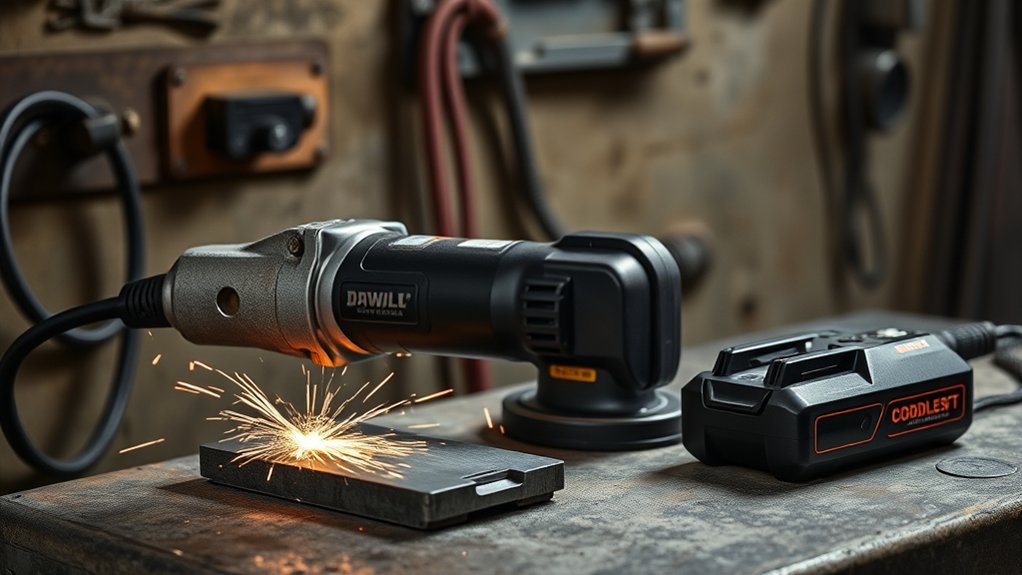
Choose a corded angle grinder when you need sustained performance and can work near a dependable power source. It is often the practical choice for fabrication benches, repeated weld grinding, long surface-preparation jobs, and frequent cutting.
Choose a Corded Grinder If…
- You grind or cut for long periods.
- You work mainly in a shop, garage, or fixed fabrication area.
- You need a larger wheel or high material-removal capacity.
- You want to avoid battery charging and replacement costs.
- You are buying a complete grinder setup without already owning a battery platform.
- You can route the power cord away from the wheel, sparks, water, traffic, and sharp edges.
Extension Cords and Generators
An undersized or damaged extension cord can cause voltage drop, heat, and poor grinder performance. Use a grounded or correctly double-insulated setup as required by the tool, and follow the cord-gauge table in the grinder manual. Cord length and the tool’s nameplate amperage both affect the required conductor size.
A generator must provide suitable voltage, frequency, starting capacity, and continuous output for the grinder. Do not assume that a generator’s peak rating can support long grinding sessions. Check both manuals before connecting the tool.
Warning: Keep the power cord behind you and away from the spinning accessory. Never wrap the cord around your wrist or arm, and do not use a damaged plug, cord, or extension lead.
When to Choose a Cordless Angle Grinder
Cordless angle grinders work best when movement and setup speed matter. They are useful for roadside repairs, fencing, construction punch-list work, outdoor projects, maintenance calls, and short tasks away from outlets.
Choose a Cordless Grinder If…
- You work away from electrical outlets.
- You need quick setup for short cuts or repairs.
- You move between work areas often.
- You work around ladders, vehicles, gates, or other places where a cord can snag.
- You already own compatible batteries and chargers.
- You can carry enough approved battery capacity for the expected workload.
Battery Platform and Motor Choice
A cordless grinder usually makes the most financial sense when it shares batteries with tools you already own. Confirm that your existing packs are approved for the grinder; physical fit does not always mean the battery can safely deliver the required current.
A brushless motor normally reduces brush maintenance and can improve efficiency, but it does not guarantee that one grinder will outperform another. Also compare the brake, overload protection, anti-kickback system, grip, guard, battery recommendation, warranty, and service support.
For repeated field work, plan for at least one spare battery when the manufacturer and job conditions permit. A fast charger can reduce downtime, but charging speed does not replace adequate battery capacity.
Essential Safety Features in Angle Grinders
Angle grinders can throw sparks, broken wheel fragments, wire bristles, hot metal, and hazardous dust. Safety features help, but they do not replace correct accessories, protective equipment, and operating technique.
| Safety Feature | What It Does | What It Does Not Do |
|---|---|---|
| Wheel guard | Helps deflect fragments and sparks away from the operator | Cannot make an incorrect, damaged, or overspeed wheel safe |
| Anti-kickback or anti-rotation control | May shut down or reduce power when sudden binding is detected | Cannot prevent every kickback event |
| Electronic brake | Stops the wheel faster after the switch is released | Does not stop the wheel instantly |
| Restart protection | Helps prevent unexpected startup after power or battery interruption | Does not replace switching the tool off before connecting power |
| Soft start | Reduces the sudden reaction at startup | Does not prevent binding after the wheel enters the work |
| Overload protection | Helps protect the motor and electronics from excessive load or heat | Does not justify forcing the wheel |
| Vibration-control handle | Can reduce transmitted vibration and fatigue | Does not correct an unbalanced or damaged accessory |
Angle Grinder Safety Checklist
- Read both manuals. Follow the grinder and accessory manufacturer instructions before use.
- Disconnect the power. Unplug a corded grinder or remove the battery before installing accessories, changing the guard, cleaning, or inspecting the tool.
- Use the correct guard. OSHA requires guards on covered portable grinding operations, and the guard must suit the wheel and operation. See OSHA 1910.243.
- Check the wheel rating. The accessory must be rated for at least the grinder’s speed and approved for its diameter and material.
- Inspect before starting. Do not use cracked, chipped, bent, expired, wet-damaged, badly worn, or unbalanced accessories.
- Secure the work. Clamp loose material and keep the cutting path clear of wiring, pipes, fuel, and hidden hazards.
- Wear primary eye protection. Use impact-rated safety glasses with side protection or suitable goggles. A face shield adds protection but does not replace primary eye protection. See OSHA 1910.133.
- Protect hearing, lungs, hands, and skin. Use suitable hearing protection, fitted work gloves where appropriate, nonflammable work clothing, and task-specific respiratory protection.
- Use two hands. Install the side handle securely and keep a firm grip until the wheel stops.
- Control sparks. Direct sparks away from your body, bystanders, glass, vehicles, fuel, batteries, gas cylinders, sawdust, and other flammable materials.
- Stand out of the wheel’s plane. Keep your body away from the direction fragments may travel if the wheel fails.
- Do not force the tool. Excessive pressure increases heat, wheel wear, binding, and kickback risk.
- Never side-grind with a cut-off wheel. Thin cut-off wheels are intended for edge cutting and can break when side-loaded. The Makita XAG25 manual also specifies a dedicated cut-off-wheel guard.
- Wait for a complete stop. Do not set the grinder down while the wheel is turning.
Warning: Grinding or cutting concrete, brick, block, mortar, and stone can release respirable crystalline silica. Use a compatible shroud and dust-control system or another manufacturer-approved control method. NIOSH reports that properly fitted local exhaust shrouds greatly reduced exposure in studied concrete-grinding work. Follow applicable workplace rules and respiratory-protection requirements.
For more detail, review the NIOSH guidance on controlling hazardous dust when grinding concrete.
Cost Comparison: Corded vs. Cordless
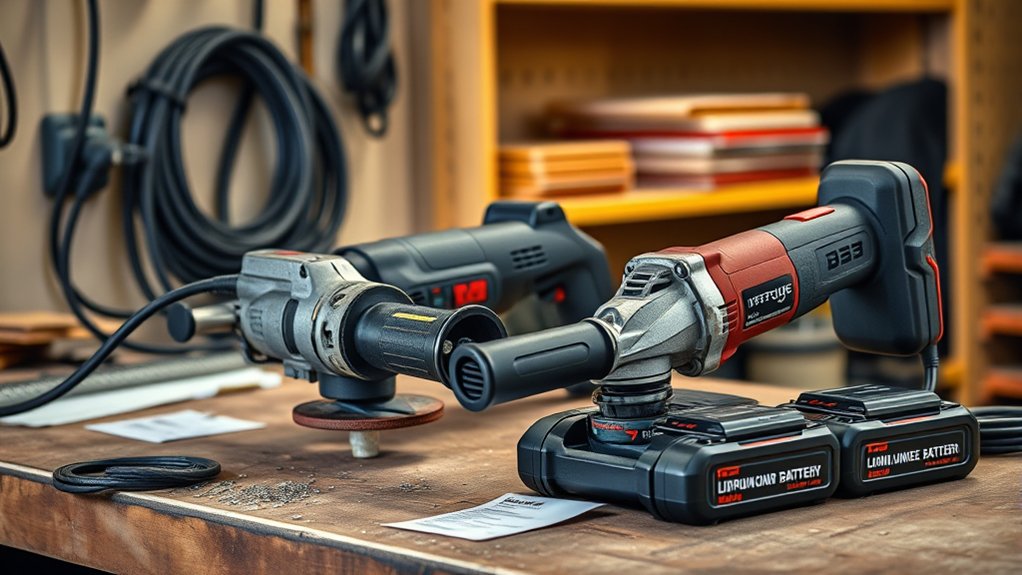
Grinder prices overlap too much to use one dependable category-wide range. A basic corded grinder may cost less than a cordless kit, but a professional large corded grinder can cost more than a compact cordless bare tool.
Compare the complete ownership cost instead:
| Cost Area | Corded Grinder | Cordless Grinder |
|---|---|---|
| Tool purchase | Usually sold as a ready-to-run tool | May be sold as a bare tool or kit |
| Required power equipment | Suitable outlet, extension cord, or generator | Approved battery packs and charger |
| Long-term replacement | Cord, switch, bearings, and brushes on applicable motors | Battery packs, charger, switch, bearings, and other electronics |
| Downtime cost | Power setup and cord routing | Charging, cooling, and battery changes |
| Best value case | Frequent, sustained work near power | Short mobile work when compatible batteries are already owned |
If you already own several suitable batteries and a charger, a cordless bare tool may be the economical choice. If you are starting from zero and expect long grinding sessions, a corded grinder often provides lower total setup cost.
How to Choose the Right Angle Grinder
Use this order when comparing models:
- Define the main job. Separate quick cutting and repair work from long grinding or surface preparation.
- Choose the wheel size. Base it on cutting depth, access, tool weight, and the accessories available for your material.
- Decide where you will work. Cordless suits remote and changing locations; corded suits fixed areas with safe power access.
- Estimate the duty cycle. Continuous grinding favors corded power. Intermittent cutting may suit cordless operation well.
- Check your battery platform. Include the cost and operating weight of approved batteries, not just the bare tool.
- Compare safety features. Prioritize the correct guards, a secure side handle, restart protection, a brake, anti-kickback control, and a switch you can release quickly.
- Check accessory availability. Make sure the grinder accepts the wheels, guards, flanges, dust shrouds, and mounting system your work requires.
- Compare total ownership cost. Include batteries, chargers, extension cords, generators, replacement packs, and expected downtime.
- Handle the tool before buying when possible. Check grip size, balance, switch reach, guard adjustment, and operating weight.
Note: Many fabricators eventually keep both types: a corded grinder for sustained bench work and a cordless grinder for setup, repairs, and quick cuts. Buying both is not necessary, but it can be practical when your work regularly includes both duty patterns.
Maintenance Tips for Longevity of Your Grinder
Regular care helps an angle grinder run cooler, hold accessories securely, and remain safer to operate.
Good maintenance starts before the wheel is installed: inspect the guard, spindle, flange, switch, cord or battery, and accessory every time you use the grinder.
- Disconnect power first. Unplug the cord or remove the battery before cleaning, inspection, or accessory changes.
- Keep cooling vents clear. Remove settled dust with a method approved by the manufacturer. Avoid driving conductive metal dust deeper into the motor.
- Inspect the guard and side handle. Replace bent, cracked, loose, or incomplete parts before use.
- Check the spindle and flanges. Damaged, dirty, or incorrect mounting parts can prevent the wheel from seating properly.
- Inspect the cord and plug. Stop using a corded grinder if insulation, strain relief, grounding parts, or plug blades are damaged.
- Check motor brushes where applicable. Brushed grinders may need brush replacement. Brushless grinders do not have carbon motor brushes but still require bearing, switch, and cooling-system care.
- Use approved batteries and chargers. Do not use cracked, swollen, overheated, wet, modified, or impact-damaged battery packs.
- Store batteries correctly. Keep them dry and away from extreme heat, metal objects, and conditions outside the manufacturer’s stated range.
- Protect accessories from damage. Keep wheels and discs dry, clean, and protected from impact, crushing, and contamination.
- Replace worn accessories. A glazed, damaged, badly worn, or incorrect wheel increases heat and reduces control.
Stop using the grinder if it develops unusual vibration, noise, heat, odor, sparking, switch problems, loose parts, or reduced control. Have damaged tools inspected by qualified service personnel.
Sources
- OSHA 1910.243 — Guarding of Portable Powered Tools — portable grinder guards and abrasive-wheel requirements.
- OSHA 1910.133 — Eye and Face Protection — primary eye protection and protection from flying particles.
- NIOSH — Control of Hazardous Dust When Grinding Concrete — silica hazards and local exhaust dust control.
- Makita XAG25 Cordless Angle Grinder Instruction Manual — wheel guards, accessory use, battery compatibility, and operating safety.
- DEWALT DWE402 Corded Grinder Specifications — example corded amperage and no-load speed ratings.
- Bosch GWS18V-8-2N Cordless Grinder Specifications — example cordless speed, safety features, and corded-equivalent rating language.
Frequently Asked Questions
Are cordless angle grinders as powerful as corded grinders?
Some modern cordless grinders can match or exceed the short-burst performance of small corded models. Corded grinders still have an advantage when you need sustained work without battery changes, charging pauses, or battery heat limits. Compare specific models and their performance under load rather than voltage or RPM alone.
How long does a cordless angle grinder last per charge?
There is no universal runtime. Battery energy, wheel type, material, pressure, temperature, grinder efficiency, and continuous versus intermittent use all change the result. For repeat jobs, track completed cuts or material removed with the battery and wheel you plan to use.
How many watts does a corded angle grinder use?
Check the grinder nameplate or manual. Many U.S. corded models are labeled in amperes rather than watts, and power requirements vary by wheel size and motor design. Do not use RPM as a substitute for an electrical power rating.
Do corded power tools last longer?
A corded grinder avoids battery aging, but that does not guarantee a longer tool life. Motor design, bearings, dust protection, workload, cooling, build quality, maintenance, and repair support matter more. A well-maintained professional cordless grinder may outlast a poorly maintained corded model.
Is a cordless angle grinder good for beginners?
A cordless grinder can be convenient for beginners because it has no trailing power cord. Look for a secure side handle, adjustable guard, no-lock-on paddle switch, brake, restart protection, and anti-kickback control. Beginners still need instruction, correct PPE, two-handed control, and the proper accessory.
Can a cordless angle grinder cut concrete?
Yes, when the grinder, diamond wheel, guard, and dust-control system are approved for the job. Concrete cutting and grinding can drain a battery quickly and create hazardous silica dust. Follow the tool, wheel, and dust-extractor instructions and all applicable workplace requirements.
Can corded and cordless grinders use the same wheels?
They can use the same accessory only when the wheel diameter, arbor or mounting system, accessory type, maximum rated speed, flange, and guard requirements all match both grinders. Never install a wheel merely because its center hole appears to fit.
What battery size is best for a cordless grinder?
Use a battery specifically approved by the grinder manufacturer. A higher-capacity pack within the same platform usually supports more work, but it also adds weight and changes balance. Choose enough capacity for the job without making the tool difficult to control.
Is a brushless angle grinder worth buying?
A brushless grinder can offer good efficiency and eliminates carbon-brush replacement, which is valuable for frequent cordless use. It is not automatically the best tool, however. Also compare safety controls, operating weight, wheel compatibility, service support, and real performance.
Conclusion
Your best angle grinder depends on the work pattern. Choose a corded grinder for long, demanding jobs near safe and reliable power. Choose a cordless grinder when mobility, quick setup, and access are more important than uninterrupted runtime.
Before buying, decide on the wheel size, material, duty cycle, power access, battery platform, operating weight, and required safety features. Then check the guard and accessory requirements in the manufacturer manuals. A well-matched grinder will be easier to control, less expensive to operate, and safer for the jobs you perform most often.